Creem vs Gumroad vs Lemon Squeezy: Which Creator Platform Keeps More of Your Money in 2026?
Creem launched in 2024 and already has founders asking whether it’s time to quit Gumroad and Lemon Squeezy. The short answer: for most indie hackers and digital product creators in 2026, yes — but the right platform depends on what you’re building and how much you’re selling. Here’s the stat that matters: at $50,000/month in
Creem launched in 2024 and already has founders asking whether it’s time to quit Gumroad and Lemon Squeezy. The short answer: for most indie hackers and digital product creators in 2026, yes — but the right platform depends on what you’re building and how much you’re selling.
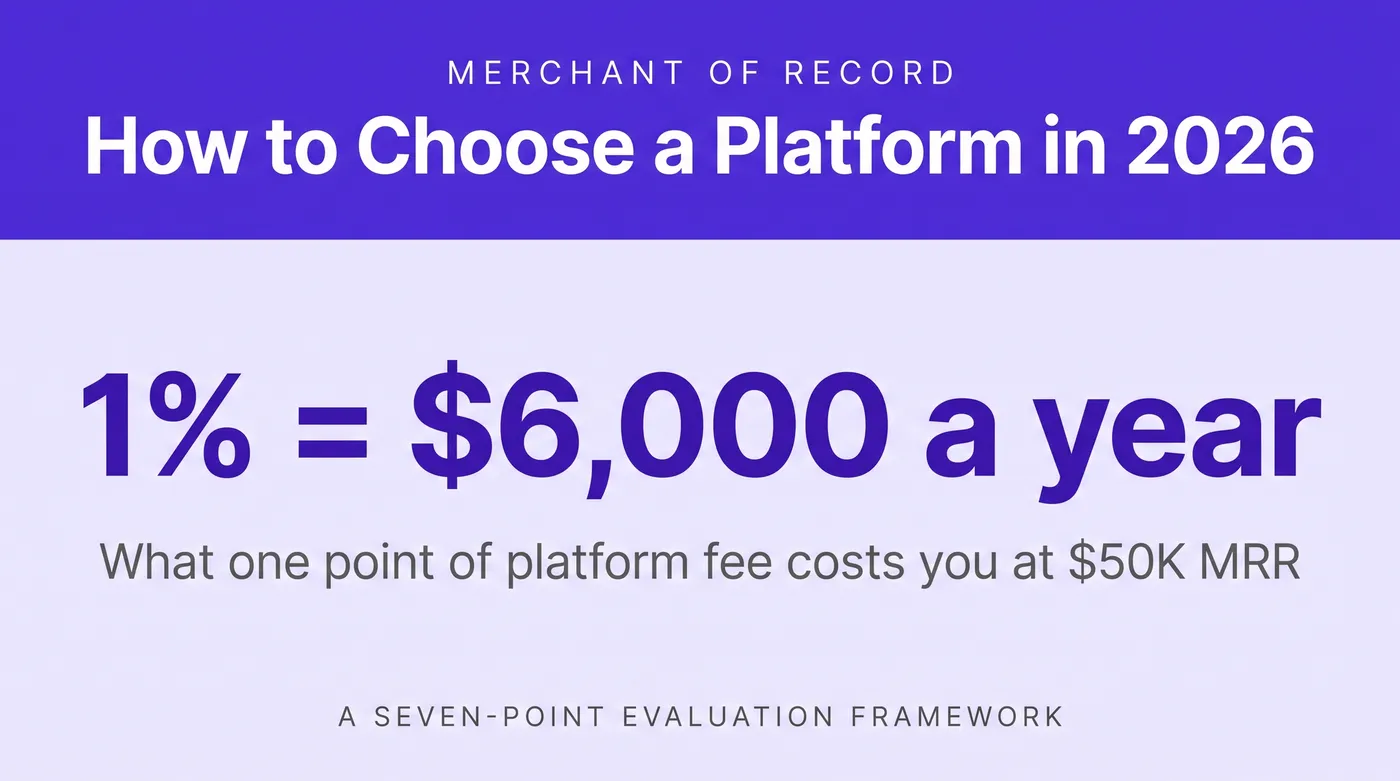
Here’s the stat that matters: at $50,000/month in revenue, Lemon Squeezy costs you roughly $6,720 more per year than Creem. At $100,000 in annual revenue, switching from Gumroad to Creem puts back $9,000+ in your pocket. That’s not affiliate math — that’s the actual fee difference.
This guide compares Creem vs Gumroad vs Lemon Squeezy on the things that actually matter: real fees, tax compliance, subscription support, payout speed, and who each platform is built for in 2026.
What Is a Merchant of Record and Why Should You Care?
Before the comparison: a quick primer on what separates these platforms at the infrastructure level.
When you use Stripe directly, you are the seller of record. That means you’re legally responsible for collecting and remitting VAT in every EU country where you have customers, sales tax across US states, GST in Australia, and a growing pile of other jurisdictions. As a solo developer or indie creator, that’s a compliance problem you genuinely can’t manage solo without expensive help.
A Merchant of Record (MoR) steps in as the legal seller. They handle global tax collection, remittance, chargebacks, and compliance — so you can keep shipping. All three platforms reviewed here operate as MoRs, which is why they’re genuinely useful compared to raw Stripe.
Gumroad became a full MoR in 2025. Lemon Squeezy has been one since launch. Creem launched as an MoR from day one in 2024.
The Real Fee Breakdown: No Marketing Math
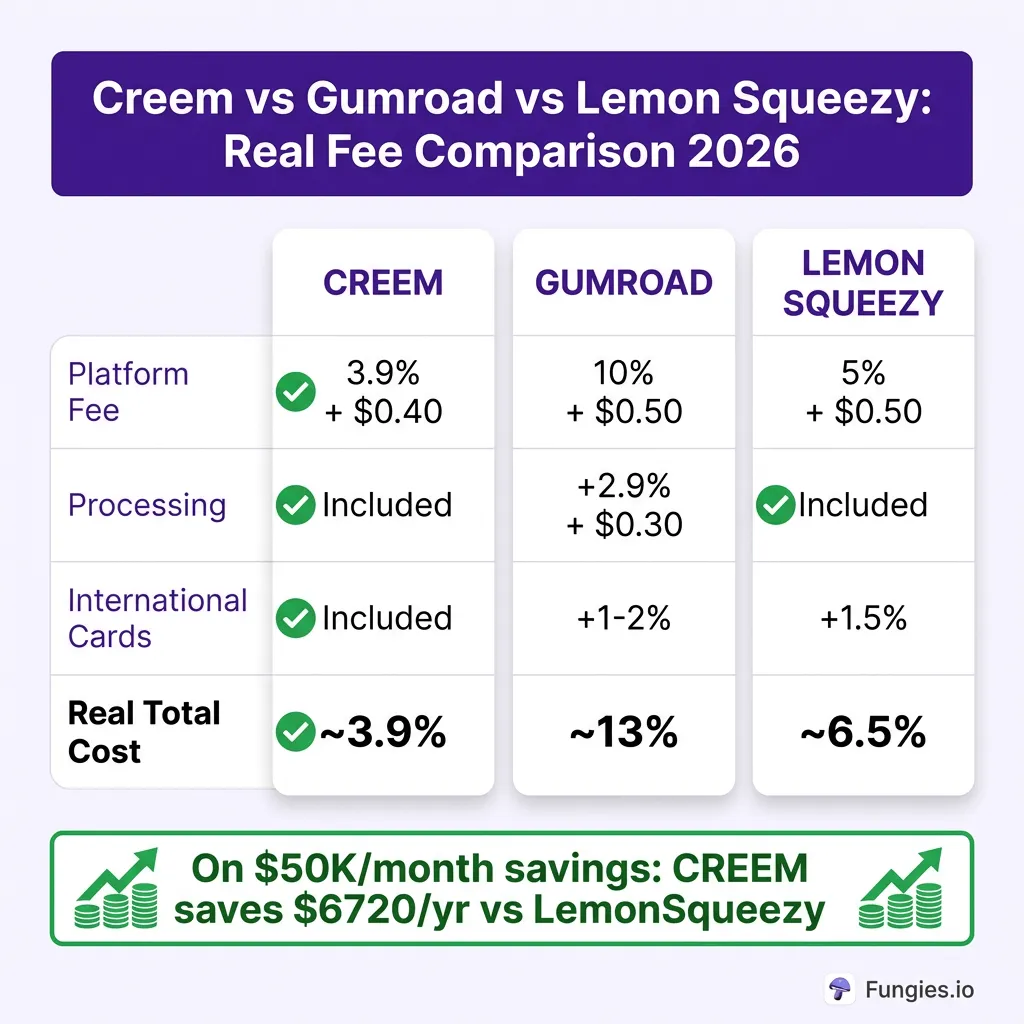
Here’s what each platform actually charges, including the fees they don’t put in the headline:
| Fee Type | Creem | Gumroad | Lemon Squeezy |
|---|---|---|---|
| Base platform fee | 3.9% + $0.40 | 10% + $0.50 | 5% + $0.50 |
| Payment processing | Included | +2.9% + $0.30 | Included |
| International cards | +0% | +1–2% | +1.5% |
| Subscription billing surcharge | +0% | N/A | +0.5% |
| Real total cost (typical) | ~3.9% | ~12.9–14% | ~6.5–7% |
| MoR (tax handled) | ✅ Yes | ✅ Yes (since 2025) | ✅ Yes |
| Monthly fee | None | None | None |
The number that surprises most people: Gumroad’s real cost is ~13%, not 10%. The 10% is the platform fee — add 2.9% + $0.30 Stripe processing and you’re at 12.9% plus currency conversion on top for international buyers. That’s a lot to give away when Creem is doing everything for 3.9%.
Real dollar math at common price points
| Sale Price | Creem Fees | Creem Creator Nets | Gumroad Fees | Gumroad Creator Nets | Lemon Squeezy Fees | LS Creator Nets |
|---|---|---|---|---|---|---|
| $10 sale | $0.79 | $9.21 | $1.59 | $8.41 | $1.00 | $9.00 |
| $50 sale | $2.35 | $47.65 | $5.95 | $44.05 | $3.00 | $47.00 |
| $200 sale | $8.20 | $191.80 | $20.90 | $179.10 | $10.50 | $189.50 |
Creem wins at every price point. On a $50 sale, you net $3.60 more than Gumroad and $0.65 more than Lemon Squeezy. Doesn’t sound huge — until you’re doing 500 sales a month and the difference is $325/month, $3,900/year.
Revenue Impact at Scale: The Numbers That Matter
This is where the choice gets expensive if you get it wrong.
| Monthly Revenue | Creem Fees | Gumroad Fees | Lemon Squeezy Fees | Creem vs Gumroad Savings | Creem vs LS Savings |
|---|---|---|---|---|---|
| $1,000/mo | ~$39 | ~$129 | ~$55 | $90/mo | $16/mo |
| $5,000/mo | ~$195 | ~$645 | ~$275 | $450/mo | $80/mo |
| $10,000/mo | ~$390 | ~$1,290 | ~$550 | $900/mo | $160/mo |
| $50,000/mo | ~$1,950 | ~$6,450 | ~$2,510 | $4,500/mo ($54K/yr) | $560/mo ($6,720/yr) |
At $50K/month, Gumroad is burning $54,000 a year in excess fees compared to Creem. Even versus Lemon Squeezy, you’re paying an extra $6,720 annually for what exactly? That’s a full-time contractor, a paid ads budget, or a year of infrastructure costs — just evaporating.
Feature Comparison: What You Actually Get

Fees matter, but features determine whether a platform can actually run your business. Here’s where each stands in 2026:
| Feature | Creem | Gumroad | Lemon Squeezy |
|---|---|---|---|
| Subscription billing | Full (trials, proration, upgrades) | Basic (fixed tiers only) | Full (metered, dunning) |
| License key generation | ✅ Built-in | ❌ Not available | ✅ Built-in |
| Revenue splits (co-founders) | ✅ Built-in | ❌ Not available | ❌ Not available |
| Affiliate program | ✅ Built-in | ✅ Built-in (since 2014) | ⚠️ Via integrations (Rewardful) |
| Customer self-service portal | ✅ Yes | Limited | ✅ Yes |
| Crypto payouts (USDC) | ✅ Yes | ❌ No | ❌ No |
| API quality | Modern REST | Older, functional | Modern REST, well-documented |
| Course/content hosting | ❌ No | Basic course UX | ❌ No (courses-first → use Teachable) |
| AI business assistant | ✅ Revenue Q&A | ❌ No | ❌ No |
| Countries supported | 100+ | 130+ (Stripe) | 200+ |
| Free introductory offer | 0% on first €1,000 | None | None |
| Support | Discord + live chat | Email (slow) | Email only |
A few feature notes worth flagging:
Revenue splits: Creem is the only platform that automatically splits payments between co-founders, affiliates, or contractors. If you’re building with a partner and currently wiring money manually every month — Creem solves that natively. Gumroad and Lemon Squeezy don’t touch this.
Affiliate programs: Gumroad has had native affiliates since 2014 and it’s genuinely good. Creem has them too. Lemon Squeezy requires external tools (Rewardful, FirstPromoter) which adds cost and integration work.
Subscription depth: Lemon Squeezy remains the strongest for serious SaaS subscription billing — metered usage, proration, trial periods, dunning management are all native. Creem is catching up fast. Gumroad’s “memberships” are more creator-tier than SaaS-tier.
Course hosting: If your product is primarily a course with video lessons, drip content, and quizzes — none of these are the right answer. Use Teachable, Podia, or Thinkific. Gumroad has a basic course UX; Lemon Squeezy and Creem don’t have it at all.
Lemon Squeezy in 2026: The Stripe Acquisition Problem
Lemon Squeezy was the indie hacker favourite for years. Then Stripe acquired it in July 2024.
The platform still works. But post-acquisition, users have reported slower feature shipping, support delays, and occasional checkout errors. More importantly: nobody knows Stripe’s long-term plan. Will Lemon Squeezy remain standalone? Get absorbed into Stripe’s MoR beta? Get quietly deprioritised as Stripe focuses on its core business?
Those questions don’t have answers yet. For existing users doing well: no urgent reason to migrate. For anyone picking a payment platform for a new product in 2026: building on a platform with acquisition uncertainty is a risk worth pricing in. Both Creem and Polar offer comparable MoR features at lower fees.
The fee picture is also harder to justify. Lemon Squeezy’s ~6.5–7% all-in cost (including international surcharges) is not the worst deal in the market — it’s much better than Gumroad — but when Creem is 3.9% all-in, you’re paying a meaningful premium for brand familiarity and slightly more mature subscription tooling.
Gumroad in 2026: When Is It Actually Right?
Gumroad gets criticized a lot, but it does have legitimate use cases.
It’s genuinely the right choice if you’re selling 1–2 products with a tiny catalog, you have under $100/month in revenue and want the fastest possible setup, your product is under $5 (Lemon Squeezy’s $0.50 floor hurts small ticket items), or you need a native affiliate system and Gumroad’s existing discovery audience.
It’s the wrong choice if you’re growing past $2–3K/month (fees compound painfully), selling to EU buyers seriously (VAT compliance is your problem even post-2025 MoR change), building SaaS subscriptions (the subscription tooling is too basic), or you have any co-founder who needs automatic revenue splits.
One real risk with Gumroad: account suspension without warning. There are documented Reddit threads from 2023–2025 about creators losing accounts overnight in adult-adjacent, AI-art, and crypto-tutorial niches. All platforms inherit Stripe’s risk policies, but Gumroad has had more public incidents than Lemon Squeezy or Creem.
Creem in 2026: The Actual Lowest-Cost MoR
Creem is the newest of the three (launched 2024) and the one with the most aggressive positioning: lowest fees, co-founder splits, crypto payouts, 0% on the first €1,000 in revenue.
That last point is worth noting if you’re pre-revenue: your first €1,000 in sales costs you zero in platform fees. That’s 10–20 early customers of a typical digital product, completely free to validate. No other MoR offers this.
The main risk with Creem is that it’s the youngest platform. Less than two years of production history means a thinner track record for billing infrastructure. Multiple founders report excellent support responsiveness — the founder reportedly replies to DMs — but “the team is responsive” is not the same as “battle-tested infrastructure.” If you’re building something where payment system downtime is a genuine business crisis, factor that in.
Creem’s crypto USDC payout is unique in this space and genuinely useful for international teams or founders in countries where Stripe payouts are complicated.
What About Fungies? The MoR Built for Game Developers and Complex Digital Products
Fungies.io is the Merchant of Record built specifically for digital products with more complex needs — particularly game developers, in-app purchases, and teams selling across multiple storefronts. Where Creem, Gumroad, and Lemon Squeezy are built for the typical “ebook/course/SaaS subscription” creator, Fungies handles the messier edge cases:
- Custom checkout embedding (no redirect required)
- Multi-currency support with localized pricing
- Full MoR coverage including global VAT, GST, and digital services tax
- API-first for developers who need to build fully custom flows
If you’re a creator selling a single ebook or course, Creem or Lemon Squeezy is probably the faster path. If you’re a developer building a product with complex payment flows, multiple products, in-game purchases, or need a truly embeddable checkout — Fungies is worth a look.
Which Creator Platform Should You Actually Use in 2026?

Here’s the honest breakdown by scenario:
| Your Situation | Best Choice | Why |
|---|---|---|
| Starting out, under $1K revenue | Creem | 0% on first €1,000, lowest ongoing fees |
| 1–2 products, under $100/mo | Gumroad | Fastest setup, zero friction |
| Scaling SaaS, $5K+/mo | Creem | ~3.9% all-in vs 6.5–13% elsewhere |
| Serious subscription billing (metered/proration) | Lemon Squeezy | Most mature subscription tooling |
| Co-founders needing revenue splits | Creem | Only platform with native built-in splits |
| EU-heavy customer base | Creem or Lemon Squeezy | Both handle VAT; Creem is cheaper |
| Developer tools + GitHub integration | Polar | Open-source, GitHub-native, Laravel SDK |
| Already on Lemon Squeezy, working fine | Stay, monitor | Migration cost vs fee savings math |
| Complex checkout, game dev, custom embed | Fungies | Built for developer-complex products |
Key Takeaways
- Creem has the lowest all-in fees of any MoR in 2026 — 3.9% + $0.40 with no hidden surcharges for international cards or subscriptions.
- Gumroad’s real cost is ~13%, not 10% — the Stripe processing fee is additive, not included, and it compounds painfully at scale.
- Lemon Squeezy is still solid for SaaS subscriptions, but the Stripe acquisition has created genuine uncertainty about the roadmap, and the fees are no longer the best available.
- Revenue splits are Creem’s killer feature — if you have co-founders or affiliates, no other major MoR handles this automatically.
- The fee math gets brutal at scale — at $50K/month, the difference between Gumroad and Creem is $4,500/month ($54K/year). That’s not a rounding error.
FAQ
Is Gumroad still a good platform in 2026?
For complete beginners selling 1–2 simple products with minimal revenue, yes — Gumroad is fast to set up and requires no upfront cost. But for anyone scaling past $2–3K/month, Gumroad’s ~13% all-in fee becomes genuinely expensive. Creem at 3.9% + $0.40 or Lemon Squeezy at 5% + $0.50 are both materially cheaper at volume.
Has Lemon Squeezy changed since the Stripe acquisition?
The core platform still works and Stripe hasn’t announced any deprecation. But post-acquisition users have reported slower feature shipping, occasional checkout errors, and support delays. For existing users running successfully on it, there’s no urgent reason to migrate. For new products starting in 2026, both Polar and Creem offer lower fees and fewer acquisition-related unknowns.
What is Creem’s 0% introductory offer?
Creem charges 0% platform fees on your first €1,000 in revenue. That typically covers your first 10–20 paying customers on a typical digital product, letting you validate product-market fit without giving up any revenue to platform fees.
Can I use Creem if I have co-founders?
Yes — and it’s actually Creem’s biggest differentiator. Creem has built-in automatic revenue splits between co-founders, affiliates, or contractors on every transaction. This is native to the platform, not a bolt-on integration. Gumroad and Lemon Squeezy don’t offer this.
Conclusion
The creator platform market has genuinely shifted in 2026. Creem’s entrance changed the fee floor for the whole category. Gumroad’s ~13% all-in cost is hard to defend now that there’s a full MoR option at 3.9%. Lemon Squeezy remains solid but has lost its “best fees + best MoR” positioning to a combination of Creem undercutting on price and Stripe acquisition uncertainty clouding the roadmap.
If you’re starting a new digital product or SaaS today: start on Creem. 0% on your first €1,000, lowest fees going forward, revenue splits if you have a co-founder. If your product grows into complex SaaS billing territory, evaluate whether Lemon Squeezy’s more mature subscription tooling is worth the premium. If you need a fully embeddable checkout for a developer-first product, Fungies is built for exactly that.
Don’t pay 13% to validate an idea that might not work. Start cheap, keep your options open, and move to the platform that fits your actual scale when you get there.
Ready to pay less and keep more? Sign up for Fungies free — built for developers who need more than a basic storefront.