Creem vs Paddle vs Fungies: Which MoR Is Best for Indie Hackers in 2026?
Choosing the wrong Merchant of Record as an indie hacker can cost you over $1,100 per year at $100K revenue — and that’s before you factor in the hours lost to tax audits, compliance headaches, and payment failures in markets you didn’t know you needed to support. In 2026, the MoR market got genuinely competitive….
Choosing the wrong Merchant of Record as an indie hacker can cost you over $1,100 per year at $100K revenue — and that’s before you factor in the hours lost to tax audits, compliance headaches, and payment failures in markets you didn’t know you needed to support.
In 2026, the MoR market got genuinely competitive. Creem, Polar, Dodo Payments, and Fungies have all shipped real products. Paddle is still the default recommendation, but it’s no longer the obvious choice for every situation.
This guide compares Creem vs Paddle vs Fungies.io — the three platforms indie hackers and SaaS founders ask about most — with actual pricing, real feature breakdowns, and clear guidance on who should use what.
What Is a Merchant of Record (And Why It Matters for Indie Hackers)?
A Merchant of Record is the legal entity that sells your product to the end customer. When you use an MoR, they collect the tax, they remit it to the right authority in the right country, and they absorb the compliance liability.
Without an MoR, you are the seller of record. That means:
- You need to register for VAT in the EU (27 countries) once you exceed €10,000 in EU sales
- You need to track US sales tax obligations across 45 states — each with different thresholds
- You absorb chargebacks and fraud liability directly
- International card failures become your ops problem
For a solo founder shipping a SaaS or digital product, this is the difference between spending time on product or on tax paperwork. MoR makes that choice obvious.
The question in 2026 isn’t whether to use an MoR — it’s which one.
Creem: Built for Indie Hackers and EU Founders
Creem launched as a direct response to what indie hackers hate about Paddle: the enterprise feel, the sales calls, the volume requirements, the $0.50 per transaction that stings at low revenue.
Pricing: 3.9% + $0.40 per transaction
That’s the lowest flat rate of any full MoR platform right now. Creem covers VAT, GST, and sales tax in 130+ countries, same as Paddle. No minimum commitment. No sales call required. You sign up, get verified, and you’re selling globally in minutes.
What Creem does that Paddle doesn’t:
- Revenue splits — automatically split payments between co-founders, affiliates, or contractors at the transaction level
- Stablecoin payouts — get paid in USDC directly to your wallet (useful for international teams)
- Built-in affiliate platform — referral links and automatic payouts, no third-party tool needed
- AI business assistant — ask plain English questions about revenue trends
- Discord support — talk directly to the team, not a support queue
What Creem doesn’t do well:
- No game developer focus or game-specific payment methods
- Smaller ecosystem than Paddle (fewer direct integrations)
- Newer platform — less battle-tested at enterprise scale
- International payout fees: 0–1% (vs Paddle’s $15 flat + 1.5% FX, which is actually worse)
Best for: EU-based founders, early-stage SaaS with <$10K MRR, teams that need revenue splits, anyone switching away from Lemon Squeezy post-Stripe acquisition.
Paddle: The Established Enterprise MoR
Paddle has been in the MoR game since 2012. If you’ve used any established SaaS tool, chances are Paddle was processing the transaction. They serve thousands of companies and have processed billions in transactions.
Pricing: 5% + $0.50 per transaction
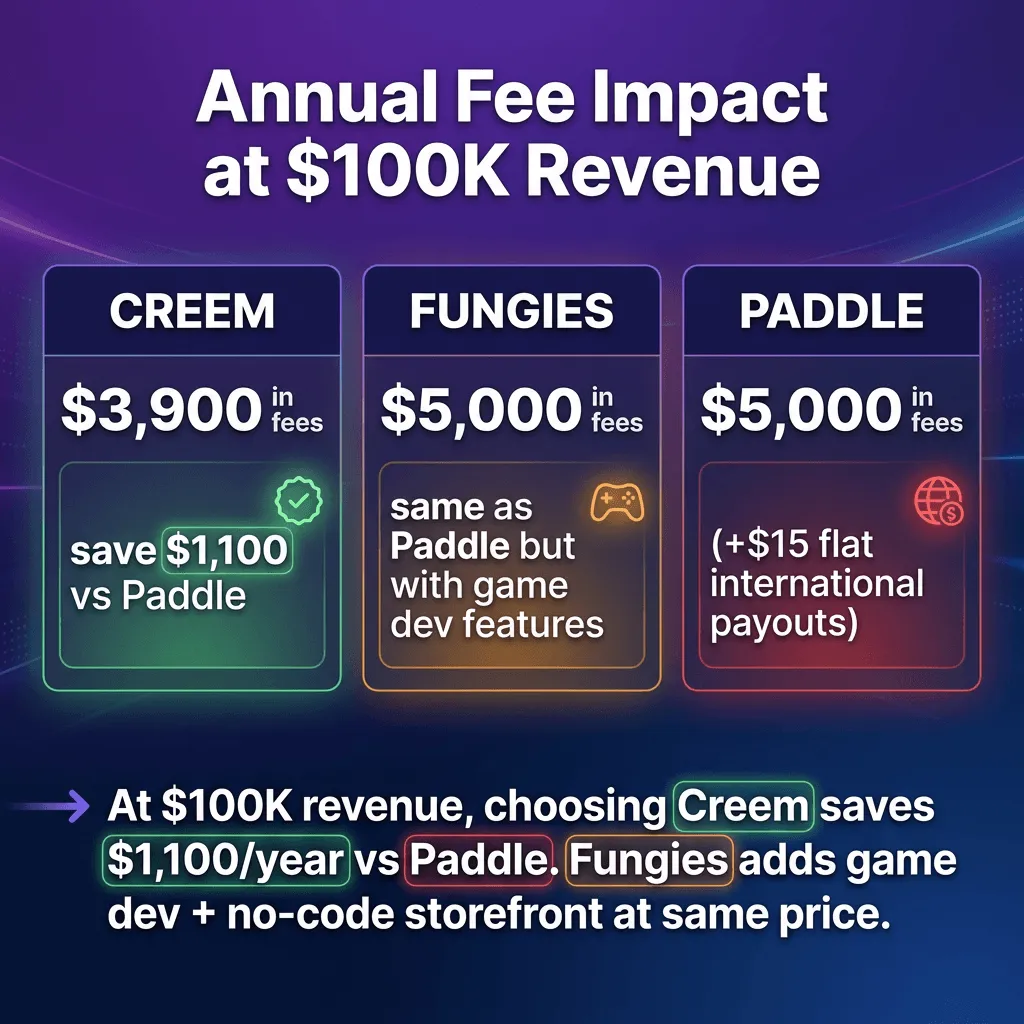
At $100K revenue, that’s $5,000 in transaction fees. Compare that to Creem at $3,900 — a difference of $1,100/year just on base fees. On top of that, international payouts cost $15 flat + 1.5% FX, which adds up fast for globally distributed teams.
Where Paddle is genuinely better:
- Battle-tested infrastructure — 13+ years processing payments, proven reliability
- Enterprise integrations — deep connections with HubSpot, Salesforce, and major analytics platforms
- Subscription lifecycle tools — churn recovery, dunning, payment retries are more mature
- Compliance pedigree — if you’re selling to enterprise customers who audit your payment stack, Paddle’s name carries weight
- 100+ country tax coverage — same as competitors but with a longer track record
Where Paddle falls short for indie hackers:
- Volume requirements for some features — not truly self-serve for small teams
- Onboarding can take 1–2 weeks with back-and-forth review
- No revenue splits built-in
- Higher fees with no discounts for early-stage founders
- Support is through ticketing, not direct access
Best for: Established SaaS with $10K+ MRR, companies that need enterprise-grade compliance documentation, teams migrating from Stripe who need full-service MoR without changing much of their stack.
Fungies.io: Best for SaaS + Game Developers
Fungies.io takes a different positioning than Creem and Paddle. Where Creem targets EU indie hackers and Paddle targets enterprise SaaS, Fungies focuses on the intersection of SaaS developers and game developers — two audiences with overlapping but distinct needs.
Pricing: 5% + $0.50 per transaction
Same base fee as Paddle. The differentiation isn’t on price — it’s on developer experience, setup speed, and game-specific features.
What Fungies does distinctly:
- Stripe-like API — developers report integration times under 30 minutes, compared to Paddle’s 1–2 week enterprise process
- 50+ payment methods — including local payment methods critical for gaming audiences in Southeast Asia, Latin America, and Eastern Europe
- No-code storefront — full e-store builder without touching code, useful for non-technical founders
- Game developer native — purpose-built for selling game assets, DLC, in-game currency, and software licenses
- 100+ country tax compliance — same coverage as Paddle with faster setup
- Revenue splits — also supported, like Creem
Where Fungies is weaker:
- Same fee as Paddle — no price advantage over Creem
- Smaller brand recognition than Paddle for enterprise deals
- Fewer enterprise integrations than Paddle (HubSpot, Salesforce, etc.)
Best for: Game developers, indie SaaS founders who want fast setup over enterprise features, developers who want a Stripe-like API without Stripe’s tax liability, sellers targeting non-English-speaking markets.
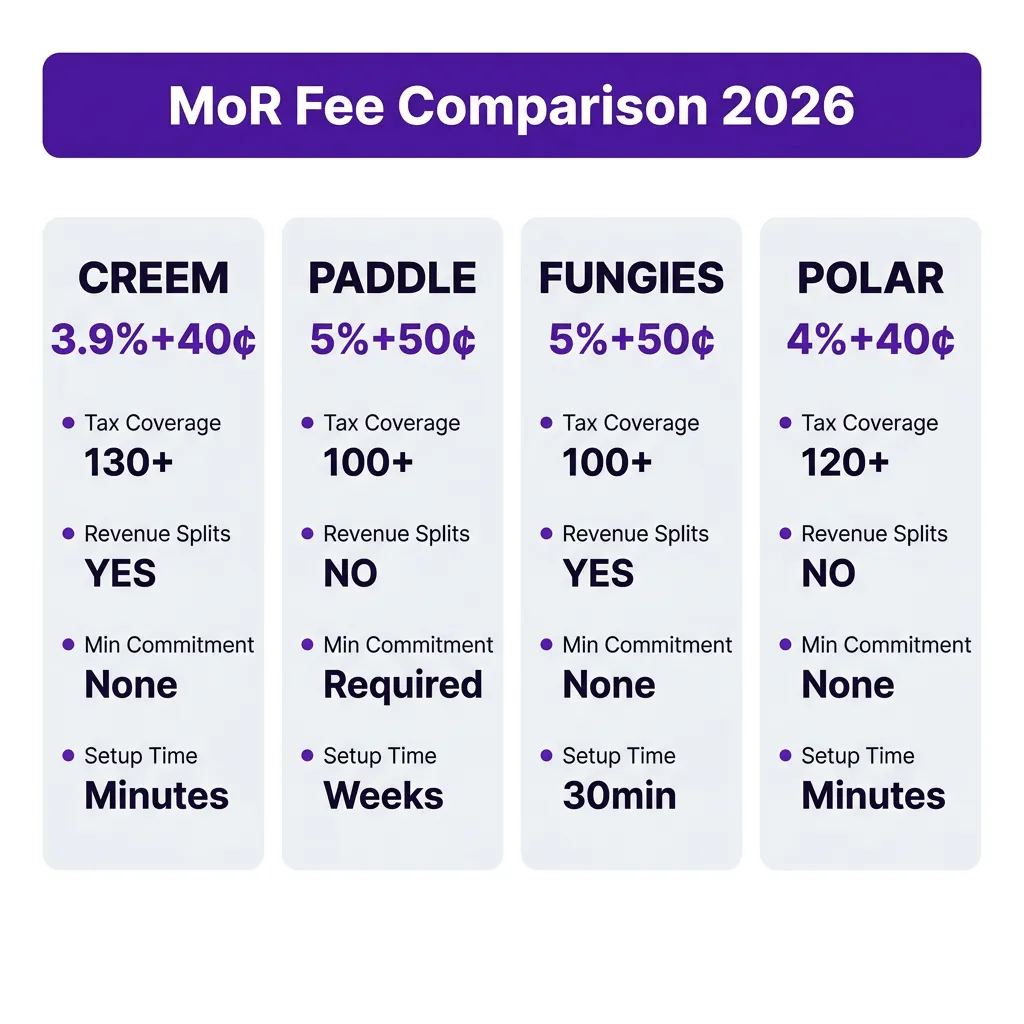
Head-to-Head: Creem vs Paddle vs Fungies Feature Comparison
| Feature | Creem | Paddle | Fungies |
|---|---|---|---|
| Base Fee | 3.9% + $0.40 | 5% + $0.50 | 5% + $0.50 |
| Tax Coverage | 130+ countries | 100+ countries | 100+ countries |
| Setup Time | Minutes | 1–2 weeks | <30 minutes |
| Minimum Commitment | None | Volume requirements | None |
| Revenue Splits | ✅ Built-in | ❌ Not available | ✅ Supported |
| Affiliate Platform | ✅ Built-in | ✅ Available | ✅ Supported |
| Payment Methods | Cards + crypto | 30+ methods | 50+ methods |
| Game Developer Focus | ❌ No | ❌ Limited | ✅ Yes |
| No-Code Storefront | Basic | Basic | ✅ Full builder |
| International Payouts | 0–1% | $15 + 1.5% FX | Standard |
| Developer API Quality | Good | Good | Stripe-like |
| Support Channel | Discord (direct) | Ticketing | Direct |
| Enterprise Integrations | Growing | HubSpot, Salesforce | Growing |
| Founded | 2023 | 2012 | 2022 |
The Real Fee Math: What You Pay at Different Revenue Levels
Percentages feel abstract until you run the numbers. Here’s what each platform actually costs at common revenue milestones for indie SaaS founders:
| Annual Revenue | Creem (3.9% + $0.40) | Paddle (5% + $0.50) | Fungies (5% + $0.50) | Creem Saves vs Paddle |
|---|---|---|---|---|
| $10,000 | ~$430 | ~$550 | ~$550 | $120/year |
| $50,000 | ~$2,150 | ~$2,750 | ~$2,750 | $600/year |
| $100,000 | ~$4,300 | ~$5,500 | ~$5,500 | $1,200/year |
| $250,000 | ~$10,750 | ~$13,750 | ~$13,750 | $3,000/year |
| $500,000 | ~$21,500 | ~$27,500 | ~$27,500 | $6,000/year |
Note: These estimates assume an average transaction size of $40–$50 (typical SaaS monthly subscription). Actual costs depend on transaction count and size.
The fee gap at early stage ($10K) is small — $120/year. At $100K it’s meaningful at $1,200/year. At $500K it’s $6,000/year — real money that could fund a new hire or six months of paid ads.
For game developers or SaaS teams that need Fungies-specific features (50+ payment methods, no-code storefront, game developer tooling), the same price as Paddle with faster setup is a genuine value proposition. You’re not paying more — you’re getting more for the same rate.
Creem vs Paddle: The Indie Hacker Verdict
The Creem vs Paddle debate is really about where you are in your journey.
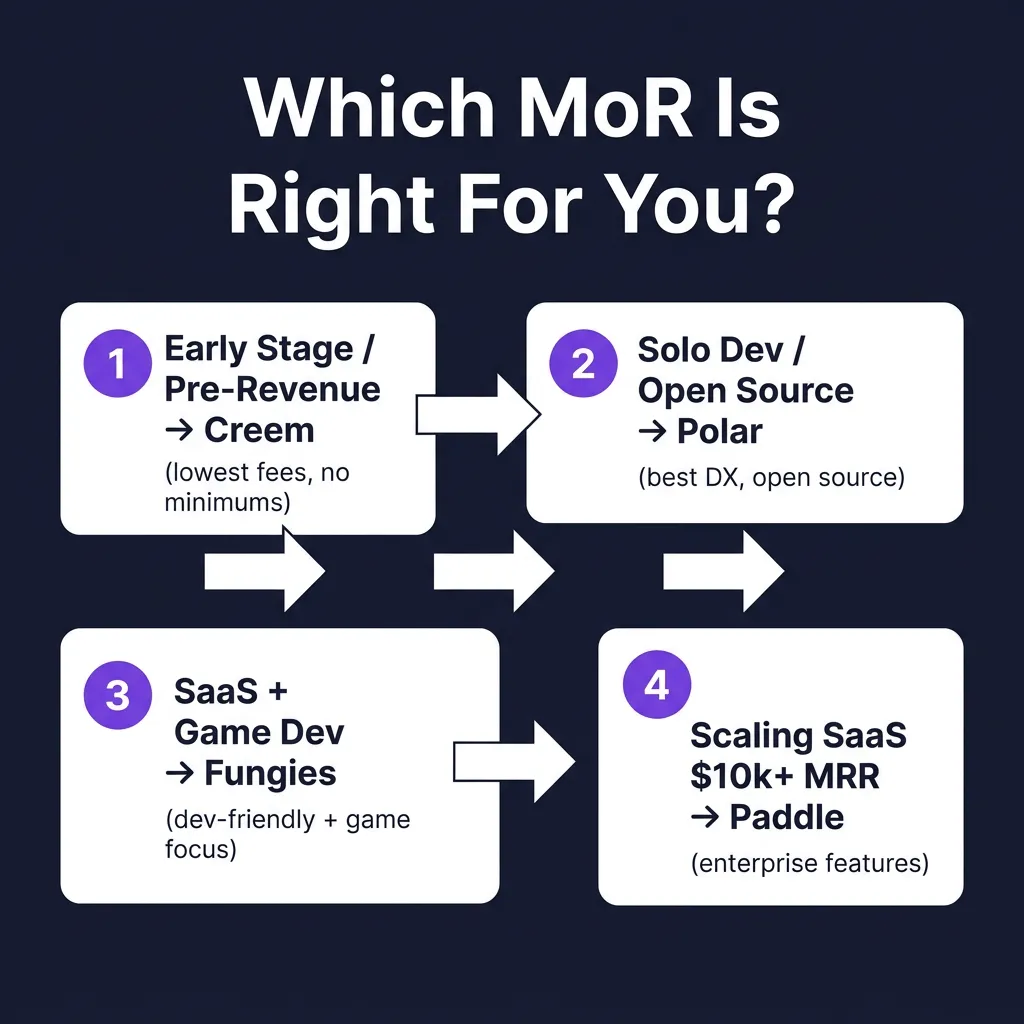
If you’re pre-revenue or under $10K MRR: Creem wins clearly. Lower fees, no minimum commitment, instant onboarding, Discord support. You don’t need Paddle’s enterprise infrastructure at this stage. Every percentage point you save on fees is runway.
If you’re at $10K–$50K MRR: Creem still makes sense unless you’re actively pitching enterprise customers who scrutinize your payment stack. Paddle’s brand recognition and compliance documentation carry more weight in B2B enterprise deals. For B2C or developer tools, Creem’s lower fees and modern feature set win.
If you’re at $50K+ MRR with enterprise customers: Paddle becomes defensible. The HubSpot and Salesforce integrations matter. The established reputation matters. The potential Paddle Enterprise custom pricing (available at higher volumes) can close the fee gap.
One note: Creem is newer (founded 2023). If you’re building something mission-critical that can’t tolerate platform risk, Paddle’s 13-year track record matters. Creem has been solid in practice — but you’re making a calculated bet on a younger platform.
Where Fungies Fits: The Third Option Most People Miss
Fungies doesn’t win on price vs Creem. It ties with Paddle on fees. So where does it win?
Game developers: If you’re selling a game, DLC, game assets, or in-game items, Fungies is the only platform of the three purpose-built for this. The 50+ payment methods include regional options critical for Southeast Asian gaming markets (GrabPay, GCash, etc.) that Creem and Paddle handle less cleanly.
Hybrid SaaS + physical/digital product sellers: The no-code storefront builder lets non-technical co-founders manage the product catalog without touching code, while developers integrate via a Stripe-like API.
Fast-moving founders: Fungies reports integration times under 30 minutes. Paddle averages 1–2 weeks. If you’re launching next week, that difference is real.
Sellers targeting emerging markets: 50+ payment methods vs Paddle’s 30+ gives Fungies an edge for founders whose customers are in Latin America, Southeast Asia, or the Middle East.
What About Polar and Dodo Payments?
Two platforms often come up in this comparison that deserve a quick mention:
Polar (4% + $0.40/txn): The developer community darling. Open source, GitHub-native, endorsed by Guillermo Rauch (Vercel CEO) and used by Tailwind Labs. Excellent developer experience — six-line integration. Catch: international card transactions add 1.5%, subscription payments add 0.5%. So your effective rate for a monthly EU subscriber is 6% + $0.40. Also, payout coverage is ~120 countries (gaps in parts of Africa and Southeast Asia).
Dodo Payments (4% + $0.40/txn): Purpose-built for India, APAC, and globally underserved markets. If you’re selling primarily to customers in India, Southeast Asia, or MENA, Dodo Payments likely has better local payment method coverage than any of the three platforms in this guide.
Neither Polar nor Dodo replaces Creem, Paddle, or Fungies for a globally-distributed SaaS — but they’re worth knowing about for specific niches.
Key Takeaways
- Creem is cheapest — 3.9% + $0.40 beats Paddle’s 5% + $0.50 by $1,200/year at $100K revenue. If you’re indie and early-stage, start with Creem.
- Paddle is battle-tested — 13 years, enterprise integrations, proven compliance. Worth the premium if you’re selling to enterprise customers or at $50K+ MRR.
- Fungies is the game dev and fast-setup winner — same price as Paddle, better developer experience, 50+ payment methods, no-code storefront. Ideal for game developers and founders launching quickly.
- All three are full MoRs — tax compliance, chargebacks, and liability handled. You can’t go wrong with any of them vs. not using an MoR at all.
- The fee gap compounds — at $10K revenue the difference is $120/year. At $500K it’s $6,000/year. Pick your platform based on where you’re going, not just where you are.
FAQ
Is Creem safe to use for a new SaaS in 2026?
Yes. Creem launched in 2023 and has processed millions in transactions. It’s a legitimate MoR with full VAT/GST/sales tax compliance in 130+ countries. The main risk is platform age — Creem is newer than Paddle (2012) or Fungies (2022). For enterprise customers who audit your payment stack, Paddle’s brand recognition carries more weight. For most indie SaaS founders, Creem is a solid choice.
Can I switch from Paddle to Creem or Fungies without downtime?
Yes, with some planning. Your subscriptions on Paddle are stored on Paddle’s side, so you’ll need to migrate customers. Both Creem and Fungies have migration support teams. The typical approach: keep Paddle active for existing subscribers, route new customers to the new platform, then gradually migrate existing subscribers over 2–3 billing cycles. Expect 4–6 weeks for a clean migration.
Which MoR is best for selling to EU customers?
All three handle EU VAT correctly. Creem specifically markets to EU founders and has strong EU VAT documentation. Paddle has the longest EU compliance track record. Fungies handles EU VAT automatically at checkout. For EU customers buying from a global storefront, any of the three works — the difference is in your own payout preferences and fee structure, not in EU buyer experience.
Does Fungies.io work for game developers on Steam?
Fungies is built for game developers selling directly (not through Steam). Steam has its own MoR infrastructure and doesn’t allow external payment processors for Steam purchases. Fungies is the right choice if you’re selling your game, DLC, or game assets on your own website, itch.io, or a custom storefront — not within the Steam ecosystem itself.
Conclusion
The right MoR for you depends on where you are and where you’re going.
Early-stage indie hacker with a SaaS or digital product? Start with Creem. Lowest fees, instant setup, no commitment, modern features. Save the $1,200/year at $100K and put it back into the product.
Game developer or founder launching in the next month? Go with Fungies. 30-minute setup, 50+ payment methods, game-developer-native tooling, and a Stripe-like API. Same price as Paddle without the 2-week onboarding.
Established SaaS at $50K+ MRR selling to enterprise? Paddle is still the safe choice. Brand recognition, enterprise integrations, proven track record at scale.
All three are genuinely good products. The worst decision is using Stripe and managing your own tax compliance. Any MoR is better than that.
Ready to start selling globally without the tax headache? Set up your Fungies account free — no upfront costs, 30-minute integration, and full MoR compliance from day one.