A shop for digital products, not a payment link with a logo
A storefront is more than a buy button. It is a catalogue, product pages people can find in search, a checkout that works in every market, delivery that happens on its own, and somewhere customers go afterwards. All of that comes as one thing here.














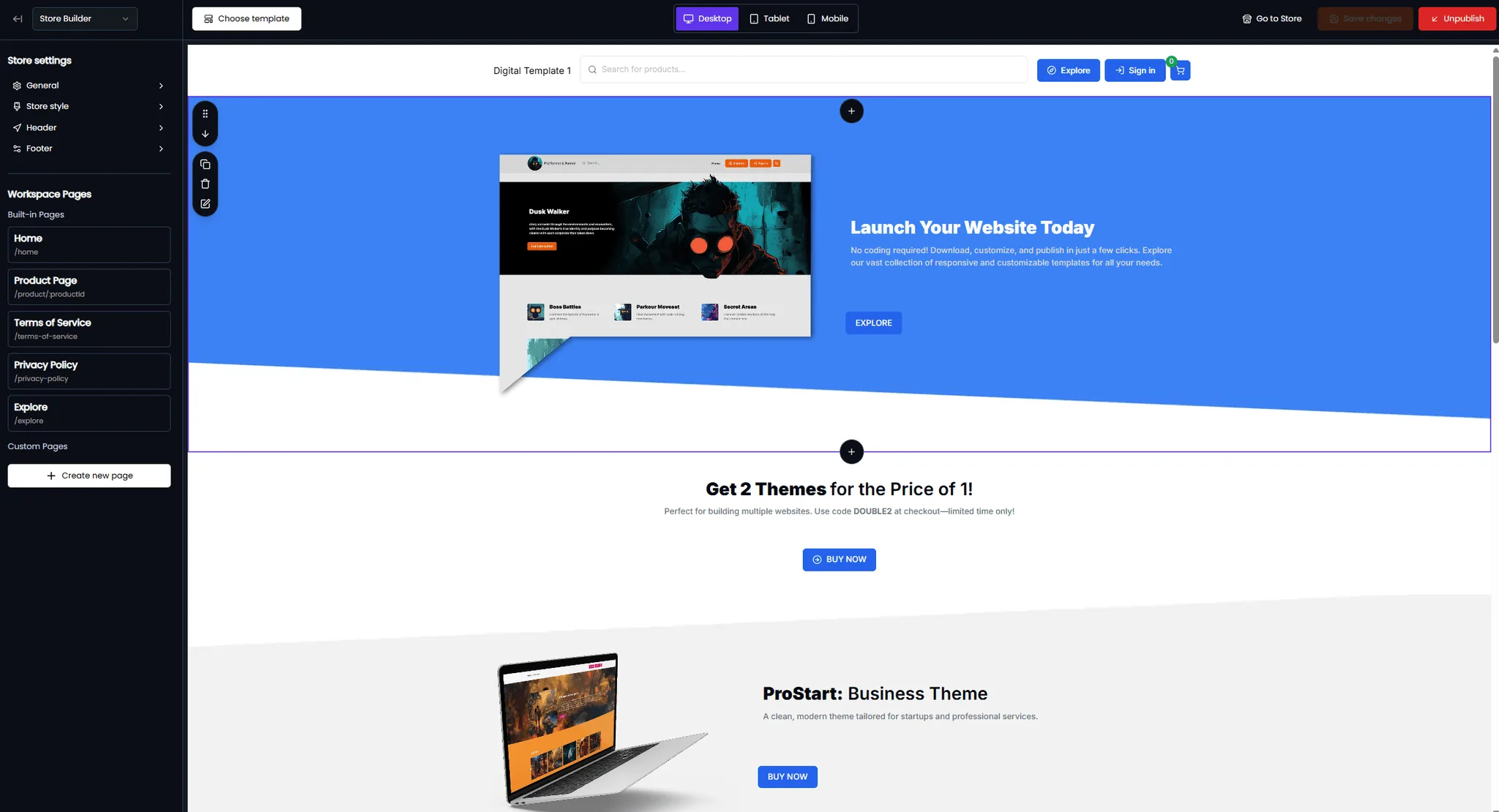
What the storefront includes
- A visual builder
- Header, footer, arbitrary pages, and sections for text, image, video, gallery, points, slider and recent products, each with its own styling. It is usable before you sign up.
- Every digital product type
- One-time purchases, subscriptions, memberships, downloads and game keys, with variants for formats or tiers and plans for billing intervals.
- Product pages that convert
- A built-in product page with customisable review categories, plus an explore and search page so a visitor can find the rest of the catalogue.
- Your own domain
- Publish on a Fungies subdomain to start, then move to a domain you own. Custom domains route through Cloudflare for DDoS protection.
- Delivery without you
- Files and keys reach the buyer on payment. Steam keys are encrypted on upload and assigned automatically as they sell.
- Found by search and shopping
- A sitemap, SEO settings and a Google Merchant Center XML feed are generated for the store rather than being something you retrofit.
Getting a shop online
- 01
Lay it out before committing
The builder opens without an account. Style it, add pages, see what your shop looks like, and only then decide whether to sign up.
- 02
Add the catalogue
Create products, add variants for the versions you sell, and set offers for each price point. A single product can carry monthly and annual pricing side by side.
- 03
Publish
The store goes live immediately on your subdomain, or on your own domain once it is connected. Sitemap and SEO settings are generated as part of publishing.
- 04
Let it run
Checkout, tax, delivery, receipts and the customer portal all operate without intervention. You are managing a catalogue, not an operation.
What makes this different from a website plus a plugin
There is no stack to maintain
A self-hosted shop is a set of plugins that need updating, a host that needs paying, and a combination that breaks when one of them ships a release. Here there is nothing on your side that can fall out of date.
Tax is part of the shop, not an add-on
Selling digital goods internationally creates obligations from the first sale. As Merchant of Record those registrations and filings are ours, which is the part a store builder plus a payment plugin cannot give you.
The customer has somewhere to go
A branded portal holds order history, downloads, keys and subscription controls. Without one, every re-download request and plan change becomes an email you have to answer personally.
You pay for sales, not for software
No subscription for the store, no per-plugin licence, no hosting bill. A flat 5% + 50¢ on the transactions that actually happened. Negotiable once you are selling at volume.
What sellers say once they have switched
★★★★★ 4.8/5 from 10 reviews on G2 → Vadim Finayev
 “We work with quite a few merchants of record, but none comes close to the support and speed of implementation of Fungies. If you want a payment partner that actually gives you the feeling they want to work with you — rather than leaving you on read for three days or randomly restricting your account — you are in the right place.”
 David Elliott
 “I researched the options and Fungies was the best fit for functionality and customisation within a store builder you can connect to your own domain. Taking a small percentage of sales, instead of charging a subscription for every environment and plugin, is refreshing.”
 Elnura Abdimanap Kyzy
 “The platform is user-friendly, integrates easily with APIs and webhooks, and simplifies managing digital products and subscriptions. We were up and running quickly and support has been responsive throughout. Fungies is clearly tailored to the needs of SaaS businesses.”
 Francisco Magnone Rienzi
 “Fungies has been a great partner — fast setup, competitive pricing, and real humans providing quick answers. They are constantly rolling out new features, and I am excited to see what is next.”
Storefront questions
A shop on your own domain, under your own brand.
Open the builder and see your shop first
It runs without an account. Lay out a page, add a product, and decide afterwards whether to publish it.