Dodo Payments Review 2026: Honest Look at Fees, Features & Limitations
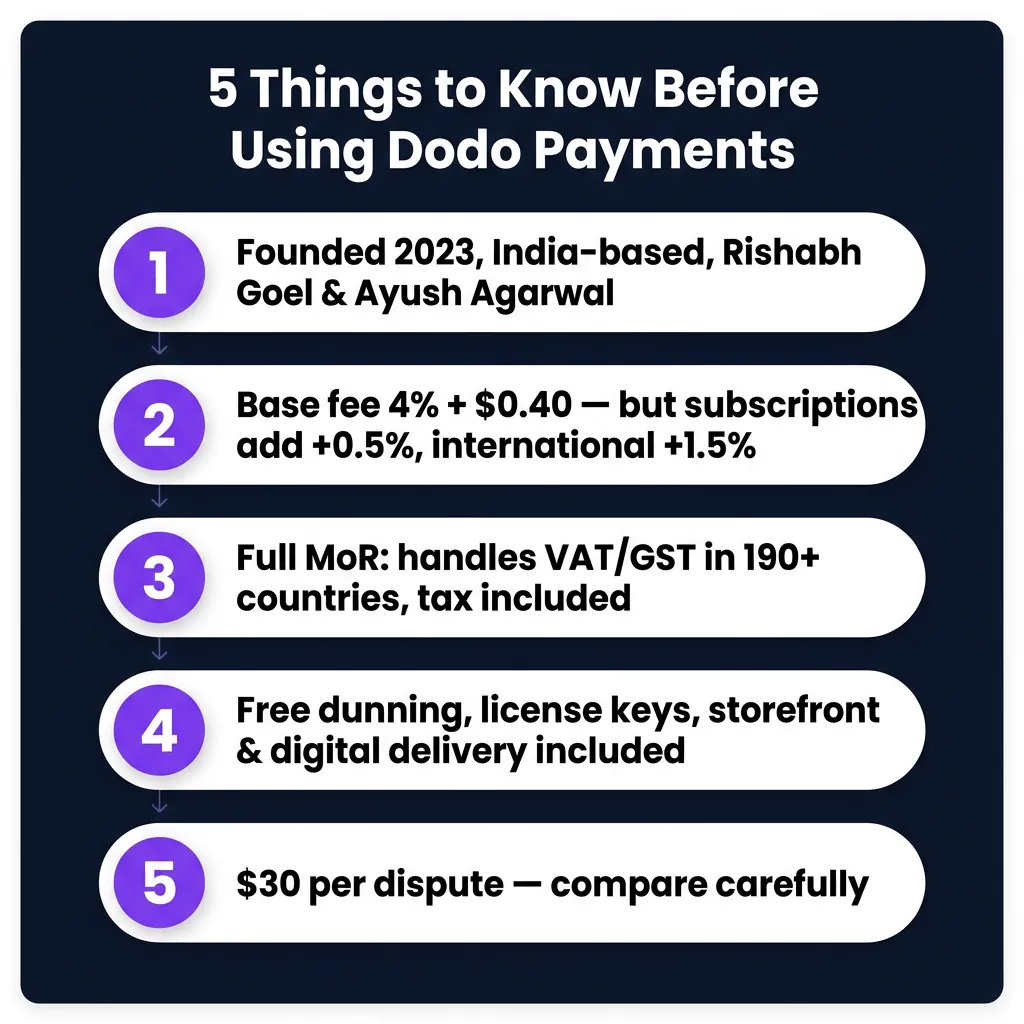
Let’s be direct: if you’re an Indian SaaS founder or an early-stage team selling digital products globally, Dodo Payments has probably come up in your research. Founded in 2023 by Rishabh Goel and Ayush Agarwal, it’s one of the newer Merchant of Record platforms specifically targeting indie developers and AI startups who want to go
Let’s be direct: if you’re an Indian SaaS founder or an early-stage team selling digital products globally, Dodo Payments has probably come up in your research. Founded in 2023 by Rishabh Goel and Ayush Agarwal, it’s one of the newer Merchant of Record platforms specifically targeting indie developers and AI startups who want to go global without the legal complexity of VAT, GST, and sales tax.
This isn’t a generic overview. This is a detailed look at what Dodo Payments actually costs, what it includes, where it falls short, and whether it’s the right choice compared to Fungies, Paddle, Creem, and Lemon Squeezy. After reviewing their pricing page, Trustpilot reviews, and community discussions on IndieHackers and Reddit, here’s the honest verdict.
What Is Dodo Payments? (And Why It Exists)
Dodo Payments is a Merchant of Record (MoR) platform. That means when your customer buys your product, Dodo legally becomes the seller — they handle VAT, GST, sales tax, chargebacks, and compliance in 190+ countries. You get the net revenue after their fees.
This solves a real problem. If you’re a solo developer in Bangalore building a SaaS tool and selling to customers in Germany, the US, and Australia, you’d normally need to register for VAT in each jurisdiction, file quarterly returns, and handle disputes. With an MoR, that becomes someone else’s problem.
Dodo specifically targets: indie hackers, AI startup founders, bootstrapped SaaS teams, and developers selling digital products globally — particularly those with roots in India or Southeast Asia where UPI and local payment methods matter.
Dodo Payments Pricing: The Real Numbers in 2026
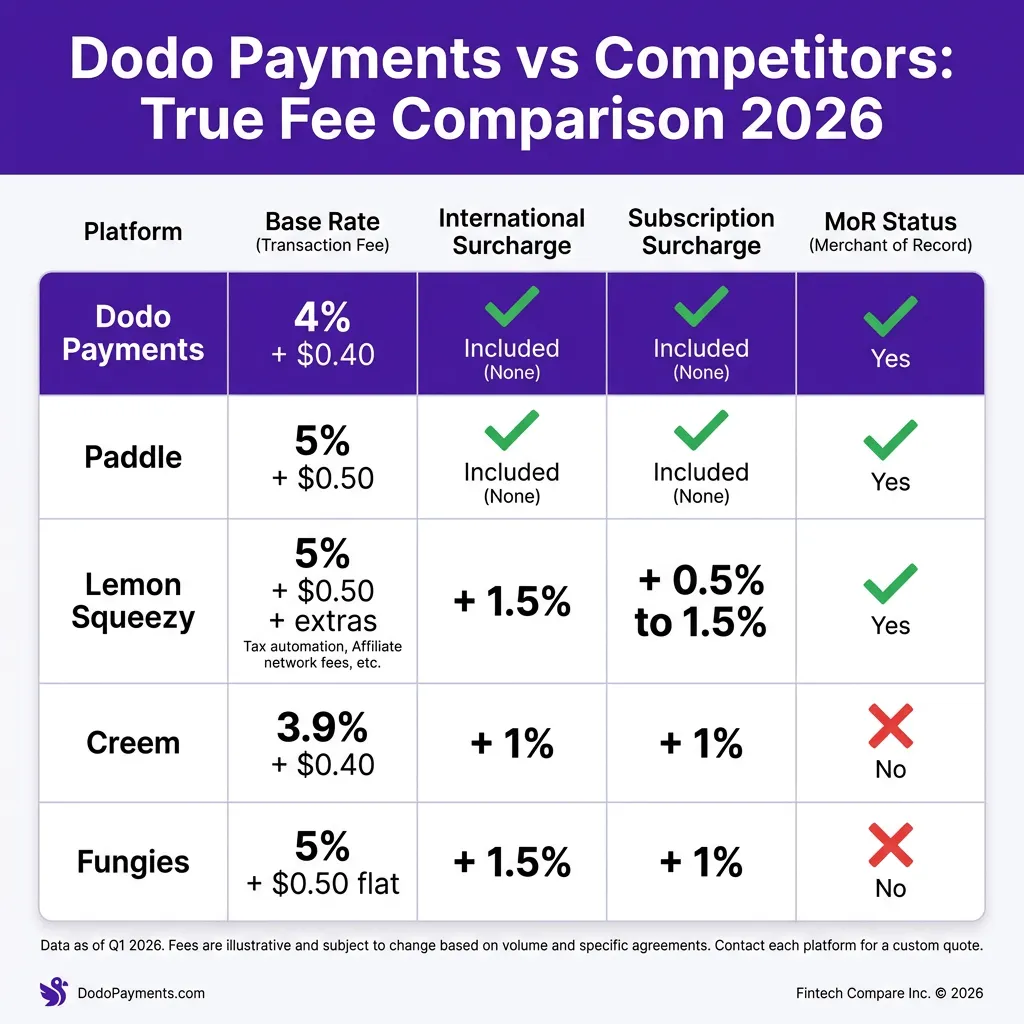
Dodo’s headline is 4% + $0.40 per transaction — slightly cheaper than Paddle’s 5% + $0.50 and Lemon Squeezy’s 5% + $0.50. But like every MoR, the real cost depends on your product type and customer geography.
Here’s what you actually pay for a typical global SaaS subscription:
| Fee Type | Dodo Payments | Paddle | Lemon Squeezy | Creem | Fungies |
|---|---|---|---|---|---|
| Base Rate (US cards) | 4% + $0.40 | 5% + $0.50 | 5% + $0.50 | 3.9% + $0.40 | 5% + $0.50 |
| International Cards | +1.5% | Included | +1.5% | +1.5% | Included |
| Subscription Billing | +0.5% | Included | +0.5% | Included | Included |
| PayPal | +3% | Varies | +1.5% | Not available | Included |
| Chargeback Fee | $30 per dispute | Handled/included | Varies | $15 per dispute | Handled/included |
| Tax Handling | Included (190+ countries) | Included | Included | Included | Included |
| Monthly Fee | $0 | $0 | $0 | $0 | $0 |
Real-world example: A $50/month international subscription paid with a non-US card through Dodo Payments:
Base: 4% = $2.00
International: +1.5% = $0.75
Subscription: +0.5% = $0.25
Fixed fee: $0.40
Total fee: $3.40 (6.8% effective rate)
That’s higher than Paddle’s flat 5% + $0.50 for the same transaction ($3.00). The 4% headline is real for domestic US one-time payments — but if your customers are global SaaS subscribers (most likely), the stacked fees push Dodo’s cost higher.
What Dodo Payments Includes
Despite the fee stacking, Dodo does include a lot out of the box — and this is where it genuinely shines for early-stage products:
Global tax compliance: VAT, GST, sales tax in 190+ countries, automated. No filing burden on you.
Storefront builder: No-code product pages included at no extra cost.
License key generation: For desktop apps and software — automated delivery included.
Subscription billing: Recurring payments, addons, and usage-based billing (metered billing for token/credit models).
Abandoned cart recovery: Free to enable — you only pay 5% on successfully recovered revenue.
Dunning management: Smart payment retries for failed subscription renewals. Free to enable, 5% on recovered revenue.
Digital product delivery: Secure file delivery for PDFs, downloads, software — included.
UPI payments (India): Local debit/credit cards and UPI in India at 4% + $0.15 — a significant advantage for Indian founders.
Analytics: Revenue, churn, and customer analytics included (vs $10/month extra on some platforms).
Dodo Payments: Pros and Cons Breakdown
What Dodo Does Well
India-first setup. If you’re building in India, UPI support is huge. Most global MoRs don’t support UPI natively. Dodo’s 4% + $0.15 for domestic India transactions is genuinely competitive.
Fast onboarding. Dodo is known for quick KYC and setup times — most founders report going live within 24-48 hours. Compare that to Paddle’s slower enterprise-oriented review process.
Everything included for early stage. License keys, storefront, digital delivery, dunning — all in one platform. For a solo founder launching their first product, this removes a lot of duct-tape integrations.
Usage-based billing support. For AI products with token/credit billing models, Dodo supports metered billing natively at $1 per million billing events. This is genuinely rare among MoRs.
No monthly fee. You only pay when you transact. Zero risk to launch, zero platform fee overhead.
Where Dodo Falls Short
The stacked fee problem. The 4% headline masks the reality: international + subscription + PayPal fees stack on top. A typical global SaaS with international subscribers paying by card is looking at 6-7% effective rates — not 4%.
$30 chargeback fee is high. Most MoRs absorb chargeback handling as part of their MoR responsibility. A $30 fee per dispute adds up fast if you sell at any volume to consumer markets where chargebacks are common.
Refund processing fee. $1 per refund processed. Small, but it penalizes you for honoring customer requests. Most MoRs don’t charge for refunds — it’s part of the service.
Smaller ecosystem. Dodo is a 2023 startup. Their integrations, documentation depth, and community support don’t yet match Paddle (founded 2012) or Lemon Squeezy. You’ll be debugging more on your own.
Geographic concentration. While Dodo handles 190+ countries for tax, their core team and infrastructure skew India. If your primary customers are in Europe or North America and you need deep local payment method coverage (SEPA, iDEAL, Bancontact), the experience is less polished than Paddle.
Dodo Payments vs The Competition: Head-to-Head
| Feature | Dodo Payments | Paddle | Creem | Lemon Squeezy | Fungies |
|---|---|---|---|---|---|
| Founded | 2023 | 2012 | 2022 | 2021 | 2019 |
| Base Fee | 4% + $0.40 | 5% + $0.50 | 3.9% + $0.40 | 5% + $0.50 | 5% + $0.50 |
| True Intl Subscription Rate | ~6-7% | ~5-6% | ~5.4-6.4% | ~7-8% | ~5-6% |
| MoR Status | ✅ Full MoR | ✅ Full MoR | ✅ Full MoR | ✅ Full MoR | ✅ Full MoR |
| UPI Support | ✅ | ❌ | ❌ | ❌ | ❌ |
| Usage-Based Billing | ✅ | ✅ (Paddle Billing) | ❌ | ❌ | ✅ |
| License Keys | ✅ | ❌ (basic) | ✅ | ✅ | ✅ |
| Storefront Included | ✅ | ✅ | ✅ | ✅ | ✅ |
| Affiliate Program Built-in | ❌ | ❌ | ❌ | ✅ | ✅ |
| Chargeback Fee | $30/dispute | Absorbed | $15/dispute | Varies | Absorbed |
| Target Market | India/Asia SaaS | Enterprise SaaS | Indie Hackers | Creators/Indie | Creators/Developers |
Who Should Use Dodo Payments?
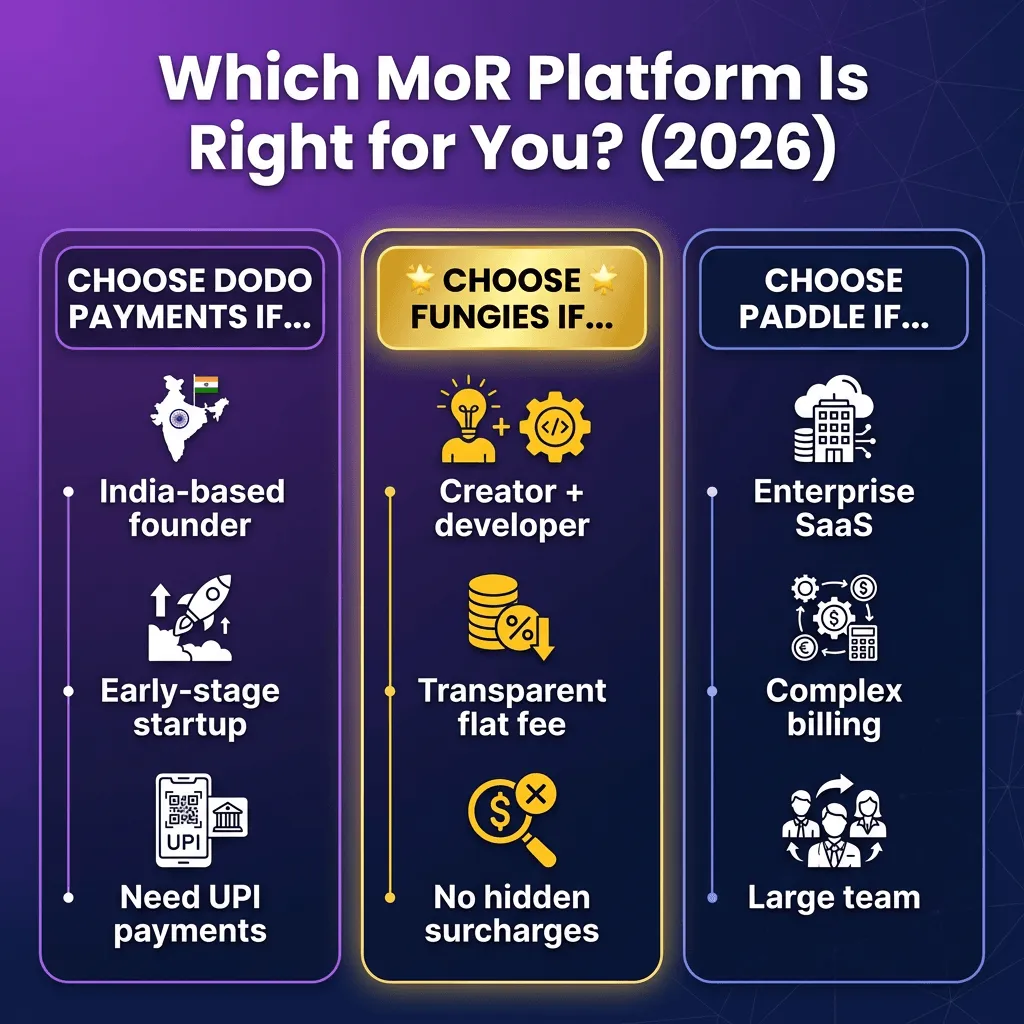
Dodo Payments is a good fit if:
You’re an Indian founder building for global markets and need UPI + international payments in one platform
You’re building an AI product with token/credit-based billing and need metered usage billing
You want fast onboarding — literally live within 24 hours
You’re in very early stage and want zero monthly overhead
Your customers are primarily US-based and pay one-time (where the 4% rate actually applies)
Dodo Payments may not be the right fit if:
Most of your subscribers are international — stacked fees push your effective rate to 6-7%
You’re doing meaningful volume and chargebacks are a concern ($30/dispute adds up fast)
You need a mature affiliate program built in (Dodo doesn’t have one)
You want SEPA, iDEAL, or deep European payment method support
You need extensive documentation, integrations, and a large support community
Fungies vs Dodo Payments: The Direct Comparison
Both Fungies and Dodo Payments are Merchant of Record platforms with no monthly fees. But there are key differences that matter depending on your business model.
Fee structure: Fungies charges a flat 5% + $0.50 with no stacking for international cards or subscriptions. Dodo starts at 4% but adds 1.5% for international and 0.5% for subscriptions — making the real rate for a typical global SaaS subscriber ~6.5% vs Fungies’ flat 5.5% effective rate.
Chargebacks: Fungies absorbs chargebacks as part of the MoR relationship. Dodo charges $30 per dispute.
Affiliate program: Fungies includes a built-in affiliate program. Dodo doesn’t — you’d need to integrate a third-party tool like Rewardful or FirstPromoter, adding cost and complexity.
Refunds: Fungies doesn’t charge for refunds. Dodo charges $1 per processed refund.
UPI: Dodo wins clearly if you need UPI for Indian customers. Fungies doesn’t support UPI natively.
The bottom line: for India-first teams needing UPI, Dodo is the better choice. For developers and creators selling globally with a standard subscription or digital product model, Fungies typically offers a simpler and more cost-effective fee structure.
What Users Are Saying About Dodo Payments
On Trustpilot (121 reviews as of June 2026), Dodo Payments has a generally positive rating from early adopters. Common positives:
“Fast onboarding, was selling globally in under a day”
“Handles all the tax headaches — game changer for Indian founders”
“Clean dashboard, easy to understand what’s happening”
Common complaints:
“High fees after you add up all the surcharges — wish it was simpler”
“$30 chargeback fee came as a surprise when I got my first dispute”
“Support is slow when you have billing edge cases”
On IndieHackers and Reddit, Dodo is frequently recommended in threads about Indian SaaS monetization, particularly where UPI is needed. In threads about general global SaaS payments, Creem, Fungies, and Paddle tend to come up more often.
Key Takeaways
The 4% headline is misleading for most SaaS businesses — international subscriptions cost 6-7% with stacked fees
Dodo is the best MoR option for Indian founders who need UPI support alongside global payments
$30 chargeback fee is unusually high — factor this in if you sell B2C at scale
Usage-based billing and AI credit models are genuinely well-supported — a strong differentiator
Fast setup (24-48 hours) makes it an excellent choice for launching quickly
FAQ
Is Dodo Payments a Merchant of Record?
Yes. Dodo Payments acts as a full Merchant of Record, becoming the legal seller when your customer purchases. They handle VAT, GST, and sales tax compliance in 190+ countries, taking on the tax liability so you don’t have to register or file in each jurisdiction.
How much does Dodo Payments actually charge for international subscriptions?
For international subscription payments (non-US cards), Dodo’s effective rate is approximately 6-7%: base 4% + international surcharge 1.5% + subscription fee 0.5% + fixed $0.40. For comparison, Paddle charges a flat 5% + $0.50 for the same transaction with no stacking.
Does Dodo Payments support UPI?
Yes — this is one of Dodo’s strongest differentiators. They support UPI, local debit/credit cards, and domestic payments in India at 4% + $0.15 per transaction, making them the best MoR option for Indian SaaS founders who need both local and global payment coverage.
What are the best Dodo Payments alternatives in 2026?
The main alternatives depend on your use case: Fungies for a flat, no-stacking fee structure with built-in affiliate program; Creem for indie hackers wanting the lowest headline rate; Paddle for enterprise SaaS needing deep billing infrastructure; Lemon Squeezy for creator-focused products with built-in affiliate marketing.
Should You Use Dodo Payments in 2026?
Dodo Payments is a solid, fast-growing MoR platform with genuine strengths — especially for Indian founders and AI startups with metered billing needs. The fast onboarding, UPI support, and comprehensive feature set make it an easy recommendation for the right use case.
But go in with clear eyes. The stacked fee structure means international SaaS subscriptions cost more than the headline suggests. The $30 chargeback fee is a real risk if your product attracts any consumer volume. And the platform is young — three years old in 2026 — with documentation and integration depth that still lags behind Paddle and other incumbents.
If you’re selling globally with a standard SaaS or digital product model and want a flat, predictable fee with no hidden surcharges, chargeback coverage included, and a built-in affiliate program — try Fungies instead. It’s built specifically for developers and creators who want to sell anywhere without the fee-stacking surprises.