How to Choose a Merchant of Record for SaaS: The Complete 2026 Guide
Learn how to choose a merchant of record for your SaaS business. This 2026 guide covers 6 critical factors: tax coverage, pricing, payment methods, billing flexibility, integration quality, and support. Compare top MoR providers and make the right choice.
Here’s a number that should wake you up: the average SaaS company spends 253 hours per year just managing tax compliance across different jurisdictions. That’s more than six full work weeks spent on paperwork, filings, and regulatory headaches instead of building product.
If you’re scaling a SaaS business internationally, you’ve probably hit this wall. You started with Stripe or PayPal because they’re easy. But then a customer from Germany asks for a proper VAT invoice. Someone in India needs a specific payment method you’ve never heard of. And suddenly you’re reading about economic nexus laws in states you’ve never visited.
This is exactly where a Merchant of Record (MoR) becomes worth considering. But here’s the thing — not all MoR providers are the same. Choose wrong, and you’ll trade one headache for another. Choose right, and you can focus on growth while someone else handles the compliance maze.
What Is a Merchant of Record (And Why It Matters for SaaS)
A Merchant of Record is the legal entity that sells your product to the end customer. They take on the liability for the transaction — including tax collection, remittance, fraud prevention, and regulatory compliance. When you use an MoR, they become the seller on record, not you.
Here’s what that actually means in practice:
- Tax compliance handled: The MoR registers for VAT/GST/sales tax wherever required, collects it at checkout, files returns, and remits payments to tax authorities. You don’t touch a single tax form.
- Fraud and chargeback protection: When a dispute arises, the MoR handles the response and absorbs the liability (depending on your agreement).
- Global payment coverage: MoRs typically offer 40+ payment methods including local options like iDEAL in the Netherlands, UPI in India, or Alipay in China.
- Legal liability shift: If something goes wrong with a transaction — regulatory issues, tax audits, compliance violations — the MoR is on the hook, not your company.
Honestly, most SaaS founders I talk to underestimate the operational drag of handling this stuff in-house. It’s not just the time cost. It’s the mental overhead of keeping track of changing regulations across dozens of markets.
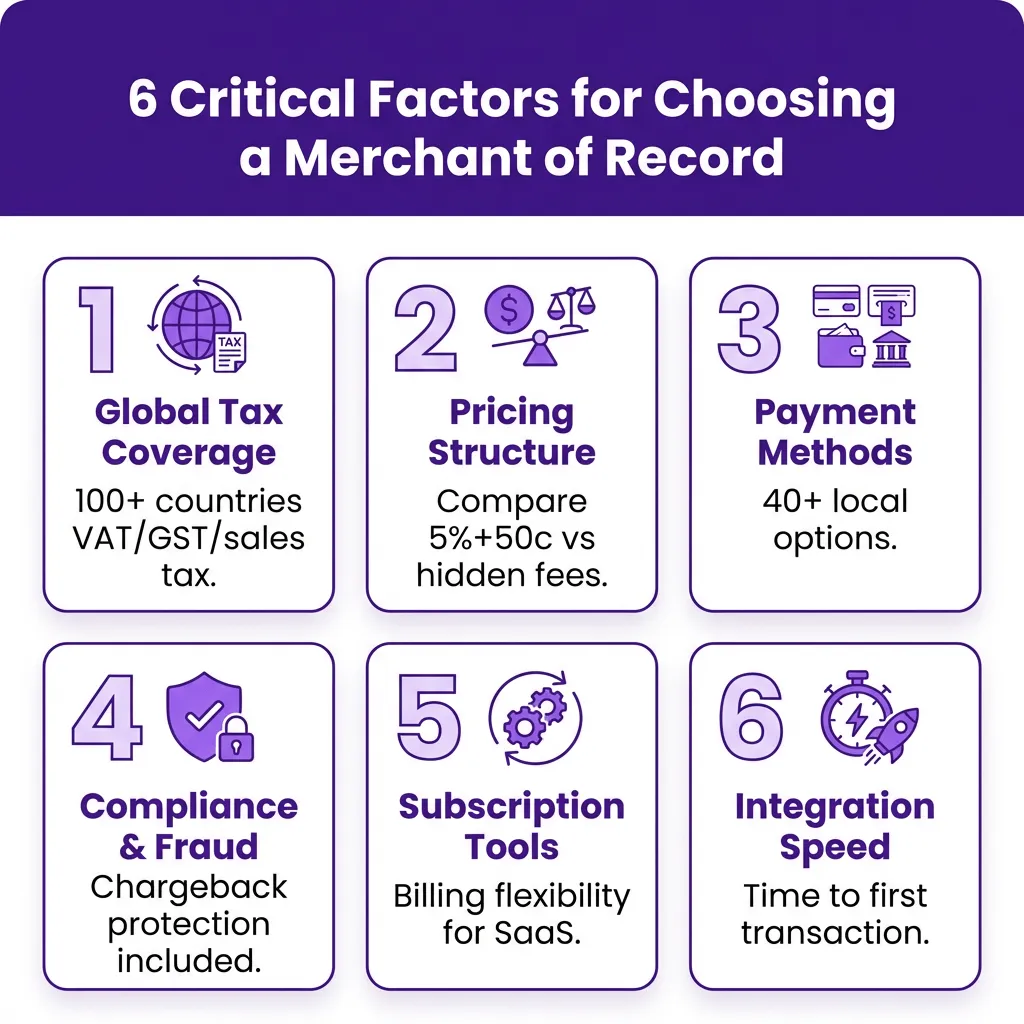
The 6 Critical Factors for Choosing a Merchant of Record
After researching every major MoR platform and talking to founders who’ve made the switch, I’ve identified six factors that separate the good providers from the ones that’ll cause you pain down the road.
1. Global Tax Coverage (The Non-Negotiable)
This is the whole point of using an MoR, so you’d be shocked how many providers have gaps. Here’s what proper tax coverage looks like:
- VAT compliance across all 27 EU member states plus the UK, Norway, and Switzerland
- GST handling for Australia, New Zealand, Singapore, and India
- US sales tax collection and remittance for all 45 states that impose it
- Canadian GST/HST/QST compliance
- Registration, collection, filing, and remittance — not just calculation
Some providers only handle tax calculation at checkout but leave you to handle the actual filing and remittance. That’s not a real MoR — that’s a calculator with extra steps.
Red flag: If a provider can’t give you a clear list of every jurisdiction they handle end-to-end, keep looking.
2. Pricing Structure and Hidden Costs
MoR pricing typically falls into three categories:
| Model | Typical Rate | Best For |
|---|---|---|
| Flat rate per transaction | 5% + $0.50 | Predictable costs, early-stage SaaS |
| Tiered by volume | 4.5% – 6% + $0.30-$0.50 | High-volume businesses |
| Revenue share + monthly fee | Variable + $99-$500/mo | Enterprise with complex needs |
But the headline rate isn’t the whole story. Watch out for these hidden costs:
- Currency conversion fees: Some providers charge 1-2% on top of the base rate for non-USD transactions
- Chargeback fees: Even if the MoR handles disputes, you might still pay $15-$25 per chargeback
- Refund processing fees: Some platforms keep their transaction fee even on refunds
- Monthly minimums: If you’re not hitting volume thresholds, you might pay flat monthly fees regardless
At around $30,000 MRR, the hidden costs of handling payments and taxes yourself typically exceed what you’d pay an MoR. Below that, the math depends on how much you value your time.
3. Payment Method Coverage
Credit cards aren’t enough for global SaaS. In Germany, 30% of online purchases use SEPA direct debit. In the Netherlands, iDEAL dominates. In India, UPI has overtaken cards entirely.
A good MoR should offer at minimum:
- Major credit cards (Visa, Mastercard, Amex)
- PayPal and digital wallets (Apple Pay, Google Pay)
- SEPA for European markets
- Local bank transfers in key markets
- Alternative methods popular in your target regions
Each additional payment method can improve conversion rates by 5-10% in that market. It adds up fast.
4. Subscription and Billing Flexibility
SaaS billing isn’t just “charge them monthly.” You need:
- Multiple billing intervals (monthly, annual, custom)
- Trial handling (free trials, paid trials, trial-to-paid conversion)
- Proration for plan changes mid-cycle
- Usage-based or metered billing if you offer it
- Grace periods and dunning management for failed payments
- Coupon and discount support
Some MoRs started as ecommerce platforms and added SaaS features as an afterthought. Their subscription handling feels clunky. Others were built for SaaS from day one.
Test this: Can you set up a annual plan with a 14-day trial, apply a 20% coupon for the first 3 months, and have customers upgrade mid-cycle with proper proration? If the answer isn’t “yes, through the dashboard, in under 5 minutes,” keep looking.
5. Integration and Developer Experience
You’re going to be living in this integration. The API quality matters.
Here’s what to evaluate:
- Documentation quality: Clear examples, multiple languages, edge cases covered
- Webhook reliability: What happens when a webhook fails? Do they retry? For how long?
- SDK availability: Do they offer native SDKs for your stack, or are you writing raw HTTP calls?
- Sandbox environment: Can you fully test the integration without real transactions?
- Migration support: If you’re switching from another provider, will they help migrate existing subscriptions?
The best MoRs treat their API as a product. The worst treat it as an afterthought.
6. Support Quality and Response Times
When your checkout is broken and customers can’t buy, “we’ll get back to you in 24-48 hours” isn’t acceptable. You need:
- Live chat or phone support for urgent issues
- Response time SLAs in writing
- Dedicated account management at higher tiers
- Technical support that actually understands your integration
Test their support before you commit. Send a technical question through their chat or email and see how long it takes to get a useful answer.
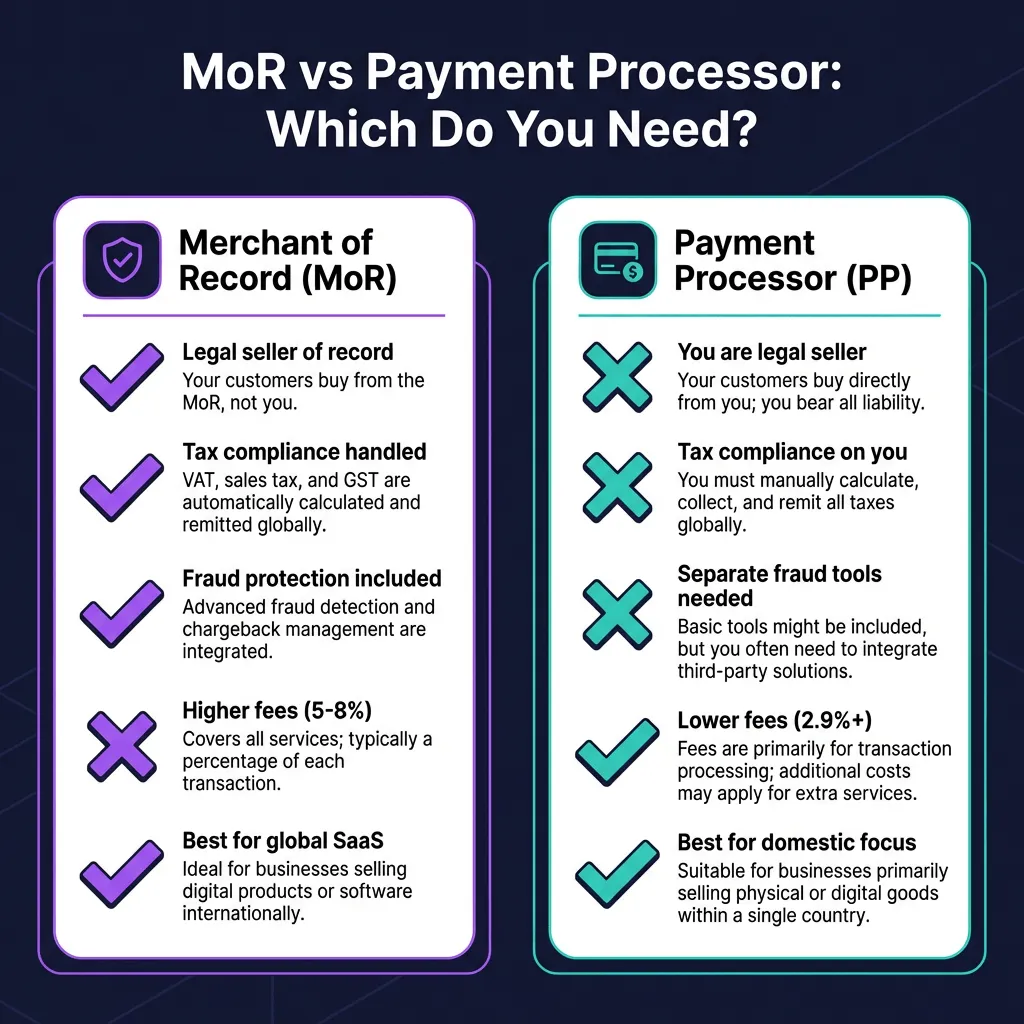
MoR vs Payment Processor: Which Do You Actually Need?
This is the decision framework I use with SaaS founders:
| Factor | Use a Payment Processor (Stripe, etc.) | Use a Merchant of Record |
|---|---|---|
| Monthly revenue | Under $20K MRR | $20K+ MRR or planning rapid global expansion |
| Geographic focus | Primarily US/Canada | Selling or planning to sell to EU, Asia, LATAM |
| Team resources | 2+ people who can handle finance/tax | Small team, limited finance/legal bandwidth |
| Risk tolerance | Comfortable managing compliance liability | Want to offload legal/financial risk |
| Control needs | Need full control over checkout/data | Okay with some abstraction for convenience |
If three or more factors point toward MoR, it’s probably time to make the switch. If you’re on the fence, consider this: the cost of getting tax compliance wrong can be catastrophic. Penalties, interest, and back taxes can wipe out months of revenue. An MoR is insurance against that risk.
Popular Merchant of Record Providers Compared
Here’s how the major players stack up on the factors that matter:
| Provider | Pricing | Best For | Key Strength | Limitation |
|---|---|---|---|---|
| Paddle | 5% + $0.50 | B2C SaaS, startups | Developer-friendly, fast setup | Limited B2B invoicing |
| FastSpring | Custom (typically 5-8%) | Digital products, software | Long track record, global coverage | Higher fees, less SaaS-focused |
| Fungies | 5% + $0.50 | SaaS, digital products | No monthly fees, instant setup | Newer platform |
| Cleverbridge | Custom enterprise | B2B SaaS, enterprise | Advanced B2B features, services | Premium pricing, no self-serve |
| Lemon Squeezy | 5% + $0.50 | Indie hackers, creators | Beautiful checkout, community | Limited API flexibility |
Each of these has a sweet spot. Paddle and Lemon Squeezy are great for getting started quickly. FastSpring works well for established software companies. Cleverbridge shines for complex B2B scenarios. Fungies hits a nice balance for SaaS founders who want MoR benefits without enterprise complexity.
Red Flags: When to Walk Away from an MoR Provider
After talking to dozens of founders who’ve switched MoR providers, here are the warning signs that indicate future problems:
- Vague tax coverage: If they can’t show you exactly which jurisdictions they handle end-to-end, they probably don’t handle them all.
- No sandbox environment: You shouldn’t need to run live transactions to test your integration.
- Long-term contracts with penalties: Good providers let you leave if it’s not working. Bad ones lock you in.
- Poor documentation: If the API docs are thin, the API probably is too.
- Slow support responses during evaluation: It won’t get better after you sign.
- Hidden fees in the fine print: If you need a lawyer to understand the pricing, run.
Implementation: Making the Switch
If you’ve decided to move to an MoR, here’s how to do it without breaking your business:
Phase 1: Parallel Setup (Week 1-2)
Don’t cancel your existing payment processor yet. Set up the MoR integration alongside your current system. Route new customers to the MoR while keeping existing subscriptions on your old platform.
Phase 2: Migration Planning (Week 3-4)
Work with your MoR to plan migrating existing subscriptions. Most providers have tools for this. You’ll need to:
- Export customer data from your current platform
- Map payment methods and subscription states
- Plan communication to customers about the change
- Set up redirects for any existing checkout links
Phase 3: Full Cutover (Week 5-6)
Execute the migration. Monitor everything obsessively for the first two weeks. Have a rollback plan ready just in case.
The whole process typically takes 4-6 weeks. Rushing it is how you break billing and anger customers.
Frequently Asked Questions
What’s the difference between a Merchant of Record and a payment processor?
A payment processor (like Stripe) handles the technical movement of money but leaves you as the legal seller responsible for tax compliance, fraud, and regulatory issues. A Merchant of Record becomes the legal seller, taking on those liabilities while you focus on your product.
At what revenue level does an MoR make sense?
Most SaaS companies find the break-even point around $20,000-$30,000 MRR. Below that, the time cost of managing compliance yourself might still be worth it. Above that, an MoR typically saves money when you factor in the true cost of tax compliance tools, finance team time, and risk mitigation.
Can I switch from an MoR back to a payment processor later?
Yes, but it’s painful. You’ll need to handle tax registrations yourself, migrate customer payment data (which providers often make difficult), and rebuild your checkout. That’s why choosing the right MoR upfront matters so much.
Do MoRs handle B2B invoicing and purchase orders?
Some do, some don’t. If you sell to enterprise customers who need net-30 terms, custom invoices, or purchase order workflows, verify this capability explicitly. Paddle and Lemon Squeezy are weaker here; Cleverbridge and FastSpring handle it better.
What happens if my MoR gets audited?
That’s the whole point — they handle it. A proper MoR maintains all tax registrations, files returns, and responds to audits on your behalf. You might need to provide some documentation, but the liability rests with them.
Conclusion: Making the Right Choice
Choosing a Merchant of Record is one of those decisions that seems small early on but becomes critical as you scale. The right choice removes compliance headaches, opens global markets, and lets you focus on building. The wrong choice creates new problems that drain time and money.
Focus on the six factors: tax coverage, transparent pricing, payment methods, billing flexibility, integration quality, and support. Test before you commit. And remember — you’re not just buying payment processing, you’re buying peace of mind.
If you’re ready to explore what a modern Merchant of Record can do for your SaaS business, check out Fungies. We built it specifically for SaaS founders who want global compliance without the enterprise complexity — 5% + $0.50 per transaction, no monthly fees, and you can be live in under an hour.
Sources and References
- Coda: How to Choose a Merchant of Record
- UserJot: Merchant of Record Guide for SaaS
- Numeral: Should SaaS Businesses Use a Merchant of Record?
- Cleverbridge: How to Choose the Right MoR Provider
- Dodo Payments: MoR vs Payment Service Provider
- FastSpring: What Is a Merchant of Record?
- PayPro Global: MoR vs Payment Gateway