How to Sell Software Online: The Developer’s Complete Guide (2026)
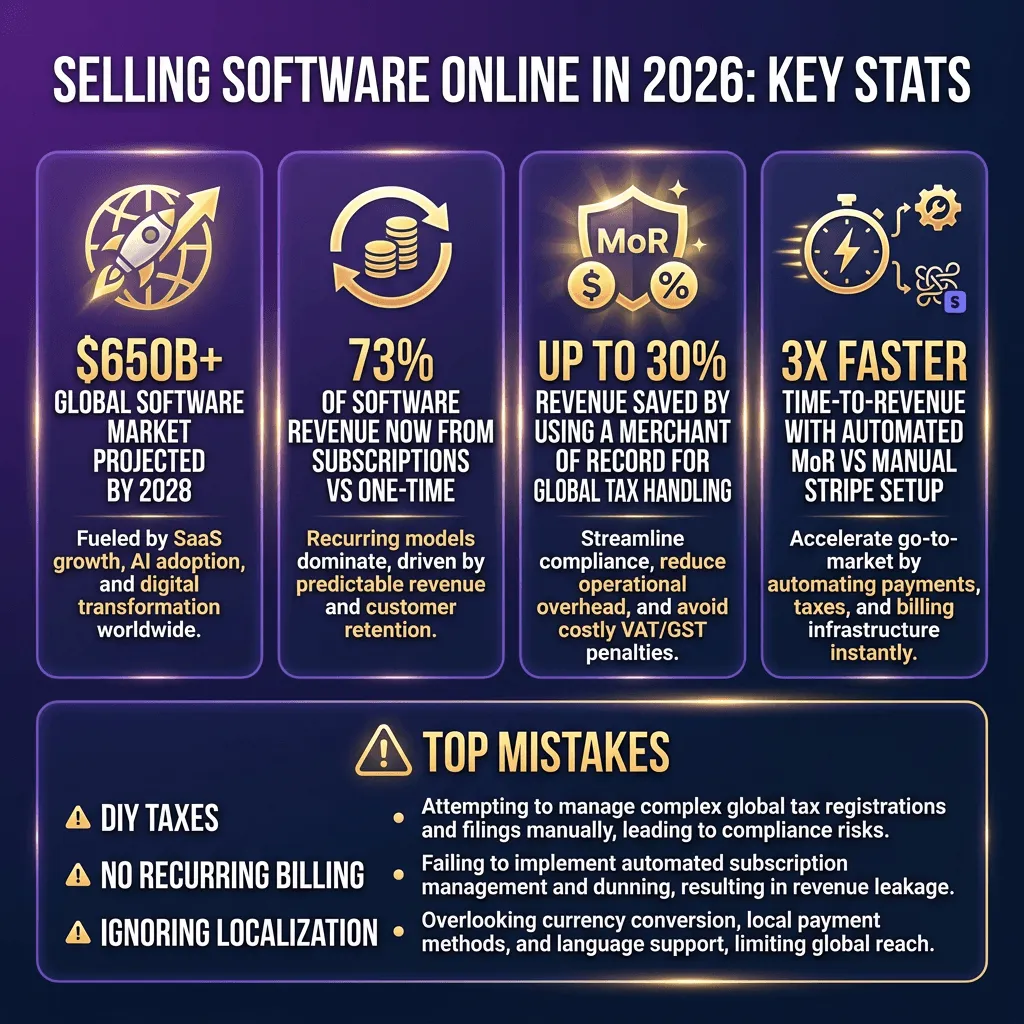
The global software market is on track to hit $650 billion+ by 2028. If you’ve built a useful tool — a desktop app, a SaaS product, a browser extension, an API — there’s real money to be made. But “how do I sell software online?” turns out to be a surprisingly complicated question once you
The global software market is on track to hit $650 billion+ by 2028. If you’ve built a useful tool — a desktop app, a SaaS product, a browser extension, an API — there’s real money to be made. But “how do I sell software online?” turns out to be a surprisingly complicated question once you get past the obvious answers.
Stripe? Sure. But who handles EU VAT? What about GST in Australia? Do you even need a license key system? What if a customer in India pays with a UPI wallet?
This guide cuts through all of it. We’ll cover the models, the platforms, the tax stuff, and how to actually go from “code complete” to your first paid customer — without spending a month on infrastructure.
What Type of Software Are You Selling?
Before you pick a platform, nail down your product type. It determines everything — delivery, billing, and compliance complexity.
Software as a Service (SaaS)
The dominant model in 2026. Users pay monthly or annually for access to your app hosted on your servers. Requires subscription billing, upgrade/downgrade logic, and churn management. About 73% of software revenue now comes from recurring subscriptions rather than one-time sales.
One-Time Purchase Apps
Desktop apps, plugins, templates, tools. Customer pays once, downloads the software. You need secure delivery and ideally license key management so customers can reinstall without hassle. Simpler billing but zero recurring revenue unless you layer in upgrade pricing.
APIs and Developer Tools
Usage-based pricing is common here — charge per API call, per token, per request. Stripe Meter or a metered billing layer handles the tracking. More complex to build but matches how customers actually use the product.
Extensions and Plugins
WordPress plugins, browser extensions, Figma plugins. Often freemium — free with a paid Pro tier. Distribution through marketplaces (WordPress.org, Chrome Web Store) but monetization happens on your own infrastructure.
How to Sell Software Online: 5 Main Approaches
You’ve got options. Each has different trade-offs on fees, complexity, and who handles the messy stuff.
1. Merchant of Record Platform (Recommended for Most)
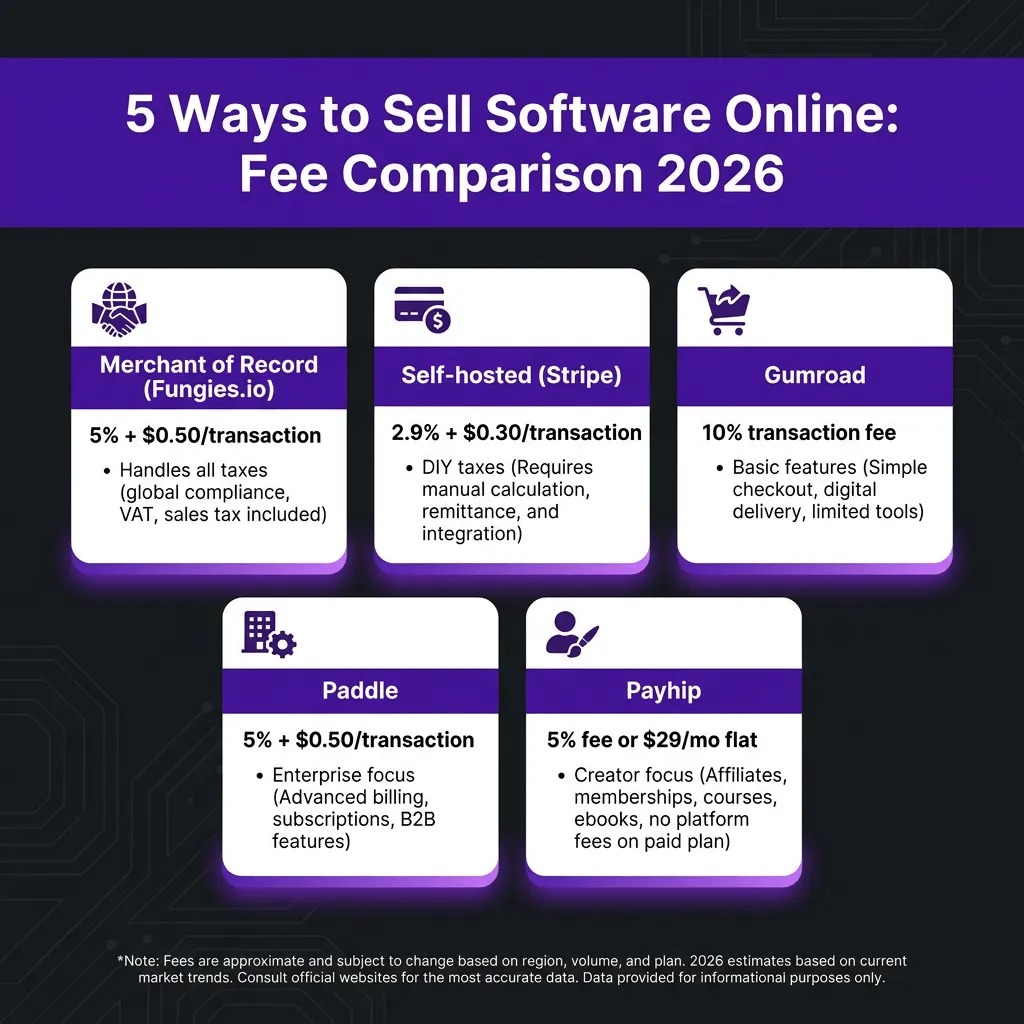
A Merchant of Record (MoR) is a company that becomes the legal seller of your software in every market you sell to. They handle tax registration, collection, and remittance in 50+ countries — including EU VAT, US sales tax, GST, and more. You focus on building; they handle compliance.
Platforms like Fungies.io, Paddle, and FastSpring operate as MoRs. You integrate once, and every sale in Germany, Australia, or California is automatically tax-compliant. No VAT registration. No quarterly filings. No surprises.
Best for: SaaS founders, indie developers selling internationally, anyone who doesn’t want to manage tax compliance manually.
2. Stripe (DIY with Full Control)
Stripe is the most powerful payment infrastructure available. Fees are lower (2.9% + $0.30 per transaction), the API is excellent, and you can build anything. But Stripe is not an MoR — you’re responsible for all tax compliance, license delivery, fraud handling, and chargeback management yourself.
For a developer selling globally, “just use Stripe” quickly turns into “just also register for VAT in the EU” plus “build a tax calculation layer” plus “set up Stripe Tax” plus “handle GDPR.” It’s doable, but it’s not free work.
Best for: Well-funded startups with a dedicated finance/ops person, or developers selling only in their home country.
3. Gumroad
Gumroad charges a flat 10% transaction fee on all sales (no monthly fee on the free plan). It’s beginner-friendly and great for creators selling ebooks, courses, and templates. For serious software products, the 10% cut gets expensive fast — and features like subscription management and license key delivery are basic.
Best for: Selling small tools, templates, and ebooks to audiences you’ve already built. Not ideal for SaaS or developer tools.
4. Payhip
Similar to Gumroad but with better economics if you upgrade: 5% on the free plan, $29/mo for 2% fees, $99/mo for 0% fees. Handles license key delivery, subscriptions, and affiliates. Payhip does handle EU VAT as an MoR in some cases — worth confirming for your specific setup.
Best for: Solo creators and indie developers with predictable, moderate sales volume.
5. Self-Hosted Checkout (Stripe + Lemon Squeezy / Paddle)
If you want the most flexibility, you can use a hybrid: Stripe for payment processing plus a separate MoR layer like Paddle or Fungies for tax handling. Or go fully custom with your own billing stack. Highest complexity, most control.
| Platform | MoR (Tax Handled?) | Transaction Fee | Monthly Fee | Best For |
|---|---|---|---|---|
| Fungies.io | ✅ Yes | 5% + $0.50 | $0 | SaaS, software, global |
| Stripe | ❌ No | 2.9% + $0.30 | $0 | DIY power users |
| Paddle | ✅ Yes | 5% + $0.50 | $0 | Enterprise software |
| Gumroad | ✅ Partial | 10% | $0 | Creator products |
| Payhip | ✅ Partial | 5% (free) / 0% ($99/mo) | $0–$99 | Small digital products |
| FastSpring | ✅ Yes | ~8.9% | $0 | Legacy software/enterprise |
| Freemius | ✅ Yes | ~7% | $0 | WordPress plugins/themes |
The Tax Compliance Problem (And How to Solve It Without Losing Your Mind)
This is the part nobody warns you about when you start selling software online. Tax compliance is genuinely hard and genuinely expensive to get wrong.
Here’s what you’re dealing with if you sell to customers in multiple countries:
- EU VAT (VATOSS/OSS): You must charge VAT on digital products sold to EU consumers, at the rate of the buyer’s country (ranging from 17% to 27%). Registration-threshold rules apply but are being tightened.
- US Sales Tax: Over 45 US states charge sales tax on digital products. Each state has different rates, rules, and nexus thresholds. After South Dakota v. Wayfair (2018), you can have nexus in a state just from economic activity — no physical presence needed.
- GST in Australia: 10% GST on all digital products sold to Australian consumers over A$75,000/year.
- Canadian GST/HST, UK VAT, Japan consumption tax… the list goes on.
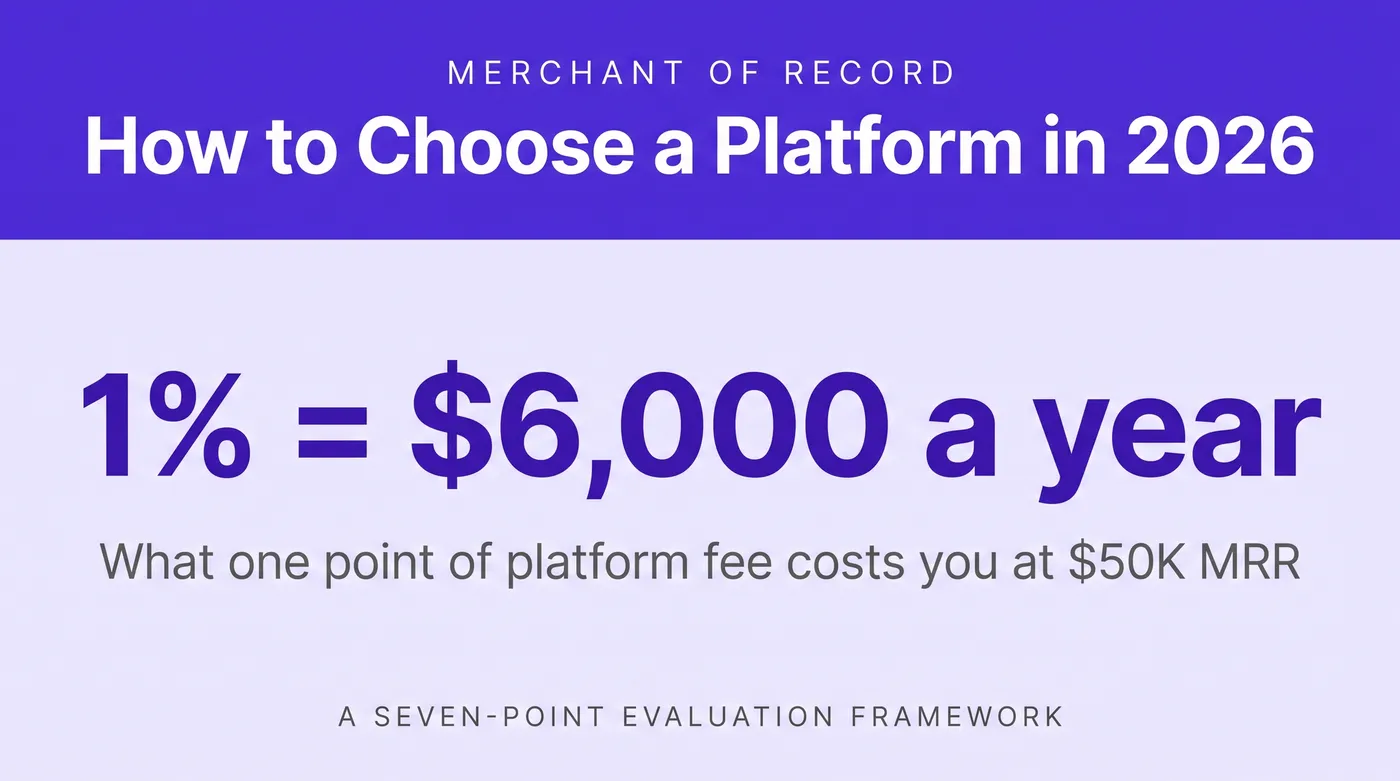
If you use an MoR platform like Fungies.io, all of this is handled automatically. The platform is the legal seller in each jurisdiction, collects the right tax, files the returns, and you get your net revenue. The typical cost is around 5% of transaction value — considerably less than what it’d cost to hire an international tax accountant.
If you use Stripe directly, you can add Stripe Tax (~0.5% per transaction) to calculate and collect the right amount, but you’re still responsible for filing returns in each jurisdiction.
Setting Up License Key Delivery
For one-time purchase software, license keys are how you protect your product while giving customers a good experience. Here’s how the major platforms handle it:
| Platform | License Key Support | How It Works |
|---|---|---|
| Fungies.io | ✅ Built-in | Auto-generate or upload your own keys; delivered instantly via email post-purchase |
| Payhip | ✅ Built-in | Upload pre-generated keys or use Payhip’s generator |
| Gumroad | ✅ Basic | Simple license key delivery, no advanced activation logic |
| Paddle | ✅ Via Paddle Licensing API | Full license key API, activation/deactivation, machine limits |
| Stripe | ❌ DIY only | You build your own key generation and delivery webhook |
| FastSpring | ✅ Built-in | License key management, activation tracking, upgrade paths |
For most indie developers, the simplest setup is: generate a batch of keys (or use a UUID library), upload them to your MoR platform, and let it handle delivery. You only need a full activation/deactivation API if you’re building desktop software with machine-based licensing.
Choosing Your Pricing Model
Pricing strategy directly impacts your revenue per customer and your LTV. Here are the main models for software in 2026:
One-Time Payment
Customer pays once, owns the software. Great for tools with clear, finite utility. Lower LTV than subscriptions but lower churn risk. Works well with optional annual upgrade pricing (“buy v2 at 50% off”).
Monthly Subscriptions
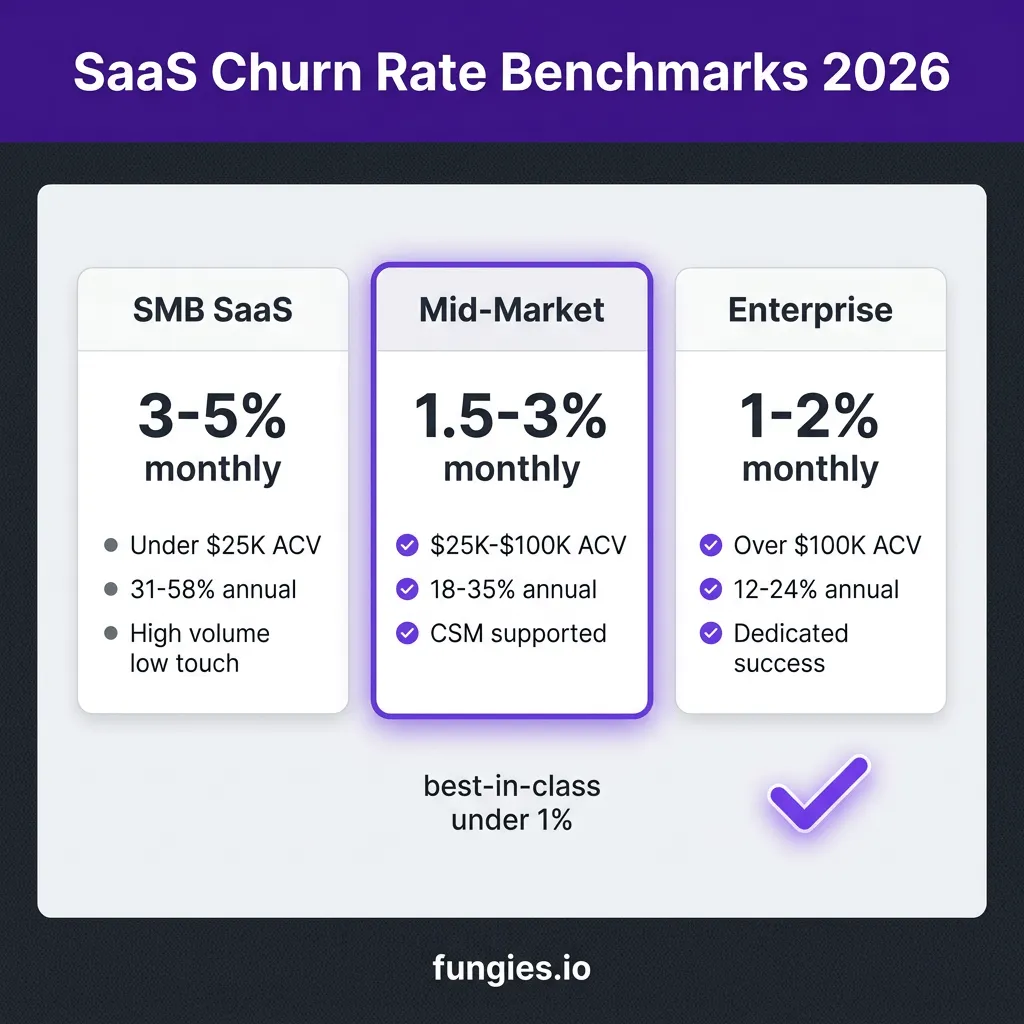
Standard SaaS model. Lower upfront friction, higher total revenue per customer over time. Typical monthly churn for indie SaaS is 3–8% — meaning average customer lifetime of 12–33 months.
Annual Plans (Strongly Recommended)
Offering annual plans at a 15–30% discount dramatically improves cash flow and cuts churn. Data from ProfitWell shows that annual customers have 30–50% lower churn than monthly customers. It’s worth pushing hard for annual uptake.
Freemium
Free tier with paid upgrades. Works best when the free product creates genuine value and natural conversion triggers (usage limits, collaboration features, export restrictions). Industry average freemium-to-paid conversion is about 2–5%.
Usage-Based
Pay per API call, per active user, per email sent. Aligns cost with value — especially relevant for AI tools where inference costs are variable. More complex billing but growing fast in developer tooling.
How to Embed Checkout Into Your App or Website
Once you’ve picked a platform, you need customers to actually pay. There are two main approaches:
Hosted Checkout Pages
Your MoR platform provides a hosted checkout URL. Customer clicks “Buy Now,” lands on the platform’s page, completes purchase, and gets redirected back. Fast to set up, no frontend work. Slightly less brand control but perfectly fine for most products.
Embedded Checkout (Overlay or Inline)
The checkout appears directly in your app or website — either as a modal overlay or an embedded iframe. More seamless experience, higher conversion rates (typically 10–15% better than redirect-to-hosted-page). Requires a JS snippet or web component integration.
With Fungies.io, you can embed the checkout with a single script tag and a few lines of JavaScript. The checkout overlay appears on your page, handles the full payment flow, and fires a callback when the purchase completes — so you can unlock the product immediately in the UI.
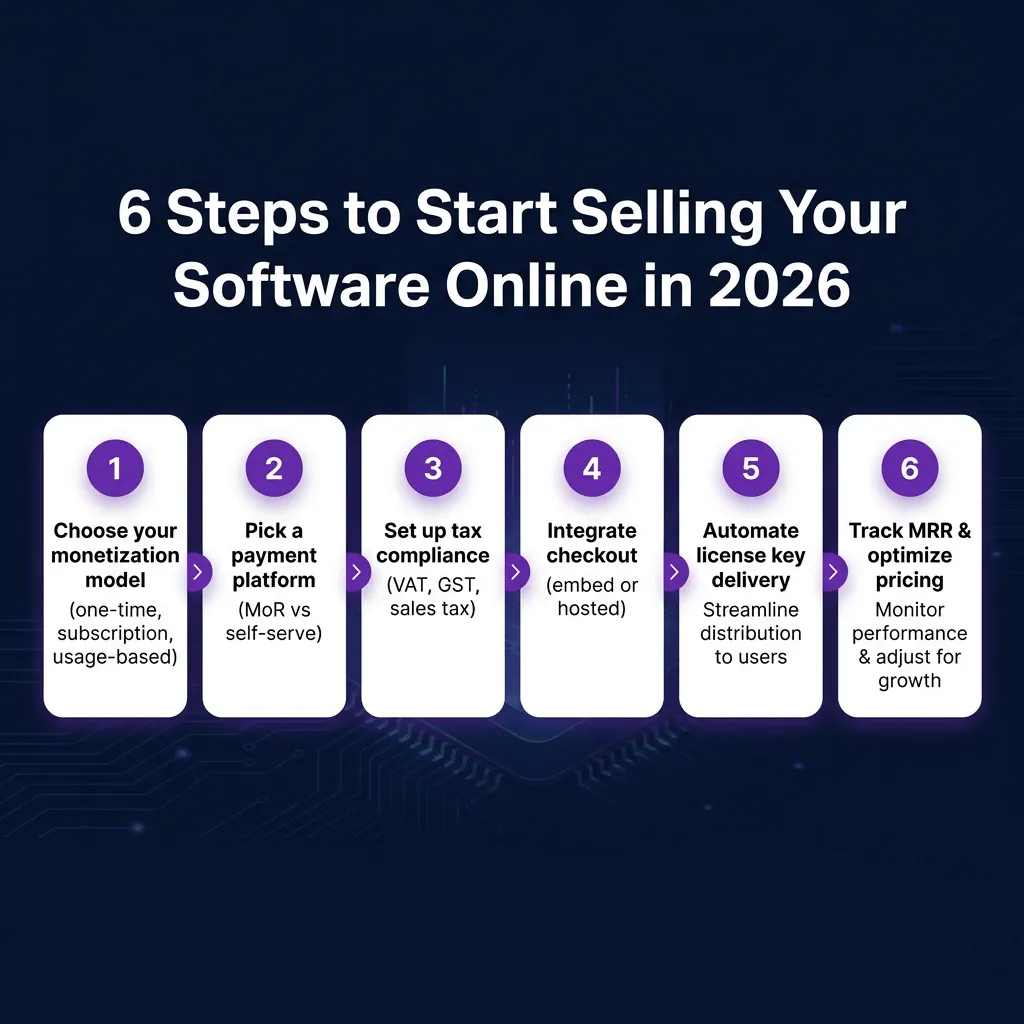
Step-by-Step: How to Start Selling Your Software Online
Here’s the practical playbook for going from zero to first sale:
Step 1: Choose Your Monetization Model
One-time, subscription, freemium, or usage-based? Pick the one that matches how customers get value from your product. If unsure, start with one-time and add subscriptions later for support/updates.
Step 2: Pick a Platform (MoR vs. DIY)
If you’re selling internationally and don’t want to manage taxes: use an MoR platform (Fungies.io, Paddle). If you’re a funded startup with ops resources and selling primarily in the US: consider Stripe. For small creator products: Payhip or Gumroad.
Step 3: Set Up Your Product and Pricing
On your chosen platform, create your product, set pricing tiers, configure any trial period, and upload license keys if applicable.
Step 4: Integrate Checkout Into Your App
Use hosted checkout (fastest, 30 minutes) or embed the checkout (best conversion, 1–2 hours). Test the full purchase flow including email delivery and license key delivery.
Step 5: Set Up a Simple Email Flow
At minimum: purchase confirmation email, license/download delivery email, and a 7-day follow-up asking for feedback. Use your MoR’s built-in transactional emails or integrate with Postmark/Mailgun.
Step 6: Track Your Numbers
From day one: MRR (or total revenue), conversion rate on your checkout, and refund rate. Monthly recurring revenue is your North Star. Everything else is noise until you hit $1k MRR.
| Stage | Focus Metric | Target |
|---|---|---|
| Pre-launch | Waitlist signups | 50+ signups before launch |
| Early traction | Checkout conversion rate | >3% (landing page → purchase) |
| Growth | MRR | $1k → $5k → $10k milestones |
| Scale | LTV / CAC ratio | 3:1 minimum, 5:1+ target |
Common Mistakes Developers Make When Selling Software Online
1. Ignoring Tax Compliance Until It Bites You
The IRS and EU tax authorities can audit retroactively. If you’ve been collecting EU customer payments without charging VAT, you could owe the full amount plus penalties. Use an MoR from day one — the 5% fee is insurance.
2. Using Stripe Without Building the Rest
Stripe handles payments. It does not handle tax collection, license key delivery, customer portal, or chargeback management. Going “just Stripe” means building all of that yourself. Budget 2–4 weeks of engineering time if you go this route.
3. Launching With Only Monthly Pricing
Always offer annual plans. Customers who pay annually churn at roughly half the rate of monthly customers. Not offering annual at launch is leaving significant MRR on the table.
4. Setting Up No Refund Policy
In the EU, consumers have a 14-day right of withdrawal for digital products unless they explicitly waive it at purchase. Make sure your checkout includes the proper legal consent flow, or your refund rate will spike and your account may get flagged.
5. Not Localizing Pricing
Charging US prices globally means losing customers in lower-income markets who could easily afford a locally-appropriate price. Platforms like Fungies.io support purchasing power parity (PPP) pricing — letting you charge $8/mo in India while charging $29/mo in the US.
Key Takeaways
- 🧾 Use a Merchant of Record if you’re selling internationally — the ~5% fee is far cheaper than DIY tax compliance infrastructure and legal exposure.
- 📆 Always offer annual plans — annual customers churn 30–50% less than monthly customers; push hard for annual uptake from the start.
- 🔑 Automate license key delivery — customers expect instant digital delivery; anything else creates support tickets and refund requests.
- 💸 Avoid the “just Stripe” trap — unless you have an ops team, Stripe alone means building tax, delivery, and chargeback systems yourself.
- 🌍 Consider PPP pricing early — localized pricing unlocks paying customers in markets that would otherwise bounce at US-dollar price points.
FAQ
Do I need to register for VAT to sell software in Europe?
If you use a Merchant of Record platform, no — the MoR handles all VAT registration, collection, and remittance in every EU country. If you use Stripe or your own payment gateway, yes: once you hit the threshold (or in some countries, from the first sale), you must register for VAT via the EU’s One-Stop-Shop (OSS) scheme or individual country registration.
What’s the best platform to sell software online without monthly fees?
Fungies.io, Paddle, and Gumroad all have no monthly fees — you only pay a percentage of transactions. For developers who need tax handling built in, Fungies.io (5% + $0.50) or Paddle (5% + $0.50) are the strongest options. For pure creator products, Gumroad’s free plan works but the 10% fee adds up.
How do I protect my software from piracy?
License key systems are the practical standard for downloaded software. For SaaS, account-based access with server-side enforcement is sufficient — your service simply won’t work without a valid session. For desktop apps, offline activation via cryptographic license keys (signed with your private key) provides reasonable protection without requiring always-on internet checks. No DRM is foolproof; focus more on making paying easy than making piracy hard.
Can I sell software on my website without a marketplace?
Absolutely — and it’s often better. Embedding your checkout directly into your own site means no marketplace fees, full control over the customer relationship, and your own brand throughout. Platforms like Fungies.io let you embed checkout with a few lines of JavaScript and handle everything backend: payments, tax, license delivery, customer management.
Ready to Start Selling?
The infrastructure for selling software online has never been better. An indie developer today can set up global tax-compliant payments, automated license delivery, and subscription billing in a single afternoon — compared to months of engineering work five years ago.
The hard part is building the product. Don’t let payment infrastructure slow you down.
Start selling your software today → Create your free Fungies account and go from zero to first sale in under an hour.