Local LLM vs Cloud API: The Complete 2026 Cost Breakdown for Developers
Local LLM vs cloud API cost comparison 2026: Real TCO numbers, break-even analysis, and monthly costs. See when local inference saves money vs OpenAI, Claude, and Gemini.
Here’s a number that should get your attention: running a 70B parameter model in the cloud can cost $300 to $800 per month for heavy users. Buy the hardware once, and that same workload costs roughly $50 to $150 per year in electricity. The math isn’t subtle.
But local LLMs aren’t free. There’s upfront hardware cost, setup time, and ongoing maintenance. So when does local actually win? This guide breaks down the real total cost of ownership (TCO) for local LLMs versus cloud APIs in 2026—with actual numbers, break-even analysis, and specific recommendations for different usage patterns.
Why Cost Comparison Matters in 2026
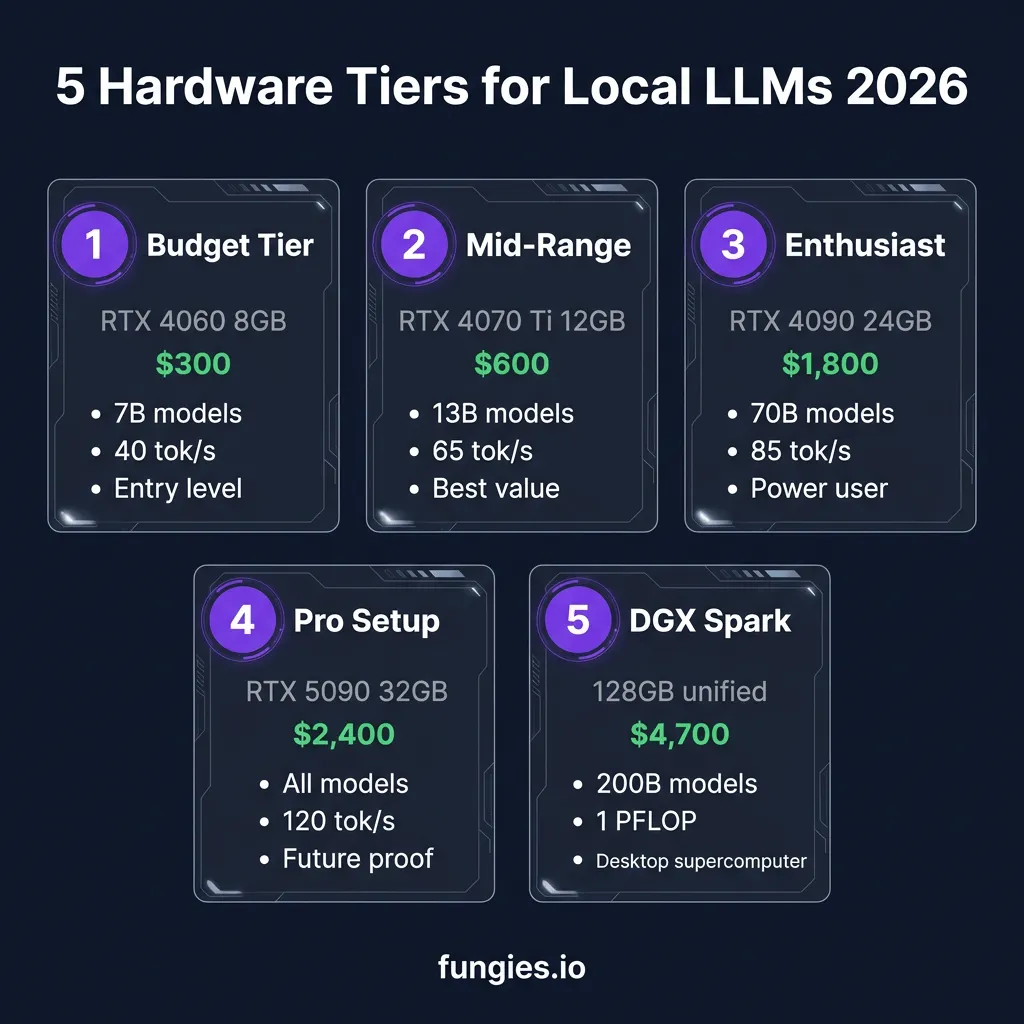
The LLM landscape shifted dramatically between 2024 and 2026. Open-weight models like Llama 4, Qwen 3, and Gemma 4 now approach GPT-4-class performance. Tools like Ollama and LM Studio have matured from weekend experiments to production-ready platforms. And hardware? The RTX 4090 delivers 24GB VRAM for under $1,800, while NVIDIA’s DGX Spark packs 128GB unified memory in a $4,699 box.
Cloud APIs, meanwhile, keep getting more expensive at scale. OpenAI’s GPT-5.4 Pro charges $30 per million input tokens and $180 per million output tokens. Claude Opus 4.7 runs $45/$225 per million. For teams processing millions of tokens daily, these costs compound fast.
The Real Cost of Cloud LLM APIs
Cloud API pricing looks cheap at small scale. It isn’t at large scale. Here’s the breakdown for major providers in 2026:
| Provider | Model | Input/1M tokens | Output/1M tokens |
|---|---|---|---|
| OpenAI | GPT-5.4 | $2.50 | $15.00 |
| OpenAI | GPT-5.4 Pro | $30.00 | $180.00 |
| Anthropic | Claude Opus 4.7 | $45.00 | $225.00 |
| Anthropic | Claude Sonnet 4.7 | $8.00 | $40.00 |
| Gemini 3.1 Pro | $1.25 | $10.00 | |
| Gemini 2.5 Flash | $0.30 | $2.50 | |
| DeepSeek | V3.2 | $0.50 | $2.00 |
Assume a 3:1 output-to-input ratio (typical for coding and content generation). At 100,000 tokens per day, you’re looking at:
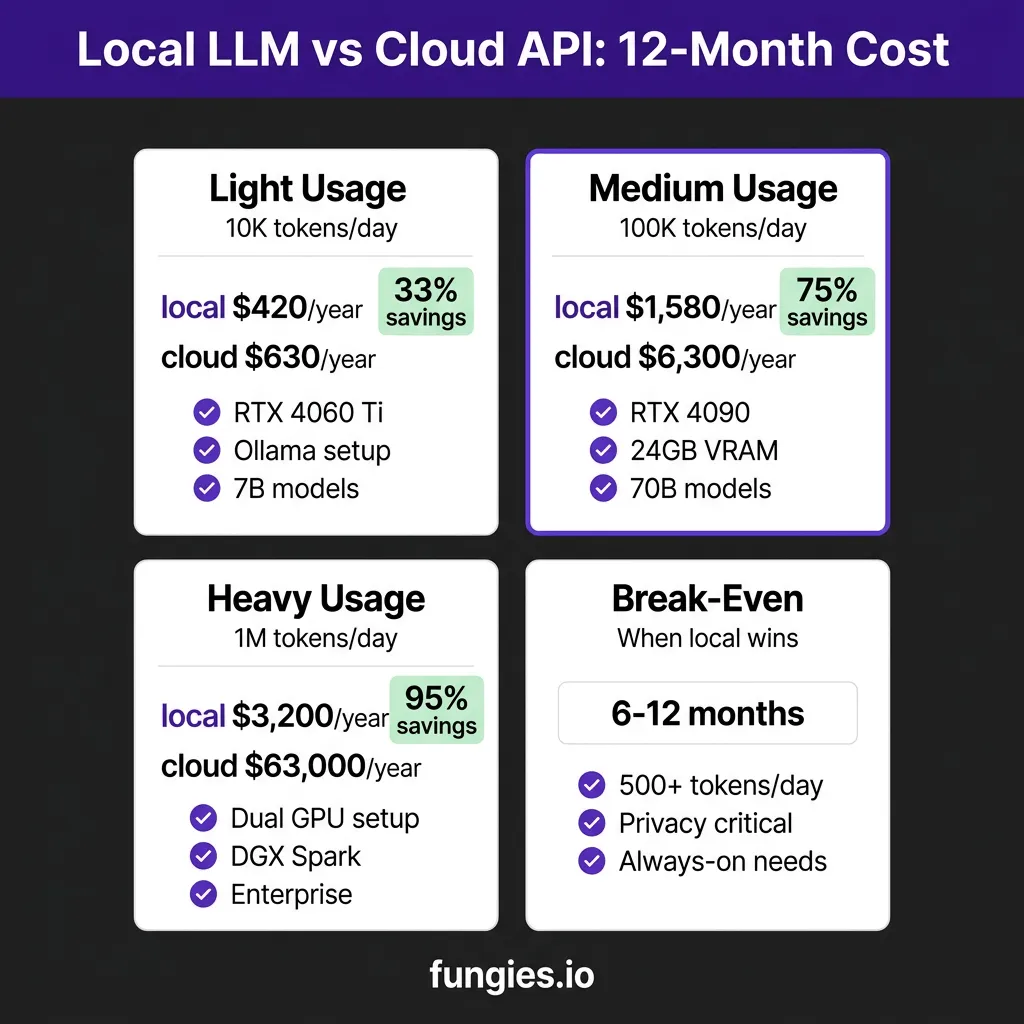
- GPT-5.4: ~$525/month or $6,300/year
- Claude Sonnet 4.7: ~$280/month or $3,360/year
- Gemini 2.5 Flash: ~$22/month or $264/year
Scale to 1 million tokens daily—a realistic number for AI-powered applications, document processing pipelines, or coding assistants—and GPT-5.4 costs $5,250/month. That’s $63,000 annually. For that money, you could buy three DGX Sparks and still have budget left over.
The Real Cost of Running Local LLMs
Local inference has three cost categories: hardware, electricity, and your time. Let’s break each down.
Hardware Costs (One-Time)
| GPU | VRAM | Price (USD) | Best For |
|---|---|---|---|
| RTX 4060 Ti | 16GB | $450 | 7B-13B models |
| RTX 4070 Ti | 12GB | $600 | 7B-13B models |
| RTX 4080 | 16GB | $1,200 | 13B-30B models |
| RTX 4090 | 24GB | $1,800 | Up to 70B models |
| RTX 5090 | 32GB | $2,400 | All consumer models |
| DGX Spark | 128GB | $4,699 | 200B+ parameters |
| 2× RTX 3090 | 48GB | $1,200 used | 70B models, budget |
The sweet spot for most developers in 2026 is the RTX 4090 at 24GB VRAM. It handles 70B parameter models at Q4 quantization comfortably and delivers 85+ tokens per second on smaller models. The RTX 5090 at 32GB is the future-proof choice if you have the budget.
Electricity Costs (Ongoing)
A desktop GPU running inference draws 200-450W under load. Assume 8 hours of daily usage at 350W average:
- Daily consumption: 2.8 kWh
- Annual consumption: 1,022 kWh
- At $0.15/kWh: ~$153/year
Even at California rates ($0.30/kWh), you’re looking at $306/year—still a fraction of cloud API costs at scale.
Setup and Maintenance Time
Initial Ollama setup takes 20-40 minutes. LM Studio is faster—maybe 10 minutes if you’re comfortable with desktop apps. Ongoing maintenance is minimal: occasional model updates, driver updates every few months, and troubleshooting when things break.
Budget 2-4 hours per month for maintenance on a local setup. At $100/hour developer time, that’s $200-400/month in labor costs. This is the hidden cost most TCO analyses miss—but it’s real, and it narrows the gap for smaller usage patterns.
Total Cost of Ownership: Three Usage Scenarios
Here’s where the rubber meets the road. These TCO models include hardware depreciation over 3 years, electricity, and estimated maintenance time.
Scenario 1: Light Usage (10,000 tokens/day)
| Cost Component | Local (RTX 4060 Ti) | Cloud (GPT-5.4) |
|---|---|---|
| Hardware/API | $450 (one-time) | $53/month |
| Electricity | $100/year | $0 |
| Maintenance | $200/month | $0 |
| Year 1 Total | $3,150 | $630 |
| Year 3 Total | $3,450 | $1,890 |
Verdict: Cloud wins at light usage. The maintenance overhead isn’t worth it for 10K tokens daily.
Scenario 2: Medium Usage (100,000 tokens/day)
| Cost Component | Local (RTX 4090) | Cloud (GPT-5.4) |
|---|---|---|
| Hardware/API | $1,800 (one-time) | $525/month |
| Electricity | $153/year | $0 |
| Maintenance | $300/month | $0 |
| Year 1 Total | $5,553 | $6,300 |
| Year 3 Total | $11,259 | $18,900 |
Verdict: Local breaks even around month 10. By year 3, you’ve saved $7,600. The savings accelerate from there.
Scenario 3: Heavy Usage (1,000,000 tokens/day)
| Cost Component | Local (DGX Spark) | Cloud (GPT-5.4) |
|---|---|---|
| Hardware/API | $4,699 (one-time) | $5,250/month |
| Electricity | $200/year | $0 |
| Maintenance | $400/month | $0 |
| Year 1 Total | $9,699 | $63,000 |
| Year 3 Total | $19,699 | $189,000 |
Verdict: Local wins decisively. Break-even is month 2. You save $169,000 over three years—enough to hire another engineer.
When Local LLMs Make Sense (And When They Don’t)
Cost isn’t the only factor. Here are the non-financial considerations that tip the scales:
Choose Local When:
- Privacy is non-negotiable. Healthcare, finance, legal—any industry with strict data residency requirements.
- You need 100% uptime. No rate limits, no API outages, no vendor maintenance windows.
- Latency matters. Local inference eliminates network round-trips. Sub-100ms responses vs 500ms+ for cloud.
- You process >500,000 tokens/day. The math starts favoring local around this threshold.
- You need offline access. Air-gapped environments, field deployments, or unreliable connectivity.
Choose Cloud When:
- Usage is sporadic. If you’re processing 1,000 tokens some days and 100,000 others, cloud elasticity wins.
- You need frontier capabilities. GPT-5.4 and Claude Opus still outperform local models on complex reasoning.
- Team is small. The maintenance overhead isn’t worth it for solo developers with light usage.
- You need multi-modal. Cloud APIs handle images, audio, and video more reliably than local setups.
- Capex is constrained. $1,800 for a GPU is a lot if you’re bootstrapping.
Hidden Costs Most Analyses Miss
A complete TCO analysis accounts for the boring-but-real costs that surface over time:
- Hardware depreciation: GPUs lose 30-50% value in year one. Budget $400-800 annual depreciation for a high-end card.
- Failed hardware: Consumer GPUs aren’t enterprise-grade. Budget 5-10% annual failure rate after year two.
- Model re-engineering: When you outgrow a 7B model and need to migrate to 70B, that’s setup time.
- Context window limits: Local models often have shorter effective contexts than cloud equivalents. This affects output quality.
- Quantization tradeoffs: Running 70B on 24GB requires Q4 quantization. You lose some quality vs FP16.
The Hybrid Approach: Best of Both Worlds
Most teams in 2026 run hybrid setups. Local models handle high-volume, low-complexity tasks—document summarization, code completion, batch processing. Cloud APIs handle complex reasoning, multi-modal tasks, and peak loads.
This approach cuts cloud costs by 60-80% while preserving access to frontier capabilities when needed. A typical hybrid setup might use:
- Local: Llama 4 70B Q4 for coding assistance, document processing, and chatbots
- Cloud: GPT-5.4 or Claude Opus for complex analysis, creative writing, and agentic workflows
Key Takeaways
- Cloud APIs win at low volume (<50K tokens/day). Local wins at high volume (>500K tokens/day).
- Break-even typically occurs between 6-12 months for medium usage (100K tokens/day).
- Hardware sweet spot: RTX 4090 (24GB) for most developers; DGX Spark for heavy enterprise use.
- Don’t ignore maintenance costs—2-4 hours monthly is realistic for local setups.
- Privacy, latency, and uptime requirements often matter more than pure cost.
- Hybrid approaches cut cloud costs 60-80% while preserving frontier capabilities.
Frequently Asked Questions
How much VRAM do I need for local LLMs?
VRAM requirements scale with model size and quantization. At Q4_K_M quantization: 7B models need 4-5GB, 13B models need 8-10GB, 30B models need 16-20GB, and 70B models need 40-48GB. The RTX 4090’s 24GB handles up to 70B models with quantization.
What’s the cheapest way to run 70B models locally?
Two used RTX 3090s (24GB each) in a single system gives you 48GB VRAM for roughly $1,200. This outperforms a single RTX 4090 for large models and costs less. The tradeoff is higher power consumption and more setup complexity.
Is the DGX Spark worth $4,699?
For heavy enterprise use processing 500K+ tokens daily, yes. The 128GB unified memory lets you run 200B parameter models without quantization. The FP4 support and 1 petaflop performance justify the premium for production workloads. For hobbyists, the RTX 4090 or 5090 is the better value.
How fast are local models compared to cloud APIs?
On an RTX 4090: 7B models run at 80-120 tokens/second, 13B models at 50-70 tokens/second, and 70B models at 15-25 tokens/second. Cloud APIs typically deliver 30-80 tokens/second depending on model and load. Local wins on smaller models; cloud can win on very large models due to data-center GPU clusters.
Can I write off local AI hardware as a business expense?
Yes. AI hardware qualifies as business equipment and can be depreciated over 3-5 years or expensed immediately under Section 179 (US) or equivalent provisions in other jurisdictions. Consult your accountant for specifics.
Conclusion
The local vs cloud LLM decision in 2026 isn’t about finding the “best” option—it’s about finding the right fit for your usage pattern, budget, and operational constraints.
For solo developers processing under 50,000 tokens daily, cloud APIs remain the pragmatic choice. The convenience and lack of maintenance overhead outweigh the cost savings of local deployment.
For teams processing 100,000+ tokens daily, the math flips. A one-time hardware investment of $1,500-$4,700 breaks even in 6-12 months and generates five-figure savings over three years. Add in privacy, latency, and uptime benefits, and local becomes the clear winner.
The smartest approach for most organizations? Start with cloud, measure actual usage, and migrate high-volume workloads to local hardware once you have data. The hybrid model—local for volume, cloud for complexity—is the configuration we see most often in production environments.
Ready to build your own AI-powered application? Fungies.io handles payments, tax compliance, and global checkout for SaaS and digital products—so you can focus on the AI, not the paperwork.
References
- SitePoint: Local LLMs vs Cloud APIs TCO Analysis 2026
- PromptQuorum: Local LLM vs Cloud API Trade-offs
- GetDeploying: LLM Price Comparison 2026
- HuggingFace: Best Open-Source LLM Models 2026
- PromptQuorum: Local LLM Hardware Guide 2026
- LocalLLM.in: Ollama VRAM Requirements Guide
- ComputingForGeeks: Ollama Models Cheat Sheet 2026