Merchant of Record vs Payment Processor: The Complete Guide for SaaS Founders (2026)
Confused about Merchant of Record vs Payment Processor? This guide breaks down the key differences, helps you choose the right model for your SaaS, and explains why the wrong choice could cost you $400K in hidden compliance costs.
Here’s a number that should wake you up: SaaS companies lose an average of $400,000 annually to sales tax compliance complexity. Not from the taxes themselves—from the operational burden of managing them.
Ive talked to dozens of SaaS founders who made the wrong choice early on. They picked a payment processor because the fees looked cheaper. Two years later, they’re drowning in VAT registrations, scrambling to handle chargebacks, and paying lawyers to navigate tax audits in countries they cant pronounce.
The choice between a Merchant of Record (MoR) and a Payment Service Provider (PSP) isnt just about transaction fees. Its about who sleeps at night when tax authorities come knocking.
What Is a Merchant of Record?
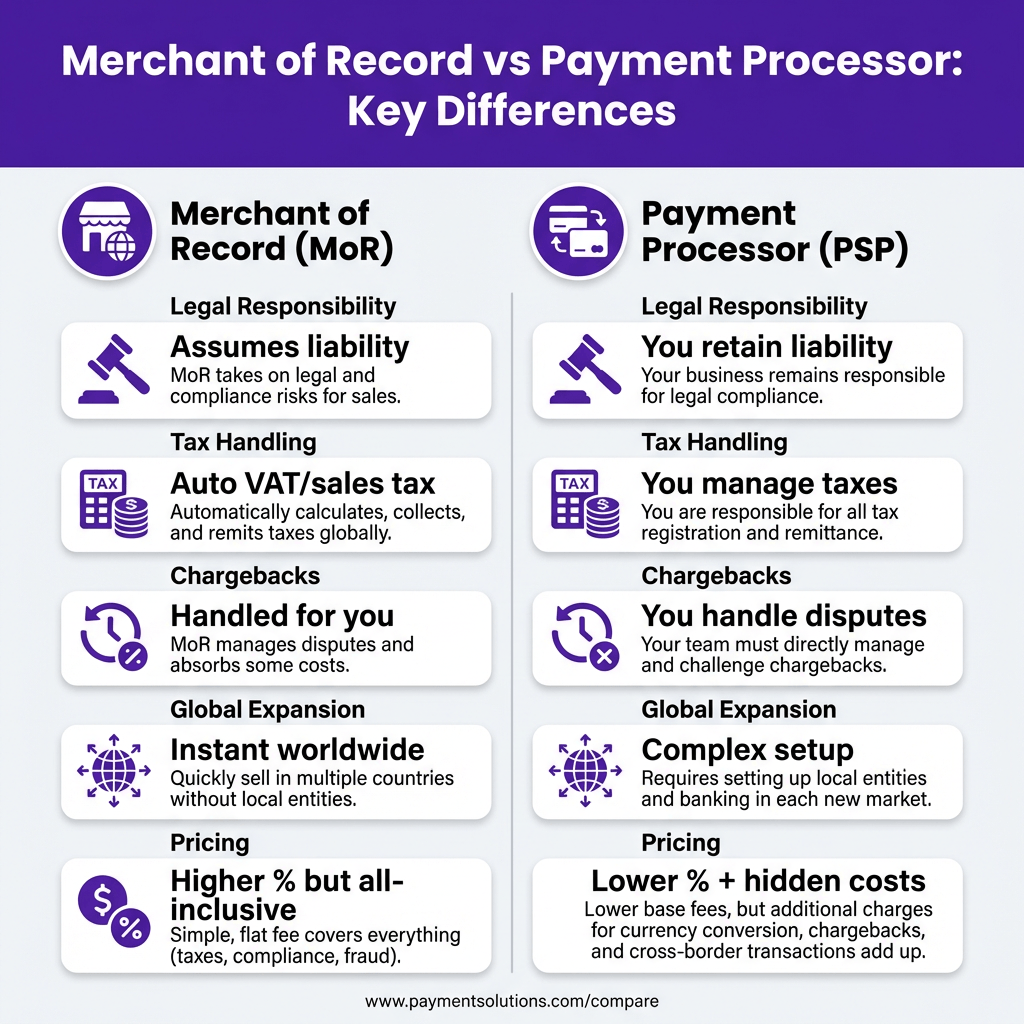
A Merchant of Record is the legal entity responsible for selling your product to the end customer. When you use an MoR like Fungies, Paddle, or Lemon Squeezy, they become the seller of record on paper.
Heres what that actually means:
- Your customers pay the MoR, not you directly
- The MoR handles all VAT, sales tax, and GST calculations
- They remit taxes to each jurisdiction
- They manage chargebacks and payment disputes
- They assume legal liability for the transaction
In exchange, you pay a higher transaction fee—typically 5-10% versus 2.9% + 30¢ for a standard payment processor. But that headline number is misleading. Well get to why.
What Is a Payment Processor?
A Payment Service Provider (like Stripe, PayPal, or Square) handles the technical movement of money. They process credit card transactions, move funds to your bank account, and provide APIs for developers.
What they dont do:
- Calculate or remit sales tax/VAT
- Handle tax compliance across jurisdictions
- Assume liability for transactions
- Manage chargeback disputes for you
- Set up local entities for global selling
You remain the Merchant of Record. That means every tax obligation, every compliance requirement, every potential audit—its all on you.
The Real Cost Comparison
Lets talk numbers. Because this is where most founders get tripped up.
| Cost Factor | Payment Processor | Merchant of Record |
|---|---|---|
| Transaction Fee | 2.9% + $0.30 | 5% + $0.50 |
| Tax Compliance Software | $500-2,000/mo | Included |
| Tax Filing & Remittance | $300-800/mo | Included |
| Chargeback Management | Your time/cost | Included |
| Legal/Accounting (Global) | $5,000-50,000/yr | Included |
| Fraud Protection | Extra cost | Included |
| True Cost at $50K MRR | ~6.5-8% | 5% + $0.50 |
Honestly, the math flips faster than most people expect. At around $30,000 MRR, the hidden costs of a payment processor typically exceed an MoRs all-in pricing. And that doesnt account for the risk exposure.
Tax Compliance: The Hidden Minefield
Heres where things get serious. As of 2026, over 140 countries now require foreign businesses to collect and remit VAT or GST on digital services. The EU alone has 27 different member states with varying rates and rules.
With a payment processor, youre responsible for:
- Registering for VAT/GST in every jurisdiction where you have customers
- Tracking changing tax rates (some countries update quarterly)
- Determining product taxability (SaaS is taxable in some places, exempt in others)
- Filing returns monthly, quarterly, or annually depending on the country
- Maintaining records for 7-10 years per jurisdiction
- Handling audits and disputes
One founder I know spent 18 months and $80,000 getting compliant in just 5 EU countries. Another got hit with a $120,000 back-tax bill because they didnt realize SaaS was taxable in Pennsylvania.
With an MoR? They handle all of it. Every registration. Every filing. Every rate change. Every audit.
Global Expansion: Speed vs Complexity
Want to sell to customers in Japan? Brazil? India?
With a payment processor, you need to:
- Research local tax laws
- Potentially establish a local entity
- Set up local payment methods
- Register for local tax collection
- Figure out compliance requirements
Timeline: 3-12 months per country. Cost: $10,000-100,000+.
With an MoR, you flip a switch. Your checkout instantly supports 100+ currencies and local payment methods. Tax compliance is handled automatically. You can literally start selling globally today.
When to Choose a Payment Processor
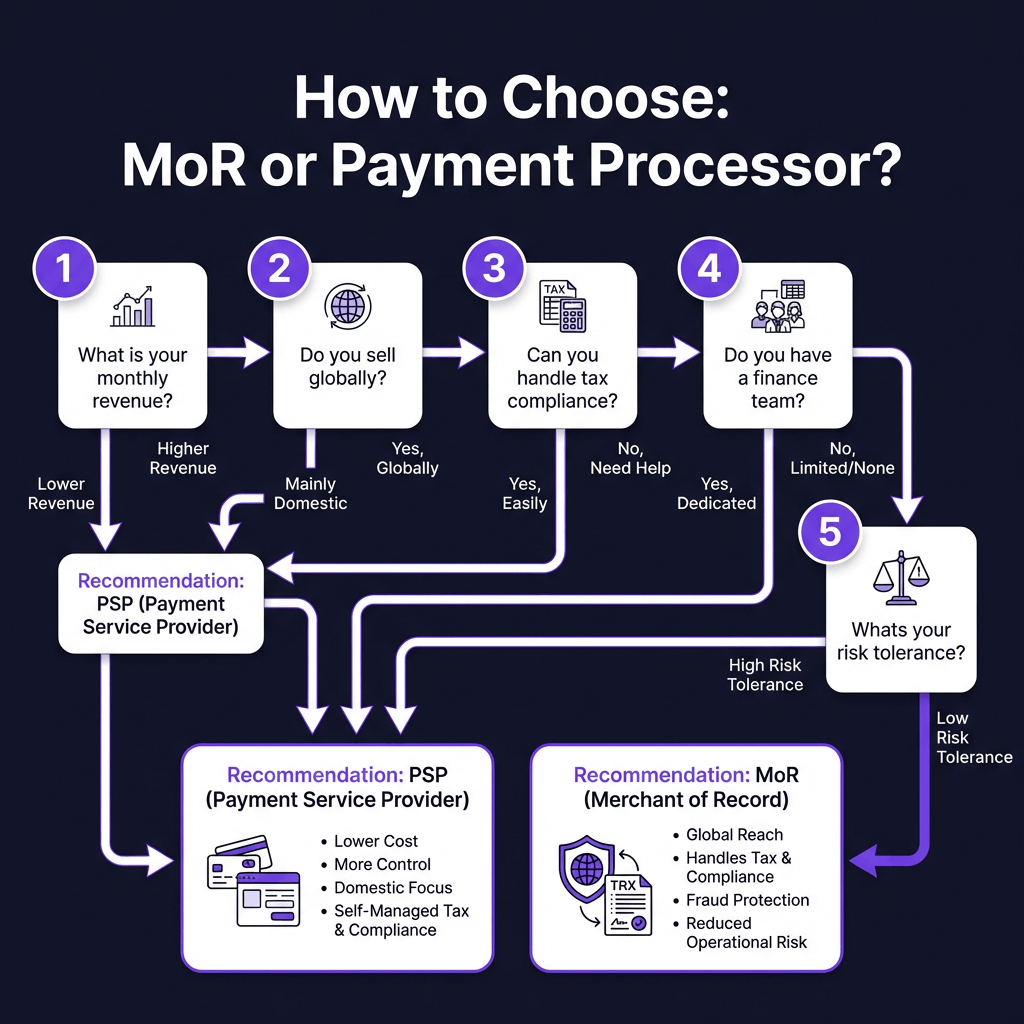
Im not going to tell you an MoR is always the right choice. Its not. Here are the scenarios where a PSP makes more sense:
1. Youre Pre-Revenue or Very Early Stage
If youre making less than $5,000 MRR and only selling in one country, the compliance burden is manageable. A PSP gets you started faster and cheaper.
2. You Have a Full Finance Team
If youve got 3+ people in finance who can handle tax compliance, chargebacks, and global expansion, you might save money with a PSP.
3. You Need Maximum Customization
Payment processors offer deeper API access and more control over the checkout experience. If youre building something highly custom, a PSP might be necessary.
4. Youre Only Selling B2B
B2B transactions often have reverse-charge VAT mechanisms that simplify compliance. If 90%+ of your revenue is B2B, the tax burden is lighter.
When to Choose a Merchant of Record
Now lets talk about when an MoR is the clear winner:
1. Youre Selling Globally (or Want To)
If you have customers in 5+ countries or want to expand internationally, an MoR eliminates the compliance nightmare.
2. Youre B2C or Mixed B2B/B2C
Consumer sales trigger tax obligations immediately. You cant use reverse-charge mechanisms. Every B2C sale needs proper tax calculation and remittance.
3. Youre a Small Team
Most SaaS companies under $10M ARR dont have dedicated tax specialists. An MoR gives you enterprise-level compliance without the headcount.
4. You Value Peace of Mind
Some founders would rather pay a bit more to sleep soundly. Knowing that tax compliance, chargebacks, and legal liability are handled? Thats worth a lot.
The Hybrid Approach (And Why Its Risky)
Some companies try to split the difference. They use a payment processor for most transactions and add tax compliance software like TaxJar or Avalara.
Heres the problem: tax software calculates what you owe, but it doesnt handle remittance, registrations, or liability. Youre still the Merchant of Record. You still get the audit letters. You still spend hours every month on compliance.
Plus, you now have two vendors to manage and two bills to pay. The cost savings often evaporate.
Popular Options Compared
| Platform | Type | Pricing | Best For |
|---|---|---|---|
| Fungies | MoR | 5% + $0.50 | SaaS, digital products, global scaling |
| Paddle | MoR | 5% + $0.50 | Established SaaS companies |
| Lemon Squeezy | MoR | 5% + $0.50 | Creators, smaller digital products |
| Stripe | PSP | 2.9% + $0.30 | Custom implementations, large teams |
| PayPal | PSP | 2.9% + $0.30 | Simple setups, consumer trust |
Notice something? The MoR pricing is remarkably consistent. Thats because the underlying costs—tax compliance, fraud protection, chargeback management—are similar across providers.
FAQ: Merchant of Record vs Payment Processor
Can I switch from a payment processor to an MoR later?
Yes, but its painful. Youll need to migrate customer payment methods (not always possible), update your checkout, and potentially re-onboard customers. Its much easier to start with the right choice.
Do MoRs handle refunds and chargebacks?
Yes. The MoR manages the entire dispute process, including evidence submission and communication with banks. Youre typically notified of the outcome but dont need to handle the process yourself.
What happens if an MoR gets audited?
The MoR handles the audit. Theyre the legal seller, so tax authorities deal with them directly. You might need to provide some transaction records, but the liability rests with the MoR.
Can I use my own domain with an MoR?
Most modern MoRs support custom domains and white-label checkout experiences. Your customers may never know youre using a third-party platform.
Is an MoR worth it for a side project?
Probably not. If youre making a few hundred dollars a month, stick with a simple PSP. Once you hit $5,000+ MRR or start getting international customers, reconsider.
Final Thoughts: Make the Smart Choice
The merchant of record vs payment processor decision isnt about fees. Its about risk, compliance, and where you want to spend your time.
If youre building a serious SaaS business with global ambitions, an MoR isnt an expense—its insurance. Insurance against tax audits. Against compliance headaches. Against the $400,000 hidden cost that crushes margins.
At Fungies, we built our MoR platform specifically for SaaS founders who want to scale globally without the compliance nightmare. Start selling worldwide today with instant tax compliance, fraud protection, and local payment methods—all at 5% + $0.50 with no monthly fees.