How to Monetize AI Agents in 2026: Billing Models, Per-Task Pricing & Payment Infrastructure
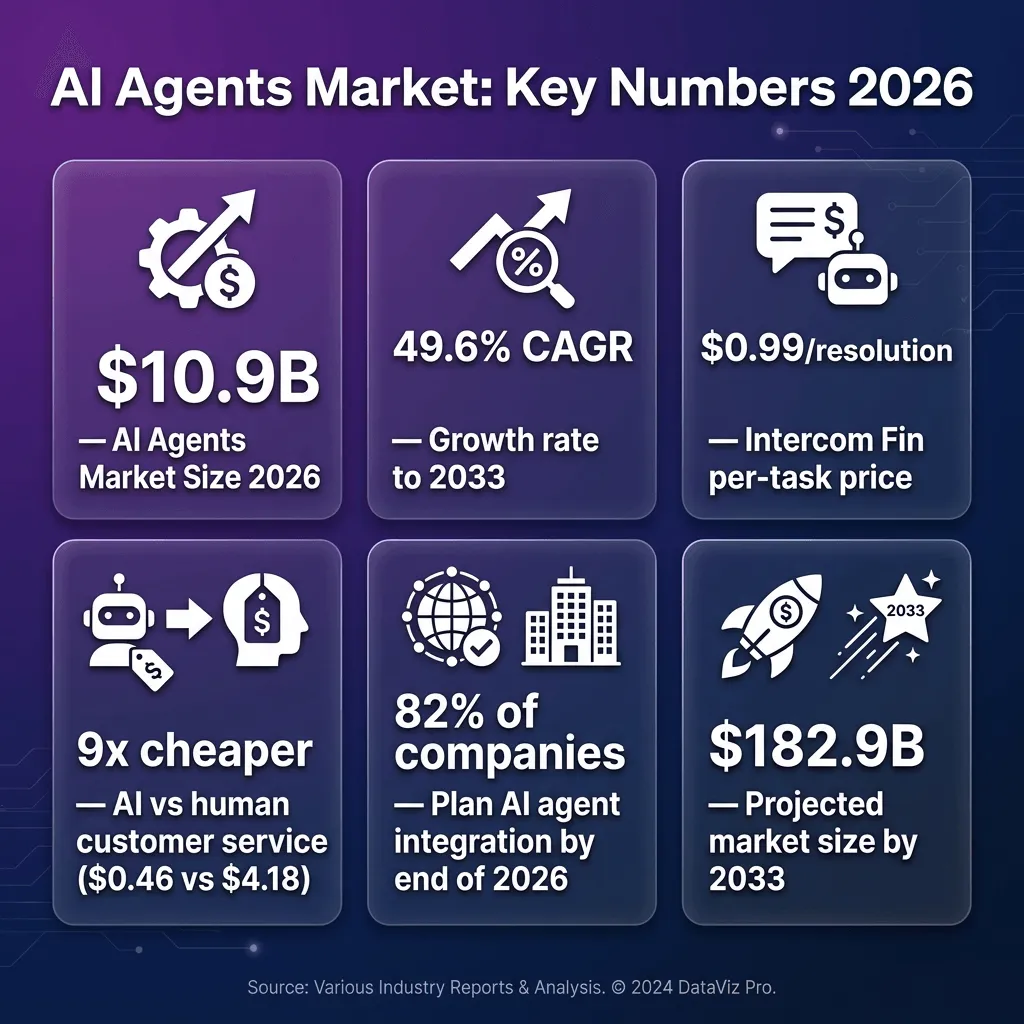
The AI agents market hit $10.9 billion in 2026. It’s heading to $182.9 billion by 2033. That’s a 49.6% CAGR — and the wildest part? Most of the founders building AI agents right now have no idea how to charge for them. Flat monthly subscription? Your most active users will cost you more than they
The AI agents market hit $10.9 billion in 2026. It’s heading to $182.9 billion by 2033. That’s a 49.6% CAGR — and the wildest part? Most of the founders building AI agents right now have no idea how to charge for them.
Flat monthly subscription? Your most active users will cost you more than they pay. Per-seat pricing? AI agents don’t have “seats.” Charge per API call? You’ll watch customers churn the moment their bill spikes unpredictably.
This is the billing problem that nobody warned you about when you started building with LLMs. Traditional SaaS billing infrastructure was designed for predictable, human-driven usage. AI agents are autonomous, variable, and sometimes take 50 actions to complete one task. The old models don’t fit.
Here’s what actually works in 2026 — and how to set up the payment infrastructure behind it.
Why AI Agent Monetization Is Different from Regular SaaS
Classic SaaS billing is simple: charge per seat, per month, per feature tier. Your customer count goes up, revenue goes up. Linear, predictable, boring in the best way.
AI agents break this model in three specific ways:
Variable compute cost. Running a simple query costs fractions of a cent. An agent that browses the web, summarizes 40 documents, drafts a report, and sends emails might cost $0.80 in inference alone. You can’t set a flat price when your cost basis swings 200x.
Outcome ambiguity. Did the agent “succeed”? A customer service agent that answered a question — but the user still filed a ticket — is that a billable event? Defining what you’re charging for is genuinely hard.
Agent-to-agent transactions. In agentic workflows, your AI might call another AI service, pay for data, or trigger external tools. Traditional payment rails weren’t built for machine-to-machine micro-transactions happening at scale.
That’s why the billing models coming out of 2026 look nothing like what came before.
The 4 AI Agent Billing Models That Actually Work
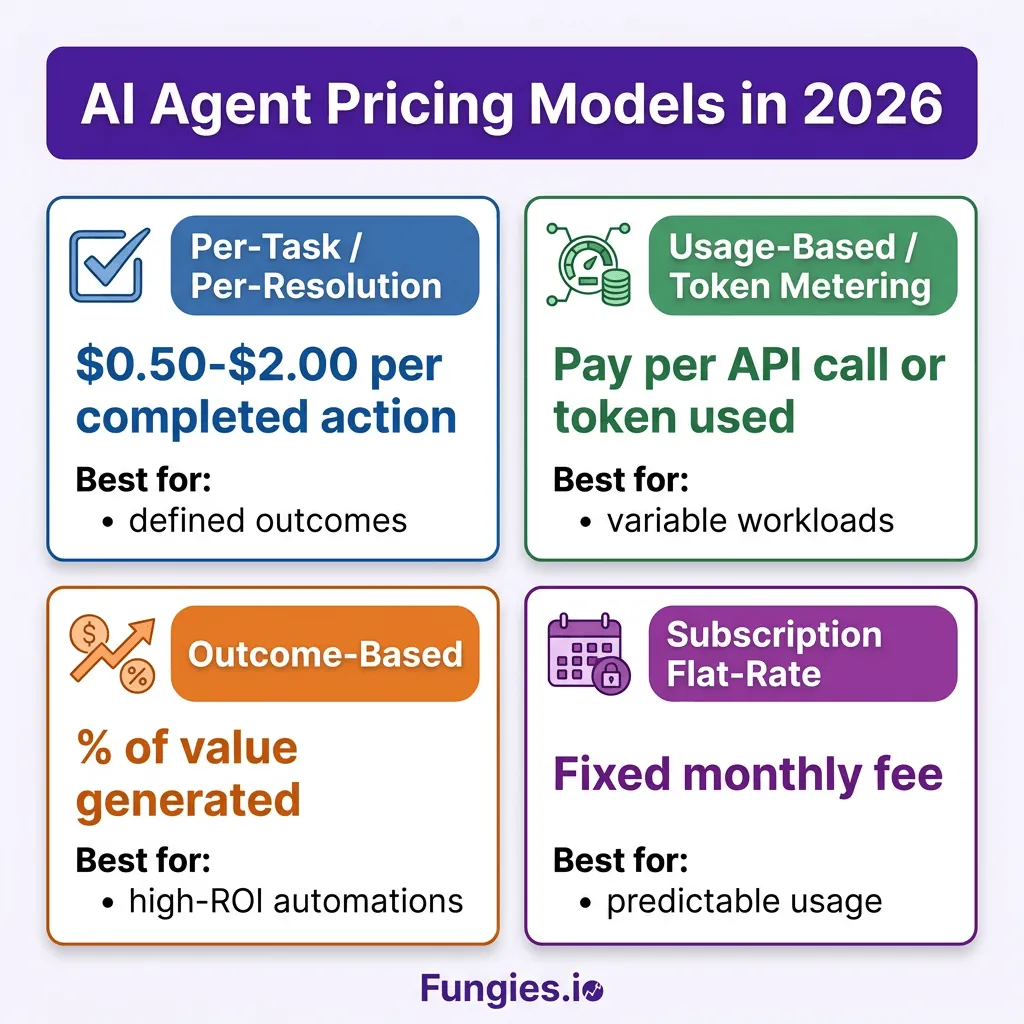
1. Per-Task / Per-Resolution Pricing
This is the model Intercom pioneered with Fin, their AI support agent. They charge $0.99 per resolved conversation. Not per conversation started — per resolved one. If the AI fails or hands off to a human, you don’t pay.
This model works when:
- You can clearly define what a “completed task” looks like
- Your agent’s success rate is consistent and measurable
- Customers care more about outcomes than costs
Intercom’s Fin AI reached nine-figure revenue using this model. It’s not an accident. Customers love paying for results because the math is simple: if Fin resolves 1,000 support tickets at $0.99, they pay $990. If their human team would’ve cost $4,180 for the same 1,000 tickets (at the $4.18 average human-handled ticket cost per Forrester TEI), Fin just saved them $3,190.
The risk: defining “resolved” fairly. Intercom uses confirmed resolution (customer says “thanks, that helped”) and assumed resolution (customer leaves without complaining). That grey zone causes disputes. Build your resolution definition carefully, and be transparent about it.
Typical price range: $0.50–$5.00 per completed task, depending on complexity.
2. Usage-Based / Token Metering
The model most AI-native startups reach for first. Charge based on actual consumption — tokens processed, API calls made, documents analyzed, or minutes of compute time.
This aligns perfectly with your cost basis. When your LLM inference bill goes up, customer billing goes up proportionally. No margin surprises.
Real-world implementations usually look like:
- Credit packs: customers buy 10,000 credits, each action costs a defined number of credits
- Token-direct: charge per 1M input/output tokens (like the model providers themselves)
- Compute minutes: charge per minute of agent runtime
The problem with raw token billing is that customers hate unpredictability. A complex task might cost 3x what they expected. Smart implementations add usage caps, alerts, and budget limits. Platforms like Flexprice and Orb were built specifically to handle this metering complexity.
Typical price range: $10–$50 per million tokens, or $0.001–$0.01 per credit.
3. Outcome-Based / Value-Share Pricing
The boldest model — and the hardest to implement. You charge a percentage of measurable value generated. A sales AI closes a deal → you take 5%. A code review agent finds bugs that would’ve cost $50K in production → you take 2%.
This is where AI monetization is heading long-term, but very few companies can pull it off today because:
- You need attribution (proving your AI caused the outcome)
- You need measurement (quantifying the value)
- You need trust (customers have to believe your numbers)
Companies like Alguna and Nevermined are building the infrastructure for this model. It’s most viable in high-value, clearly measurable use cases: lead qualification, contract review, fraud detection.
Typical price range: 2–10% of verifiable outcome value.
4. Hybrid Subscription + Usage
In practice, most successful AI agent companies in 2026 use a hybrid: flat monthly base + usage overage. The subscription gives customers predictability (and gives you ARR); the usage component captures value from power users.
Example structure:
- $99/month base — includes 500 tasks/month
- $0.15 per additional task
- Enterprise: custom volume pricing
This mirrors how cloud providers bill. AWS charges monthly minimums on committed use plus on-demand for spikes. It’s a pattern customers already understand.
AI Agent Billing Models: Side-by-Side Comparison
| Model | Best For | Typical Price | Margin Risk | Customer Preference |
|---|---|---|---|---|
| Per-Task | Support, document processing | $0.50–$5.00/task | Low (if well-defined) | High (clear ROI) |
| Usage/Token | Developer tools, APIs | $10–50/M tokens | Low (cost-aligned) | Medium (unpredictable bills) |
| Outcome-Based | Sales, fraud, legal | 2–10% of value | High (attribution risk) | High (pay-for-performance) |
| Hybrid Sub+Usage | Most SaaS with AI features | $99+ base + overage | Low-Medium | High (predictable base) |
The Payment Infrastructure Problem Nobody Talks About
Picking a billing model is the easy part. The hard part is the infrastructure behind it.
Traditional payment processors like Stripe were designed for simple subscriptions and one-time payments. They’re fine for human-scale billing: a few thousand customers, monthly invoices, predictable amounts.
AI agents create entirely different demands:
- High-frequency micro-transactions. An active AI agent might generate thousands of billable events per hour. Most billing systems weren’t built for this event volume.
- Real-time metering. Customers need to see live usage. If they can’t see how fast they’re burning through credits, they’ll churn — or worse, file chargebacks after an unexpected bill.
- Global tax compliance at scale. If you’re selling AI agent access globally, you need to collect and remit VAT in 50+ countries, GST in Australia, sales tax across 47 US states. Getting this wrong creates legal exposure.
- Agent-to-agent payments. Increasingly, AI agents need to pay other services autonomously — data APIs, compute, other AI tools. Traditional payment rails require human authorization. Machine-native wallets and pre-authorized spending limits are emerging to solve this.

How to Set Up AI Agent Billing: Step-by-Step
Step 1: Define Your Value Metric
Before picking tools, get obsessive about what you’re actually selling. Not “access to the AI” — the specific, measurable unit of value delivered.
Good value metrics for AI agents:
- Tasks completed (for workflow automation)
- Tokens processed (for data-intensive applications)
- API calls served (for developer platforms)
- Documents processed (for document AI)
- Conversations resolved (for support agents)
Bad value metric: “time spent running” — this doesn’t correlate with customer value and punishes efficiency improvements.
Step 2: Choose Your Billing Infrastructure
You have three main options:
Build on Stripe + Metering. Stripe’s usage-based billing can handle event ingestion and metering. Works well for simpler models. Gets painful at high event volumes or with global tax needs.
Use a specialized metering platform. Tools like Lago (open-source), Orb, or Flexprice are purpose-built for usage-based billing. They handle high-frequency event ingestion, real-time aggregation, and complex pricing rules. They don’t handle payments or tax compliance though — you still need a payment processor.
Use a Merchant of Record. A MoR like Fungies handles everything: payment processing, global tax collection and remittance, invoicing, receipts, and compliance. You send billing events; they handle the rest. This is especially valuable if you’re selling to customers in multiple countries.
The practical answer for most AI agent companies: combine a metering platform (Lago/Orb/Flexprice) with a Merchant of Record (Fungies) for global tax compliance.
Step 3: Implement Real-Time Metering
Every billable action in your agent needs to emit an event to your metering system. This event should include:
- Customer/organization ID
- Timestamp (with millisecond precision)
- Event type (task_completed, tokens_used, api_call_made)
- Quantity (how many units of the billing metric)
- Metadata (agent ID, task type, model used)
Make metering asynchronous — you don’t want billing infrastructure blocking your agent’s critical path. Use a message queue (Kafka, SQS, or even Redis Streams) to decouple event emission from event processing.
Step 4: Handle Global Tax Compliance
This is where most AI agent startups get blindsided. You ship globally on day one, but you might not realize you’ve created VAT obligations in Germany, GST in Australia, and sales tax nexus in California until you get a compliance notice — or an audit.
The cleanest solution: route all sales through a Merchant of Record. The MoR becomes the seller of record in each country, collects local taxes at the right rate, and remits them to tax authorities on your behalf. You’re insulated from the complexity.
This matters especially for AI agents because:
- AI services are classified as “electronically supplied services” in the EU → subject to VAT in customer’s country
- Usage-based billing creates irregular payment amounts → harder to reconcile for VAT purposes manually
- AI agent use is often business customers (B2B) → VAT reverse charge rules apply differently by country
Step 5: Set Customer Guardrails
Customers need to trust that their AI agent won’t run up an unlimited bill. Build these controls into your product:
- Credit pre-purchase: Customers buy credits upfront; agent only runs while credits remain. Zero surprise invoices.
- Soft spending limits: Agent slows down or pauses when approaching a budget threshold, alerting the customer.
- Hard spending caps: Agent stops completely at max budget. Requires manual re-authorization to continue.
- Real-time usage dashboard: Visible, live consumption data. Customers who can see their usage don’t panic-churn when bills arrive.
AI Agent Billing Tools: What’s Available in 2026
| Tool | Type | Best For | Pricing | Tax Compliance |
|---|---|---|---|---|
| Flexprice | Metering + billing | AI/SaaS companies | Usage-based | Limited |
| Orb | Metering platform | High-volume billing | $500+/mo | No |
| Lago (OSS) | Metering platform | Self-hosted control | Free / $800+/mo | No |
| Chargebee | Subscription billing | Hybrid models | $249+/mo | Partial |
| Stripe Billing | Payment + billing | Simple usage billing | 0.8% of revenue | Stripe Tax (extra) |
| Fungies (MoR) | Full MoR | Global sales + tax | 5% + $0.50/txn | Full global MoR |
| Nevermined | Agent-native billing | AI agent economy | Custom | Limited |
The Tax Angle Most AI Founders Miss
Here’s a scenario that plays out constantly in 2026: a developer in Warsaw ships an AI coding assistant. It gets popular. 3,000 users in Germany, 800 in France, 1,200 in the UK. Monthly recurring revenue: $40,000.
What they don’t know: they now owe VAT to the German tax authority at 19%, French TVA at 20%, and UK VAT at 20%. That’s roughly $6,000–$8,000/month in taxes they might not even be collecting from customers correctly.
Under EU VAT rules for electronically supplied services (which AI agents clearly are), you’re required to register for VAT in the EU, collect at the customer’s local rate, and remit quarterly. Failing to do this exposes you to back taxes plus penalties.
A Merchant of Record solves this entirely. When your AI agent sells a subscription through Fungies, Fungies is the legal seller. They collect the right VAT from each European customer, remit it to the correct tax authority, and issue compliant invoices. You receive your revenue net of taxes. No VAT registration needed, no quarterly filings, no compliance headaches.
For AI companies specifically, this matters because you’re almost certainly selling globally from day one — that’s the whole point of software. The compliance tail can be severe if you ignore it.
Real Numbers: What AI Agent Monetization Looks Like at Scale
Let’s look at how per-task pricing math works for a real AI agent business:
Scenario: AI customer support agent
- Price: $0.99 per resolved ticket
- Agent resolve rate: 68% of tickets
- Average customer: 2,000 tickets/month
- Billable events: 1,360 resolutions
- Monthly revenue per customer: $1,346
At 100 customers: $134,600 MRR. Annualized: $1.6M ARR.
Your COGS at that scale (mostly LLM inference): ~$0.10–$0.15 per resolution. So margin on the $0.99 price is 85%+. That’s SaaS-grade gross margin from a pure usage model.
Compare that to a flat-rate $500/month subscription per customer: 100 customers = $50K MRR. With per-task billing, you capture more value from heavy users automatically. The pricing model doubles your revenue at the same customer count.
Key Takeaways
- Per-task pricing beats flat subscriptions for AI agents — you capture value from heavy users without complex tiering, and customers pay for outcomes rather than access.
- Real-time metering is non-negotiable — customers who can’t see their live usage churn or dispute charges; invest in a visibility dashboard early.
- Global tax compliance hits AI companies hardest — you sell globally from day one, which means VAT obligations in 50+ countries; route through a Merchant of Record rather than building compliance infrastructure yourself.
- Hybrid models win most markets — a flat base fee for predictability plus usage overage for power users captures both ends of the market without alienating either.
- Define your value metric precisely before you pick tools — “tokens processed” and “tasks completed” require different infrastructure, different pricing psychology, and different customer conversations.
FAQ
What’s the difference between per-task and usage-based billing for AI agents?
Per-task billing charges for completed outcomes (a resolved ticket, a generated report, a processed document). Usage-based billing charges for consumed resources (tokens processed, API calls made, compute minutes). Per-task is simpler for customers to understand and has stronger ROI justification; usage-based aligns more directly with your cost structure and is easier to implement technically.
Do I need a Merchant of Record for my AI agent business?
If you sell to customers in more than one country, yes — you almost certainly need a MoR or a similar tax compliance solution. AI agent services are classified as electronically supplied services in the EU, making them subject to VAT at the customer’s local rate in every EU country. A Merchant of Record handles this for you, acting as the legal seller, collecting and remitting taxes, and issuing compliant invoices. Without this, you’re exposed to back-taxes and regulatory penalties.
What billing infrastructure should I use for a high-volume AI agent?
For high-frequency event metering, use a dedicated metering platform: Lago (open-source, self-hosted), Orb, or Flexprice. These handle thousands of events per second with real-time aggregation. Pair this with a payment processor or Merchant of Record for the actual billing and tax compliance. Stripe’s native usage billing works for lower volumes but gets expensive and limited as you scale.
How does outcome-based pricing work in practice for AI agents?
Outcome-based pricing charges a percentage of measurable value the AI generates — for example, 5% of contract value closed by a sales AI, or $X per fraud case detected. It requires clear attribution (proof your AI caused the outcome), reliable measurement, and mutual trust. It’s the most compelling model for enterprise buyers (pure pay-for-performance) but the hardest to implement. Most companies start with per-task or usage-based pricing and move toward outcome-based pricing as their measurement capabilities mature.
Conclusion
The AI agents market is moving faster than the billing infrastructure that supports it. Founders who figure out how to price their agents — and how to handle the compliance, metering, and payment infrastructure behind that pricing — will capture an outsized share of a $182.9 billion market by 2033.
The good news: you don’t have to build this from scratch. Metering platforms like Lago and Orb handle the event infrastructure. Merchant of Record providers like Fungies handle global tax compliance and payments. Combined, you can set up robust AI agent billing in weeks, not quarters.
Ready to set up compliant global payments for your AI agent or SaaS product? Get started with Fungies — it takes about 15 minutes to go live.
References
- Grand View Research — AI Agents Market Size Report 2026–2033
- Intercom — Fin AI Agent Outcomes & Pricing
- Forrester TEI — via Digital Applied: AI Agent Productivity Statistics 2026
- Nevermined — How to Monetize AI Agents in 2026
- Flexprice — Top Solutions for AI and Agentic Monetization
- Kyle Poyar / Growth Unhinged — State of B2B Monetization in 2026
- Chargebee — Selling Intelligence: The 2026 Playbook for Pricing AI Agents
- Landbase — 39 Agentic AI Statistics for 2026