Polar.sh vs Creem vs Dodo Payments: The 2026 MoR Showdown for Indie SaaS Founders
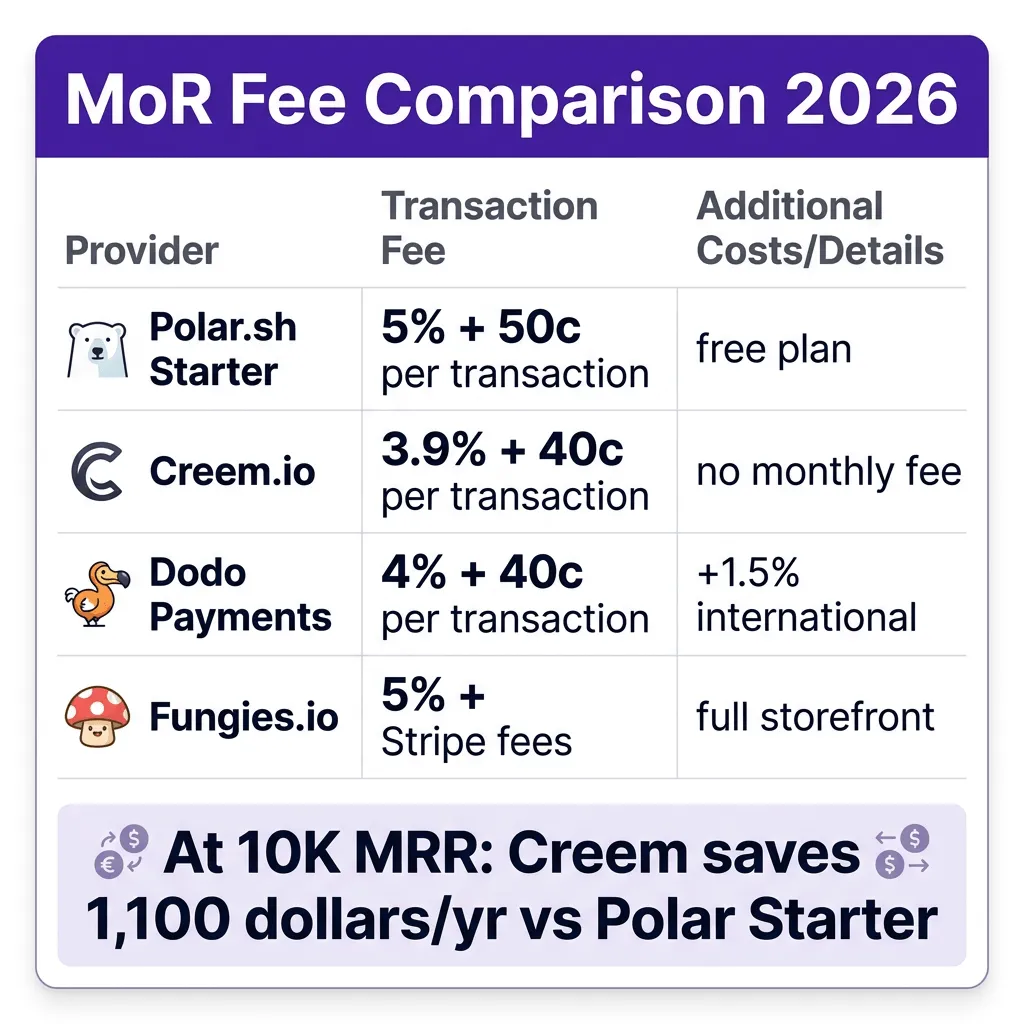
Here’s a number worth knowing before you pick a Merchant of Record platform: at $10K MRR, the fee difference between Polar.sh’s free Starter tier (5% + 50¢) and Creem.io (3.9% + $0.40) comes out to roughly $1,300 per year. That’s not chump change for an indie SaaS founder — and it’s just one of the
Here’s a number worth knowing before you pick a Merchant of Record platform: at $10K MRR, the fee difference between Polar.sh’s free Starter tier (5% + 50¢) and Creem.io (3.9% + $0.40) comes out to roughly $1,300 per year. That’s not chump change for an indie SaaS founder — and it’s just one of the variables you need to get right.
In 2026, three newer MoR platforms have become the go-to options for solo founders and indie hackers who want global tax compliance without the overhead of enterprise contracts: Polar.sh, Creem.io, and Dodo Payments. They all solve the same core problem — handling VAT, GST, and sales tax globally so you don’t have to. But they’re built for different types of founders, with meaningfully different fee structures, developer experiences, and platform philosophies.
This is a straight-up breakdown. Actual pricing, real feature comparisons, and a clear decision framework for which platform fits which situation.
What Is a Merchant of Record (And Why You Need One)
A Merchant of Record (MoR) is the legal entity that takes on sales tax liability when your customers buy your product. Instead of you registering for VAT in Germany, GST in Australia, and sales tax in 40+ US states, the MoR handles that — and absorbs the legal risk if something’s wrong.
Payment processors like Stripe don’t do this. Stripe moves money. You’re still the seller of record, which means you own all tax obligations. That’s fine when you’re selling to a handful of US customers. Once you’re selling globally, it’s a compliance nightmare that can get you fined or banned from markets.
For indie SaaS founders, the MoR decision is really a question of: how much are you willing to pay for compliance peace of mind, and which platform’s product actually fits how you ship?
Polar.sh: The Open-Source MoR for Developers
Polar.sh launched in 2023 as an open-source monetization platform for developers. It’s built on Stripe under the hood and positions itself as the transparent, developer-first alternative to black-box MoR providers. Their entire codebase is on GitHub, their pricing is fully public, and they’ve deliberately avoided the “sales-gated discount” game that most enterprise MoR providers play.
Polar.sh Pricing (2026)
Polar offers a free Starter plan plus three paid plans:
| Plan | Monthly Fee | Per Transaction | Support |
|---|---|---|---|
| Starter | Free | 5% + 50¢ | Standard |
| Pro | $20/mo | 3.8% + 40¢ | Prioritized |
| Growth | $100/mo | 3.6% + 35¢ | Prioritized |
| Scale | $400/mo | 3.4% + 30¢ | Slack + Priority |
The paid plans only make financial sense above certain revenue thresholds:
- Pro breaks even at ~$1,379/mo in sales
- Growth breaks even at ~$5,634/mo in sales
- Scale breaks even at ~$19,048/mo in sales
Below those thresholds, staying on Starter or a lower tier is the cheaper move.
What Polar.sh Does Well
Polar handles subscriptions, one-time purchases, license keys, and digital product delivery — all under MoR coverage. The developer experience is genuinely good: clean API, Next.js/React SDKs, webhooks that don’t suck, and a GitHub Sponsors-style storefront for open-source maintainers who want to monetize their work.
The open-source angle is real. If you want to see exactly how your payment infrastructure works under the hood, Polar lets you do that. That matters to a non-trivial number of developers who are allergic to vendor lock-in.
Account reviews are required before your first payout — Polar verifies your business and product to prevent fraud and high-risk activity. This is standard for MoR platforms but worth knowing if you need to ship fast.
Where Polar Falls Short
At Starter (5% + 50¢), Polar is the most expensive of the three platforms in this comparison. It’s $1,300+/year more expensive than Creem at $10K MRR. That’s not a rounding error — it’s a real cost for bootstrapped founders.
Polar’s platform is also more developer-centric than product-centric. If you want a polished no-code storefront or an embeddable checkout that non-technical founders can configure without touching code, you’ll have more friction here than with Dodo or Fungies.
Creem.io: The Cheapest All-In MoR for Indie Hackers
Creem launched in 2023 and built a reputation fast in the European indie hacker scene. Their pitch: one flat rate, no hidden fees, no monthly costs. 3.9% + $0.40 per transaction, full MoR coverage, done.
Creem Pricing
| Revenue Level | Monthly Creem Fees | Annual Cost |
|---|---|---|
| $1K MRR | ~$43/mo | ~$516/yr |
| $5K MRR | ~$215/mo | ~$2,580/yr |
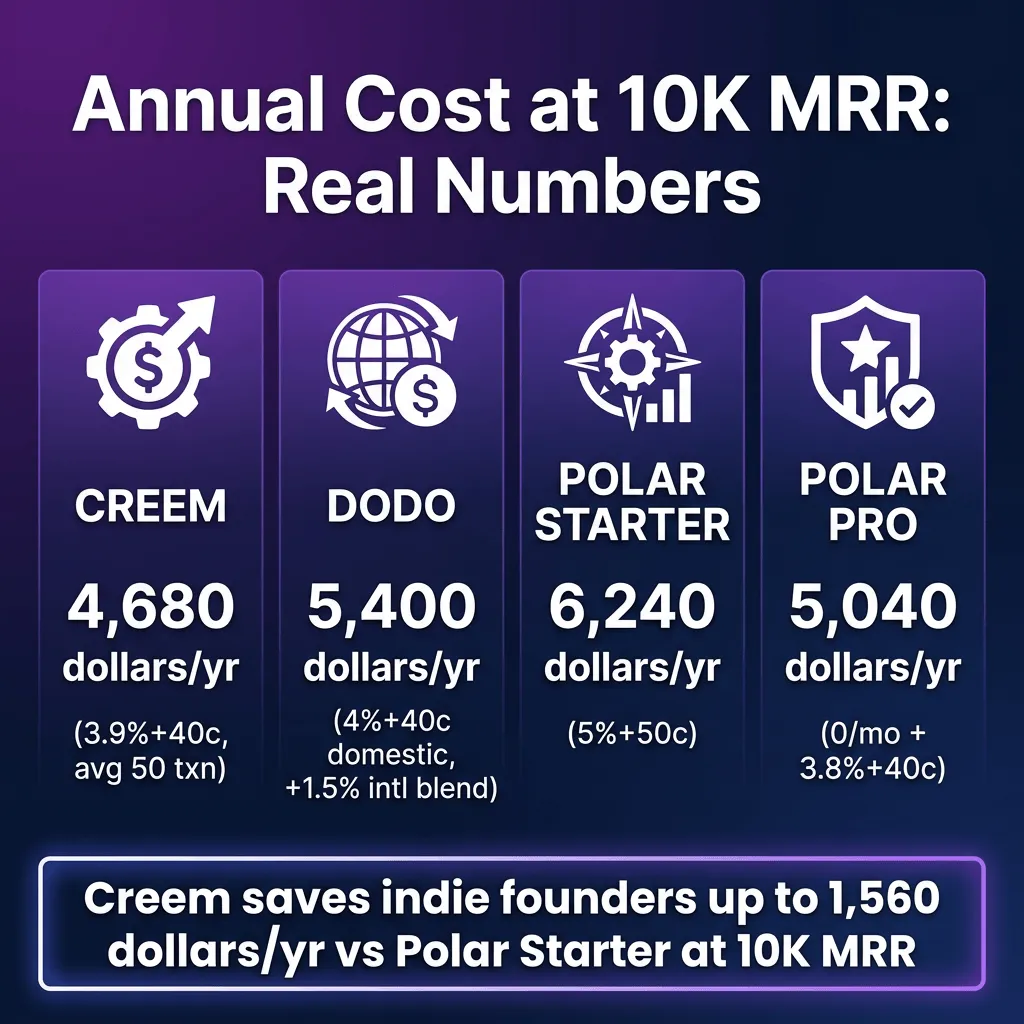
| $10K MRR | ~$390+/mo | ~$4,680+/yr |
| $50K MRR | ~$1,950/mo | ~$23,400/yr |
Creem covers 130+ countries with full MoR liability, automatic VAT/GST calculation, fraud protection, and built-in affiliate tools. No setup fees. No migration fees. Cancel anytime.
What Creem Does Well
Creem is EU-based and designed for European compliance from the ground up — particularly useful for EU founders navigating GDPR + VAT OSS simultaneously. Their currency handling and payout options are strong for European markets.
Their fee calculator is genuinely useful. It shows real-time comparison against Lemon Squeezy, Paddle, and Gumroad at any revenue level, which makes the savings concrete rather than abstract. At $5K MRR, Creem saves you roughly $165/mo compared to Lemon Squeezy.
Built-in revenue splits and affiliate tools are included at no extra cost — a meaningful differentiator if you’re running a referral program or co-selling with partners.
Where Creem Has Friction
Creem has had waitlist periods — demand has outpaced their onboarding capacity at various points in 2025 and 2026. If you need to launch in the next two weeks, Creem might not be available to you immediately. Apply early.
Creem’s platform coverage (130+ countries) is smaller than Dodo’s 220+ and Polar’s global Stripe-backed coverage. This rarely matters for indie SaaS, but if you’re targeting markets like Southeast Asia or the Middle East with specific local payment method requirements, double-check coverage before committing.
Dodo Payments: The Global-First MoR for AI Startups and International Teams
Dodo Payments was founded in 2023 by Rishabh Goel and Ayush Agarwal, initially targeting Indian SaaS founders who need to sell globally but face significant complexity setting up merchant accounts and handling international tax. It’s grown fast — now trusted by 50,000+ builders worldwide — and has expanded well beyond its initial niche.
Dodo Payments Pricing (Full Breakdown)
| Transaction Type | Dodo Fee |
|---|---|
| Domestic US (cards, Apple Pay, Google Pay) | 4% + 40¢ |
| International cards/APMs | 4% + 40¢ + 1.5% surcharge |
| PayPal | +3% on top of base rate |
| BNPL (Klarna, Afterpay) | +3% on top of base rate |
| Subscriptions | +0.5% per transaction |
| India domestic (INR/UPI) | 4% + 15¢ |
The base rate looks competitive. But the international surcharge means your effective rate for a global SaaS (typical mix: ~60% international) often lands around 5-5.5% all-in. Still competitive, but less of a slam-dunk against Creem once you factor this in.
Subscriptions add 0.5%, which matters if your entire business is subscription-based — and for most SaaS, it is.
What Dodo Does Well
Dodo’s breadth is genuinely impressive: 220+ countries, 40+ payment methods, usage-based billing, credit systems, license key generation, and a no-code storefront — all included. For founders targeting emerging markets or running AI products with token-based billing, Dodo has the most complete feature set out of the three.
The AI startup focus is real. Dodo has native support for credit-based billing (you sell usage credits, customers consume them, billing adjusts automatically) and usage metering. If you’re building on top of LLM APIs and charging per token or per call, Dodo handles this natively in a way Creem and Polar currently don’t.
Their startup program gives early-stage teams up to 12 months of fee credits — worth factoring in if you’re pre-revenue or in early beta.
Where Dodo Has Friction
The international surcharge makes Dodo’s effective fee less competitive than the headline 4% + 40¢ suggests. For a US-centric product, it’s excellent. For a genuinely global product with heavy EU or APAC user base, the surcharge adds up.
Dodo is also newer to the European regulatory environment than Creem. European founders dealing with strict VAT OSS filing and GDPR compliance may find Creem’s EU-native stance more reassuring.
Feature Comparison: Polar.sh vs Creem vs Dodo Payments vs Fungies
| Feature | Polar.sh | Creem.io | Dodo Payments | Fungies.io |
|---|---|---|---|---|
| Base Transaction Fee | 5% + 50¢ (Starter) | 3.9% + $0.40 | 4% + 40¢ | 5% + Stripe fees |
| Monthly Fee Option | $20–$400/mo for lower rates | None | None | None |
| Countries | Global (Stripe-backed) | 130+ | 220+ | 150+ |
| MoR Status | ✅ Full | ✅ Full | ✅ Full | ✅ Full |
| Subscriptions | ✅ | ✅ | ✅ (+0.5%) | ✅ |
| License Keys | ✅ | ❌ | ✅ | ✅ |
| Usage-Based Billing | Limited | ❌ | ✅ Native | ❌ |
| Affiliate Tools | ❌ | ✅ Built-in | ✅ | ✅ |
| No-Code Storefront | Limited | Limited | ✅ | ✅ |
| Open Source | ✅ | ❌ | ❌ | ❌ |
| EU-Native | ❌ | ✅ | ❌ | ❌ |
| India/INR Support | Via Stripe | Limited | ✅ Native (4%+15¢) | Via Stripe |
| Instant Signup | ✅ (review before payout) | ⚠️ Waitlist periods | ✅ | ✅ |
| Game Developer Focus | ❌ | ❌ | ❌ | ✅ |
Fee Math: What You Actually Pay at Each Revenue Level
Let’s run real numbers. Assumptions: average transaction = $49, subscription-based SaaS, 50% international traffic mix for Dodo.
| Monthly Revenue | Polar Starter (5%+50¢) | Polar Pro ($20+3.8%+40¢) | Creem (3.9%+40¢) | Dodo (blend ~4.9%+40¢) |
|---|---|---|---|---|
| $1,000/mo | ~$60/mo | ~$58/mo | ~$47/mo | ~$57/mo |
| $5,000/mo | ~$300/mo | ~$230/mo | ~$215/mo | ~$282/mo |
| $10,000/mo | ~$550/mo | ~$420/mo | ~$390/mo | ~$532/mo |
| $50,000/mo | ~$2,550/mo | ~$1,980/mo | ~$1,950/mo | ~$2,533/mo |
At $10K MRR:
- Creem saves ~$160/mo vs Polar Starter — that’s $1,920/year
- Creem saves ~$30/mo vs Polar Pro (Polar Pro breakeven is ~$1,379/mo, so it makes sense at $10K MRR)
- Dodo is competitive with Polar Pro but trails Creem due to international surcharge
At $50K MRR, Creem and Polar Pro are nearly equivalent ($1,950 vs $1,980), but Polar Scale ($400/mo + 3.4%) becomes interesting at this level — and comes with Slack support.
Developer Experience Comparison
Polar.sh DX
Polar’s developer experience is probably the strongest of the three for pure API work. The SDKs are clean, the docs are well-maintained (they publish an LLMs.txt for AI tooling — a nice touch), and the fact that it’s open source means you can read the actual implementation when something’s unclear. Webhooks, event streams, and API-first design throughout.
If you’re building a Next.js or React app, Polar’s official SDK makes checkout embed trivially easy. They’ve also been quick to ship native integrations for AI stack tooling.
Creem DX
Creem’s developer experience is clean and intentionally simple. One API endpoint, minimal configuration, good webhook support. The tradeoff is depth — Creem is designed to get you live fast, not to support complex billing edge cases. For 90% of indie SaaS use cases, this is fine. For custom metering or usage-based models, you’ll hit limits.
Dodo Payments DX
Dodo has the most complete feature set but also the steepest learning curve. The billing, payments, and distribution systems are somewhat separate modules — which gives you flexibility but requires more upfront architecture decisions. Their “Sentra” AI coding assistant (an IDE-integrated tool for payment integration) is genuinely useful if you’re unfamiliar with their API patterns.
Framework-specific SDKs for Next.js, React, Python, and others are available and well-documented. The no-code storefront option means non-technical founders can set up a basic purchase flow without touching code at all.
Compliance and Tax Coverage
All three are full Merchants of Record, which means:
- They’re the legal seller on every transaction
- They handle VAT, GST, and sales tax collection and remittance
- Chargebacks are their problem, not yours
- Customer invoices show the MoR’s name as the seller
Coverage differences matter at the edges:
- Dodo has the widest geographic coverage (220+ countries) — important for founders targeting markets like India, Southeast Asia, or Latin America
- Creem is strongest on EU compliance and GDPR alignment — critical for EU-based founders or products with heavy EU user bases
- Polar inherits Stripe’s global infrastructure, which covers most markets but with less emphasis on local payment method optimization in non-US/EU markets
Who Should Use Which Platform
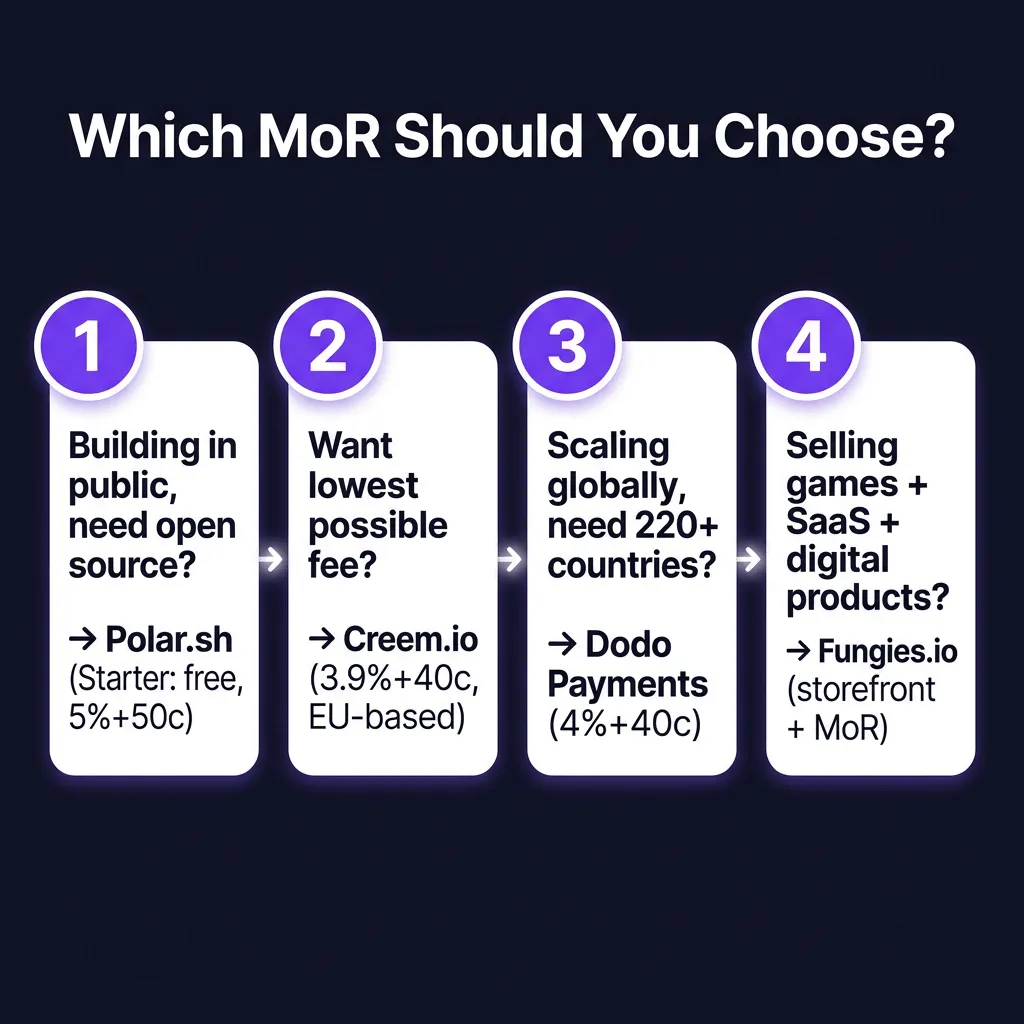
Choose Polar.sh if:
- You’re building open source or in public and want your payment infrastructure to match your values
- You’re early-stage and want zero monthly fees while getting started
- You want the deepest API control and are comfortable with Stripe-based infrastructure
- You’re monetizing GitHub Sponsors, open-source memberships, or developer tools
Choose Creem.io if:
- Lowest possible fee is your primary constraint
- You’re EU-based or your customer base is heavily EU
- You want built-in affiliate tools without extra setup
- You can wait for potential waitlist approval
Choose Dodo Payments if:
- You’re building an AI SaaS with usage-based or credit-based billing
- You’re India-based or India is a primary market
- You need 220+ country coverage from day one
- You want the most complete out-of-the-box storefront without code
Choose Fungies.io if:
- You’re selling games, game assets, or a mix of digital products + SaaS
- You’re already in the Stripe ecosystem and want MoR coverage layered on top
- You need a storefront + MoR combo specifically designed for games and digital goods
- You want to get started immediately without a waitlist or review before launch
Key Takeaways
- Creem is the cheapest flat-rate MoR for indie SaaS in 2026 — 3.9% + $0.40, no monthly fees, EU-compliant. If fee minimization is your priority, Creem wins.
- Polar’s Starter tier is the most expensive of the three at 5% + 50¢, but its open-source model and developer-first ethos are genuinely differentiated — and Pro ($20/mo + 3.8%) is competitive at $1.5K+ MRR.
- Dodo’s headline fee looks great until you factor in the international surcharge (+1.5%) and subscription fee (+0.5%). Effective rates for global SaaS land around 5-5.5%.
- Usage-based billing is Dodo’s unique strength — credit meters, token tracking, and AI-native billing patterns are native features, not bolt-ons.
- All three platforms handle MoR compliance adequately — the decision should be driven by fee structure, developer experience fit, and specific market needs, not by trust in compliance quality.
FAQ
Is Polar.sh really a Merchant of Record?
Yes. Polar.sh takes on full legal liability for international sales taxes globally. They’re the seller of record on every transaction, handling VAT, GST, and sales tax collection and remittance in countries where required. They’re built on Stripe for payment processing but take on the MoR layer on top.
Is Creem.io cheaper than Dodo Payments for a global SaaS?
For most global SaaS products, yes. Creem’s flat 3.9% + $0.40 beats Dodo’s 4% + 40¢ + 1.5% international surcharge once you factor in that most global SaaS has a significant non-US customer base. The exception is if your product is heavily India-focused — Dodo’s native INR support at 4% + 15¢ is a significant advantage there.
Can I switch from Polar.sh to Creem or Dodo later?
Yes, but plan for it. Switching MoR providers means migrating existing subscriptions (which requires customer-facing re-authorization in some cases), updating API integrations, and ensuring continuity of tax records. It’s doable, but budget 2-4 weeks of engineering time for a clean migration. The sooner you pick the right platform, the less migration pain you’ll face.
How does Fungies.io compare to these three platforms?
Fungies.io is particularly strong for game developers and digital product sellers who want a full-featured storefront built on top of MoR infrastructure. Its fee structure (5% + Stripe fees) is less competitive than Creem on a pure percentage basis, but Fungies offers deeper game-specific features (game asset delivery, license management) and a polished storefront experience that the other three don’t match. If your product is games or a mix of games + SaaS, Fungies is worth evaluating.
Conclusion
The MoR market has gotten genuinely competitive in 2026 — which is good for indie founders. Two years ago, your real choices were Paddle (expensive but reliable) or Lemon Squeezy (then acquired by Stripe). Now you’ve got Polar, Creem, Dodo, Fungies, and others all competing for your business with meaningfully different approaches.
For most solo founders launching a SaaS in 2026: Creem if you can get access (lowest fees, simple setup), Dodo if you need AI/usage billing or India coverage, Polar if open source and developer experience matter more than fee optimization.
Don’t overthink the selection. The cost of picking the “wrong” MoR is measured in percentage points of fees, not existential risk. Pick the one that ships fastest for your use case, validate your product, and optimize later.
If you’re building a digital product, game, or SaaS and want to see how Fungies stacks up for your specific situation, create a free Fungies account here — setup takes about 10 minutes.
References
- Polar.sh Pricing — https://polar.sh/resources/pricing
- Polar.sh MoR Introduction — https://polar.sh/docs/merchant-of-record/introduction
- Creem.io Pricing — https://www.creem.io/pricing
- Dodo Payments Pricing — https://dodopayments.com/pricing
- Polar.sh Review 2026 (Dodo Payments) — https://dodopayments.com/blogs/polar-sh-review
- Best Merchant of Record for SaaS 2026 (Creem) — https://www.creem.io/blog/best-merchant-of-record-saas-2026
- Fungies.io — Dodo Payments Review 2026 — https://fungies.io/dodo-payments-review-2026