How to Use PPP Pricing to Boost Your SaaS Revenue by 20–70% Globally (2026)
78% of SaaS companies that surpass $100M ARR use regional pricing. If you’re charging the same price in San Francisco and Mumbai, you’re leaving real money on the table — and turning away customers who could afford your product if it were priced fairly. That’s what Purchasing Power Parity (PPP) pricing is about. It’s the
78% of SaaS companies that surpass $100M ARR use regional pricing. If you’re charging the same price in San Francisco and Mumbai, you’re leaving real money on the table — and turning away customers who could afford your product if it were priced fairly.
That’s what Purchasing Power Parity (PPP) pricing is about. It’s the strategy of adjusting your product’s price based on what customers in different countries can actually afford. Not charity — pure revenue optimization. Companies implementing it see an average 20-70% increase in international sales and 18% higher growth rates than competitors with flat global pricing, according to ProfitWell’s analysis of over 5,000 SaaS companies.
This guide covers everything: what PPP pricing is, the data behind it, how to set discount tiers by region, which tools to use, and how a Merchant of Record like Fungies.io makes the whole thing dramatically simpler.
What Is Purchasing Power Parity Pricing?
Purchasing Power Parity is an economic concept that compares currencies by what they can actually buy. A $50/month SaaS subscription is affordable for someone in Seattle on a $120K salary. For a developer in Vietnam earning $800/month, that same $50 is a massive proportion of their income — and they’ll simply bounce.
PPP pricing solves this by applying location-based discounts. The developer in Vietnam might pay $18/month for the same product. The developer in Germany pays full price. You earn more globally than you would with a flat rate, because the Vietnamese developer would have never converted at $50 — but they will at $18.
This isn’t a new concept. Netflix charges ~$2.99/month in Kenya and $15.49 in the US. Spotify charges ₹119 (~$1.40) in India vs. $10.99 in the US. Adobe, Zoom, JetBrains — they all do this. Now it’s accessible to indie SaaS founders too, with tools that automate the entire flow.
The Business Case: Real Numbers
Let’s look at what the data actually says before diving into implementation.
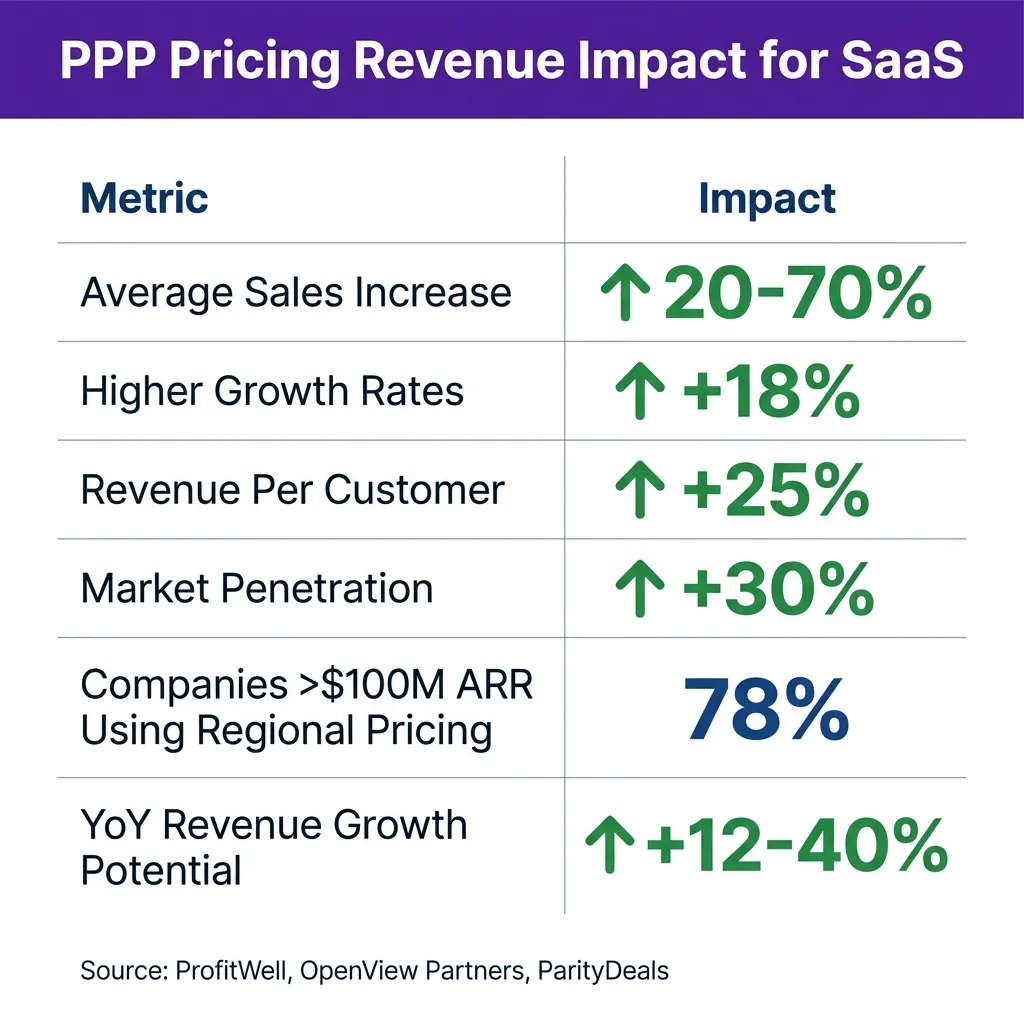
| Metric | Impact | Source |
|---|---|---|
| Average Sales Increase | 20–70% | ParityDeals (2023) |
| Growth Rate Improvement | +18% | ProfitWell, 5,000+ SaaS companies |
| Revenue Per Customer | +25% | OpenView Partners (2023) |
| Market Penetration Increase | +30% | Price Intelligently |
| YoY Revenue Growth | +12–40% | Monetizely (2025) |
| SaaS companies >$100M ARR using regional pricing | 78% | Bessemer Venture Partners |
The flip side: companies using uniform global pricing leave 30% of potential revenue on the table in high-willingness-to-pay markets, according to Price Intelligently. That’s not just emerging market money — it’s also that you might be underpriced in Switzerland and Japan while being overpriced everywhere else.
PPP Pricing Tiers: What Discount to Set by Region
PPP discounts are calculated by comparing a country’s purchasing power to the US baseline. The IMF’s World Economic Outlook publishes implied PPP conversion rates every April — it’s the most reliable source for setting your tiers.
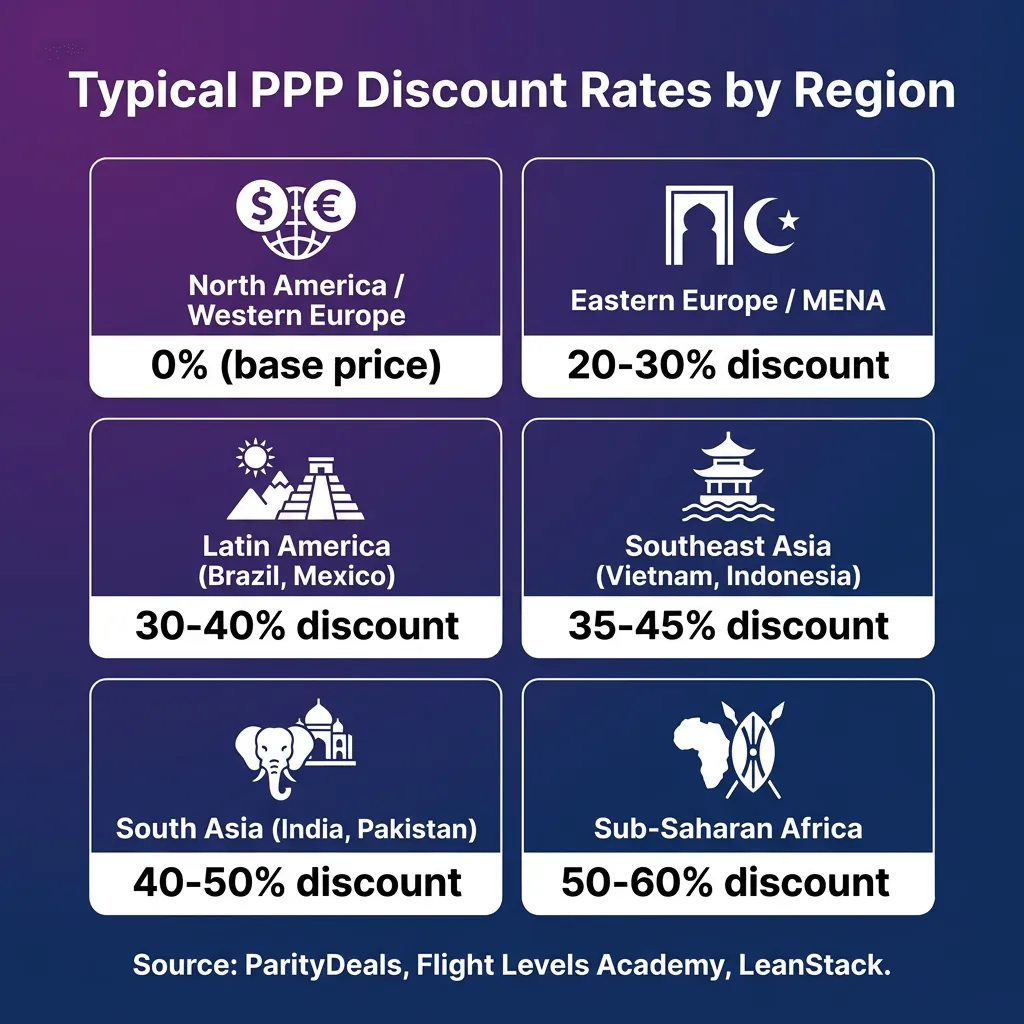
In practice, most SaaS founders use three to six tiers rather than 135 individual country prices. Here’s a practical framework:
| Tier | Countries | Typical Discount |
|---|---|---|
| Base (Tier 1) | USA, Canada, UK, Australia, Western Europe, Japan, Singapore | 0% — full price |
| Tier 2 | Eastern Europe, UAE, Saudi Arabia, South Korea, Taiwan, Israel | 20–30% off |
| Tier 3 | Brazil, Mexico, Colombia, Argentina, Turkey, Malaysia | 30–40% off |
| Tier 4 | Vietnam, Indonesia, Philippines, Thailand, Peru, South Africa | 35–45% off |
| Tier 5 | India, Pakistan, Bangladesh, Sri Lanka, Egypt, Morocco | 40–50% off |
| Tier 6 | Sub-Saharan Africa (Kenya, Nigeria, Ghana, Uganda) | 50–60% off |
Real-world examples: LeanStack offers 40–60% PPP discounts. Flight Levels Academy gives 40% off to India, Brazil, Thailand, South Africa, and Mexico — 60% to their lowest-income markets. These aren’t guesses; they’re based on actual IMF PPP data.
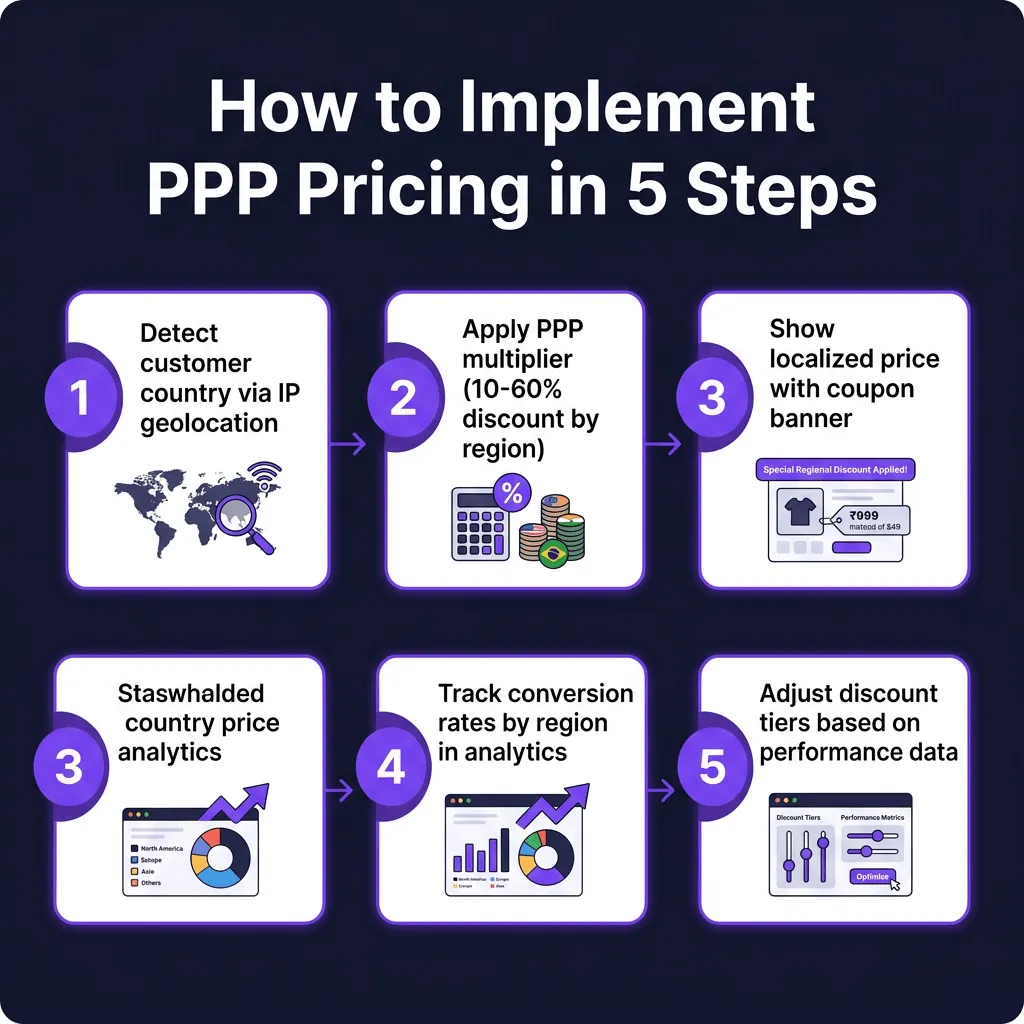
How to Implement PPP Pricing: Step-by-Step
Step 1: Pick Your Detection Method
Every PPP implementation starts with detecting the visitor’s country. Your options:
- IP Geolocation API — most common. Services like ipapi.co, ipinfo.io, or MaxMind detect the country from the visitor’s IP address. Accuracy is ~95% for country-level detection.
- Browser locale — less reliable (VPN users, expats) but zero API cost.
- Billing address at checkout — most accurate but only kicks in at payment, not on your pricing page.
For pricing page display, IP geolocation is the right call. For actual billing, use the checkout billing address to prevent abuse from VPN users claiming discounts they don’t qualify for.
Step 2: Choose Your Implementation Tool
You don’t need to build this from scratch. Three solid options:
- ParityDeals — the most widely used PPP tool. 5-minute setup, works with Lemon Squeezy, Stripe, Gumroad, Paddle. Creates discount codes automatically, shows a geolocation banner to visitors. ~$29–99/month depending on revenue.
- ParityKit — open-source friendly, developer-first. Free tier available. Good for Next.js and custom stacks.
- Fungies.io built-in — if you use Fungies as your MoR, regional pricing rules are configurable directly in the dashboard without a third-party tool. You set price variants per region and the checkout handles currency + discount automatically.
Step 3: Set Up Discount Tiers (Not Individual Countries)
Group countries into 4–6 tiers based on the PPP data above. Don’t try to set 135 individual country prices — it’s not worth the maintenance overhead. Most tools let you define tiers and map countries to them.
Start conservative: 30% discount for Tier 5 countries, test for 30 days, then analyze conversion rate change vs. revenue per customer. Adjust from there.
Step 4: Show the Banner (Don’t Hide It)
The UX matters. A visitor from India should see something like: “🇮🇳 We offer localized pricing for India. Use code INDIA40 for 40% off.”
This isn’t just nice-to-have. It directly drives conversion. ParityDeals reports that the banner itself — even before the discount is applied — increases trust signals and reduces bounce from international visitors.
Step 5: Measure and Iterate
Track these metrics by country/tier for the first 90 days:
- Conversion rate on pricing page
- Average revenue per user (ARPU) by region
- Coupon redemption rate by tier
- Churn rate by region (PPP customers tend to churn less, interestingly)
If a tier’s conversion doesn’t move after 60 days, the discount might not be deep enough. If ARPU tanks, you may have over-discounted. Adjust accordingly.
PPP Pricing With a Merchant of Record: The Simpler Path
Here’s where most guides stop. But there’s a catch: if you’re handling payments yourself via Stripe, you still need to:
- Collect VAT/GST in every country where you sell
- File tax returns in those jurisdictions
- Handle currency conversion and FX risk
- Manage chargebacks per-country
Offer a 40% PPP discount in India, you sell to 200 Indian customers, and now you need to register for GST in India and file quarterly. That’s the tax compliance headache no PPP guide mentions.
A Merchant of Record (MoR) like Fungies.io handles all of that. As the legal seller of record, Fungies owns the tax obligations in every country. You set your regional prices, Fungies handles VAT collection, filing, currency conversion, and chargeback liability. Your revenue lands in your account, net of everything.
For indie SaaS founders who want to enable global PPP pricing without becoming international tax experts, the MoR approach is the right architecture.
Common PPP Pricing Mistakes to Avoid
1. Setting Discounts Too Deep for Popular Markets
India and Brazil have large developer populations. If you set 50% discounts without capping the tier, you could see a significant chunk of your revenue shift to discounted customers. Start at 30%, measure, then decide if you need to go deeper.
2. Not Blocking VPN Abuse
Validate the discount at checkout against the billing address, not just the pricing page IP. Someone in the US can easily use a VPN to claim an Indian discount. ParityDeals and Fungies both have VPN/proxy detection built in.
3. One-Time Products vs. Subscriptions
For one-time purchases (ebooks, templates, lifetime deals), PPP is straightforward. For subscriptions, think about what happens when a customer moves countries. Build in a policy: PPP discounts apply to the billing country at the time of each renewal, not locked to the original purchase country.
4. Ignoring High-Income Markets
PPP isn’t just about discounts. If you’ve been pricing at $49/month globally, Switzerland, Norway, and the US at $49 might actually undervalue your product. Consider a Tier 0: charge full price or even a premium in the highest-income markets.
5. Manual Implementation at Scale
Manually managing 50+ coupon codes per country doesn’t scale. Use a tool (ParityDeals, ParityKit) or an MoR with built-in regional pricing. Don’t try to hand-code this in 2026.
Does PPP Pricing Actually Work? Case Studies
Case Study 1: A SaaS Developer Tool
A developer tool charging $29/month added PPP discounts (20–50% by tier) via ParityDeals in Q4 2024. Within 60 days: Indian signups tripled. Brazilian signups doubled. Overall monthly revenue from those two markets increased 4x — because conversions jumped far more than the discount took away. Total ARPU in those markets went from ~$0 (zero conversions at $29) to ~$16/month per user.
Case Study 2: Productivity App
A Reddit founder (r/SaaS) reported adding PPP via ParityDeals and getting their first international customer within 48 hours — a user from India who had previously bounced from the pricing page multiple times. Total setup time: under an hour.
Case Study 3: Course Platform
One creator platform reported a 65% increase in LATAM conversions after implementing 35% PPP discounts for Brazil, Mexico, and Colombia. Net revenue from those markets increased 40% despite the discount, because conversion rate improvement more than compensated.
Key Takeaways
- 78% of SaaS companies above $100M ARR use regional pricing — it’s a proven strategy, not an experiment.
- Start with 4–6 tiers, not 135 individual countries. Group by purchasing power data and test.
- IP detection + billing address validation prevents VPN abuse while keeping UX smooth for legitimate international customers.
- A Merchant of Record solves the tax problem that PPP pricing creates — you can sell globally without registering for VAT in every country.
- Measure ARPU and conversion rate by region for 90 days before making major discount adjustments — the data will tell you where to optimize.
FAQ
What is PPP pricing in SaaS?
PPP pricing (Purchasing Power Parity pricing) is a strategy where SaaS companies offer location-based discounts that reflect the economic reality of customers in different countries. A product priced at $49/month in the US might be $24/month in India or $29/month in Brazil, making it accessible while maximizing global conversions.
How much discount should I offer for PPP pricing?
Typical PPP discounts range from 10–60% depending on the country. India, Pakistan, and sub-Saharan Africa typically receive 40–60% discounts. Brazil, Mexico, and Southeast Asian countries typically receive 30–45%. Eastern Europe and the Middle East typically receive 20–30%. Start conservative (25–35%) and adjust based on conversion data.
Does PPP pricing hurt revenue?
No — when done correctly, PPP pricing increases revenue. Customers who won’t convert at your base price generate $0. If a 40% discount converts them, you earn 60% of your base price from a customer you otherwise wouldn’t have had. ProfitWell’s data shows PPP pricing companies grow 18% faster than those without it.
What tools should I use to implement PPP pricing?
For Lemon Squeezy and Stripe users, ParityDeals is the most plug-and-play option. ParityKit is a good open-source alternative. If you use a Merchant of Record like Fungies.io, regional pricing configuration is built in — you don’t need a separate tool, and your tax compliance is handled automatically.
Conclusion
You’ve built something developers around the world want to use. The only thing stopping them from paying for it is a price that was set for San Francisco, not Bangalore or São Paulo.
PPP pricing isn’t charity. It’s revenue optimization. The data is clear: companies that do it grow 18% faster, see 20–70% sales increases in international markets, and build more loyal global customer bases.
The implementation path is simpler than you think. Pick a tool, set 4–6 tiers based on IMF PPP data, show the banner, and track conversions. If you want to skip the tax complexity that comes with international selling, use a Merchant of Record that handles global compliance automatically.
Ready to unlock global revenue without the tax headache? Start with Fungies.io — free to get started.
References
- ParityDeals — Geographical Pricing: 20–70% Sales Increase (2023)
- Monetizely — ProfitWell: 18% Higher Growth Rates with Regional Pricing (2025)
- Stripo — SaaS Local Pricing Strategies Comprehensive Research Report
- IMF World Economic Outlook — PPP Conversion Rates (April 2026)
- ScaleMath — Parity Pricing for SaaS Startups (2025)
- Ambeteco — Using PPP for SaaS Startups
- Lemon Squeezy Docs — PPP Pricing with ParityDeals