Recurring Billing vs Subscription Management: The Complete Guide for SaaS Founders (2026)
Discover the key differences between recurring billing software and subscription management platforms. Learn which solution your SaaS needs based on your growth stage, pricing complexity, and operational requirements.
Here’s a statistic that surprises most SaaS founders: 67% of subscription businesses use the terms “recurring billing” and “subscription management” interchangeably — yet they’re fundamentally different tools solving different problems. If you’re building a SaaS product and evaluating payment infrastructure, misunderstanding this distinction could cost you thousands in operational overhead and lost revenue.
I’ve spent years analyzing payment stacks for SaaS companies, and the confusion is understandable. Both tools handle subscriptions. Both automate payments. But one focuses on the transaction while the other manages the relationship. Choose the wrong one, and you’ll either overspend on features you don’t need or discover critical gaps when it’s too late.
What Is Recurring Billing Software?
Recurring billing software automates the process of generating invoices and collecting payments on a fixed schedule. Think of it as your automated accounts receivable department. It handles the mechanical aspects of getting paid repeatedly without manual intervention.
At its core, recurring billing software performs these essential functions:
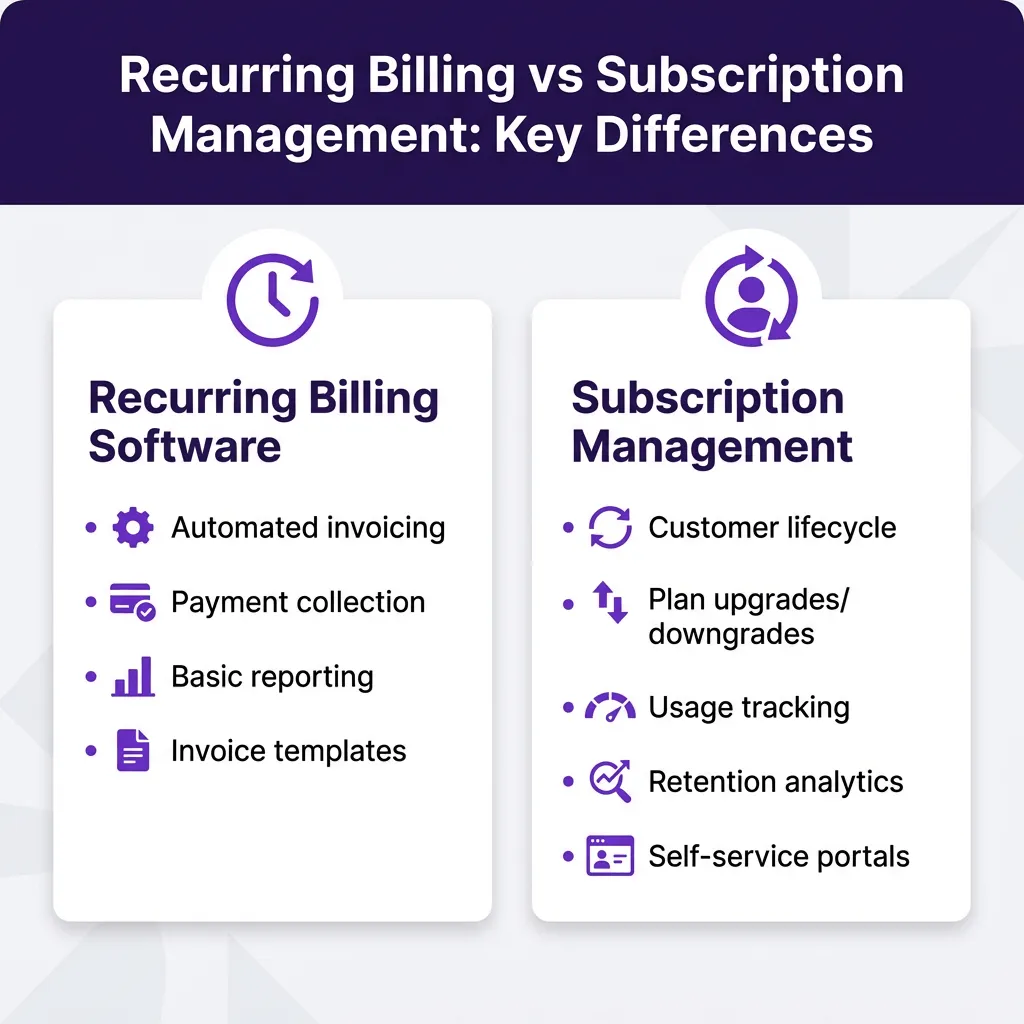
- Automated invoice generation — Creates and sends invoices based on predefined schedules (monthly, quarterly, annually)
- Payment collection — Processes credit cards, ACH transfers, and digital wallets automatically
- Payment retry logic — Attempts failed payments multiple times before flagging accounts
- Basic reporting — Tracks revenue, outstanding invoices, and collection rates
- Invoice templates — Customizes branding and formatting for customer communications
Popular recurring billing tools include ChargeOver, Invoice Ninja, and the billing modules within accounting software like QuickBooks and Xero. These solutions work well for businesses with straightforward subscription models where customers sign up, pay on schedule, and rarely change their plans.
Honestly, if you’re running a simple SaaS with one or two pricing tiers and minimal customer churn, recurring billing software might be all you need. The problem? Most SaaS companies aren’t that simple for long.
What Is Subscription Management Software?
Subscription management software goes far beyond billing. It handles the entire customer lifecycle from signup through cancellation, including all the messy changes that happen in between. This is where the real complexity of SaaS operations lives.
A robust subscription management platform includes:
- Plan management — Upgrades, downgrades, proration, and grandfathering
- Customer self-service portals — Let customers modify their own subscriptions
- Usage tracking and metering — Essential for usage-based or hybrid pricing models
- Retention tools — Dunning management, cancellation flows, and win-back campaigns
- Revenue analytics — MRR, ARR, churn rate, LTV, and cohort analysis
- Multi-currency and tax handling — Global compliance for international sales
- Integration ecosystem — CRM, accounting, and marketing automation connections
Platforms like Chargebee, Recurly, and Stripe Billing fall into this category. They’re built for SaaS companies that need flexibility — businesses with multiple pricing tiers, usage-based components, enterprise contracts, and complex billing scenarios.
In my experience, most SaaS founders underestimate how complex their billing will become. You start with a simple $29/month plan. Then you add a $99 tier. Then enterprise customers want annual contracts with quarterly invoicing. Then you introduce usage-based API calls. Suddenly, your “simple” recurring billing needs have evolved into full subscription management requirements.
Key Differences: Side-by-Side Comparison
| Feature | Recurring Billing Software | Subscription Management |
|---|---|---|
| Primary Focus | Automating invoice generation and payment collection | Managing customer lifecycle and subscription changes |
| Plan Changes | Limited or manual handling | Automated upgrades, downgrades, and proration |
| Self-Service | Rarely included | Customer portals for subscription management |
| Usage Tracking | Not typically supported | Built-in metering for usage-based pricing |
| Revenue Analytics | Basic reporting only | MRR, churn, LTV, cohort analysis |
| Dunning/Retention | Basic retry logic | Sophisticated failed payment recovery |
| Global Tax Handling | Usually not included | Automated tax calculation and compliance |
| Pricing Models | Simple subscriptions | Tiered, usage-based, hybrid, custom |
| Integration Depth | Accounting focus | CRM, marketing, analytics ecosystem |
| Best For | Simple, stable subscription models | Growing SaaS with complex needs |
When to Choose Recurring Billing Software
Recurring billing software makes sense in specific scenarios. Don’t let sales teams convince you that you need enterprise subscription management if your needs are genuinely simple.
Choose recurring billing software when:
- You have 1-2 simple pricing tiers with minimal changes
- Your customers rarely upgrade, downgrade, or modify plans
- You don’t offer usage-based or metered billing
- Your customer base is primarily in one tax jurisdiction
- You already have separate tools for CRM and analytics
- Budget is tight and you need basic automation only
Service businesses, membership sites, and simple SaaS products with fixed pricing often fit this profile. A consultant charging $500/month for ongoing services doesn’t need subscription management — they need reliable recurring billing.
When You Need Full Subscription Management
Most SaaS companies eventually outgrow simple recurring billing. The question isn’t whether you’ll need subscription management — it’s whether you’ll realize it before the operational pain becomes critical.
You need subscription management when:
- Customers frequently upgrade, downgrade, or pause subscriptions
- You offer multiple pricing tiers or add-on products
- Your pricing includes usage-based components (API calls, storage, seats)
- You sell internationally and need multi-currency/tax support
- You want customers to self-manage their subscriptions
- Churn reduction and revenue retention are priorities
- You need detailed analytics on subscription metrics
- Sales teams negotiate custom contracts and terms
Here’s the reality: once you hit roughly $10K MRR with more than 100 customers, the administrative overhead of managing subscriptions manually or through basic recurring billing tools starts eating into your growth. At that point, subscription management software pays for itself through reduced churn and operational efficiency.
The Hidden Cost of Choosing Wrong
I’ve seen founders make expensive mistakes on both sides of this decision. Choosing subscription management when you need simple billing means paying 3-5x more for features you’ll never use. But choosing basic recurring billing when you need subscription management creates invisible costs that compound over time.
The hidden costs of under-investing include:
- Revenue leakage — Manual processes lead to missed charges, incorrect proration, and billing errors
- Customer churn — Friction in plan changes and lack of self-service frustrates customers
- Engineering time — Building workarounds for missing features diverts dev resources from product
- Opportunity cost — Inability to launch new pricing models limits revenue growth
- Compliance risk — Manual tax handling creates exposure in global markets
A SaaS founder I advised recently discovered they’d been undercharging enterprise customers by 15% for six months because their recurring billing tool couldn’t handle the complex pricing rules in their contracts. The cost of that mistake far exceeded what they would have spent on proper subscription management.
Popular Tools Compared
| Tool | Category | Best For | Starting Price |
|---|---|---|---|
| ChargeOver | Recurring Billing | Small B2B services | $99/month |
| Invoice Ninja | Recurring Billing | Freelancers, agencies | Free-$16/month |
| Chargebee | Subscription Management | Growing B2B SaaS | $249/month |
| Recurly | Subscription Management | Enterprise SaaS | $249/month |
| Stripe Billing | Subscription Management | Technical teams | 0.5% on recurring |
| Paddle | Merchant of Record | Global SaaS | 5% + $0.50/transaction |
| Fungies | Merchant of Record | SaaS + digital products | 5% + $0.50/transaction |
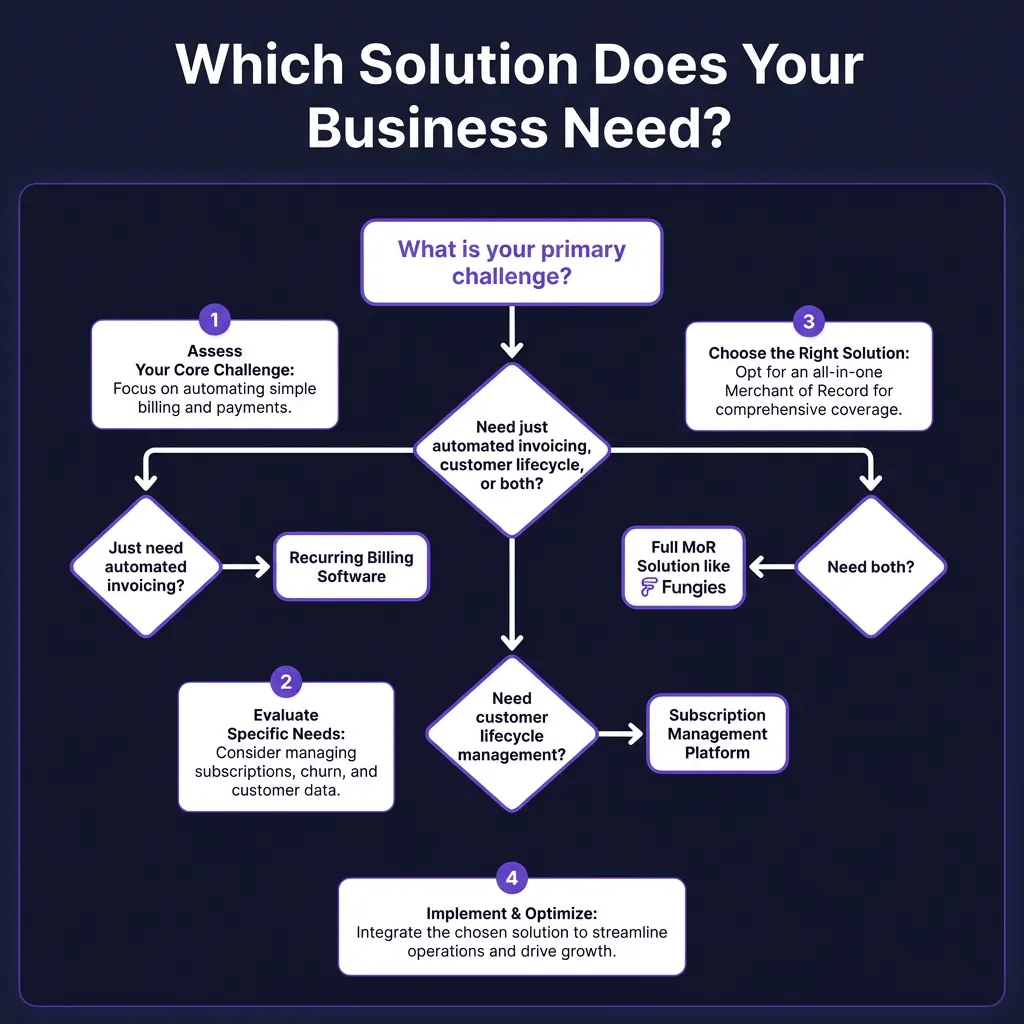
Note the distinction between subscription management platforms and Merchant of Record (MoR) solutions like Paddle and Fungies. MoR platforms include subscription management capabilities but also handle tax compliance, fraud prevention, and global payment processing — effectively becoming your reseller in every market you sell to.
The Merchant of Record Alternative
There’s a third option that many SaaS founders overlook: Merchant of Record platforms. These solutions combine subscription management with global tax compliance, fraud prevention, and localized payment methods. Instead of integrating billing software and then separately solving tax and compliance, an MoR handles everything.
Merchant of Record platforms like Fungies offer:
- Complete subscription management (upgrades, downgrades, proration)
- Global tax compliance (VAT, GST, sales tax) handled automatically
- Fraud prevention and chargeback protection
- Multiple payment methods and local currencies
- Simple integration (often just a few lines of code)
- No monthly fees — pay only when you make sales
For SaaS companies selling globally, an MoR can actually be cheaper than subscription management software once you factor in the cost of tax compliance tools, multiple payment processors, and the engineering time to maintain complex billing infrastructure. At 5% + $0.50 per transaction with no monthly fees, Fungies competes favorably with subscription management platforms that charge $249-$500+ monthly plus payment processing fees.
Making Your Decision: A Framework
Still unsure which direction to take? Here’s a simple framework based on where you are in your SaaS journey:
Stage 1: Validation ($0-$5K MRR)
Use simple recurring billing or even manual invoicing. Don’t over-invest in billing infrastructure before you’ve validated product-market fit. Stripe’s basic recurring payments or a simple PayPal subscription button might be enough.
Stage 2: Growth ($5K-$50K MRR)
This is where subscription management becomes valuable. You’re likely adding pricing tiers, dealing with upgrades/downgrades, and starting to sell internationally. Consider Chargebee, Recurly, or Stripe Billing.
Stage 3: Scale ($50K+ MRR)
At this stage, the cost of subscription management software plus separate tax compliance tools often exceeds the cost of a Merchant of Record solution. If you’re selling globally, evaluate whether an MoR like Fungies or Paddle makes more sense than managing billing, tax, and compliance separately.
FAQ: Recurring Billing vs Subscription Management
Can I use recurring billing software for a SaaS product?
Yes, if your SaaS has simple, fixed pricing with minimal plan changes. However, most SaaS products eventually outgrow basic recurring billing as they add pricing tiers, usage-based components, or enterprise contracts.
What’s the difference between subscription billing and subscription management?
Subscription billing focuses specifically on generating invoices and collecting payments. Subscription management encompasses the entire customer lifecycle, including plan changes, usage tracking, retention analytics, and self-service capabilities.
Do I need subscription management from day one?
Probably not. Most early-stage SaaS companies can start with simple recurring billing and migrate to subscription management as complexity grows. However, migrating billing systems is painful — if you anticipate rapid growth or complex pricing, starting with subscription management might save you a migration later.
Is a Merchant of Record better than subscription management?
For SaaS companies selling globally, an MoR often provides better value because it includes subscription management plus tax compliance, fraud protection, and global payment processing in one solution. For domestic-only businesses, traditional subscription management might be more cost-effective.
How much should I budget for subscription management software?
Subscription management platforms typically start at $249-$500 per month for growing SaaS companies, plus payment processing fees (usually 2.9% + $0.30 per transaction). Merchant of Record solutions like Fungies charge a percentage of revenue (5% + $0.50 per transaction) with no monthly fees.
Conclusion: Choose Based on Complexity, Not Price Alone
The recurring billing vs subscription management decision isn’t just about comparing monthly costs. It’s about matching your tools to your operational complexity and growth trajectory.
Start simple if you’re pre-product-market fit. Invest in subscription management when billing complexity starts consuming your time. And consider a Merchant of Record when global expansion and compliance become priorities.
The founders who get this right don’t just save money — they build billing infrastructure that scales with their business instead of constantly fighting against it.
Ready to simplify your SaaS billing? Create your free Fungies account and start accepting payments globally with built-in subscription management, tax compliance, and fraud protection — all at 5% + $0.50 per transaction with no monthly fees.
Sources
- Chargebee — Recurring Billing Software Guide
- Stax Bill — Subscription Billing vs Management Software
- Salesforce — Best Recurring Billing Software 2026
- HubiFi — Subscription Management Software Features
- Turnstile — Best Recurring Billing Software Tools 2026
- Niora AI — Subscription Management for SaaS 2025