How to Reduce SaaS Churn: The Complete 2026 Guide to Retention Strategies
Learn how to reduce SaaS churn with proven 2026 strategies. Discover churn benchmarks by segment, calculate NRR correctly, and implement 8 retention tactics that actually work. Complete guide with data from 939+ B2B SaaS companies.
Here’s a number that should keep every SaaS founder up at night: 70% of customer churn happens in the first 90 days. That means most of your users decide whether to stick around before they’ve even fully explored your product. And if you’re relying on the old “5% monthly churn is average” rule, you’re working with data that blends B2B with B2C, monthly with annual, and enterprise with SMB into one meaningless average.
The truth is, churn isn’t just a customer success problem. It’s a growth problem. A revenue problem. And in 2026, with acquisition costs climbing and competition intensifying, reducing churn has become the highest-leverage growth lever most companies underinvest in.
What Is SaaS Churn Rate (And Why Most Teams Measure It Wrong)
Churn rate measures the percentage of customers or revenue you lose over a given period. But here’s where it gets complicated: there are two types of churn, and most teams only track one.
Customer churn (logo churn) counts the number of accounts you lose. If you start the month with 1,000 customers and lose 50, that’s 5% customer churn. Simple enough.
Revenue churn measures the dollar value of recurring revenue lost to cancellations and downgrades. This is where things get interesting. You can have positive customer churn (losing accounts) but negative revenue churn if your expansion revenue from retained customers exceeds what you lost.
Then there’s Net Revenue Retention (NRR) — the metric that matters most to investors. NRR measures how much revenue you retain and grow from your existing customer base over 12 months. A 110% NRR means you’re growing 10% annually from existing customers alone, before any new sales.
SaaS Churn Benchmarks by Segment: Where Do You Stand?
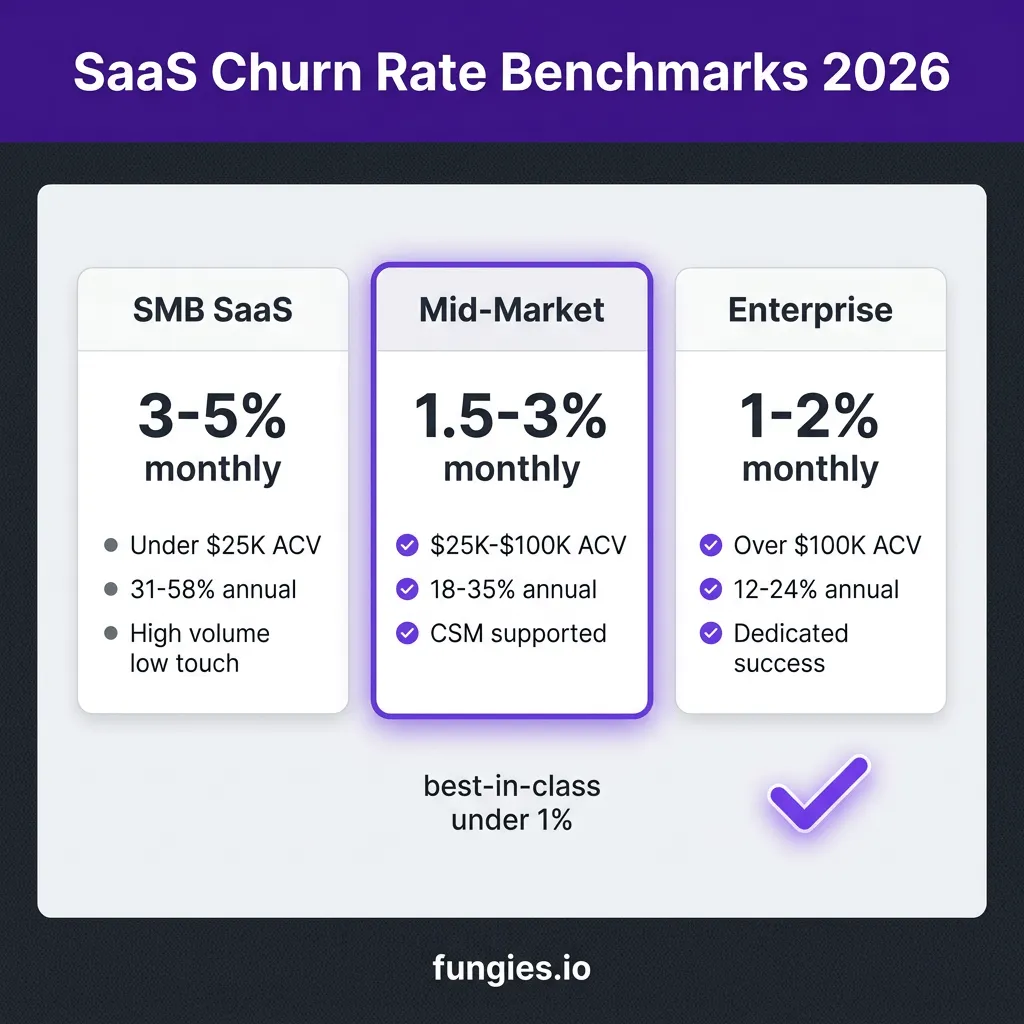
According to Optifai’s 2026 Pipeline Study of 939 B2B SaaS companies, churn varies dramatically by customer segment. Comparing yourself to a generic “industry average” is like comparing apples to spaceships.
| Segment | Monthly Churn | Annual Churn | ACV Range | Best-in-Class |
|---|---|---|---|---|
| SMB | 3-5% | 31-58% | Under $25K | <2% |
| Mid-Market | 1.5-3% | 18-35% | $25K-$100K | <1.5% |
| Enterprise | 1-2% | 12-24% | Over $100K | <1% |
The gap between enterprise and SMB is massive — a 21-point spread in annual churn rates. Enterprise SaaS with over $100K ACV typically sees 118% median NRR, while SMB SaaS under $25K ACV sits at 97%. That’s the difference between growing through your existing base and constantly fighting to refill a leaky bucket.
Bootstrapped SaaS companies with $3M-$20M ARR show median revenue growth of 15%, NRR of 103%, and Gross Revenue Retention of 91%. If you’re venture-backed, the median NRR is 106%, with top quartile companies hitting 117%.
The 5 Drivers of SaaS Churn (And How to Fix Each One)
Churn doesn’t happen in a vacuum. After analyzing thousands of SaaS companies, five consistent drivers emerge. Understanding which ones affect your business is the first step to fixing them.
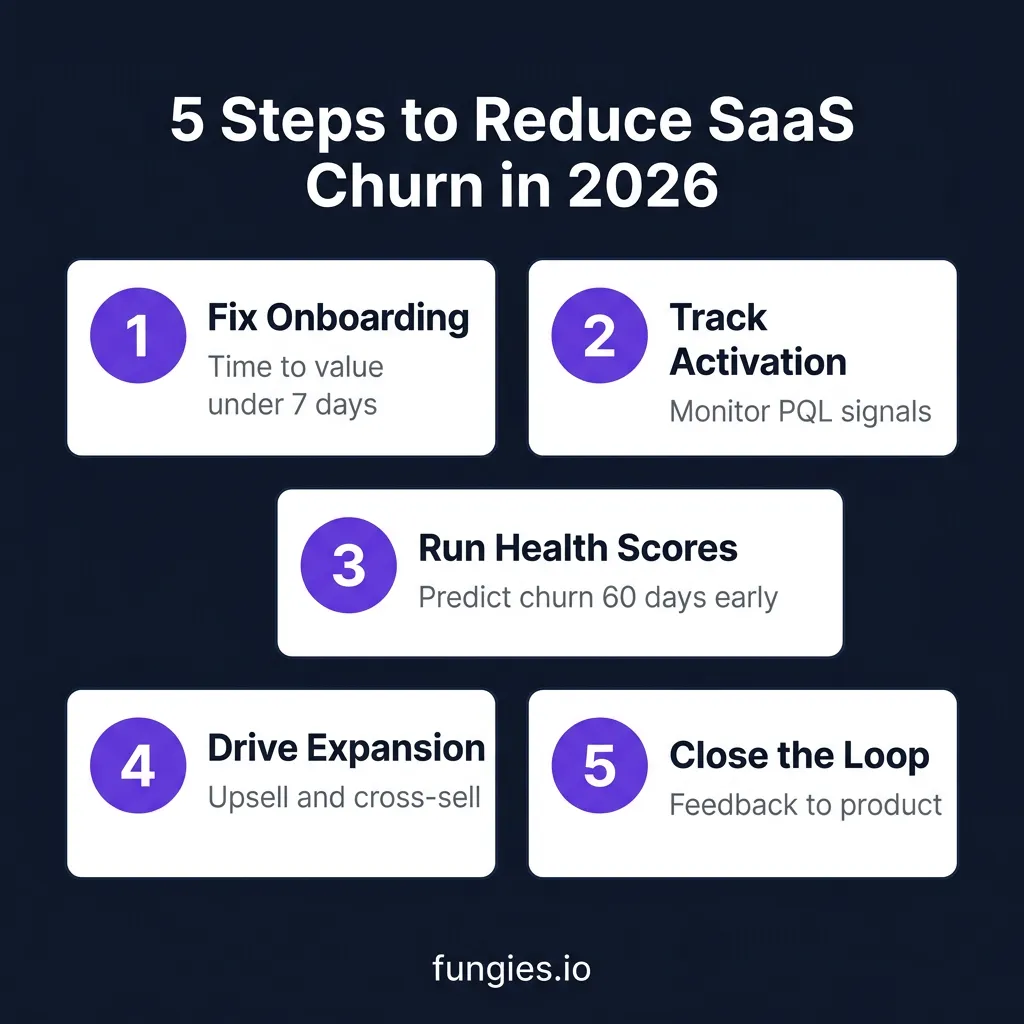
1. Poor Onboarding and Time-to-Value
This is the big one. Teams that get customers to first value in under 7 days see 50% lower churn rates than those taking longer. The first week sets the tone for the entire relationship.
Your onboarding should answer one question fast: “How does this product solve my specific problem?” Not «here are all our features.» Not «watch this 30-minute demo.» But «import your data and see results in 5 minutes.»
Interactive product tours, contextual tooltips, and progress indicators all help. But honestly? The best onboarding often means getting out of the user’s way. Strip away friction, don’t add more «helpful» popups.
2. Weak Activation and Feature Adoption
Activation is the moment a user experiences real value from your product. For a project management tool, it might be creating their first project and inviting a teammate. For analytics software, it’s seeing their first meaningful insight.
Users who don’t reach activation within the first session rarely come back. Track your activation rate religiously. Segment it by user type, acquisition channel, and plan tier. Then optimize the path to that aha moment.
3. Lack of Relationship Health Visibility
Here’s something that might surprise you: most B2B SaaS teams don’t churn because their product is bad. They churn because they’re flying blind inside customer accounts.
The leading indicators that actually predict churn — relationship health, sentiment, and strategic alignment — don’t show up in product analytics. NPS surveys generate 5-15% response rates and rarely capture the «why.»
Modern churn reduction requires structured customer conversations at scale. AI-led interviews can close that diagnostic gap, surfacing issues before they become cancellations.
4. No Expansion Revenue Strategy
It’s 60-70% easier to sell to existing customers than acquire new ones. Yet half of all SaaS companies underinvest in expansion.
Expansion revenue comes from three sources: upsells (customers upgrading to higher tiers), cross-sells (customers adding new products or modules), and usage-based growth (customers naturally consuming more as they grow).
44% of SaaS companies say they get more than 10% of new revenue from upselling and cross-selling. The best-in-class companies structure their pricing and packaging specifically to encourage natural expansion.
5. Reactive Instead of Predictive Churn Management
By the time a customer emails you saying they want to cancel, it’s usually too late. The decision was made weeks ago. Effective churn management requires predicting cancellations 60-90 days before they happen.
This means building health scores that combine product usage, support ticket sentiment, NPS trends, and relationship signals. When a score drops below a threshold, trigger a save play — not a generic «we miss you» email, but a targeted intervention based on why that specific account is at risk.
How to Calculate and Track the Right Churn Metrics
You can’t improve what you don’t measure. Here’s how to calculate the metrics that actually matter.
Customer Churn Rate
Formula: (Customers at start of period – Customers at end of period) / Customers at start of period × 100
Example: You start January with 1,000 customers. You gain 100 new ones but lose 50. Your customer churn rate is 50/1,000 = 5%.
Gross Revenue Churn
Formula: MRR lost to downgrades and cancellations / MRR at start of period × 100
This shows how much revenue you’re bleeding before accounting for expansion. A healthy gross revenue churn for B2B SaaS is under 10% annually.
Net Revenue Retention (NRR)
Formula: (Starting MRR + Expansion MRR – Contraction MRR – Churned MRR) / Starting MRR × 100
NRR over 100% means you’re growing from existing customers. Top-quartile SaaS companies hit 120%+. Anything under 100% means you’re shrinking even before accounting for acquisition costs.
8 Proven Strategies to Reduce SaaS Churn
Now for the actionable part. Here are eight strategies that actually move the needle, based on data from hundreds of SaaS companies.
1. Fix Your Onboarding in the First 7 Days
Remember: 70% of churn happens in the first 90 days. Your onboarding isn’t a product tour — it’s a guided path to first value. Map out the exact steps a user needs to take to experience your product’s core benefit, then remove every obstacle in their way.
Personalize based on use case. A marketer using your analytics tool needs a different path than a product manager. Ask one question during signup («What brings you here?») and customize the experience accordingly.
2. Implement Product-Qualified Leads (PQLs)
Not all signups are equal. A PQL is a user who has taken actions indicating they’re ready to buy or expand. Maybe they’ve invited 3 teammates, used a premium feature, or hit a usage threshold.
Track these signals and trigger sales outreach when they fire. PQLs convert at 3-5x the rate of cold leads because they’ve already experienced value.
3. Build a Health Score That Predicts Churn
Combine product usage (login frequency, feature adoption), support interactions (ticket volume, sentiment), and relationship signals (NPS, survey responses) into a single health score per account.
Segment accounts into green (healthy), yellow (at risk), and red (critical). Assign different playbooks to each segment. Green accounts get expansion outreach. Yellow gets check-in calls. Red gets executive attention.
4. Run Quarterly Business Reviews (QBRs)
For mid-market and enterprise accounts, QBRs are non-negotiable. These aren’t sales calls — they’re strategic conversations about the customer’s goals, your product’s impact, and what’s coming next.
Come prepared with data: usage trends, ROI calculations, and recommendations for expansion. End every QBR with agreed next steps and a scheduled follow-up.
5. Create a Customer Advisory Board
Your most engaged customers want to shape your roadmap. Give them a formal channel to do so. A customer advisory board meets quarterly to provide feedback on product direction, beta test new features, and advocate for your brand.
Advisory board members have significantly lower churn rates because they feel invested in your success. They’re also your best source of case studies and referrals.
6. Implement Usage-Based Pricing Triggers
If your pricing is usage-based, set up notifications when customers approach plan limits. Don’t wait for them to hit a wall — proactively suggest upgrades with clear value explanations.
«You’re at 85% of your monthly API calls. Based on your growth rate, you’ll hit your limit in 5 days. Upgrading to Pro gives you 3x the volume plus priority support.»
7. Build a Cancellation Save Flow
When someone clicks «cancel,» don’t just let them go. Ask why. Offer alternatives. Provide a downgrade option. Sometimes a temporary pause is better than permanent churn.
Analyze cancellation reasons monthly. If 30% of churn is due to pricing, that’s a signal. If it’s missing features, that’s product feedback. Use churn data to drive prioritization.
8. Close the Feedback Loop
Customers who provide feedback want to know it was heard. When you ship a feature based on customer input, tell them. «You asked for CSV exports. We built them. Here’s how to use the new feature.»
This simple act builds loyalty. Customers who see their feedback implemented are 3x more likely to renew and 2x more likely to expand.
FAQ: SaaS Churn Reduction
What is a good churn rate for B2B SaaS?
It depends on your segment. SMB SaaS typically sees 3-5% monthly churn, mid-market 1.5-3%, and enterprise 1-2%. Best-in-class companies achieve under 1% monthly regardless of segment. Focus on improving your own trend rather than hitting an arbitrary benchmark.
How does churn affect SaaS valuation?
Massively. According to McKinsey research, reducing annual churn by 5 percentage points can increase a SaaS company’s enterprise value by 30-50% over five years. A 10-point improvement in NRR translates to a 20-30% valuation uplift. Investors prioritize NRR above growth rate and gross margin.
What’s the difference between gross and net revenue retention?
Gross revenue retention (GRR) measures revenue kept from existing customers before expansion. Net revenue retention (NRR) includes expansion revenue. A company with 90% GRR and strong expansion can hit 115% NRR — meaning they grow 15% annually from existing customers alone.
How can I predict churn before it happens?
Build a health score combining product usage (login frequency, feature adoption), support sentiment (ticket volume, CSAT), and relationship signals (NPS trends, engagement with communications). Flag accounts that drop below thresholds and trigger save plays 60-90 days before expected cancellation.
Should I focus on acquisition or retention?
Both, but retention compounds. Acquiring a new customer costs 5-7x what it costs to retain an existing one. Every 1% reduction in monthly churn compounds into 12%+ in annual net revenue retention. Fix your leaky bucket before pouring more water in.
Conclusion: Make Retention Your Growth Engine
Churn reduction isn’t a customer success initiative. It’s a company-wide operating principle. From product decisions to pricing strategy to sales compensation, every function impacts retention.
The SaaS companies winning in 2026 treat NRR as their North Star metric. They instrument product engagement to predict churn 60-90 days early. They run structured save plays based on churn drivers, not gut feel. And they close the feedback loop so customers feel heard.
Start with your onboarding. Get users to first value in under 7 days. Then build your health scoring system. Segment your customers and assign different playbooks to each tier. Finally, create a churn analysis loop — review cancellations monthly, identify root causes, and fix them systematically.
The best part? Every improvement compounds. A 5% reduction in churn doesn’t just add revenue this quarter — it adds revenue forever. That’s the power of retention.
Ready to reduce churn and grow your SaaS revenue? Get started with Fungies.io today and join thousands of SaaS companies streamlining their billing and revenue operations.
Sources
- Optifai Pipeline Study 2026 — 939 B2B SaaS companies churn benchmarks
- SaaS Capital 2026 Benchmarking Survey — 1,000+ private B2B SaaS companies
- ChartMogul Subscription Growth Benchmark 2024 — 2,100 companies
- McKinsey SaaS Research — Churn impact on valuation
- Recurly Subscription Metrics — 76M+ subscribers across 2,200 merchants
- SubJolt Churn Rate Benchmarks 2026
- CRV SaaS Churn Rate Benchmarks for Investors 2026