SaaS Churn Reduction: The Complete 2026 Guide to Retaining Customers and Maximizing Revenue
Discover proven SaaS churn reduction strategies for 2026. Learn how top companies achieve <5% annual churn through optimized onboarding, health scoring, and proactive customer success. Includes benchmarks, frameworks, and actionable tactics.
Here’s a sobering statistic: reducing your annual churn by just 5 percentage points can increase your SaaS company’s enterprise value by 30–50% over five years. That’s not marketing fluff—that’s McKinsey research. And yet, most founders I talk to still treat churn like a secondary metric, something to worry about after they’ve nailed acquisition.
Honestly? That’s backwards. In 2026, with customer acquisition costs climbing 15% year-over-year and AI making it easier than ever for competitors to copy features, retention is your real moat. The companies winning right now aren’t just growing fast—they’re keeping what they have.
What Is SaaS Churn Rate (And Why It Matters More Than Ever)
Churn rate measures the percentage of customers or recurring revenue you lose within a specific period. Simple enough. But here’s where it gets interesting: not all churn is created equal, and not all churn metrics tell the same story.
There are two primary types you need to track:
- Customer churn (logo churn): The percentage of customers who cancel their subscriptions. If you had 100 customers and lost 5, your customer churn is 5%.
- Revenue churn: The percentage of recurring revenue lost from those customers. This matters because not all customers pay the same—losing one enterprise account hurts way more than losing ten free users.
Then there’s gross revenue retention (GRR) versus net revenue retention (NRR). GRR measures what you keep from existing customers without counting expansion revenue. NRR includes upsells, cross-sells, and upgrades. A healthy SaaS business should have GRR above 85% and NRR above 100%—ideally pushing toward that coveted 120%+ that top-quartile companies achieve.
SaaS Churn Benchmarks: Where Do You Stand?
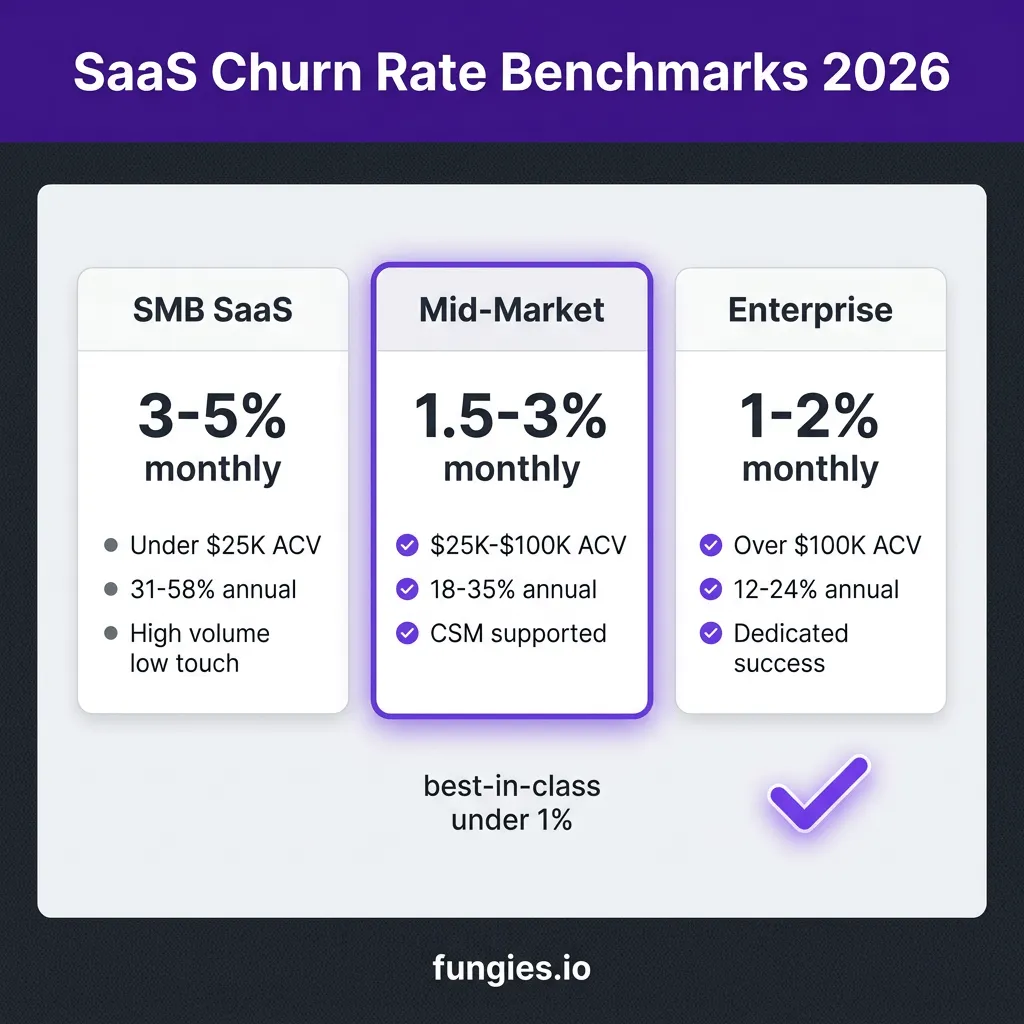
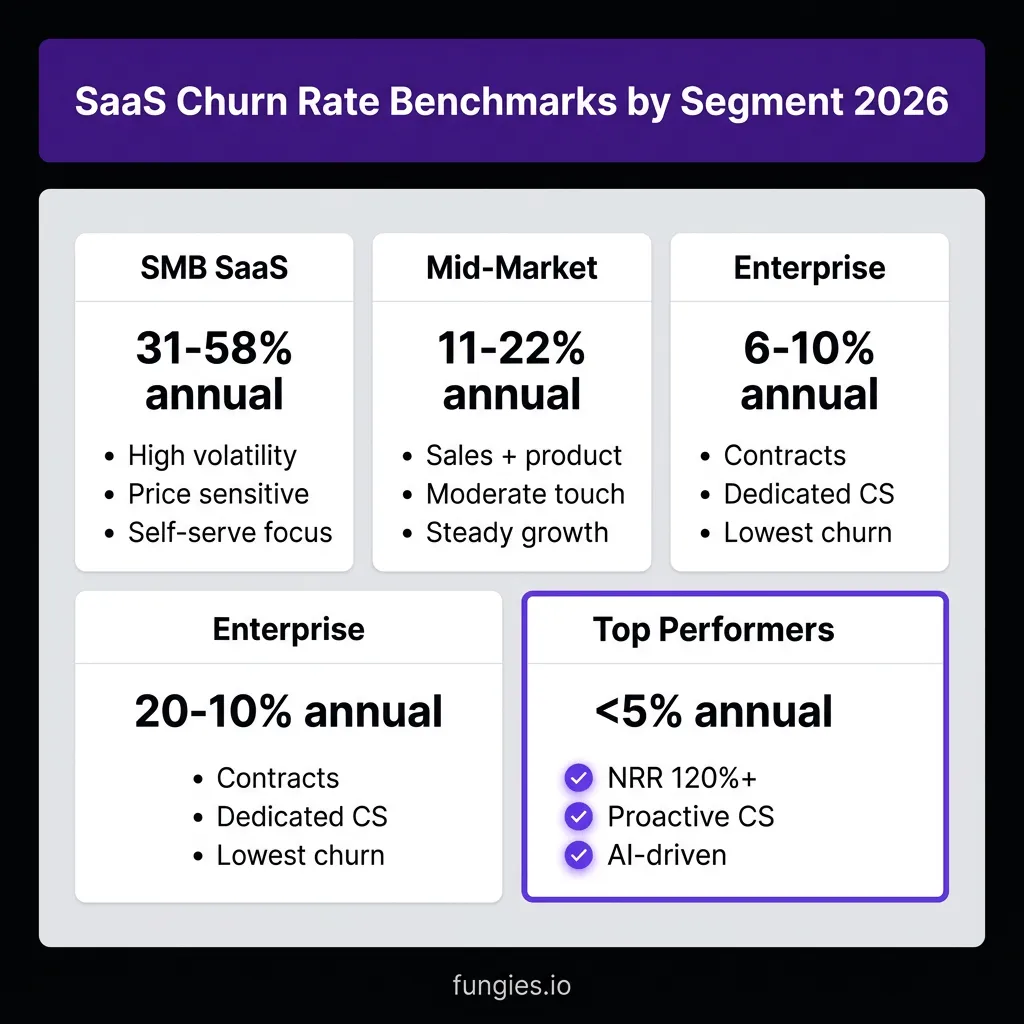
Before you can improve, you need to know what “good” looks like. Based on 2026 data from SaaS Capital, ChartMogul, and Optifai’s pipeline study of 939+ B2B SaaS companies, here are the benchmarks:
| Company Segment | Annual Churn Range | Monthly Equivalent | Key Characteristics |
|---|---|---|---|
| SMB SaaS | 31–58% | 3–6% | High volatility, price-sensitive, self-serve |
| Mid-Market | 11–22% | 1–2% | Hybrid sales/product motion |
| Enterprise | 6–10% | 0.5–0.8% | Annual contracts, dedicated CSMs |
| Top Performers | <5% | <0.4% | NRR 120%+, proactive CS, AI-driven |
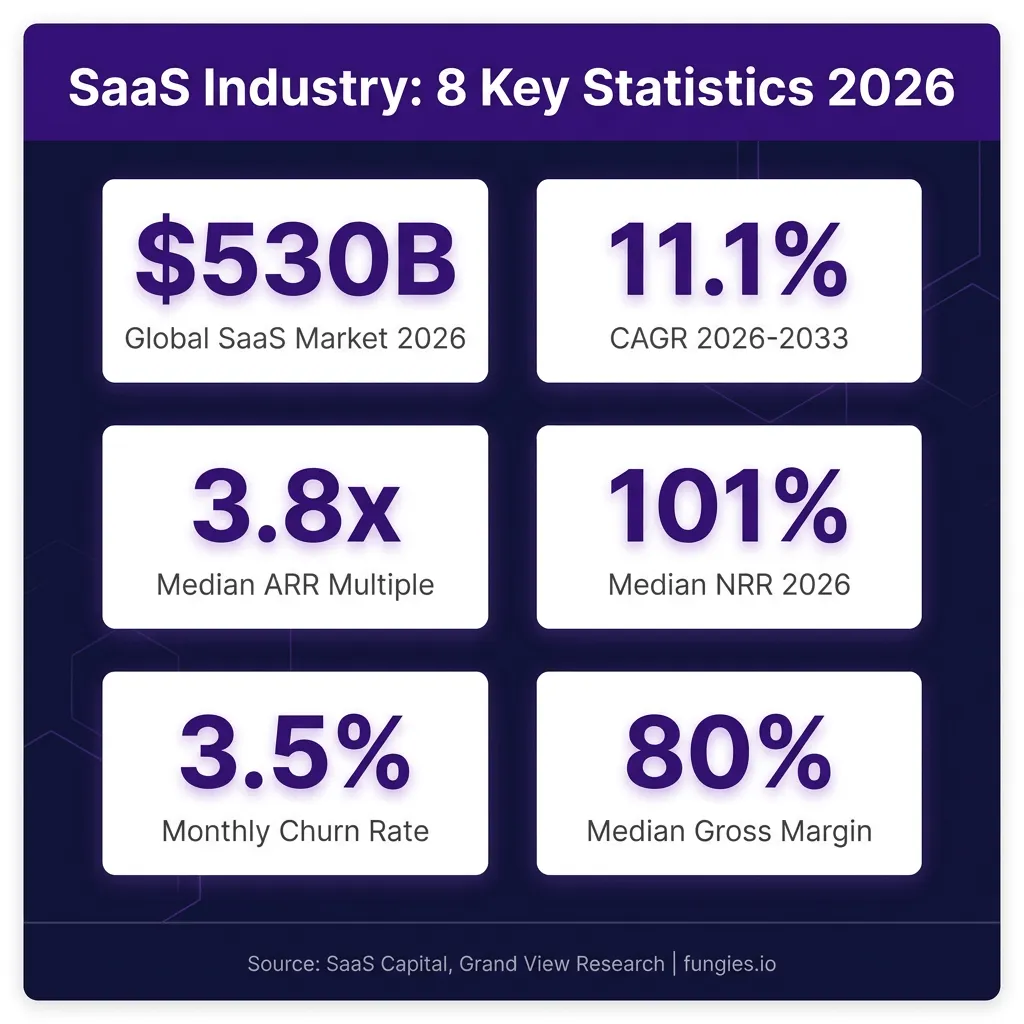
The average monthly churn across all subscription businesses sits at 5.3%, but that number is almost meaningless without context. A 5% monthly rate might be fine for a subscription box business where 68% of churn comes from failed payments, not active cancellations. For B2B SaaS? That’s an emergency.
Here’s something that might surprise you: annual plans reduce churn by roughly half compared to monthly subscriptions. Annual subscribers are about 2x more profitable over their lifetime. If you’re not offering (and incentivizing) annual billing, you’re leaving money on the table.
The Real Cost of Churn (Do This Math)
At 3% monthly gross churn, you lose 30% of your cohort’s ARR each year before any expansion. Let that sink in. You could be growing 50% year-over-year through new sales and still be flat if your churn is high enough.
The math is unforgiving. Let’s say you’re at $1M ARR with 10% annual churn:
- Year 1: You need $100K in new ARR just to break even
- Year 5: You’ll need $161K in new ARR just to maintain (assuming no growth)
- By year 10: You need $260K in replacement ARR annually
Now flip it. Drop that churn to 5% annual:
- Your compound growth effect accelerates dramatically
- Customer lifetime value doubles
- Your CAC payback period gets cut in half
This is why investors now treat NRR as the single most reliable indicator of SaaS business quality—valuing it above growth rate, above gross margin, and often above absolute revenue. Companies with NRR of 120%+ command median EV/revenue multiples of 21x versus roughly 9x for companies below that threshold.
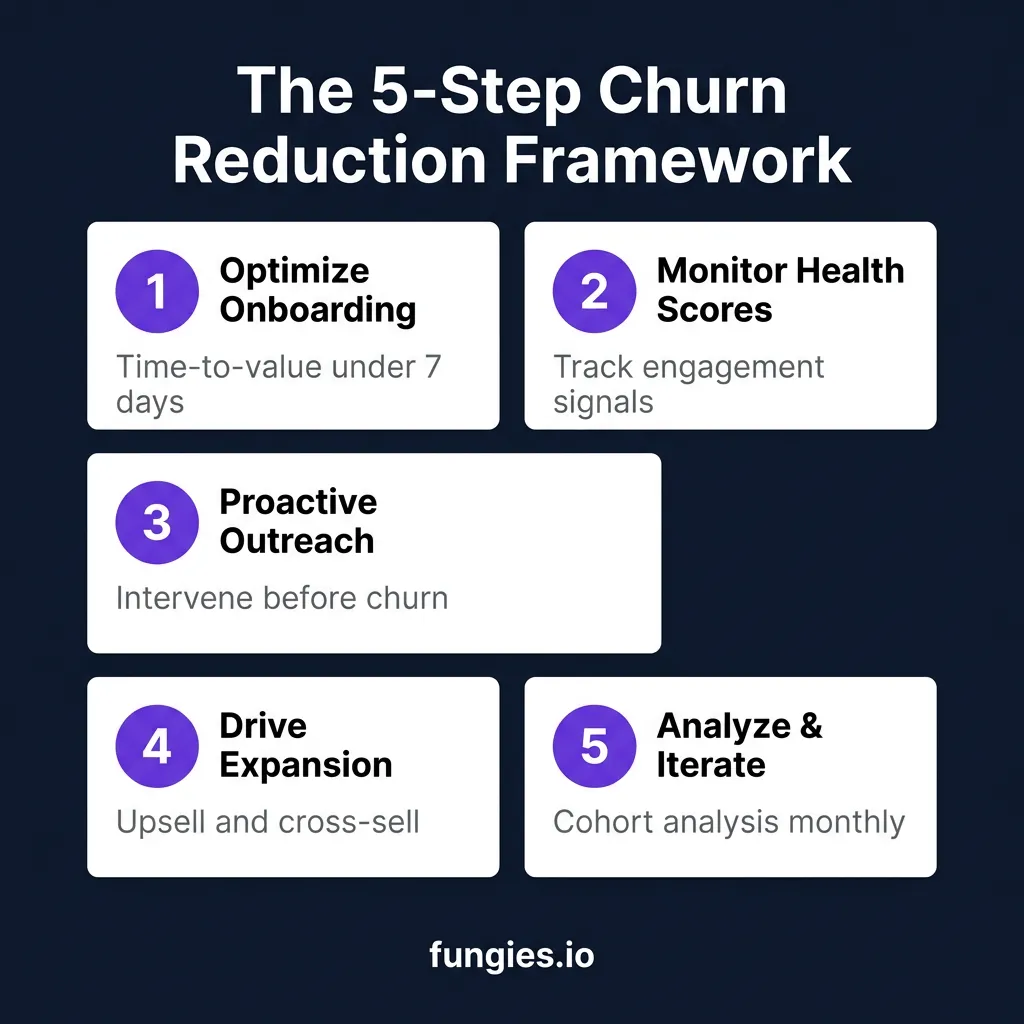
The 5-Step Churn Reduction Framework
After analyzing hundreds of SaaS companies and their retention strategies, I’ve identified five core pillars that separate the top performers from everyone else. This isn’t theory—these are the specific tactics working in 2026.
Step 1: Optimize Onboarding for Time-to-Value
Companies with strong onboarding (time-to-first-value under 7 days) see 50% lower churn rates. This is your highest-leverage intervention.
The mistake most SaaS companies make? They confuse “onboarding completed” with “value received.” Just because someone clicked through your tutorial doesn’t mean they’re getting what they paid for. You need to measure actual outcomes.
Here’s what best-in-class onboarding looks like:
- Single milestone focus: Identify the one action that correlates most strongly with retention (usually completing a core workflow or inviting team members), then optimize ruthlessly for that.
- Progressive disclosure: Don’t dump every feature on day one. Introduce capabilities as users need them.
- Multiple paths: Self-serve for the DIYers, guided tours for the hand-holders, and 1:1 onboarding for enterprise.
- Exit interviews for incomplete onboarding: If someone ghosts during setup, reach out within 24 hours. You’ll learn more from these conversations than any survey.
Step 2: Implement Health Scoring (Before It’s Too Late)
Telemetry tells you who is churning; it almost never tells you why in time to save the account. That’s where health scoring comes in.
A good health score combines:
- Product usage: Login frequency, feature adoption, depth of use
- Engagement: Support ticket sentiment, NPS responses, community participation
- Business context: Contract value, renewal date, stakeholder changes
- Expansion signals: Team growth, API usage increases, feature requests
The key is building automated triggers. When a health score drops below a threshold, your CS team should get alerted immediately—not in a weekly report, but in real-time. Speed matters. A customer who hasn’t logged in for 14 days is salvageable. One who hasn’t logged in for 60 days? Probably not.
Step 3: Proactive Outreach (Not Just When They’re Leaving)
Most churn reduction happens before the cancellation request. The best CS teams don’t wait for red flags—they look for yellow ones.
Run structured conversations at these four moments:
- Onboarding stalls: If someone hasn’t hit their first milestone within 48 hours, intervene.
- Health score downgrades: Any drop should trigger a personalized check-in.
- The renewal window: Start renewal conversations 90 days out, not 30.
- Expansion gates: When customers hit usage limits, that’s an opportunity—not just for upsell, but for relationship deepening.
AI-moderated customer conversations are becoming the norm here. Tools like Perspective AI can route telemetry signals into structured interviews, then feed insights back into your CS plays. The companies winning at retention treat NDR like a product surface, not just a CS KPI.
Step 4: Drive Expansion Revenue (The Anti-Churn)
Net revenue retention above 100% means you’re growing even without new customers. This is the holy grail of SaaS economics.
Expansion revenue comes from:
- Upsells: Moving customers to higher tiers
- Cross-sells: Adding complementary products or modules
- Usage-based growth: Natural expansion as customers grow (seats, API calls, storage)
- Annual prepay: Offering discounts for upfront annual payment (improves cash flow and retention)
The median NRR for bootstrapped SaaS companies with $3M–$20M ARR is 103%. Top performers hit 117.9%+. Every percentage point matters—at scale, a 5-point NRR improvement can mean millions in enterprise value.
Step 5: Cohort Analysis and Continuous Iteration
What gets measured gets managed. You should be running cohort analysis monthly, looking at:
- Retention curves by acquisition channel (some channels bring better-fit customers)
- Churn by feature adoption (which features correlate with stickiness?)
- Seasonal patterns (B2B SaaS often sees churn spikes in December/January)
- CSM performance (which CSMs retain best, and what do they do differently?)
Use this data to refine your ideal customer profile. Often, the fastest way to reduce churn is to stop selling to customers who were never going to stick around anyway.
Advanced Tactics for 2026
The basics will get you to “good.” These tactics will get you to “best-in-class.”
Payment Failure Recovery (The Hidden Churn)
Involuntary churn from failed payments can account for 20–40% of your total churn. This is pure leakage—you haven’t lost the customer’s intent, just their payment method.
Best practices:
- Retry logic with smart timing (not just “every day”)
- Pre-dunning emails before cards expire
- In-app payment update prompts
- Multiple payment methods on file
Tools like Churnkey and Butter have built entire businesses around this. For good reason—recovering failed payments is often the highest-ROI churn reduction tactic.
AI-Driven Churn Prediction
The top-quartile companies in 2026 aren’t just reactive—they’re predictive. They’re using machine learning models to identify at-risk accounts weeks before any human would notice.
These models analyze:
- Usage pattern changes (declining engagement is often the first signal)
- Support ticket sentiment (frustration precedes cancellation)
- Product stickiness metrics (which features create lock-in?)
- External signals (customer’s industry, funding news, hiring freezes)
You don’t need to build this yourself. Tools like Gainsight, ChurnZero, and Vitally have made predictive churn scoring accessible to mid-market SaaS companies.
The Hybrid PLG/SLG Motion
Product-led growth (PLG) and sales-led growth (SLG) aren’t mutually exclusive. The best retention strategies combine both.
Use PLG for:
- Low-touch onboarding and activation
- Self-serve expansion (upgrading tiers, adding seats)
- Product-qualified leads (PQLs) for sales
Use SLG for:
- Enterprise deals with complex procurement
- Strategic account management
- Custom implementations and integrations
The key is seamless handoffs. A user who starts self-serve shouldn’t feel friction when they need sales help—and an enterprise customer should still get value from the product during implementation.
FAQ: SaaS Churn Reduction
What is a good churn rate for SaaS?
For B2B SaaS, a “good” annual churn rate is generally below 5% (under 0.4% monthly). However, this varies significantly by segment: enterprise SaaS should aim for 6–10% annual churn, mid-market for 11–22%, and SMB SaaS often sees 31–58% due to higher price sensitivity and self-serve models.
What’s the difference between gross and net revenue retention?
Gross revenue retention (GRR) measures the percentage of recurring revenue retained from existing customers, excluding expansion. Net revenue retention (NRR) includes expansion revenue from upsells and cross-sells. A healthy SaaS business should have GRR above 85% and NRR above 100%—top performers push NRR above 120%.
How do I calculate churn rate?
Customer churn rate = (Customers at start of period – Customers at end of period) / Customers at start of period × 100. For revenue churn: (Revenue at start – Revenue at end) / Revenue at start × 100. Most SaaS companies track both monthly and annual churn, with annual being more relevant for B2B with longer sales cycles.
What’s the #1 factor in reducing churn?
Time-to-value. Companies that get users to their first “aha moment” within 7 days see 50% lower churn rates than those with longer onboarding. Everything else—health scoring, proactive outreach, expansion—is secondary to delivering value quickly.
Should I focus on new customers or reducing churn?
Both, but churn reduction often has higher ROI. Acquiring a new customer costs 5–7x more than retaining an existing one. Plus, existing customers are more likely to buy from you (60–70% probability vs. 5–20% for new prospects). If your churn is above benchmark for your segment, fix that first.
Conclusion: Retention Is the New Growth
The SaaS landscape in 2026 is more competitive than ever. Features get copied, ad costs rise, and AI is leveling the playing field. The one thing that’s hard to replicate? A customer base that loves your product and sticks around.
Churn reduction isn’t a one-time project—it’s a continuous discipline. The companies that treat retention as a core competency, not an afterthought, are the ones building durable, valuable businesses.
Start with onboarding. Measure everything. Intervene early. And remember: every customer you keep is worth more than the one you replace.
Ready to build a SaaS business with best-in-class retention? Get started with Fungies—the merchant of record platform that handles payments, tax compliance, and checkout so you can focus on what matters: building a product your customers love. Flat 5% + $0.50 per transaction. No monthly fees. No hidden charges.