How to Sell Digital Products Globally Without Worrying About VAT/Sales Tax
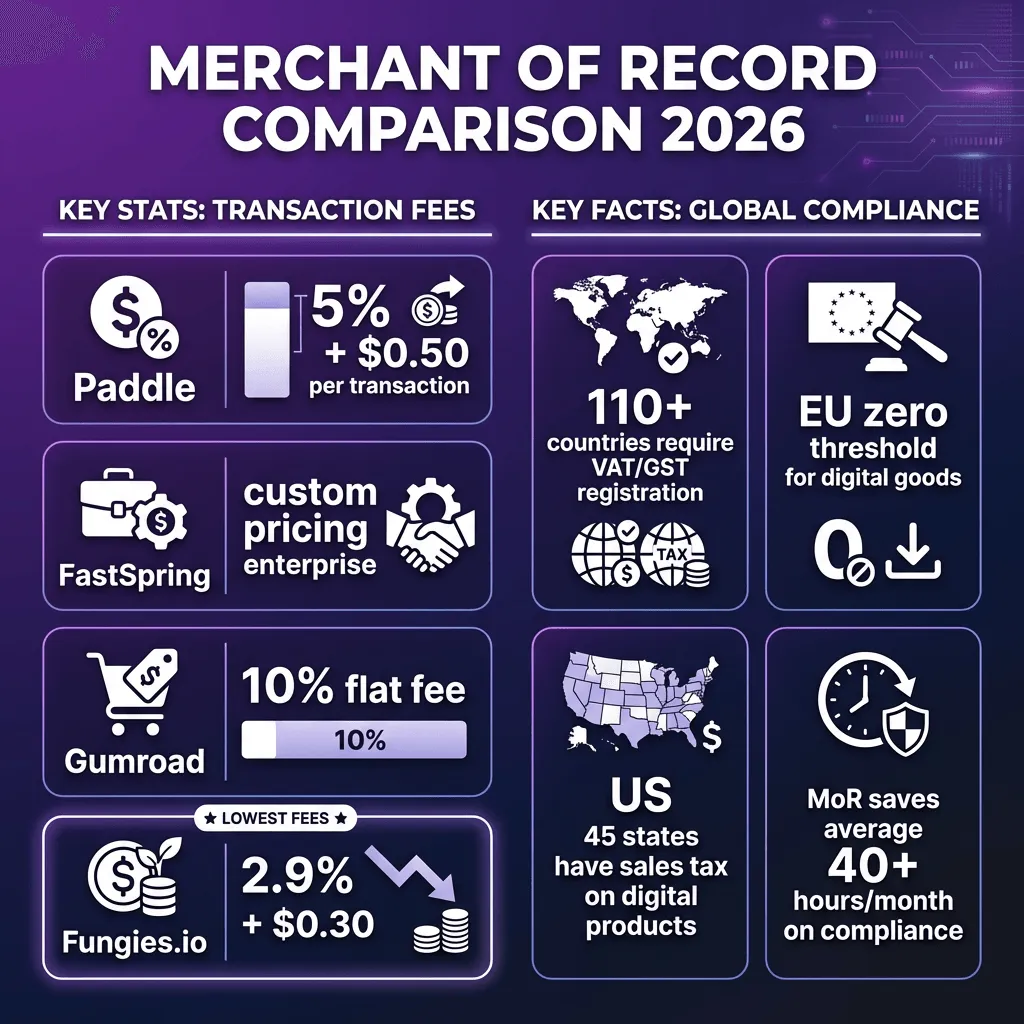
Here’s a number that should worry you: over 110 countries now require foreign digital sellers to register for VAT or GST. The EU has a zero threshold — meaning you owe tax from the very first euro you earn from a European customer. Sell one $9 ebook to someone in Germany, and you technically have
Here’s a number that should worry you: over 110 countries now require foreign digital sellers to register for VAT or GST. The EU has a zero threshold — meaning you owe tax from the very first euro you earn from a European customer. Sell one $9 ebook to someone in Germany, and you technically have a tax obligation. That’s not a niche edge case. That’s your reality in 2026.
If you’re selling digital products globally — SaaS, ebooks, templates, courses, plugins — and you’re still handling payments through Stripe or PayPal without an MoR layer, you’re exposed. The question isn’t if you’ll get caught, it’s when. And the penalties? Retroactive tax bills, frozen payment accounts, domain bans in entire regions.
There’s a cleaner path. This guide walks you through exactly how global digital tax works in 2026, what it costs to do it wrong, and how a Merchant of Record (MoR) eliminates the whole problem — without requiring a tax lawyer on retainer.
What Is a “Digital Product” for Tax Purposes?
Governments got smart. Almost every jurisdiction in 2026 treats SaaS, downloadable software, ebooks, courses, templates, plugins, and streaming services as taxable digital goods. The old defense — “we’re just software” — doesn’t hold up anymore.
The key definitions to know:
- VAT (Value Added Tax) — Used by EU, UK, Australia, Canada, and 100+ other countries. Applied to the customer’s location, not yours.
- GST (Goods and Services Tax) — Australia, New Zealand, Singapore, India. Same principle, different acronym.
- Sales Tax — US-specific. Varies by state. Not federal — 45 states have it, with different rules per state.
- DST (Digital Services Tax) — France, UK, India, and others. Extra tax layer targeting digital platforms.
If you’re wondering whether your product counts — it almost certainly does. SaaS is treated as a digital service in virtually every jurisdiction that taxes digital goods.
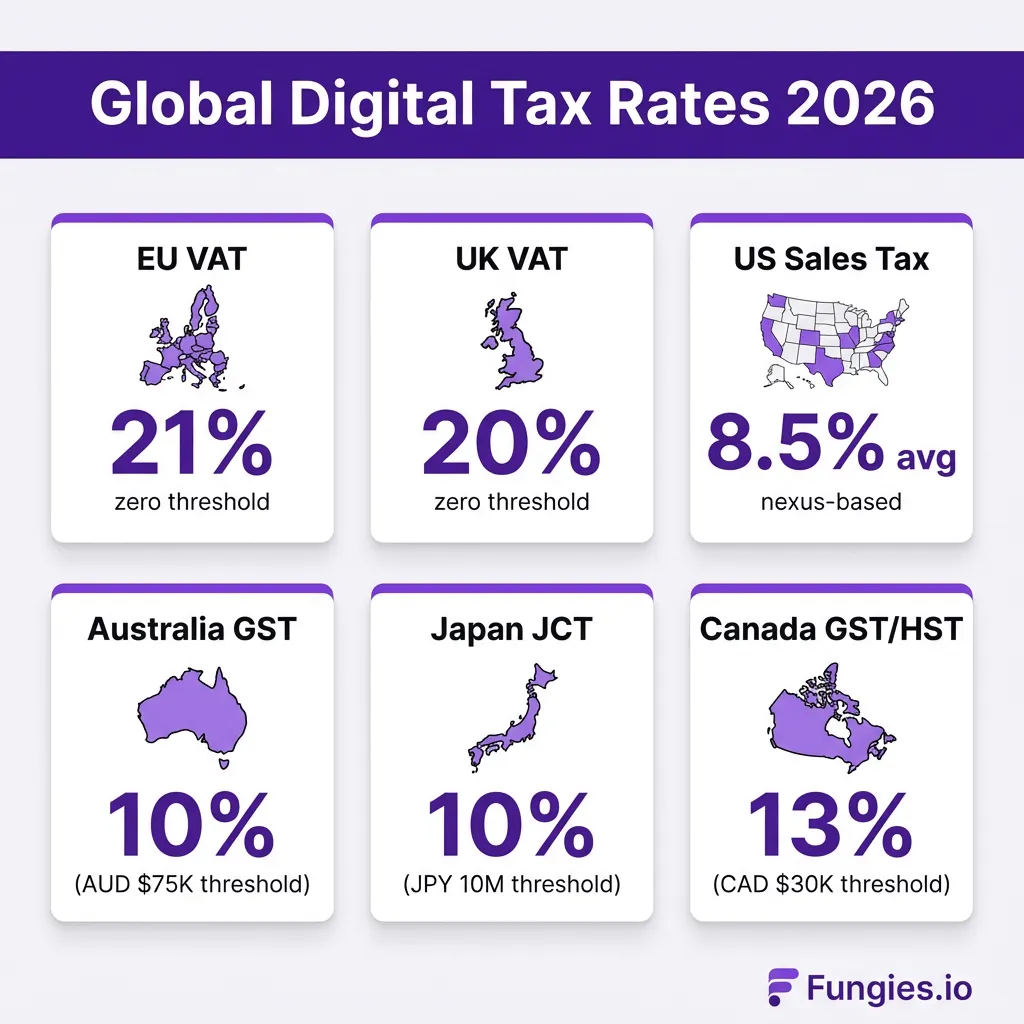
Global Digital Tax Rates in 2026: The Numbers You Need
The rate you need to collect depends entirely on where your customer is located at the time of purchase. Not where you’re incorporated. Not where your servers are. Where they are.
| Region | Tax Type | Average Rate (2026) | Threshold for Foreign Sellers |
|---|---|---|---|
| European Union | VAT | ~21% | €0 — from first sale |
| United Kingdom | VAT | 20% | £0 — from first sale |
| United States | Sales Tax | ~8.5% avg | Varies by state (nexus rules) |
| Australia | GST | 10% | AUD $75,000 |
| Japan | JCT | 10% | JPY 10 million |
| Canada | GST/HST | 13% | CAD $30,000 |
| India | GST | 18% | INR 2 million |
| Norway | VAT | 25% | NOK 50,000 |
The EU is the one that catches most indie founders off guard. There’s genuinely no minimum — if a single German customer buys your $5 Notion template, technically you owe 19% VAT on that transaction to the German tax authorities. And you’d need to be registered in the EU’s OSS (One Stop Shop) system to remit it.
Managing this across 27 EU member states, 50 US states, plus Australia, Canada, Norway, Japan, and the rest of the world? That’s a full-time compliance operation. Or one smart infrastructure decision.
The Real Cost of Doing It Yourself
Let’s be concrete about what “handling it yourself” actually means.
In the EU alone, you’d need to:
- Register for the EU OSS (One Stop Shop) system
- Determine the correct VAT rate per EU country per transaction
- Collect two pieces of location evidence per sale (billing address + IP, or billing address + bank country code)
- File quarterly VAT returns
- Remit collected VAT in euros
- Keep transaction records for 10 years
For the US, you’d need to:
- Track economic nexus in every state (usually $100K in sales or 200 transactions per year)
- Register for sales tax permits in nexus states
- Calculate the correct rate per ZIP code (county + city + state layers)
- File monthly, quarterly, or annual returns per state
- Handle exemptions for B2B transactions
That’s 40+ hours per month in compliance overhead for a mature digital business, according to tax compliance firms. Plus ongoing legal costs. Plus the risk of getting it wrong.
Founders who’ve been audited describe it as one of the most expensive and time-consuming experiences of running a business — not because the tax itself was huge, but because of penalties, back-filing, and accounting fees.
What a Merchant of Record Actually Does
A Merchant of Record is the legal entity that stands between you and your customers in a transaction. When you use an MoR, they become the legal seller of your product. They collect the payment, apply the correct tax rate, remit it to the right authority, and handle any disputes.
From a customer’s perspective, the checkout experience is seamless — they buy from your brand. From a legal perspective, the MoR is the seller, which means the MoR carries the tax liability, not you.
Here’s what changes when you add an MoR:
| Without MoR | With MoR |
|---|---|
| You register for VAT/GST in 30+ countries | MoR handles all registrations globally |
| You calculate correct rate per transaction | Automatic tax calculation at checkout |
| You remit taxes quarterly per jurisdiction | MoR remits automatically |
| You handle chargebacks and disputes | MoR manages disputes and fraud |
| You maintain 10-year records per country | MoR maintains compliant records |
| You’re liable for tax errors | MoR assumes legal liability |
The MoR model isn’t new — companies like Paddle and FastSpring have been doing this for years. What’s changed is pricing and accessibility. In 2024–2025, new MoR platforms emerged specifically for indie developers and small digital product businesses, making this protection available at transaction fees comparable to Stripe.
MoR Platforms Compared: Fees, Coverage, and Trade-offs
Not all MoRs are equal. Here’s a direct comparison of the major players in 2026:
| Platform | Transaction Fee | Global Tax Coverage | Setup | Best For |
|---|---|---|---|---|
| Fungies.io | 2.9% + $0.30 | 100+ countries | <30 min | SaaS, digital products, indie devs |
| Paddle | 5% + $0.50 | Global | Approval required | Mid-market SaaS |
| FastSpring | Custom (enterprise) | Global | Sales call required | Enterprise software |
| Gumroad | 10% flat | EU + UK + US | Instant | Creators, simple products |
| Lemon Squeezy | ~5% + $0.50 | Global (Stripe-owned) | Approval required | SaaS (uncertain future) |
| Payhip | 5% standard | Limited | Instant | Creators, EU/UK focus |
The fee gap matters more than it looks. On $10,000 in monthly revenue:
- Fungies.io: ~$320 in fees
- Paddle: ~$530 in fees
- Gumroad: ~$1,000 in fees
That’s $680 in extra cost every month for the same compliance protection. Over a year, that’s $8,160 you could spend on ads, product development, or just not paying unnecessarily.
Lemon Squeezy deserves a special mention. Stripe’s 2024 acquisition created uncertainty for thousands of existing LS customers. Stripe itself is not a Merchant of Record — Stripe processes payments but doesn’t assume tax or compliance liability. Whether Lemon Squeezy retains its MoR status long-term post-acquisition remains unclear, which is why many founders are migrating to alternatives.
The B2B Loophole: Reverse Charge Mechanism
One important nuance: if your customers are other businesses (B2B), you might not need to collect VAT in the EU at all.
The EU’s reverse charge mechanism means that for B2B sales, the buyer is responsible for reporting and paying VAT — not you. If your customer provides a valid VAT registration number, you don’t charge VAT on the sale.
This is massive for SaaS companies with business customers. But there are catches:
- You must validate the VAT number in real-time via the EU’s VIES system
- If you accept a fake VAT number and it’s later flagged as invalid, you’re liable for the unpaid tax
- The reverse charge only applies in the EU — US, Australia, Japan still require collection even for B2B
An MoR handles this automatically. The checkout detects whether a VAT number is provided, validates it in real-time, and applies (or removes) VAT accordingly.
US Economic Nexus: The Trap Nobody Tells You About
The US situation is more complex than “just collect sales tax.” Economic nexus is the real trap.
Economic nexus means you owe sales tax in a state based on how much you sell there — not whether you have an office, employees, or any physical presence. Most states trigger nexus at $100,000 in sales or 200 transactions per year.
Founders assume they’re safe because they’re based in Europe or don’t have a US entity. They’re not. If you have enough US customers, you have tax obligations in multiple states. And the enforcement in 2026 is real — states are actively cross-referencing payment processor data to find non-compliant sellers.
The state-by-state patchwork is genuinely absurd:
- Colorado: SaaS and downloaded software not taxable, but digital books are
- Texas: Digital goods generally taxable, SaaS taxable
- California: SaaS not taxable (yet), but digital downloads often are
- Washington: Digital goods and SaaS both taxable
Getting this right requires constant monitoring. Your nexus status changes as your revenue grows. An MoR monitors your volume per state and automatically triggers compliance processes when you approach thresholds.
How to Switch to an MoR: The Practical Playbook
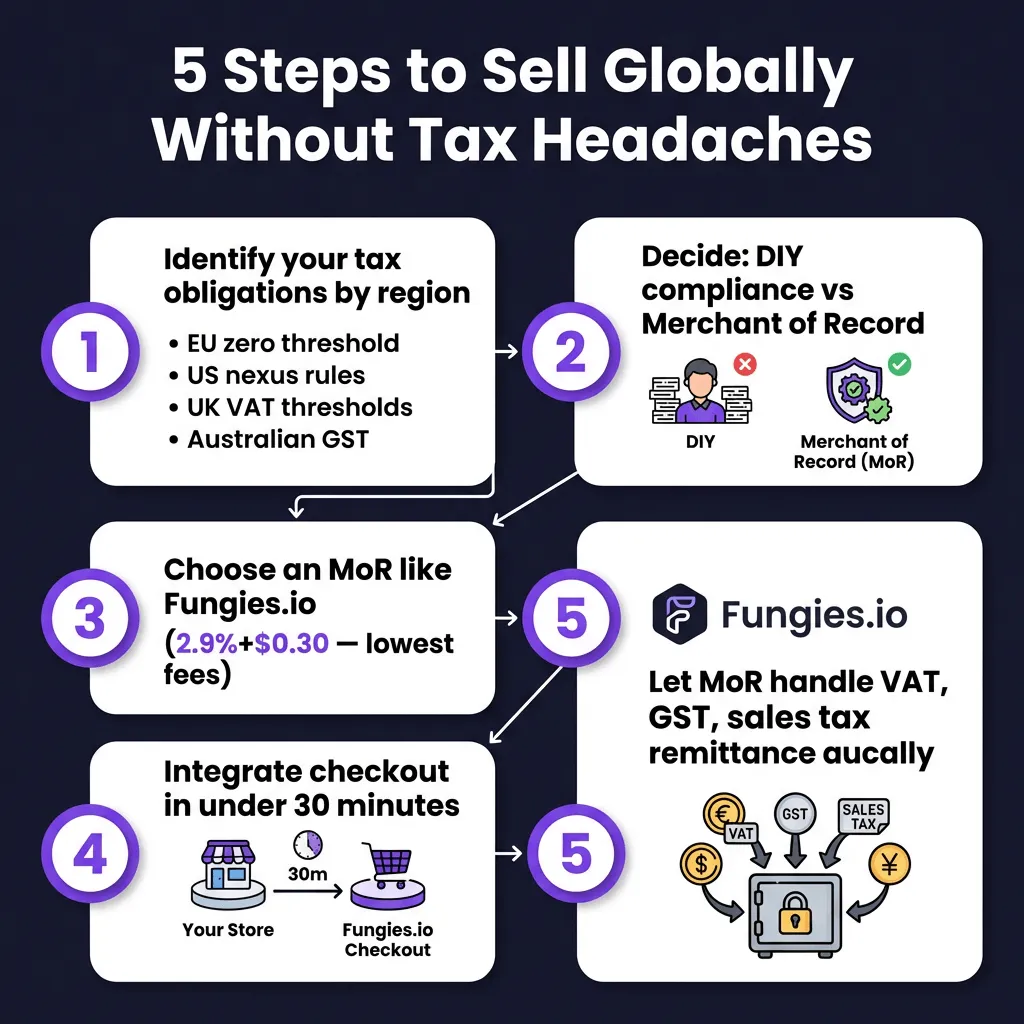
If you’re currently using Stripe or PayPal direct, switching to an MoR doesn’t have to be a big migration project. Here’s the realistic process:
Step 1: Audit your current tax exposure
Look at your last 12 months of revenue by country. Identify where you’ve been selling without collecting tax. For most indie founders, this is primarily EU and UK sales. The good news: proactively registering and starting to collect tax typically closes your liability — the IRS and EU authorities generally don’t pursue small sellers who fix the problem before being audited.
Step 2: Choose your MoR
For most digital product sellers and SaaS founders, the decision comes down to Fungies.io vs Paddle. Fungies offers significantly lower fees (2.9% + $0.30 vs 5% + $0.50) with the same global tax coverage. Paddle has a longer track record and more enterprise features if you’re at scale. FastSpring is worth evaluating for complex enterprise software needs.
Step 3: Integrate the checkout
Modern MoRs offer embeddable checkout that drops into your existing stack. Fungies integrates in under 30 minutes for most setups — it’s a few lines of JavaScript or a REST API call, not a month-long project. Your checkout can look exactly like your current one; the MoR layer is invisible to customers.
Step 4: Migrate your subscribers
If you have existing subscription customers on Stripe, coordinate the migration carefully. You’ll need to update payment methods for recurring subscribers. Most MoRs have migration guides and will help with this process.
Step 5: Shut down your direct payment setup
Once the MoR is live and handling new transactions, deprecate your direct Stripe setup for new sales. Keep historical transaction records — you’ll need them if any pre-MoR transactions get audited.
Key Takeaways
- The EU has a zero threshold for digital goods VAT — you owe tax from the first euro, even as a foreign seller. This is actively enforced in 2026.
- US economic nexus catches founders who assume they’re safe — $100K or 200 transactions per state triggers registration requirements, regardless of where your company is incorporated.
- A Merchant of Record eliminates the entire compliance problem — they become the legal seller, assume tax liability, and handle all remittances automatically.
- Fee comparison matters — Fungies.io at 2.9% + $0.30 vs Gumroad at 10% flat represents $680+/month in savings on $10K revenue, with identical compliance protection.
- Lemon Squeezy’s Stripe acquisition created uncertainty — if you’re on Lemon Squeezy, have a migration plan ready. Stripe itself is not an MoR and doesn’t handle your tax liability.
Frequently Asked Questions
Do I need to collect VAT if I’m a small indie developer selling a $10 plugin?
Technically, yes — if you sell to EU or UK customers. Both regions have zero thresholds for foreign digital sellers, meaning you owe VAT from the very first sale. Practically, enforcement of nano-businesses is rare, but the liability is real. The cleanest solution is using an MoR from day one so compliance is automatic and you never have to think about it.
Is Stripe a Merchant of Record?
No. Stripe is a payment processor. When you use Stripe, you remain the Merchant of Record — meaning you’re responsible for all tax collection, remittance, chargebacks, and compliance. Stripe provides tools to help (like Stripe Tax), but the legal liability stays with you. An MoR like Fungies.io or Paddle takes that liability off your plate entirely.
What happens if I’ve been selling globally without collecting VAT for years?
Proactive registration is your best option. Most tax authorities are more interested in future compliance than punishing small sellers who self-correct. Consult a tax professional to assess your specific exposure — in many cases, registering, starting to collect correctly, and filing going forward closes the issue without penalties. What you don’t want is to be discovered in an audit.
Does using a Merchant of Record affect my brand or customer experience?
Minimally. The MoR appears on the customer’s payment statement (e.g., “Fungies” instead of your company name), but your checkout, emails, and product experience remain fully branded. Most customers never notice. Some MoRs allow white-labeling the payment descriptor to reduce confusion.
The Bottom Line
Global digital tax in 2026 is genuinely complex. The rules change constantly, enforcement is getting stricter, and the penalties for getting it wrong can be business-threatening. The choice between “figure it out yourself” and “use an MoR” used to involve a meaningful fee trade-off. At 2.9% + $0.30, it no longer does.
If you’re building a digital product business with any international ambitions, a Merchant of Record is infrastructure — as fundamental as your payment processor, your hosting, or your analytics. The question isn’t whether to use one. It’s which one to use.
Ready to sell globally without the tax headaches? Start with Fungies.io — sign up free, no approval queue, live in under 30 minutes.
References
- Calcix: Digital Goods VAT Guide 2026
- 1StopVAT: Latest Trends in Global VAT Compliance 2026
- Global VAT Compliance: Digital Services VAT Rules 2026
- Dodo Payments: Sales Tax on Digital Goods by State
- Nexway: What Is a Merchant of Record? Guide 2026
- Fonoa: Global VAT & GST on Digital Services
- York.ie: Hidden Sales Tax Risks for SaaS in 2026