Sell the template on your terms, not a marketplace's.
Asset marketplaces set the price bands, take a large cut, keep the buyer, and put four competitors underneath your listing. Your own shop sells personal and commercial licences as variants, bundles them how you like, and pays out daily.














00 % + 50¢- the only cut taken
- $
00 - listing fee, ever
00 +- ways a buyer can pay
00 h- default payout cycle
Why leave the marketplace

Licences are just variants
Personal, commercial and extended sit on one product page at your prices, rather than being squeezed into whatever tiers a marketplace decided everyone should sell.

Nobody is listed underneath you
A marketplace product page exists to keep the buyer on the marketplace, which is why it shows them alternatives. Your own page does not have a competitor rail down the side.

Buyers come back for updates
The branded portal holds their purchase, so a new version is something they can fetch themselves. That is also how an asset pack becomes a subscription rather than a one-off.

Business buyers need invoices
Agencies and studios expense assets. A buyer who supplies a tax ID at checkout gets a proper invoice emailed automatically, which is what unblocks the purchase order.
Setting up the shop
- 01
Lay out the store
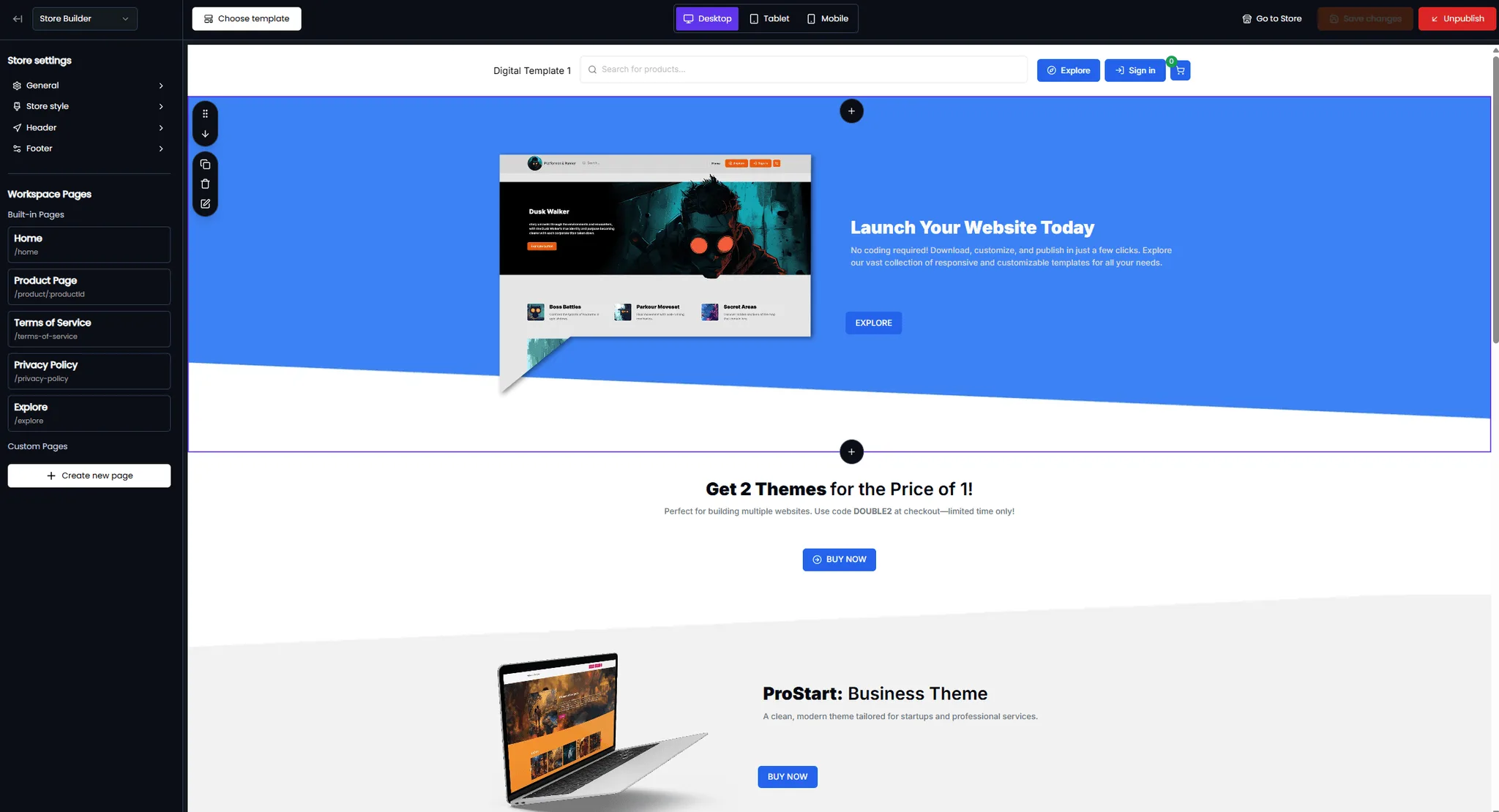
Previews, galleries and copy in the visual builder. It opens before you sign up, so you can see it first.
- 02
Add the licence tiers
One product, one variant per rights level. Price them for the buyer you actually want rather than the marketplace median.
- 03
Turn the billing step on
That is what lets an agency enter a tax ID and receive the invoice their finance team will ask for.
- 04
Ship updates through the portal
Existing buyers fetch the new version themselves, which turns a one-off sale into a reason to come back.
You could do all of this yourself
Selling digital goods across borders means registering for tax in each market, wiring up a tax engine, and answering for every dispute. As your Merchant of Record, that is our name on the paperwork instead of yours.
What you can sell and how
- Any asset that is a file
- UI kits, templates, fonts, icon sets, LUTs, presets, 3D models, sound packs, brushes — all ordinary downloads.
- Licence tiers as variants
- One page, several rights levels, each with its own price and its own file if the deliverable differs.
- Bundles
- Group packs into one offer for a launch or a seasonal sale without duplicating the products beneath.
- Subscriptions for a library
- A monthly plan for access to everything, with trials and self-serve cancellation handled for you.
- A shop that gets found
- Product pages with review categories, an explore and search page, a sitemap and a Google Merchant feed.
- Tax and chargebacks
- We are the Merchant of Record, so VAT and sales tax are filed by us and disputes land on us, not on you.
5% + 50¢
per sale, and nothing else
Negotiable at higher sales volume.
No monthly fee. No minimum. No card to get started.
One rate covers the whole stack. There is no tier that unlocks tax filing and no add-on for the store builder.
- ✓ Payment processing
- ✓ Tax calculation and filing
- ✓ Fraud screening
- ✓ Chargeback handling
- ✓ Store builder and hosting
- ✓ Every platform feature
Teams like yours, already shipping
FreeVocals.com
Off WordPress, and off the plugin treadmill
A vocal sample marketplace left a WordPress stack behind and stopped paying subscriptions for the privilege of selling.
Viewbot.tv
Merchant of Record billing, live in one session
The engagement platform for Twitch and Kick streamers moved its whole subscription business onto a checkout that matches its own dark theme.
RenderAI
From days of integration to a couple of minutes
An AI image platform replaced a slow manual payment process with three subscription tiers and an overlay checkout.
Questions from asset sellers
Price your own work
Build the shop, add your licence tiers, and keep the difference between 5% and a marketplace's cut.