Stripe Managed Payments vs Merchant of Record: What SaaS Founders Need to Know in 2026
Stripe just entered the Merchant of Record space — and it’s going to cost you 7–9% per transaction. That’s not a typo. In April 2025, Stripe launched a private beta for Stripe Managed Payments, their attempt at a full MoR service. By early 2026, it started rolling out more broadly. The promise: all the tax
Stripe just entered the Merchant of Record space — and it’s going to cost you 7–9% per transaction. That’s not a typo.
In April 2025, Stripe launched a private beta for Stripe Managed Payments, their attempt at a full MoR service. By early 2026, it started rolling out more broadly. The promise: all the tax compliance and liability coverage of a traditional MoR, but inside the Stripe ecosystem you already know.
The reality is more complicated. And if you’re a SaaS founder choosing between Stripe Managed Payments, a traditional Merchant of Record like Paddle, or newer players like Fungies.io, Creem, or Dodo Payments — this breakdown is exactly what you need.
What Is a Merchant of Record (and Why Does It Matter)?
A Merchant of Record is the legal entity that sells your product to customers. When you use a MoR, they become the seller of record — not you. That means:
- They collect VAT, GST, and sales tax from your customers
- They remit that tax to the correct authorities worldwide
- They handle chargebacks and payment disputes
- They absorb the liability for compliance failures
When you use Stripe (standard), you are the Merchant of Record. You own the tax liability. You’re responsible for knowing when you’ve hit nexus in a US state. You need to figure out whether your EU customers owe VAT and remit it via OSS. Miss a filing and you’re looking at fines, not Stripe.
This distinction is the core of the Stripe vs MoR debate — and it’s why Stripe Managed Payments is such a significant shift in the market.
Stripe Managed Payments: What Changed in 2026
Stripe Managed Payments launched in private beta in April 2025 and began wider rollout in 2026. Here’s what it actually does:
- Stripe becomes the MoR for transactions processed through Managed Payments
- Tax calculation, collection, and remittance handled automatically
- Chargebacks and disputes managed by Stripe
- Available initially for US-based businesses selling globally
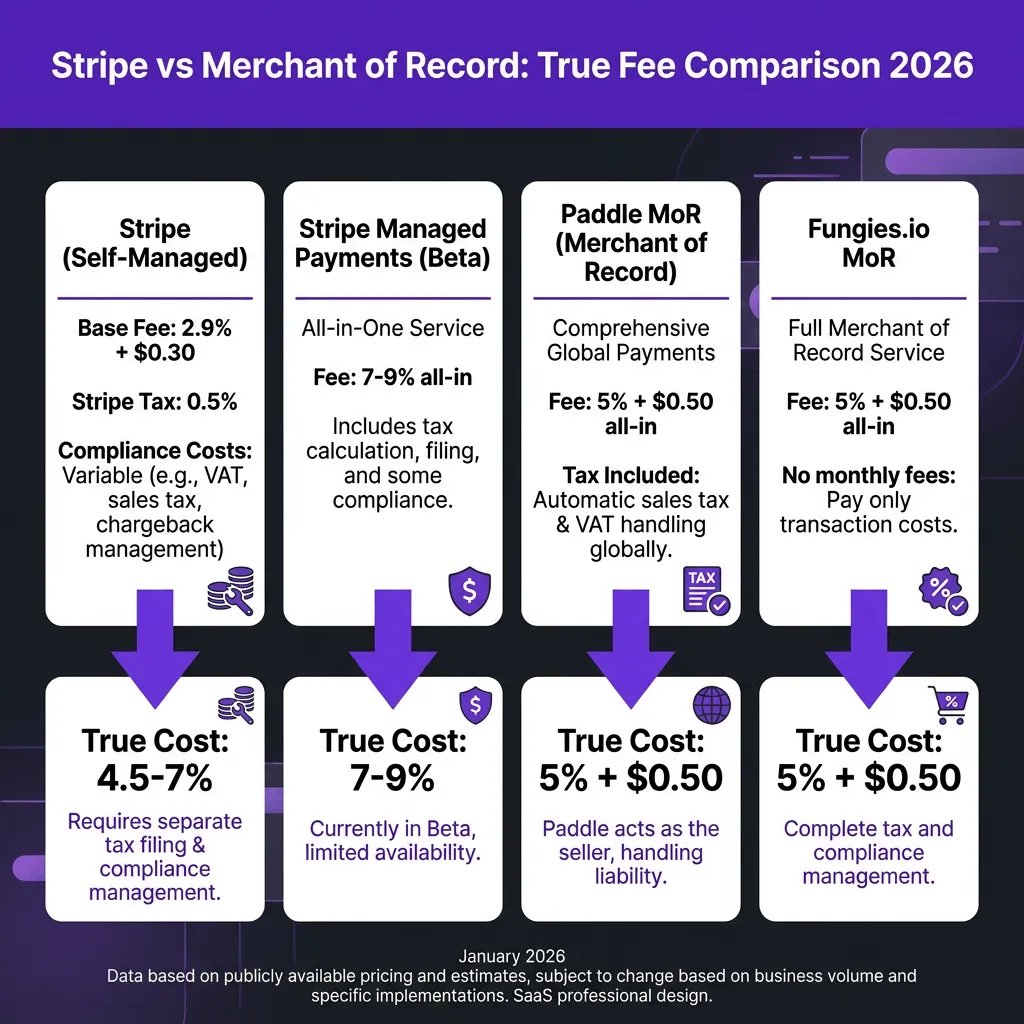
The fee: 7–9% total, calculated on the tax-inclusive amount. That means if your product costs $100 + $20 VAT, you’re paying fees on $120, not $100. Stripe confirmed the pricing in their support docs: additional 3.5% on top of standard Stripe processing fees.
So a typical EU transaction: 2.9% + $0.30 (Stripe base) + 1.5% (international card) + 3.5% (Managed Payments premium) = roughly 8% effective rate. Compare that to Paddle’s flat 5% + $0.50.
It’s worth being honest: for some teams, the familiarity of the Stripe dashboard and existing integrations might justify the premium. But for most indie founders and early-stage SaaS companies, it’s hard to make the numbers work.
Traditional MoR Platforms: How They Compare
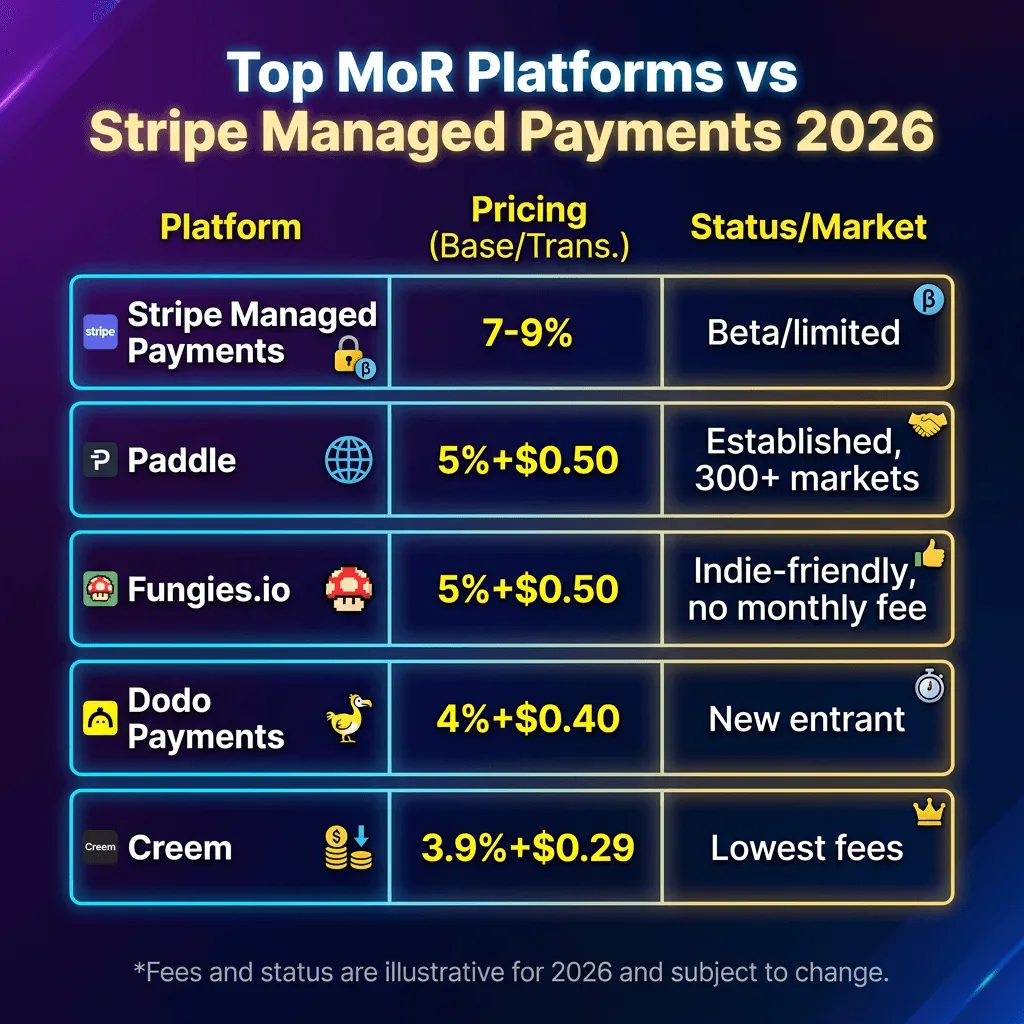
Before Stripe entered the scene, the MoR market was already competitive. Here’s how the main players stack up in 2026:
| Platform | Model | Transaction Fee | Monthly Fee | Best For | Tax Coverage |
|---|---|---|---|---|---|
| Stripe Managed Payments | MoR (beta) | 7–9% | $0 | Existing Stripe users | Global |
| Paddle | MoR | 5% + $0.50 | $0 | Established SaaS | Global (300+ markets) |
| Fungies.io | MoR | 5% + $0.50 | $0 | Indie hackers, AI startups | Global |
| Dodo Payments | MoR | 4% + $0.40 | $0 | Micro-SaaS, bootstrapped | Global |
| Creem | MoR | 3.9% + $0.29 | $0 | Indie hackers, new AI tools | Global |
| FastSpring | MoR | 5.9% + $0.95 | $0 | Enterprise software | Global |
| Stripe (standard) | Payment processor | 2.9% + $0.30 | $0 (+$25 Stripe Tax) | B2B SaaS, single-country | DIY with Stripe Tax |
A note on Creem and Dodo Payments: both are newer platforms that have grown rapidly among the indie hacker and AI-first startup community. They offer lower fees than Paddle with solid MoR coverage, though they have a shorter track record for enterprise-scale needs.
When Stripe Still Makes Sense
Stripe isn’t wrong for everyone. There are genuine cases where standard Stripe beats any MoR:
- B2B SaaS with invoicing needs: Stripe’s invoicing and quoting tools are significantly better than most MoRs. If you’re selling $10K+ annual contracts to businesses, Stripe plus an accountant often makes more sense.
- Single jurisdiction selling: If you’re a US founder selling only to US customers, you don’t need global tax coverage. Stripe at 2.9% + $0.30 beats a MoR at 5%.
- Revenue above $1M ARR with a finance team: At scale, a dedicated finance person handling tax filings often costs less than the MoR fee premium.
- Existing Stripe infrastructure: If you’ve already built complex integrations on Stripe’s API, switching can be costly. Sometimes staying is the pragmatic call.
The Real Cost of Being Your Own Merchant of Record
This is where a lot of founders underestimate Stripe. The 2.9% looks cheap. The true cost doesn’t.
Here’s what you actually need to handle as your own MoR with standard Stripe:
- Stripe Tax: $0 base, but charges 0.5% per taxable transaction for automated tax calculation. Still doesn’t file for you — just tells you what you owe.
- EU VAT OSS registration: Required once you exceed €10,000 in EU B2C sales. Filing quarterly. Time cost: 4–8 hours/quarter minimum.
- US sales tax nexus tracking: With economic nexus thresholds dropping (South Dakota v. Wayfair), you can hit nexus in 20+ states at $50K MRR. TaxJar or Avalara: $19–$99/month.
- Chargeback handling: You fight disputes directly. Win rate without a dedicated team: ~30–40%.
A realistic estimate for a $50K MRR SaaS selling globally with Stripe: true total payment cost of 4.5–6.5%, not 2.9%. Add compliance time, and a MoR starts looking cheap.
Stripe Managed Payments vs Paddle: The Head-to-Head
| Feature | Stripe Managed Payments | Paddle |
|---|---|---|
| MoR model | ✅ Yes (beta) | ✅ Yes (established) |
| Fee | 7–9% (tax-inclusive) | 5% + $0.50 |
| Tax filing | ✅ Included | ✅ Included |
| Global coverage | ✅ Yes | ✅ 300+ markets |
| Subscription billing | ✅ Stripe Billing | ✅ Built-in |
| Developer API | ⭐⭐⭐⭐⭐ Industry best | ⭐⭐⭐ Good, improving |
| Checkout flexibility | ⭐⭐⭐⭐ High (Stripe Elements) | ⭐⭐⭐ Moderate |
| Maturity | ⚠️ Beta (limited availability) | ✅ 12+ years, battle-tested |
| New business acceptance | ✅ Fast | ⚠️ Reported delays for new accounts |
| Startup-friendly | ⭐⭐⭐ Medium | ⭐⭐ Lower (approval issues reported) |
The honest verdict: Paddle wins on fees (5% vs 7–9%) and on battle-tested reliability. Stripe Managed Payments wins on API quality and existing ecosystem fit. Neither is the obvious winner for an indie hacker just launching.
What the Stripe Managed Payments Launch Means for the MoR Market
Stripe entering the MoR space is genuinely significant. Here’s what it actually changes:
Validation for the MoR model: When Stripe decides a product category is worth building, it’s a signal that the market is real and growing. MoR was once a niche concept. It’s now mainstream SaaS infrastructure.
Pressure on fees: Creem launched at 3.9% + $0.29. Dodo Payments at 4% + $0.40. The sub-5% MoR era has arrived, driven partly by competitive pressure from a well-funded Stripe entering the space. Paddle’s 5% + $0.50 is no longer the low-cost option.
More options for founders: Competition in the MoR market is genuinely good for you. More platforms means more choices, lower fees over time, and more feature development.
What hasn’t changed: The fundamental question of whether you want to be your own MoR is still a question of scale, geography, and how much you value your time. Stripe Managed Payments doesn’t change that calculus for a bootstrapped founder — if anything, the 7–9% fee makes traditional MoRs look more attractive by comparison.
Which Platform Should You Choose in 2026?
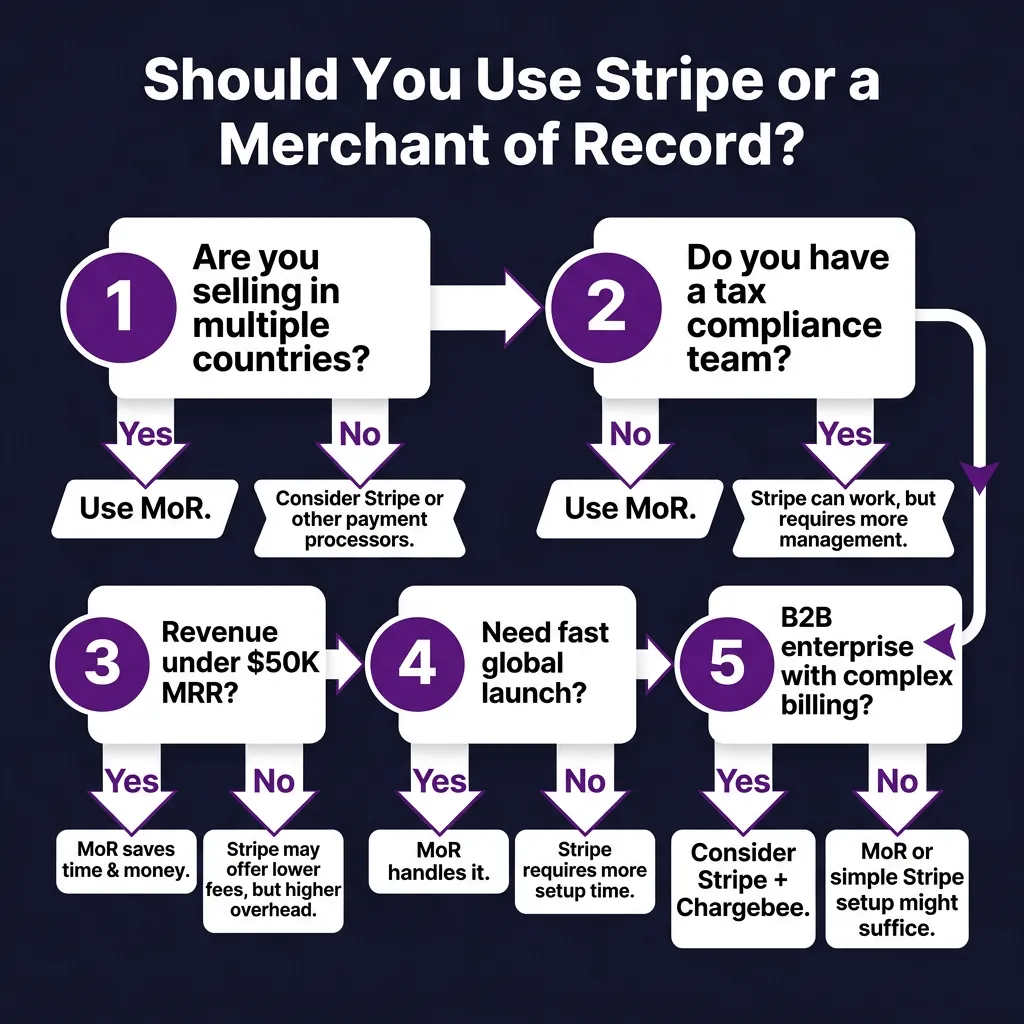
Here’s the honest decision framework:
Choose standard Stripe if: You’re B2B, selling to businesses in 1–2 countries, have budget for a tax tool, and your business is complex enough that Stripe’s API flexibility pays off.
Choose Stripe Managed Payments if: You’re already deep in the Stripe ecosystem, can’t afford a migration, and the compliance coverage is worth paying 2–4% more than alternative MoRs. Watch for the beta to mature.
Choose Paddle if: You’re an established SaaS team (5+ people), selling globally, and want the most battle-tested MoR with the strongest track record for subscription management and global compliance.
Choose Fungies.io if: You’re an indie hacker or early-stage AI startup who wants full MoR coverage with no monthly fees, an embedded checkout that converts, and a platform built for developers who ship fast. Fungies handles the compliance so you can focus on building.
Choose Creem or Dodo Payments if: You want the lowest fees in the market (sub-4%) and are comfortable with newer platforms. Both have grown quickly in 2025–2026 with strong developer communities.
Choose FastSpring if: You’re selling enterprise desktop software, games, or complex digital products where FastSpring’s 20+ years of experience in software-specific commerce matters.
Key Takeaways
- Stripe Managed Payments costs 7–9% — significantly more expensive than Paddle (5%) or newer MoRs like Creem (3.9%). The Stripe premium is real.
- Standard Stripe true cost is 4.5–6.5% when you factor in Stripe Tax, international card fees, and compliance overhead. It’s not as cheap as it looks.
- The MoR market is getting more competitive — Creem and Dodo Payments launched below Paddle’s price point in 2025–2026. Fees are trending down.
- For most indie SaaS and AI startups, a traditional MoR like Fungies.io or Paddle beats both Stripe options on total cost and compliance simplicity.
- The best time to choose is at launch. Migrating payment processors at scale is painful and expensive — pick carefully from day one.
FAQ
Is Stripe Managed Payments available for everyone in 2026?
As of mid-2026, Stripe Managed Payments is still rolling out gradually and is primarily available to US-based businesses with good standing on Stripe. Availability varies by region and business type. Check your Stripe dashboard for access.
What’s the difference between Stripe Tax and Stripe Managed Payments?
Stripe Tax calculates and helps you collect tax — but you are still the Merchant of Record and responsible for filing and remittance. Stripe Managed Payments makes Stripe the MoR, meaning they take on the full compliance liability. Completely different models.
Can I use Fungies.io or Paddle if I’m not a US company?
Yes. Most MoR platforms — including Fungies.io and Paddle — accept businesses registered anywhere in the world. You don’t need a US LLC. This is actually one of the biggest advantages of using a MoR if you’re a non-US founder selling globally.
How hard is it to migrate from Stripe to a Merchant of Record?
Migration complexity depends on your integration depth. If you’re using basic Stripe Checkout, migration to a MoR like Fungies.io can take a few days. If you’ve built complex Stripe Billing workflows, subscriptions, and webhooks, plan for 2–4 weeks. Most MoRs offer migration guides and support.
Conclusion
Stripe entering the MoR space confirms what most experienced SaaS founders already knew: if you’re selling globally, you need a Merchant of Record. The question is which one.
Stripe Managed Payments makes sense as a no-migration option for teams deeply invested in the Stripe ecosystem. But at 7–9%, you’re paying a significant premium for familiarity. For most founders — especially indie hackers and AI startups — a purpose-built MoR like Fungies.io offers better fees, cleaner developer experience, and zero monthly fees.
The global payments market is $71 billion and growing. Don’t let the wrong payment setup become the thing that holds your product back.
Try Fungies.io free — get full Merchant of Record coverage, embedded checkout, and global tax compliance with no monthly fees.
References
- Stripe Managed Payments Pricing — Stripe Support
- Stripe vs Paddle: Why Businesses Outgrow Stripe — Paddle
- Is Stripe a Merchant of Record? — Dodo Payments
- Stripe vs Paddle 2026 — SaaS Software Tools
- Top Paddle Alternatives for SaaS in 2026 — Affonso
- Stripe vs Paddle vs Lemon Squeezy for Micro-SaaS — F3 Fundit
- Best Merchant of Record for SaaS 2026 — Creem