Stripe vs Paddle vs Fungies.io: Which Payment Platform Is Right for Your SaaS in 2026?
Here’s a number that should grab your attention: the global payment processing market hit $71.15 billion in 2026 and is growing to $122 billion by 2031. SaaS payments aren’t a commodity decision — they’re a strategic one. And right now, three platforms dominate the conversation for indie SaaS founders: Stripe, Paddle, and Fungies.io. Pick the
Here’s a number that should grab your attention: the global payment processing market hit $71.15 billion in 2026 and is growing to $122 billion by 2031. SaaS payments aren’t a commodity decision — they’re a strategic one. And right now, three platforms dominate the conversation for indie SaaS founders: Stripe, Paddle, and Fungies.io.
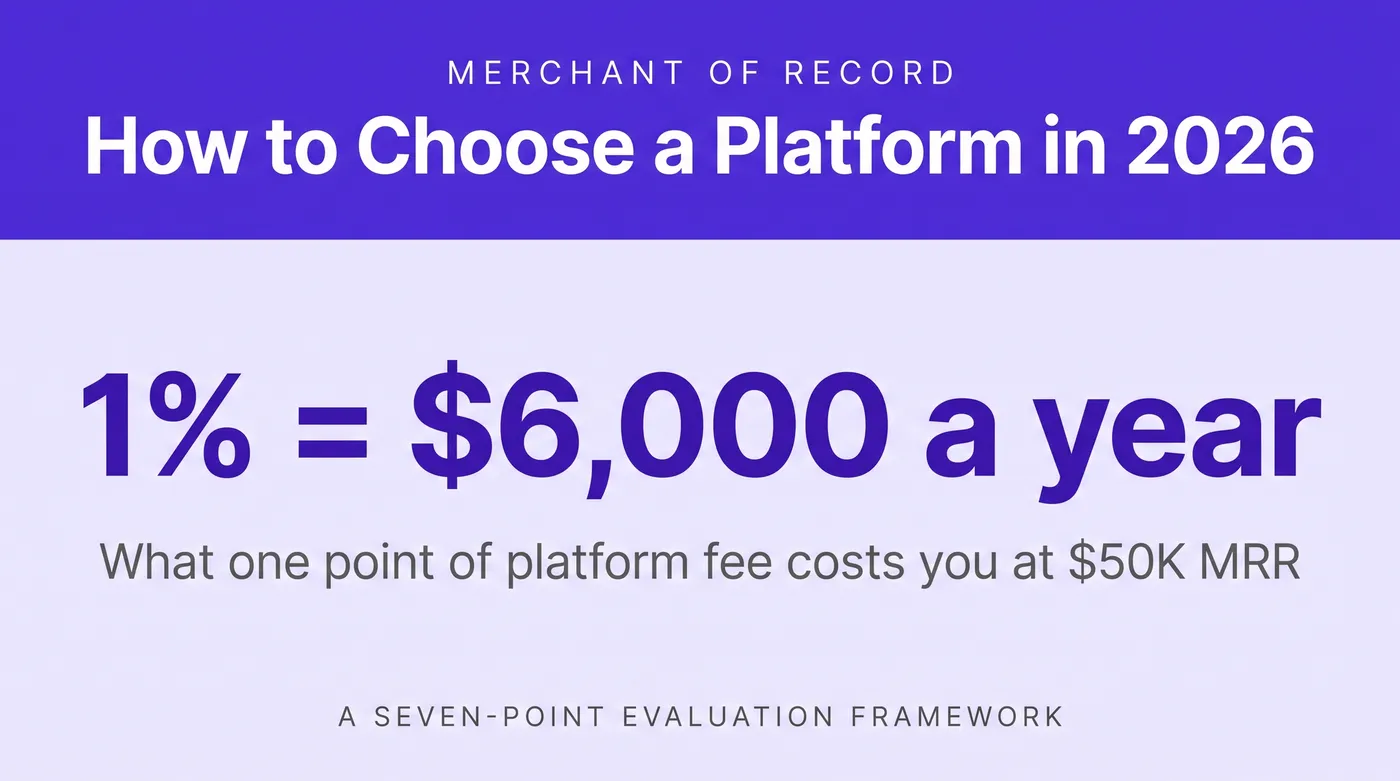
Pick the wrong one at launch and you could be bleeding $7,000+ a year on a $50K MRR business. Pick the right one and you skip months of compliance headaches entirely. This guide breaks down all three — with real numbers, real trade-offs, and a clear recommendation based on what you’re actually building.
The Fundamental Difference: Payment Gateway vs. Merchant of Record
Before you compare fees, you need to understand what you’re actually comparing. These aren’t three versions of the same thing.
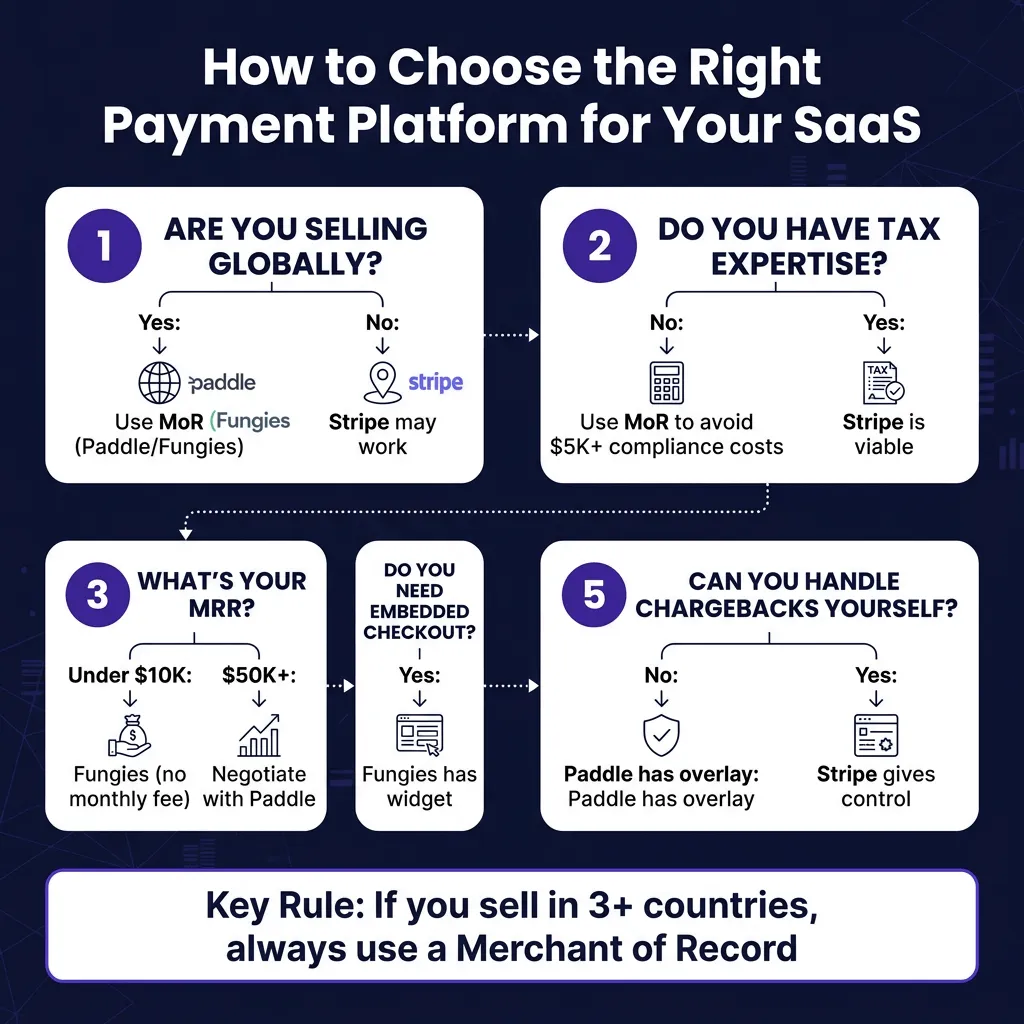
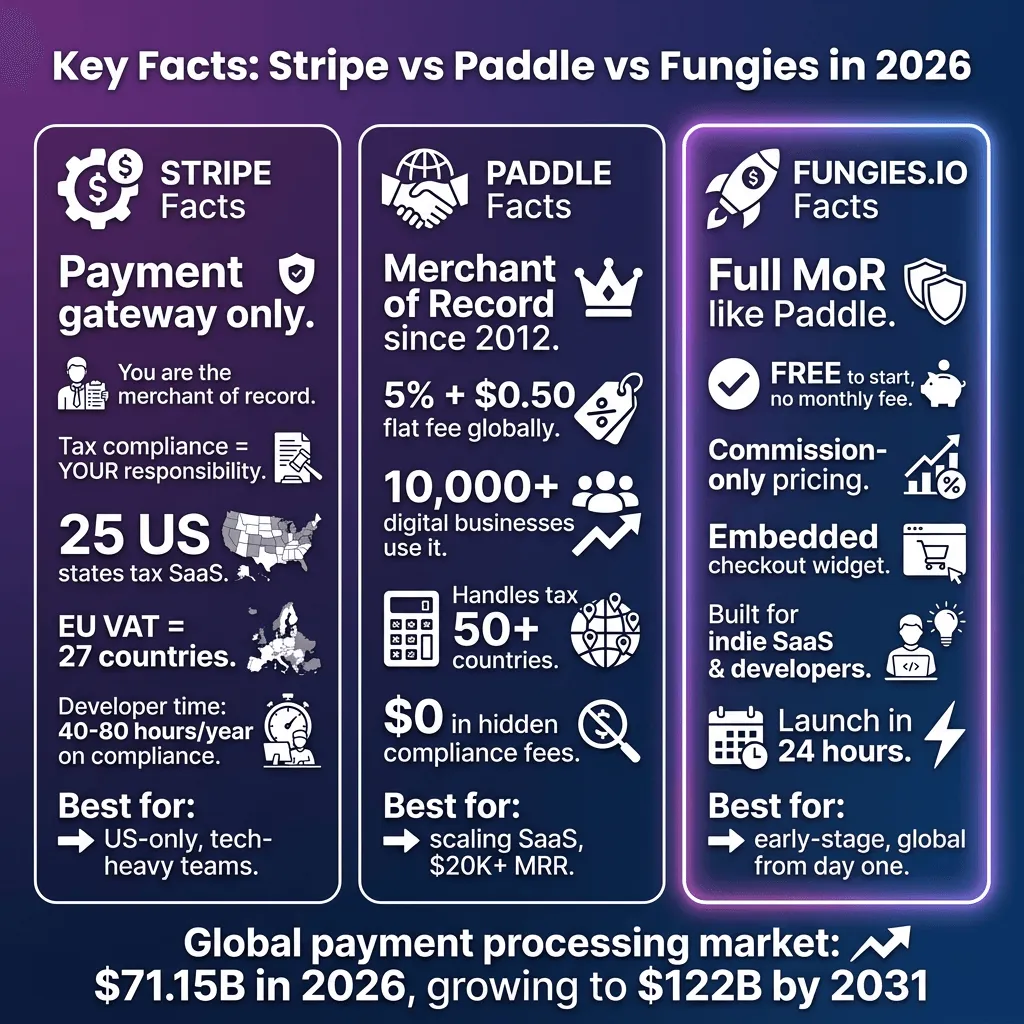
Stripe is a Payment Service Provider (PSP) — a payment gateway. It moves money from your customer’s card to your bank account. That’s it. When you use Stripe, you are the merchant of record. You’re legally responsible for calculating, collecting, and remitting sales tax in every jurisdiction where you operate. VAT in Germany? Your problem. GST in Australia? Also yours. Sales tax in 25 US states that tax SaaS? Still yours.
Paddle is a Merchant of Record (MoR). When Paddle processes a transaction, they legally become the seller. Your customers are buying from Paddle, not from you. That means Paddle owns the tax liability across every country, handles fraud disputes, remits VAT to 27 EU member states, and manages PCI compliance. You get a payout. They handle everything else.
Fungies.io is also a Merchant of Record — built with modern, developer-first architecture. Like Paddle, Fungies takes on the legal and tax burden. Unlike Paddle, Fungies has no monthly fees, offers a more flexible embedded checkout experience, and is specifically designed for indie developers and early-stage SaaS founders who need to go global without a compliance team.
Pricing Breakdown: What You’re Actually Paying
“2.9% + $0.30” is not the full story for Stripe. Let’s go through actual costs.
Stripe Fees
| Fee Type | Rate |
|---|---|
| Standard domestic (US) | 2.9% + $0.30 |
| International card surcharge | +1.5% |
| Stripe Tax (EU VAT automation) | +0.5% |
| Currency conversion | +1.0% |
| ACH / bank transfers | 0.8% (capped at $5) |
| Monthly platform fee | $0 |
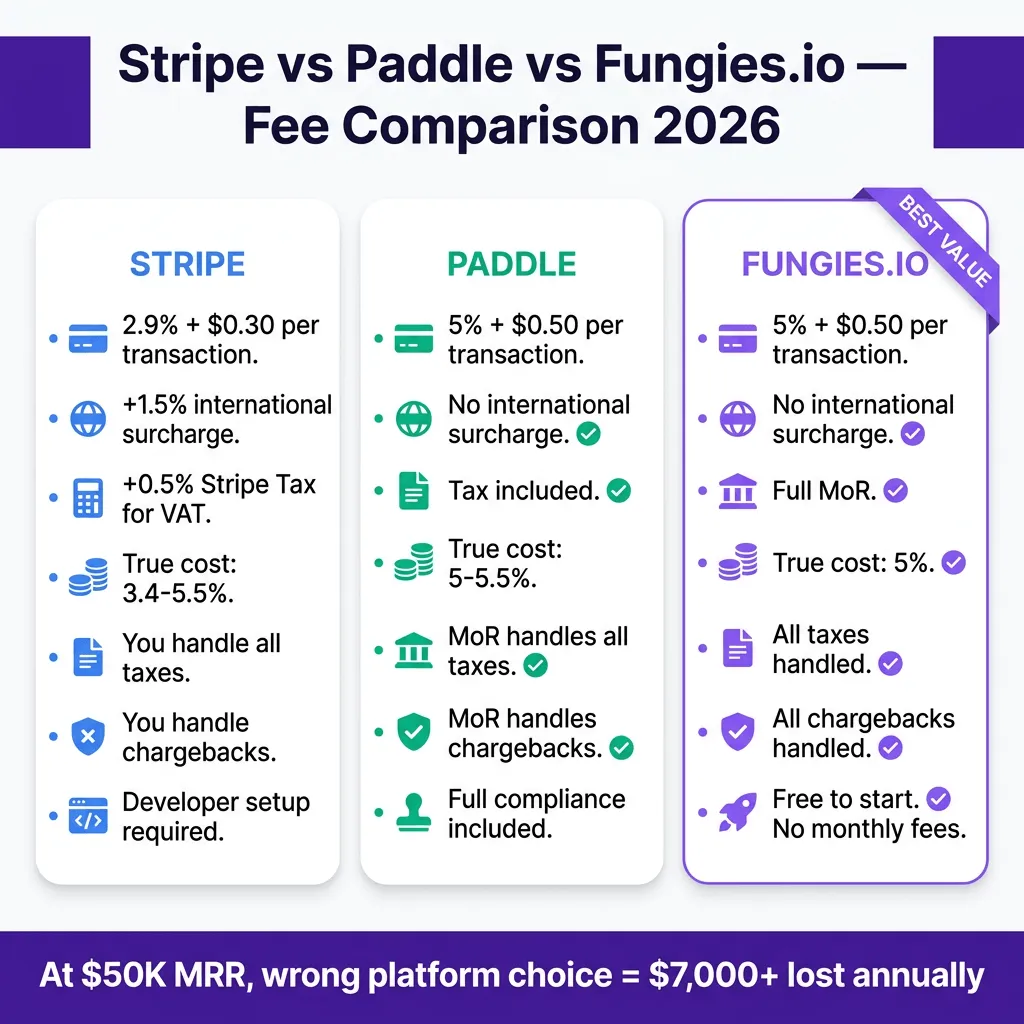
For a US-only SaaS, Stripe’s true cost is around 2.9–3.2%. Add EU customers with Stripe Tax and an international card mix, and your true cost climbs to 4.5–5.5%. That’s before developer hours to build tax logic, filing infrastructure, and dispute management.
Paddle Fees
| Fee Type | Rate |
|---|---|
| All transactions (flat) | 5% + $0.50 |
| International card surcharge | $0 (included) |
| VAT/GST/Sales tax handling | $0 (included) |
| Chargeback management | $0 (included) |
| Monthly platform fee | $0 |
| Volume discount threshold | Negotiable, typically $200K+/year |
Paddle’s headline 5% + $0.50 looks more expensive than Stripe at first glance. But once you factor in what’s included — tax compliance software, fraud protection, chargeback handling, currency conversion — the true cost comparison flips for most international SaaS businesses.
Fungies.io Fees
| Fee Type | Rate |
|---|---|
| Transaction fee | 5% + $0.50 |
| International card surcharge | $0 (included) |
| VAT/GST/Sales tax handling | $0 (included as MoR) |
| Chargeback management | $0 (included) |
| Monthly platform fee | $0 (free forever) |
| Setup/onboarding fee | $0 |
| Embedded checkout widget | Included |
Fungies matches Paddle on the MoR model and pricing structure, but wins on one critical point: zero monthly fee, free to start, no credit card required. For an indie developer pre-revenue or under $5K MRR, that’s the difference between building and waiting.
Real Cost Scenario: $10K MRR SaaS Selling Globally
Let’s make this concrete. You have a SaaS doing $10,000 MRR with 40% US customers and 60% international (EU + APAC).
| Platform | Processing Fees | Tax Compliance Cost | Developer Time Cost | Total Monthly Cost |
|---|---|---|---|---|
| Stripe | ~$380 (3.8% effective) | ~$200–400 (Stripe Tax or accountant) | ~$150 (DIY compliance maintenance) | $730–930 |
| Paddle | $550 (5.5%) | $0 (included) | ~$0 (handled) | $550 |
| Fungies.io | $550 (5.5%) | $0 (included) | ~$0 (handled) | $550 |
At $10K MRR, you’re paying $180–380/month more with Stripe once you properly account for compliance overhead. That’s $2,160–4,560 per year — for a $10K/month business. At $50K MRR, that gap exceeds $7,000 annually.
Feature Comparison: What Each Platform Actually Gives You
| Feature | Stripe | Paddle | Fungies.io |
|---|---|---|---|
| Merchant of Record | ❌ (you are MoR) | ✅ | ✅ |
| Global tax handling | Partial (Stripe Tax add-on, ~0.5%) | ✅ Full | ✅ Full |
| EU VAT compliance | Via Stripe Tax (paid) | ✅ Included | ✅ Included |
| US sales tax (SaaS) | Via Stripe Tax (paid) | ✅ Included | ✅ Included |
| Chargeback management | ❌ (you handle) | ✅ | ✅ |
| Embedded checkout | Elements (requires dev work) | Overlay/hosted | ✅ Native widget |
| Subscription billing | ✅ Stripe Billing (complex) | ✅ | ✅ |
| Monthly platform fee | $0 | $0 | $0 |
| API quality | ⭐⭐⭐⭐⭐ (best in class) | ⭐⭐⭐⭐ | ⭐⭐⭐⭐ |
| Setup time | Hours to days (complex) | 1–2 days | 24 hours or less |
| Free to start | ✅ | ✅ | ✅ |
| Best for | US-only, tech-heavy teams | Scaling SaaS ($20K+ MRR) | Indie SaaS, global from day one |
Tax Compliance: The Real Reason Most Founders Switch
Tax compliance is where Stripe users get blindsided. In 2026, digital SaaS is taxable in:
- 25+ US states — each with its own nexus rules, filing deadlines, and SaaS-specific definitions
- 27 EU member states — via VAT OSS (One Stop Shop), requiring registration and quarterly filings
- Australia — GST at 10% for B2C digital services
- Canada — HST/GST varying by province
- UK — 20% VAT post-Brexit, separate from EU
- India — 18% GST for digital services
If you’re using Stripe and selling globally without Stripe Tax, you may already be non-compliant in jurisdictions where you have nexus. Tax authorities in the EU particularly have been cracking down on B2B and B2C digital service providers since 2021.
With Stripe Tax enabled, you get automated calculation and collection — but you still have to file and remit to each jurisdiction yourself (or hire someone). With Paddle or Fungies, you don’t touch any of this. It’s fully abstracted.
The hidden cost of Stripe compliance for a globally-selling SaaS founder: 40–80 hours per year in maintenance, plus accounting/legal fees that typically run $200–600/month once you hit multiple jurisdictions.
Checkout Experience: Where Fungies Pulls Ahead
Stripe’s checkout is developer-first. Stripe Elements gives you full customization, but it requires significant dev work — typically 20–40 hours to build a proper checkout flow with subscription support, tax display, and localization. Stripe’s hosted checkout is faster to deploy but limits customization.
Paddle uses an overlay/popup checkout model. It works well and converts reasonably. But it interrupts the user flow — the user gets a Paddle-branded overlay rather than something that feels native to your product.
Fungies.io offers an embedded checkout widget. You drop it directly into your product page or SaaS app. No redirect, no overlay, no break in the user journey. For SaaS products where brand consistency matters during conversion, this is a meaningful advantage.
Checkout UX has a measurable impact on conversion rates. Research from Baymard Institute shows that 17% of cart abandonments are caused by too-complicated checkout processes. Embedded, in-flow checkout consistently outperforms redirect/overlay models by 5–15%.
When to Use Each Platform
Choose Stripe When:
- You’re selling exclusively to US enterprise B2B customers who pay by invoice
- You have a dedicated finance/tax team or outsourced accounting
- You need maximum payment method flexibility (BNPL, bank transfers, custom flows)
- You’re building a marketplace or platform that needs Stripe Connect
- Your transaction volume justifies negotiated rates (typically $1M+/year)
Choose Paddle When:
- Your SaaS is scaling ($20K+ MRR) and you need battle-tested compliance at scale
- You’re selling to both B2B and B2C across multiple countries
- You want proven global infrastructure with dedicated support
- You’re replacing an existing billing stack with something more robust
Choose Fungies.io When:
- You’re an indie developer or early-stage SaaS founder (under $20K MRR)
- You want to launch globally from day one without any compliance setup
- You need an embedded checkout that feels native to your product
- You want zero monthly fees and commission-only pricing
- You’re selling SaaS subscriptions, digital products, or game assets
- Speed to market matters — Fungies can be live in under 24 hours
Migration Considerations
Already on Stripe and considering switching? Here’s what to think about:
Stripe → Paddle: Doable but complex. Paddle has a migration team and can import customer subscription data. Expect 1–3 months for full migration depending on your billing complexity. Main risk: subscription continuity and customer notification requirements.
Stripe → Fungies.io: Fungies’s modern architecture makes migration more straightforward. You connect your Stripe account initially, which means you can use Fungies’s MoR layer while keeping Stripe as the underlying payment processor. The transition can be gradual — new customers go through Fungies while existing subscriptions run out.
Paddle → Fungies.io: Most founders make this switch for the embedded checkout and better fit for indie SaaS. Fungies supports the same subscription models Paddle does. Data portability is generally clean.
Key Takeaways
- Stripe is not the cheapest option for global SaaS. Once you add tax compliance costs, international fees, and developer overhead, Stripe’s true cost for a globally-selling SaaS runs 4.5–5.5% — matching or exceeding MoR pricing.
- Merchant of Record is the right model for most SaaS founders. If you’re selling in 3+ countries, the compliance burden of being your own MoR is not worth the nominal fee savings.
- Fungies.io is the best starting point for indie SaaS. No monthly fee, full MoR model, embedded checkout, and a 24-hour setup timeline make it the lowest-friction path to global revenue.
- Paddle scales better for larger operations. If you’re above $50K MRR with complex billing requirements, Paddle’s enterprise support and infrastructure are proven at scale.
- The $7K/year gap is real. At $50K MRR, the wrong payment platform costs $7,000+ annually in hidden compliance overhead. Revisit this decision at each major MRR milestone.
FAQ
Is Stripe a Merchant of Record?
No. Stripe is a Payment Service Provider (PSP) — a payment gateway. When you use Stripe, you remain the merchant of record and are legally responsible for all tax compliance, VAT collection, and remittance. Stripe Tax helps automate calculation, but you still own the liability and filing obligations.
What’s the difference between Paddle and Fungies.io?
Both are Merchant of Record platforms that handle global tax compliance and chargebacks. The main differences: Fungies.io has no monthly fee (Paddle also has no monthly fee), offers a native embedded checkout widget, and is specifically built for indie developers and early-stage SaaS. Paddle has a longer track record (since 2012) and is better suited for larger operations with complex billing needs.
Can I use Stripe with a Merchant of Record?
Yes — Fungies.io actually connects your existing Stripe account and adds a MoR layer on top of it. This means you get Stripe’s payment infrastructure combined with Fungies’s tax compliance and merchant-of-record status. It’s a practical way to get MoR benefits without fully migrating away from Stripe.
Which payment platform is best for selling SaaS globally in 2026?
For most indie and early-stage SaaS founders, Fungies.io offers the best combination of zero upfront cost, full MoR model, and fast setup. For larger SaaS businesses ($50K+ MRR) with complex billing, Paddle’s enterprise support and infrastructure are proven. Stripe is best reserved for US-focused businesses or teams with dedicated compliance resources.
Conclusion
The “just use Stripe” advice made sense in 2018. In 2026, with 25+ US states taxing SaaS, EU VAT enforcement getting stricter, and global expansion being table stakes for any serious SaaS — the calculus has changed.
If you’re early-stage and building globally: start with Fungies.io. Zero friction, full compliance, embedded checkout. You can always scale to Paddle later if your billing complexity outgrows it.
If you’re scaling past $20K MRR and need proven infrastructure: Paddle is a solid choice. The support team is responsive, the global coverage is excellent, and the 5% + $0.50 fee is competitive once you factor in what it replaces.
If you’re US-only with a compliance team or a very specific technical use case: Stripe still wins on API quality and flexibility. Just budget properly for the compliance overhead.
Ready to skip the tax headaches and launch globally today? Start your free Fungies.io account here — no credit card required.
References
- Stripe vs Paddle vs Lemon Squeezy: Best Payment Platform for Micro-SaaS (2026) — F3 Fund It
- Stripe vs Paddle: Which Payment Processor is Right for Your SaaS? — Chartsy
- Paddle vs Stripe: Why Businesses Outgrow Stripe — Paddle
- Paddle vs. Stripe: The Ultimate 2026 Comparison — UniBee
- Is Stripe a Merchant of Record? — Dodo Payments
- Stripe vs Paddle — Indie Hackers
- Top Merchant of Record Providers of 2026 — Cleverbridge