Usage-Based Pricing for SaaS in 2026: How to Implement It (And Why It’s Winning)
43% of SaaS companies have already switched to usage-based pricing — and the rest are seriously thinking about it. If you’re still charging a flat monthly rate for software that customers use in wildly different amounts, you’re likely losing deals at the top and leaving money on the table at the bottom. Usage-based pricing (UBP)
43% of SaaS companies have already switched to usage-based pricing — and the rest are seriously thinking about it. If you’re still charging a flat monthly rate for software that customers use in wildly different amounts, you’re likely losing deals at the top and leaving money on the table at the bottom.
Usage-based pricing (UBP) isn’t new. Stripe charges per transaction. Twilio charges per SMS. AWS charges per compute hour. But in 2026, it’s becoming the default model for indie SaaS founders and bootstrapped teams who want to grow without constantly fighting churn from underutilizers.
This guide breaks down exactly what usage-based pricing is, how it compares to flat-rate and per-seat models, how to implement it technically, and which merchant of record platforms actually support metered billing without an enterprise contract.
What Is Usage-Based Pricing for SaaS?
Usage-based pricing means customers pay based on how much they actually consume — not a fixed monthly fee. The unit of measurement varies by product:
API calls — most common for developer tools and AI apps
Active seats — usage grows with team size
Data volume — storage, messages, events processed
Transactions processed — relevant for payment tools and e-commerce
Outcomes delivered — leads generated, reports run, videos rendered
The key is that your pricing tracks value delivery. When customers get more value from your product, they pay more. When they barely use it, they pay less and you don’t have to fight churn from someone paying $99/month for a tool they open twice.
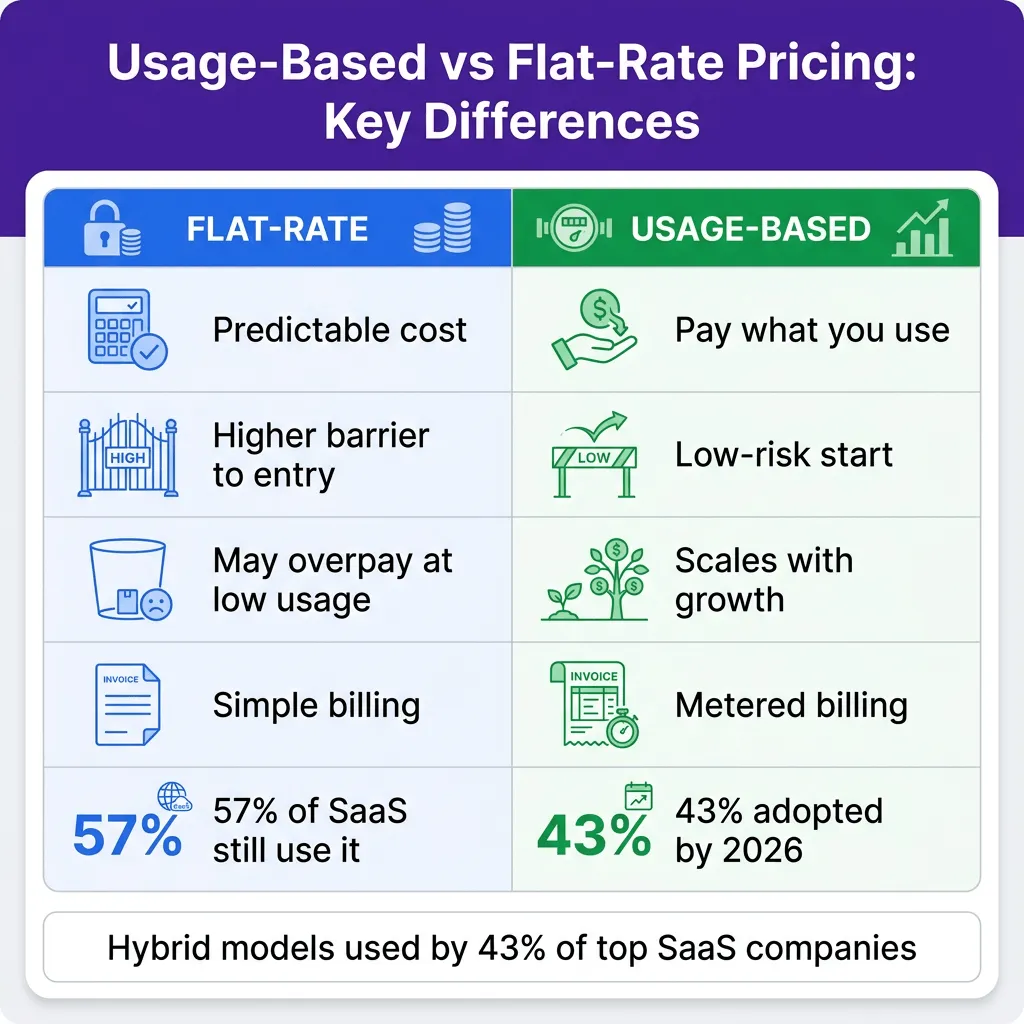
Usage-Based vs Flat-Rate vs Per-Seat: The Real Differences
| Model | How You Charge | Best For | Biggest Risk |
|---|---|---|---|
| Flat-Rate | Fixed monthly/annual fee | Simple tools, early traction | Churn from low-use customers |
| Per-Seat | Per user per month | Collaboration tools, CRMs | Caps revenue — customers consolidate seats |
| Usage-Based | Per API call, transaction, event | AI tools, developer APIs, data platforms | Revenue unpredictability, billing surprises |
| Hybrid | Base fee + variable usage | Most SaaS in 2026 | Complexity in billing infrastructure |
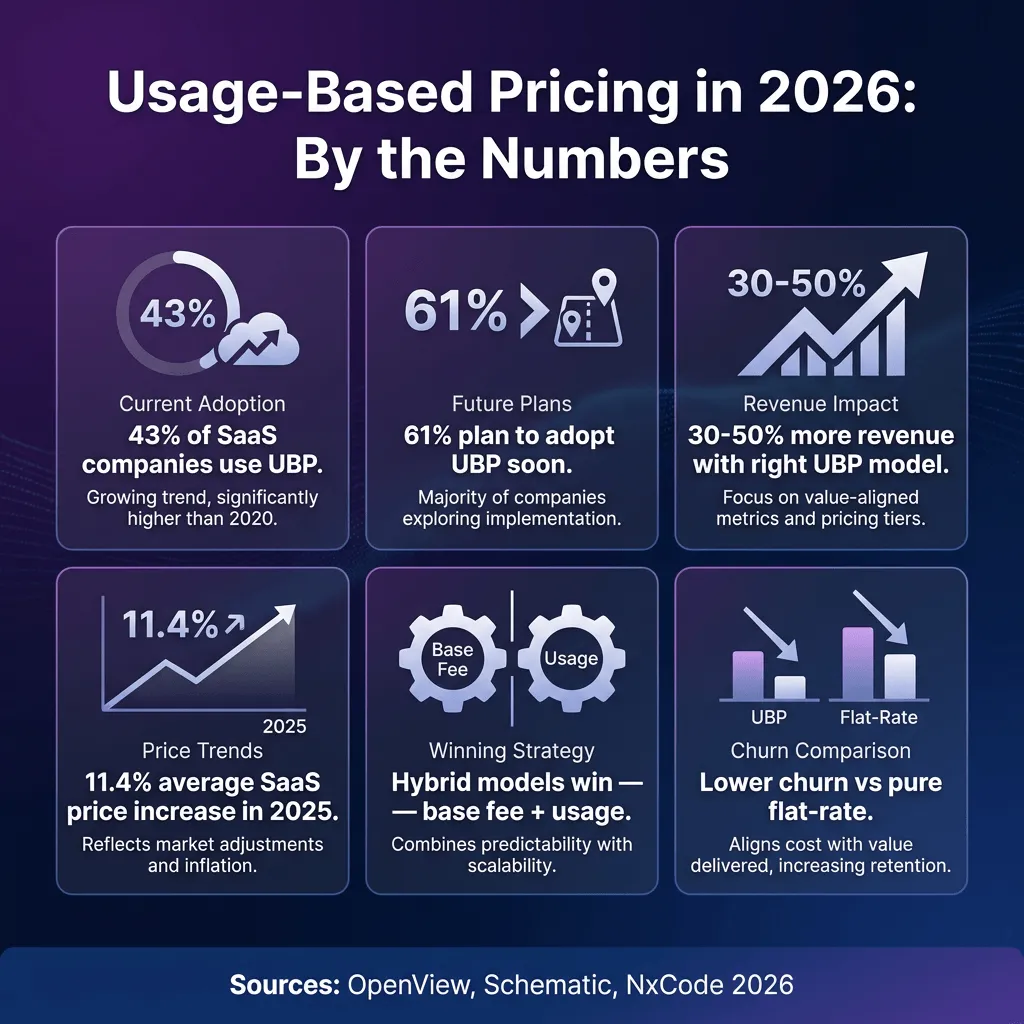
According to NxCode’s 2026 SaaS Pricing Report, 43% of SaaS companies now use hybrid pricing — a base subscription plus variable usage components. That number is projected to hit 61% by end of 2026. Flat-rate isn’t dying, but it’s becoming the exception, not the rule.
Why Usage-Based Pricing Is Winning in 2026
Three things converged to make UBP the dominant model for new SaaS companies launching today:
1. AI Changed the Cost Structure
Building an AI-powered SaaS product means your costs scale with usage — every LLM call, every inference, every embedding costs you money. Charging a flat rate when your costs are variable is a recipe for margin compression. Usage-based pricing lets you pass that variable cost through while building in margin.
This is why almost every AI tool launched in 2024–2026 uses credit-based or consumption pricing. Cursor, Perplexity, Claude — all usage-based at their core.
2. It Lowers the Barrier to Entry
A $99/month flat subscription creates friction for first-time buyers. A free tier plus pay-as-you-go removes it entirely. Customers can validate your product with zero commitment, then scale spending as they get value.
OpenView’s research shows that product-led growth companies using UBP consistently see faster top-of-funnel conversion because the “start free, pay as you grow” pitch is genuinely lower risk for buyers.
3. Customers Demand Value Alignment
Enterprise procurement teams in 2026 increasingly push back on flat SaaS fees for tools where usage varies significantly by team. They’ve been burned by ghost seats and underutilized software. Usage-based models speak their language — you pay for what you use, full stop.
The Main Drawback: Revenue Predictability
Usage-based pricing introduces variance. Some months customers churn down usage, your MRR dips, and your forecasts become harder to model. This is the single biggest reason founders hesitate.
The hybrid model solves most of this. A base subscription ($29–$49/month) covers your infrastructure costs and provides a revenue floor. Usage overages on top of the base generate your upside. You get predictable baseline revenue plus expansion revenue when customers grow.
Baremetrics data shows SaaS companies on hybrid models typically see 15-25% higher net revenue retention than pure flat-rate models, because revenue naturally expands as customers increase usage — without requiring a manual upsell conversation.
How to Implement Usage-Based Pricing: Step by Step
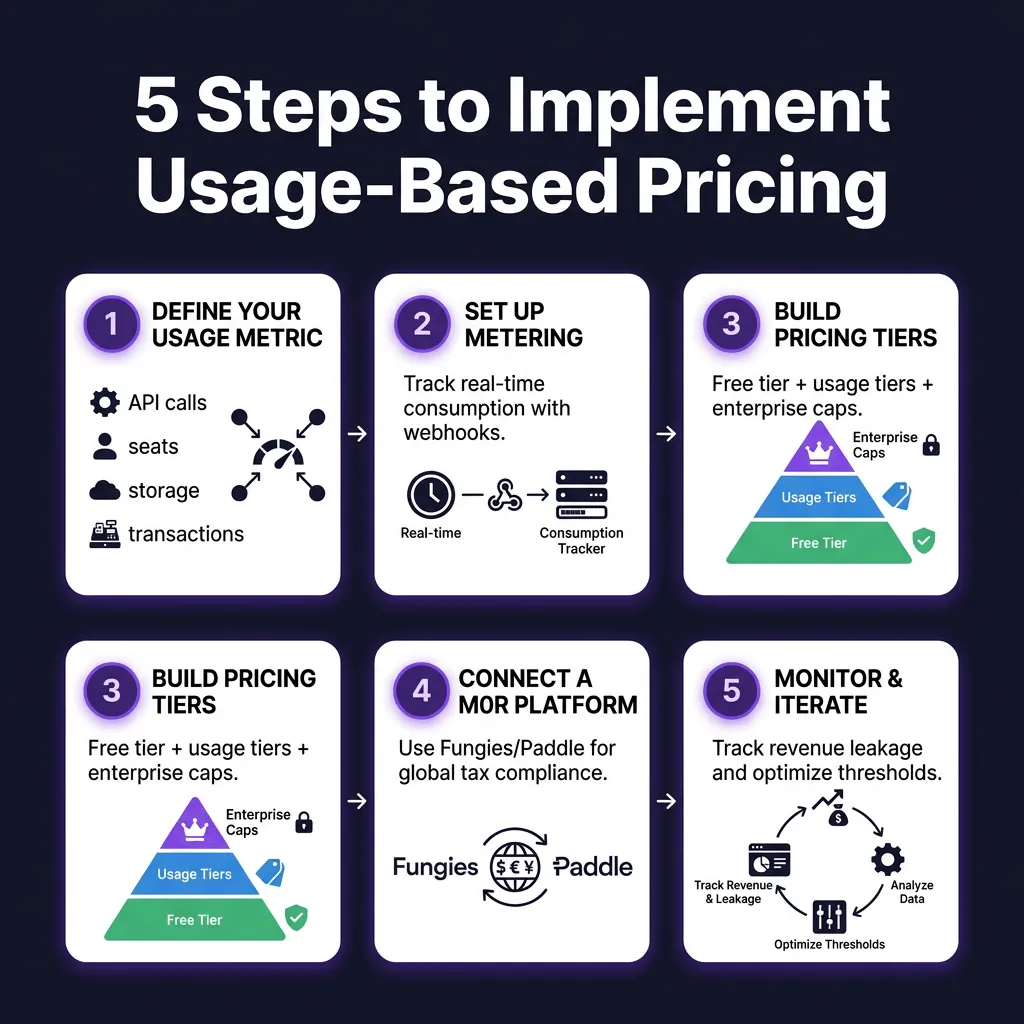
Step 1: Define Your Usage Metric
This is the most important decision. Your usage metric must:
Correlate directly with value delivered to the customer
Be easy for customers to understand and predict
Be technically measurable without significant overhead
Scale with customer success — as they win, you win
Bad metric: “number of logins” — doesn’t track value. Good metric: “API calls made” or “documents processed” — tracks actual product usage.
Step 2: Instrument Your Application
You need real-time usage metering before you can bill for it. The standard stack in 2026:
Event tracking — emit a usage event every time the metered action occurs
Aggregation — sum events per billing period per customer
Reporting — surface usage data to customers in their dashboard
Webhooks — alert customers approaching limits (prevents bill shock)
Libraries like Lago (open source), Schematic, or Amberflo handle the metering infrastructure so you don’t have to build it from scratch. Most integrate via a simple API call each time a metered action occurs.
Step 3: Design Your Pricing Tiers
Even usage-based products need tiers. Pure pay-as-you-go can feel overwhelming. A typical structure:
| Tier | Price | Included Usage | Overage Rate |
|---|---|---|---|
| Free | $0/month | 1,000 API calls | N/A (hard cap) |
| Starter | $29/month | 10,000 API calls | $0.002 per call |
| Pro | $99/month | 50,000 API calls | $0.0015 per call |
| Business | $299/month | 200,000 API calls | $0.001 per call |
| Enterprise | Custom | Custom | Negotiated |
Notice the overage rate drops at higher tiers — this incentivizes upgrades while rewarding your best customers with volume discounts. The free tier provides the entry point; the overage charges fund growth.
Step 4: Choose a Payment Infrastructure That Supports Metered Billing
Not all payment platforms are built for usage-based billing. Here’s the honest comparison:
| Platform | Metered Billing | Global Tax Compliance | Developer API | Fee Structure |
|---|---|---|---|---|
| Stripe Billing | ✅ Native metered billing | ❌ You handle tax (Stripe Tax extra 0.5%) | ⭐⭐⭐⭐⭐ | 2.9% + $0.30 |
| Paddle | ✅ Paddle Billing metered | ✅ Full MoR | ⭐⭐⭐⭐ | 5% + $0.50 |
| Fungies | ✅ Flexible billing models | ✅ Full MoR — handles VAT, GST, sales tax globally | ⭐⭐⭐⭐⭐ | Competitive flat fee |
| FastSpring | ⚠️ Limited metered support | ✅ Full MoR | ⭐⭐⭐ | 8.9% or 5.9% + $0.95 |
| Chargebee | ✅ Advanced metered billing | ❌ Not MoR | ⭐⭐⭐⭐ | $599/month + % |
The key decision: are you the merchant of record, or does the platform take on that liability? If you’re selling globally, using an MoR like Fungies or Paddle means you don’t need to register for VAT in Germany, GST in Australia, or handle US state sales tax. That alone can save tens of thousands in compliance costs as you scale.
Stripe is cheaper per transaction — but you’re the MoR. At $5k+ MRR with global customers, the hidden tax compliance overhead starts to cost more than the fee savings.
Step 5: Communicate Clearly to Customers
The #1 complaint with usage-based pricing is bill shock. Customers hate unexpected charges. Prevent it:
Send email alerts at 50%, 80%, and 100% of their included usage
Show a real-time usage meter in their account dashboard
Let customers set hard caps or spending limits
Include a usage estimator on your pricing page
Transparent usage communication isn’t just nice UX — it’s a retention strategy. Customers who feel in control of their bill churn less than customers who feel surprised by it.
Usage-Based Pricing + Merchant of Record: Why They Go Together
When you implement usage-based pricing, you’re generating more frequent, more varied invoices. Customers in different countries. Different currency conversions. Dynamic tax rates that change based on transaction amounts and customer location.
This is where using a Merchant of Record becomes genuinely valuable, not just convenient. An MoR like Fungies takes on the legal liability for every transaction — including the ones generated by your metered billing system. You define the usage rules; the MoR handles:
VAT/GST calculation per customer location
Tax remittance in 60+ countries
Invoice generation that complies with local requirements
Chargeback disputes on metered charges
Currency conversion and payout in your preferred currency
Without an MoR, you’re not just writing billing logic — you’re becoming a tax compliance department. For an indie founder or small team, that’s a significant tax on your time and attention.
Real-World Usage-Based Pricing Models to Steal
The Credit Bundle Model
Customers buy a bundle of credits upfront ($29 for 5,000 credits). Each action costs a defined number of credits. Credits roll over monthly. This model is predictable for you (upfront revenue) and familiar for customers (like phone credits or printer ink). Used by most AI tools including ChatGPT, Claude, and Midjourney.
The Base + Overage Model
A fixed monthly fee includes a usage allowance. Usage beyond the allowance is billed at a per-unit rate. Best for: developer tools, APIs, and data platforms. Used by Twilio, SendGrid, and most modern developer infrastructure.
The Purely Consumption-Based Model
No monthly fee — you pay exactly for what you use. Best for: infrastructure tools (AWS, Cloudflare), analytics platforms with variable query volume. Hardest to forecast but most attractive for buyers with uncertain usage patterns.
Key Takeaways
43% of SaaS companies use UBP in 2026 — it’s the direction of the industry, not a niche experiment
Hybrid models win — a base subscription plus usage overages gives you predictable revenue plus expansion upside
Define your usage metric carefully — it must correlate directly with value delivered, or customers will resent the billing
Instrument before you launch — you can’t bill for usage you can’t measure; build metering into your architecture from day one
Use an MoR if you sell globally — the tax compliance overhead of metered billing across 60+ countries will eat your team’s time without one
Frequently Asked Questions
What is usage-based pricing in SaaS?
Usage-based pricing is a billing model where customers pay based on actual consumption — API calls, data volume, seats, transactions, or other measurable units — rather than a fixed monthly fee. It aligns cost with value and lowers the barrier to entry for new customers.
Is usage-based pricing better than flat-rate for SaaS?
It depends on your product. Usage-based pricing works best when your product’s value scales with consumption (AI tools, APIs, data platforms). Flat-rate is simpler and works well for tools with consistent usage patterns. Hybrid models — a base fee plus usage overages — are becoming the dominant approach in 2026, combining predictability with expansion revenue.
How do I implement metered billing for my SaaS?
You need three things: (1) event tracking in your application that fires when a metered action occurs, (2) a usage aggregation system that sums events per customer per billing period, and (3) a billing platform that supports metered subscriptions. Platforms like Fungies, Paddle, or Stripe Billing all support metered billing via API, with varying levels of global tax compliance built in.
Does Fungies support usage-based pricing?
Yes. Fungies supports flexible billing models including usage-based and hybrid pricing while acting as the Merchant of Record — meaning Fungies handles global tax compliance, VAT, GST, and sales tax remittance automatically. You define the pricing logic; Fungies handles the compliance and payment processing globally.
Conclusion
Usage-based pricing isn’t just a trend — it’s a structural shift in how SaaS businesses monetize. The companies growing fastest in 2026 are the ones who figured out the right usage metric, built metering into their product from the start, and chose billing infrastructure that handles the global compliance complexity for them.
If you’re ready to launch a SaaS with usage-based pricing and want global tax compliance handled for you from day one, create a free Fungies account and set up metered billing in minutes — no tax headaches, no compliance overhead.
References
NxCode — SaaS Pricing Strategy Guide 2026
Schematic HQ — Usage-Based Billing Explained for SaaS Teams
Ordway Labs — Usage-Based Pricing for SaaS: 8 Stats on Revenue Predictability
Baremetrics — SaaS Pricing Model and Strategy Guide
Momentumnexus — The SaaS Pricing Strategy Guide for 2026