Paddle Review 2026: Honest Look at Fees, Pros, Cons, and Who It’s Actually For
Paddle took 5% of your revenue before you made your first sale. That’s the trade-off. In return, you never file a VAT return, never argue with the Irish Revenue Commissioners, and never explain to a customer in Tokyo why their card failed. In 2026, Paddle is used by 6,000+ software companies and has processed billions
Paddle took 5% of your revenue before you made your first sale. That’s the trade-off. In return, you never file a VAT return, never argue with the Irish Revenue Commissioners, and never explain to a customer in Tokyo why their card failed.
In 2026, Paddle is used by 6,000+ software companies and has processed billions in SaaS revenue. It’s one of the most established Merchant of Record (MoR) platforms in the world. But “established” doesn’t mean “right for you.” This review covers exactly who Paddle is built for — and who should look elsewhere.
What Is Paddle? (And Why “Merchant of Record” Actually Matters)
Paddle isn’t a payment processor. It’s a Merchant of Record — the legal entity that sells your product to your customer. That distinction is enormous.
When you use Stripe, you are the merchant. You collect tax. You file returns. You handle chargebacks. You maintain compliance in 50 US states, 27 EU countries, and anywhere else your customers live.
When you use Paddle, Paddle is the merchant. They collect tax. They file. They handle disputes. They’re on the hook legally. Your name doesn’t appear on the customer’s card statement — Paddle’s does.
For a solo founder shipping a SaaS tool to customers on 4 continents, this isn’t a luxury. It’s what keeps you out of legal trouble you don’t have time to deal with.
Paddle Fees in 2026: The Real Number
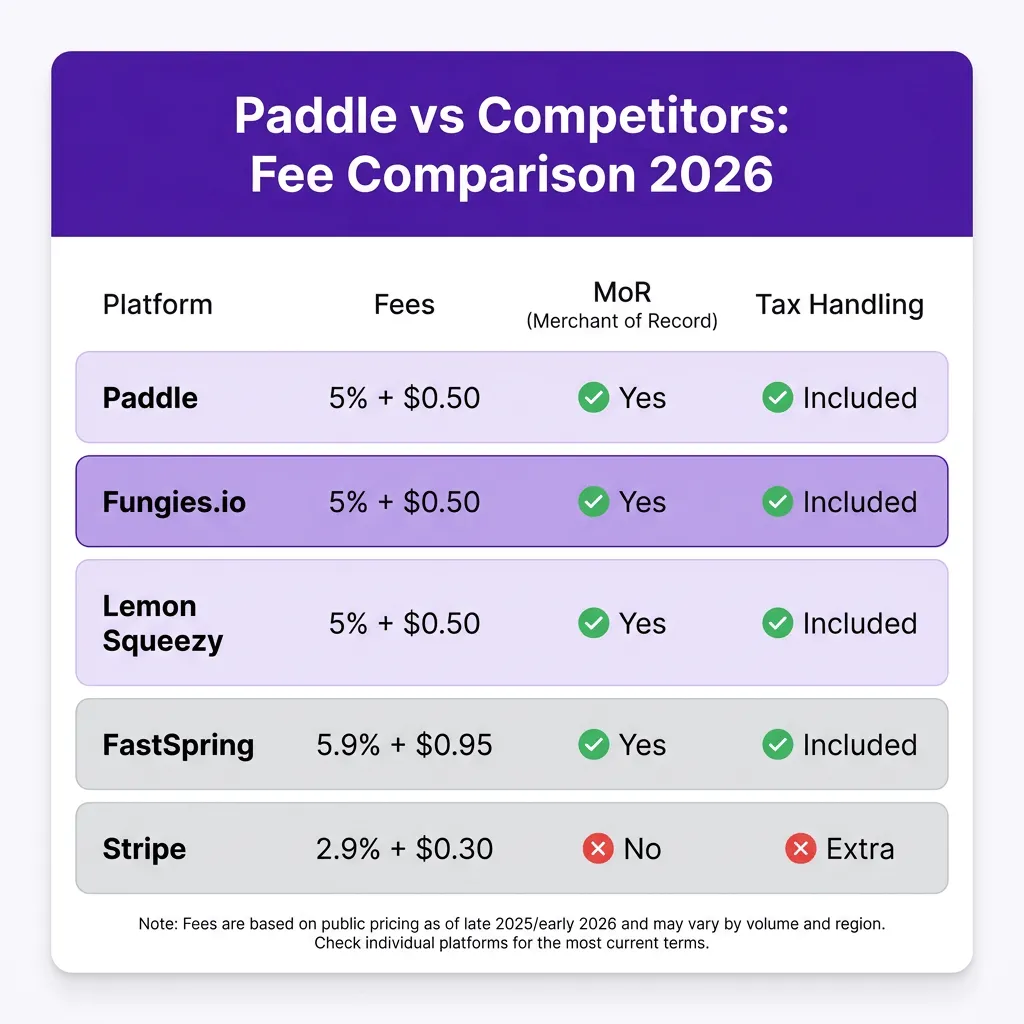
Paddle’s published rate: 5% + $0.50 per transaction. No monthly fees, no setup costs, no hidden platform charges.
But that’s the starting number, not the final number. Here’s what actually affects your effective rate:
Currency conversion
If your customer pays in EUR and you receive USD, Paddle applies a currency conversion spread — typically 1.5–2%. On a €50 transaction, that’s an extra €0.75–€1.00 on top of the headline fee.
Chargeback costs
Paddle handles chargeback disputes on your behalf, but if you lose a chargeback, the funds come out of your payout. There’s no per-dispute fee like Stripe’s $15 chargeback fee — but your funds are still at risk when disputes occur.
Refunds
Paddle processes refunds but doesn’t return the original transaction fee. On a refunded $100 sale, you ate $5.50 in fees.
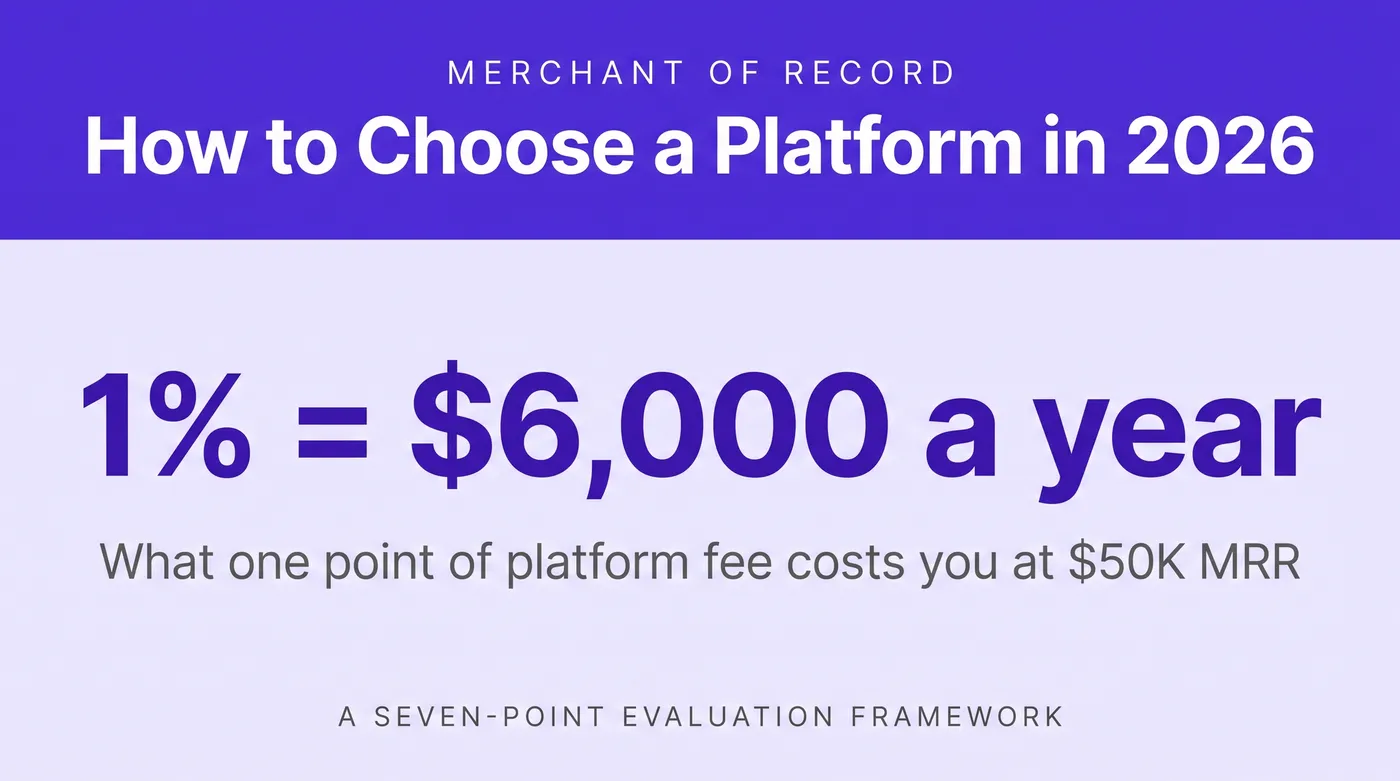
Realistically: at $10,000/month in revenue with average $49 transactions, you’re paying roughly $650/month in fees (6.5% effective). At $50,000/month, that climbs to $3,000+ per month. At that scale, the math deserves a closer look.
| Platform | Base Fee | Per Transaction | Monthly Fee | Tax Included | MoR |
|---|---|---|---|---|---|
| Paddle | 5% | $0.50 | $0 | ✅ Yes | ✅ Yes |
| Fungies.io | 5% | $0.50 | $0 | ✅ Yes | ✅ Yes |
| Lemon Squeezy | 5% | $0.50 | $0 | ✅ Yes | ✅ Yes |
| FastSpring | 5.9% | $0.95 | $0 | ✅ Yes | ✅ Yes |
| Dodo Payments | 3% | $0.50 | $0 | ✅ Yes | ✅ Yes |
| Stripe Billing | 2.9% | $0.30 | +$25/mo | ❌ Extra 0.5% | ❌ No |
What Paddle Handles (That You’d Otherwise Do Yourself)
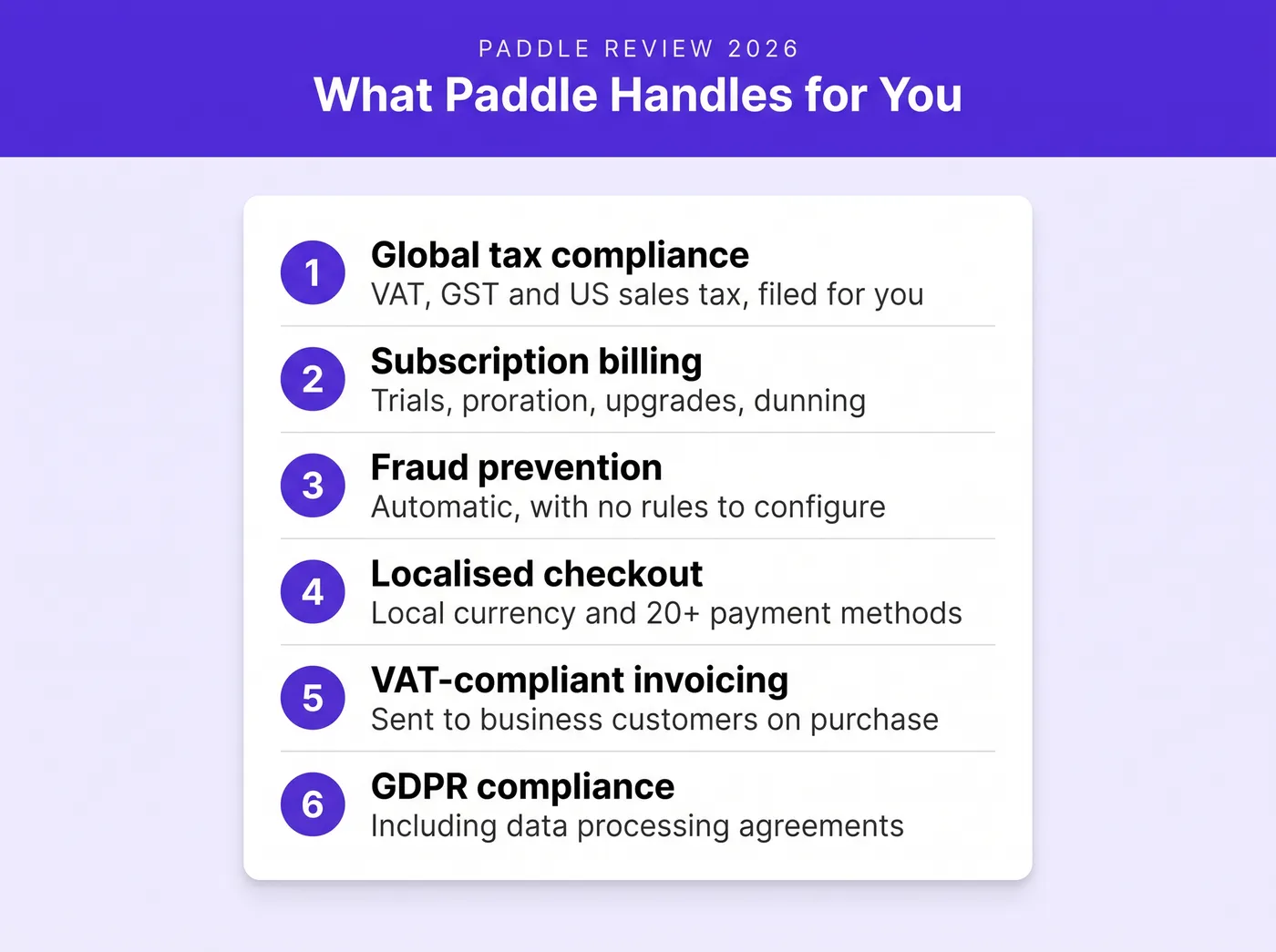
The real value of Paddle isn’t the checkout widget. It’s everything that happens around the payment that most founders don’t think about until they’re audited.
- Global tax compliance — VAT in EU countries, GST in Australia/Canada/India, sales tax in 50 US states. Paddle files on your behalf in every jurisdiction where it’s registered.
- Subscription billing — Via Paddle Billing: trials, upgrades, downgrades, proration, dunning, pause/resume. Solid feature set for standard SaaS models.
- Fraud prevention — Machine learning on transaction patterns. You don’t configure rules; Paddle’s system handles this automatically.
- Localized checkout — Auto-detects user location, shows local currency and payment methods. Supports 20+ local payment methods including PayPal, Apple Pay, Google Pay, and regional options.
- Invoicing — Automated VAT-compliant invoices sent to B2B customers on purchase.
- GDPR compliance — Paddle is GDPR-compliant and provides Data Processing Agreements.
Paddle’s Approval Process: The Part Nobody Tells You About
This is where Paddle’s reputation takes a hit. Worth being direct about it.
Paddle has a manual domain verification process. Before you accept live payments, Paddle reviews your product, website, legal pages, and business type. This is standard MoR practice — they’re taking on legal liability for your sales, so they need to vet what you’re selling.
The problem: the process is opaque and inconsistently applied.
Real complaints from 2024–2025 include:
- Generative AI rejections — Multiple founders reported being denied because their product was flagged as “Generative AI” — even for tools with clear, legitimate use cases.
- The 3-month processing history requirement — Paddle requires prior payment processing history for some product types. Many founders only discover this after a week of back-and-forth.
- Entity mismatch rejections — If your legal entity name doesn’t exactly match what’s on your website, you’ll be rejected. One capitalization difference can cause a week-long delay.
- Missing legal pages — No privacy policy or refund policy visible from the checkout? Rejected. These need to be accessible during the purchase flow.
Typical approval timeline: 3–7 business days for standard products. Longer for anything unusual. Some founders report 2–3 rejection cycles before getting through.
If you’re pre-launch and need to move fast, this friction matters. Alternatives like Fungies.io and Dodo Payments have lighter onboarding requirements for indie founders and AI tool builders.
Paddle Billing: Subscription Features Deep Dive
Paddle Billing launched as a major upgrade from their older “Paddle Classic” system. It’s now the default for new accounts and is genuinely strong for subscription management.
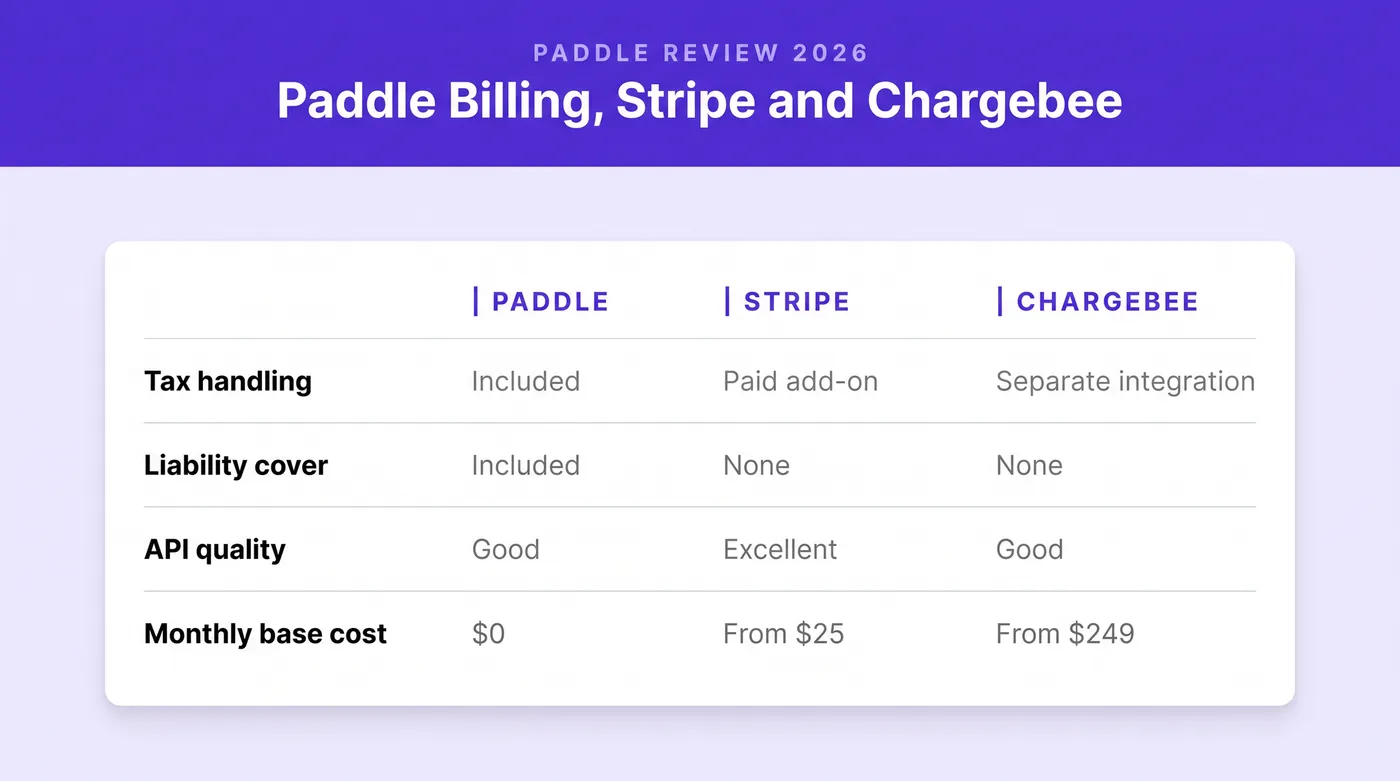
| Feature | Paddle Billing | Stripe Billing | Chargebee |
|---|---|---|---|
| Free trials | ✅ | ✅ | ✅ |
| Usage-based billing | ✅ | ✅ | ✅ |
| Proration | ✅ | ✅ | ✅ |
| Dunning / failed payment retry | ✅ (up to 17% recovery reported) | ✅ | ✅ |
| Tax handling included | ✅ | ❌ (+0.5% Stripe Tax) | ❌ (separate integration) |
| MoR liability coverage | ✅ | ❌ | ❌ |
| API quality | Good | Excellent | Good |
| Monthly base cost | $0 | $25+/mo | $249+/mo |
One limitation: Paddle’s billing logic is opinionated. If your pricing is highly complex — seat-based with usage overages and multiple add-ons — you may hit friction that Chargebee handles more gracefully. For standard SaaS models (monthly/annual, flat-rate or per-seat), Paddle Billing is sufficient and tightly integrated with compliance.
Who Should Use Paddle in 2026
Paddle is a genuinely good product. But it’s not the right product for everyone at every stage.
Paddle is a strong fit if:
- You’re selling SaaS globally to customers in multiple tax jurisdictions
- You want zero tax compliance overhead — ever
- You’re generating at least $2,000–$5,000/month (fees are more justifiable at this scale)
- Your product is an established SaaS tool with a clear, simple description
- You want subscription billing and payment infrastructure under one roof
Paddle is a poor fit if:
- You’re building a Generative AI product or anything in a “high-risk” category — approval friction is documented and real
- You’re pre-revenue or pre-launch — the approval process assumes a live product exists
- You need highly customized billing logic or complex revenue recognition
- You’re only selling to a single geography (Stripe + Stripe Tax may be cheaper)
- You need immediate payment acceptance without a multi-day review window
Paddle Alternatives Worth Considering
| Alternative | Best For | Fee | MoR | Indie Friendly |
|---|---|---|---|---|
| Fungies.io | AI tools, indie hackers, early-stage SaaS | 5% + $0.50 | ✅ | ✅ High |
| Lemon Squeezy | Digital products, creators | 5% + $0.50 | ✅ | ✅ High |
| Dodo Payments | Developer-first, lower fees | 3% + $0.50 | ✅ | ✅ High |
| FastSpring | Enterprise software, complex ops | 5.9% + $0.95 | ✅ | ❌ Low |
| Stripe + Stripe Tax | US-focused, high volume, finance team | 2.9% + $0.30 + 0.5% | ❌ | ✅ Medium |
Fungies.io specifically mirrors Paddle’s fee structure (5% + $0.50, no monthly fee, full MoR with global tax included) but with lighter onboarding — making it worth a serious look for founders who want the same compliance coverage without the approval friction. You can get started free here.
Key Takeaways
- Paddle works best at scale. At $5,000–$50,000+/month, the 5% fee makes real sense given everything it offloads.
- The approval process is a genuine friction point. Budget 1–2 weeks, have your legal pages ready, and ensure your legal entity name matches your website exactly before applying.
- Paddle Billing is solid for standard subscription models. Complex billing logic may warrant Chargebee or Recurly instead.
- Currency conversion adds real cost. For international-heavy products, factor in an extra 1.5–2% effective rate on cross-border transactions.
- AI and high-risk categories: check alternatives first. Fungies.io, Dodo Payments, and Creem have smoother onboarding for AI tools and non-standard products.
Frequently Asked Questions
What does Paddle charge per transaction in 2026?
Paddle charges 5% + $0.50 per transaction with no monthly fees, no setup costs, and no separate charges for tax compliance or subscription management. The effective rate may be higher when accounting for currency conversion spreads on international transactions.
Is Paddle better than Stripe for SaaS?
It depends on your situation. Stripe is cheaper on paper (2.9% + $0.30) but you remain the Merchant of Record — meaning you handle tax collection, compliance filings, and chargeback liability yourself. Paddle costs more in fees but offloads all of that. For international SaaS without a dedicated finance team, Paddle typically costs less in total when you factor in accounting, legal, and founder time.
How long does Paddle account approval take?
Standard approval takes 3–7 business days. Products in sensitive categories (Generative AI, gambling-adjacent, crypto) may take longer or be declined. Having polished legal pages (privacy policy, refund policy, terms of service) accessible from your checkout page and a consistent legal entity name significantly reduces friction.
What are the best Paddle alternatives in 2026?
For indie hackers and AI founders: Fungies.io (same fee structure, lighter onboarding) and Dodo Payments (lower base fee at 3%). For digital product creators: Lemon Squeezy. For enterprise software: FastSpring. For teams willing to manage their own tax compliance: Stripe Billing + Stripe Tax.
Conclusion
Paddle is the Merchant of Record most SaaS founders encounter first — and for good reason. It’s battle-tested, has solid subscription infrastructure, and genuinely eliminates the global tax compliance problem that quietly drowns solo founders.
But it’s not frictionless. The approval process has real edge cases. The fees compound as you scale. And for early-stage builders in AI or creator tools, the onboarding assumptions don’t always match reality.
If Paddle’s profile fits your business — go for it. If you’re pre-revenue, building AI tools, or looking for something with lighter onboarding and the same compliance coverage, Fungies.io is worth a serious look.
References
- Paddle official site
- UniBee: Paddle Review 2026 — Features, Pricing, Pros & Cons
- Dodo Payments: Paddle Fees 2026 — The Real Cost Analysis
- HackerNews: Paddle rejection experience (no prior processing statements)
- Dev.to: Paddle rejected my SaaS 3 times — what they check
- Capterra: Paddle Reviews 2026
- Stripe vs Paddle: Fees, Tax Handling & MoR Compared
- Fungies.io: 9 Best Paddle Alternatives for SaaS in 2026