Here’s the number that stops most indie developers cold: the top 10% of AI tools built in 2025 each crossed $10,000 MRR within 60 days of launch. The bottom 80%? Still figuring out how to charge their first dollar.
It’s not the product that separates them. It’s how they handle monetization — the pricing model, the payment stack, and whether they spent two weeks fighting VAT registrations or shipped another feature instead.
If you’ve built (or are building) an AI tool, LLM wrapper, or no-code AI app in 2026, this guide is for you. I’ll walk through every monetization model that actually works, what payment infrastructure you need to sell globally without getting buried in tax compliance, and how to make your first $1,000 MRR without hiring an accountant.
Why Monetizing AI Tools Is Different From Regular SaaS
Building on top of LLMs introduces a cost structure that most SaaS founders have never dealt with. Every user interaction burns API credits. That changes everything about how you price.
In 2026, LLM API costs range from $0.05 to $30 per million input tokens — a 600x spread. GPT-5.4 Pro runs $30/million tokens. Gemini 2.5 Flash-Lite can process the same prompt for under $0.10. If you built your pricing model without modeling your token costs first, you’re either leaving money on the table or bleeding cash per active user.
There’s a second problem: global distribution. AI tools don’t respect borders. The moment you put your tool online, you’ll get signups from Germany, Brazil, Australia, and Japan. Each of those countries has different VAT/GST rules. Mess this up and you’re technically non-compliant in 140+ jurisdictions from day one.
The good news: both problems have clean solutions. Let’s start with pricing.
The 5 Monetization Models That Work for AI Tools
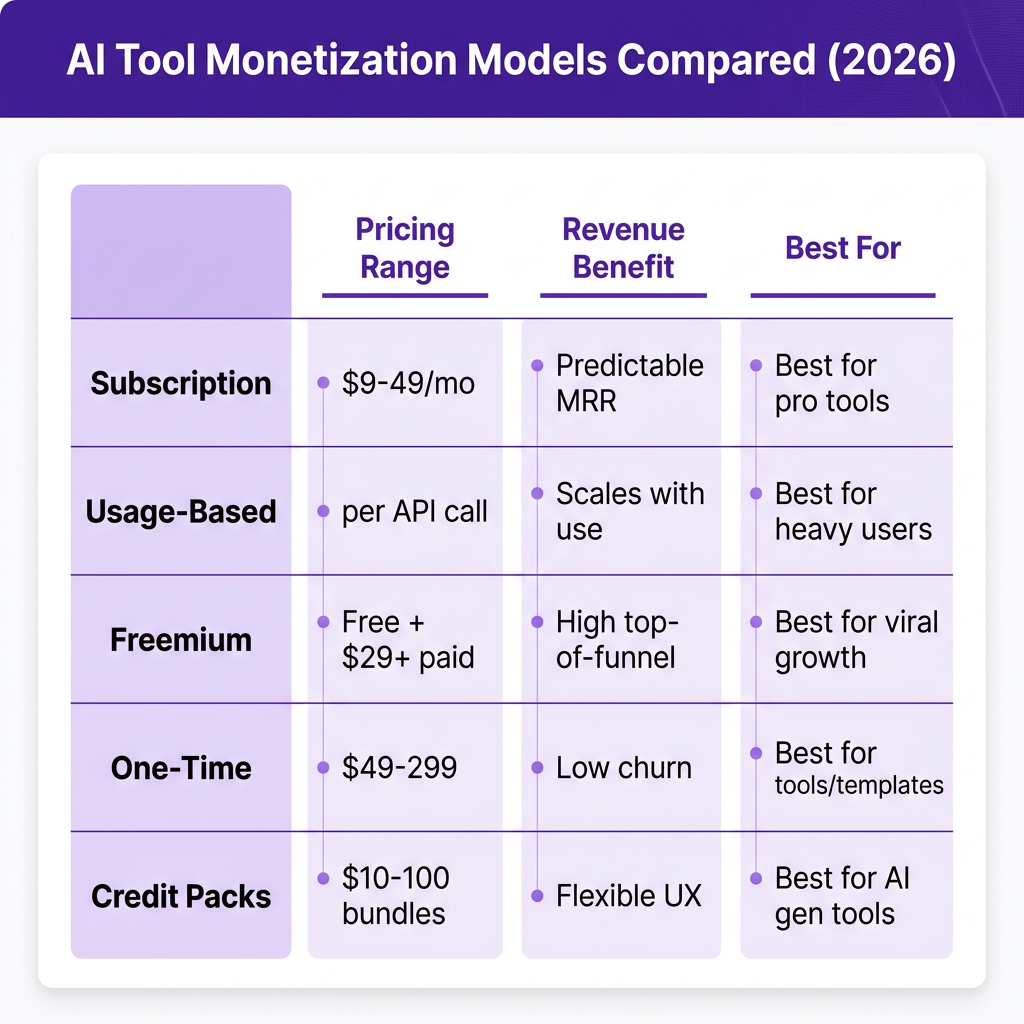
1. Subscription (Most Common, Best for Recurring Revenue)
The standard play. You charge a flat monthly or annual fee for access. Works best when your users have a recurring workflow — writing tools, image generators, research assistants, code helpers.
What actually works in 2026:
- Price between $9–$49/month for individual tiers
- Separate tiers by usage limits (e.g., 100 AI generations/month vs. unlimited)
- Annual discount of 20–30% to boost LTV and reduce churn
The danger: if you’re on a flat subscription but your power users consume 10x the API credits of casual users, you’ll get killed by cost asymmetry. Use usage caps or fair-use limits.
Real example: Most AI writing tools ($19–$29/month) give 100–200 generations on the starter plan and unlimited on pro. That cap isn’t arbitrary — it’s covering their GPT-4o costs while keeping the conversion funnel open.
2. Usage-Based / Pay-Per-Call (Best for Heavy or Unpredictable Use)
You charge per API call, per generation, per document processed, or per token consumed. This model scales perfectly with actual value delivered and eliminates the cost-asymmetry problem.
Usage-based pricing is growing fast in 2026. 44% of SaaS companies now use some form of usage metering, up from 27% in 2023 (OpenView Partners, 2026 Expansion SaaS Benchmarks).
Typical pricing:
- AI image generation: $0.01–$0.05 per image
- AI text processing: $0.002–$0.01 per 1,000 words
- AI code review: $0.05–$0.20 per PR
The catch: usage-based models are harder to predict for customers. They work better for developer tools and API products where buyers are technical and comfortable with metered billing.
3. Freemium (Best for Top-of-Funnel Volume)
Free tier to hook users, paid plan to unlock real value. This is the model that built ChatGPT, Midjourney, and Perplexity. It works when:
- Your tool has a strong “aha moment” in the first session
- Free users share or embed outputs (virality)
- Paid features are clearly superior (not just more usage)
The freemium trap: if 98% of your users stay free and your API costs are non-trivial, you’re funding a charity. Set hard limits on the free tier and make the upgrade obvious.
4. One-Time Purchase (Best for Tools and Templates)
Charge once, deliver forever. Works well for Notion templates, AI prompt packs, standalone scripts, and tools that don’t require ongoing server costs (or have very low ones).
Typical one-time pricing: $19–$299 depending on perceived value and complexity. If your tool has ongoing API costs, one-time purchase is risky unless you cap lifetime usage or eat the costs strategically as a customer acquisition play.
5. Credit Packs (Best for AI Generation Tools)
Users buy bundles of credits upfront ($10 = 100 credits, $50 = 600 credits, etc.) and spend them as they use the tool. This is the model behind Midjourney, DALL-E, and most AI image/video tools.
Credit packs solve the “I don’t know how much I’ll use” customer anxiety while giving you predictable cash flow. Users who run out of credits feel pressure to buy more — it’s a natural conversion funnel.
The Payment Stack Question: Stripe or Merchant of Record?
This is where most AI tool founders get it wrong. They copy what they know — usually Stripe — without thinking through the compliance implications of selling globally.
Here’s the core distinction you need to understand:
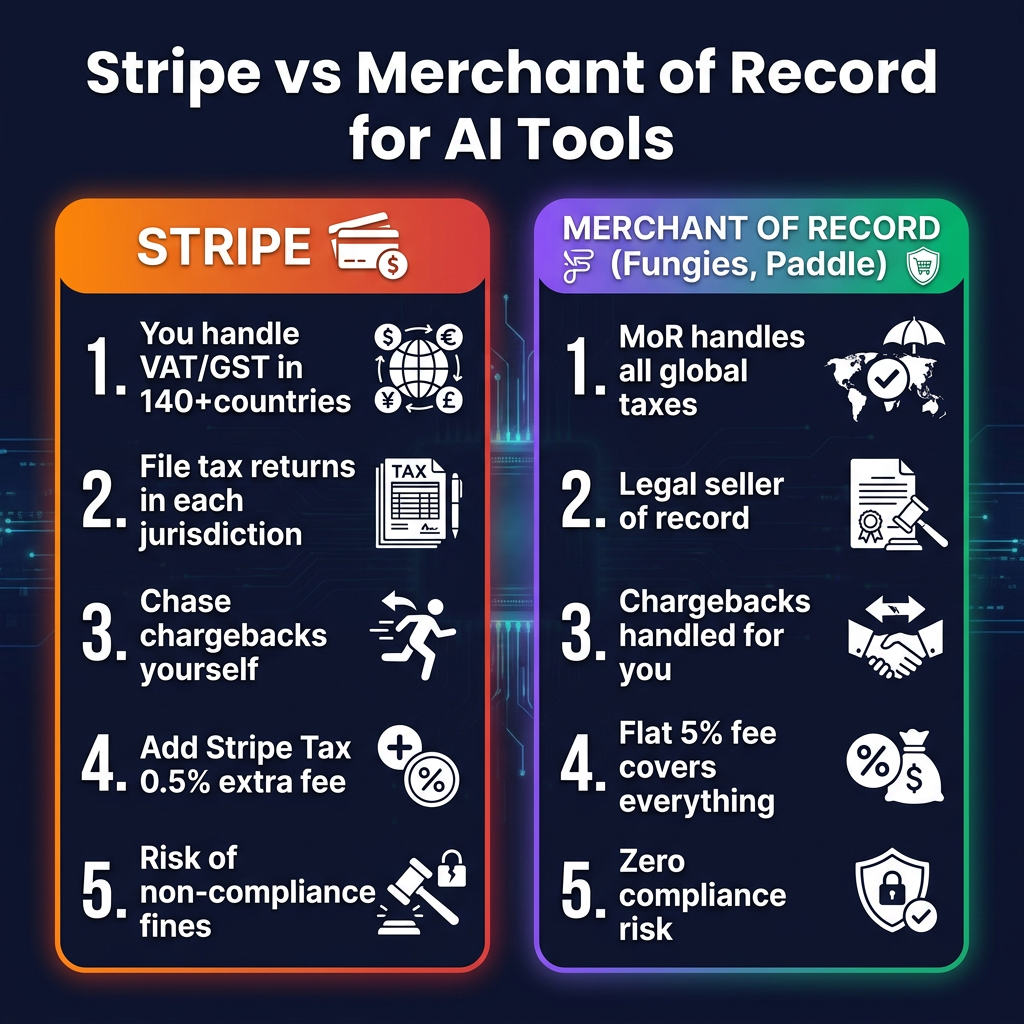
| Factor | Stripe (Payment Processor) | Merchant of Record (e.g., Fungies, Paddle) |
|---|---|---|
| Legal seller | You | The MoR platform |
| VAT/GST handling | You (+ Stripe Tax at 0.5% extra) | Included, automatic |
| Tax filing | You file in each jurisdiction | MoR files for you |
| Chargeback liability | You absorb them | MoR handles them |
| Base fee | 2.9% + $0.30 | ~5% + $0.50 (all-inclusive) |
| Stripe Tax add-on | +0.5% per transaction | Included |
| EU VAT compliance | DIY | Handled |
| Global tax jurisdictions | 140+ you must manage | 140+ auto-managed |
When you add Stripe Tax (0.5%), plus the cost of an accountant to file in each jurisdiction, plus your time managing compliance — the MoR model often costs less in total, not more.
When to Use Stripe (and When Not To)
Stripe makes sense if:
- You’re selling only in the US and have a US entity
- You’re B2B only (VAT reverse charge applies in EU, simplifying compliance)
- You have an in-house accountant or CFO handling tax filings
- Your transaction volume is high enough that 2% fee savings matter more than compliance overhead
Stripe becomes a problem when:
- You’re getting signups from EU countries (you need to register for VAT if you exceed €10,000 in EU digital sales per year)
- You have B2C customers (each country’s consumer tax rules apply)
- You don’t want to deal with quarterly VAT filings across 5–15 countries
- You’re solo or a very small team — compliance eats founder time
The EU threshold is worth flagging specifically: if you generate more than €10,000 in B2C digital sales across EU countries in a calendar year, you must register for VAT in each country where you sell, or register for the EU’s OSS (One Stop Shop) scheme. Most indie developers hit this faster than they expect, especially with AI tools that have strong European demand.
Setting Up Payments for Your AI Tool: A Practical Walkthrough
Here’s what the actual setup looks like for an indie AI tool founder in 2026, going from zero to accepting global payments:
Option A: Stripe + Tax Plugin (DIY compliance)
- Create a Stripe account and connect your bank
- Enable Stripe Tax (adds 0.5% per transaction)
- Configure tax rates for your target markets
- Set up Stripe Billing for subscriptions or Stripe Checkout for one-time
- Register for VAT in the EU (or OSS) once you hit €10k threshold
- File quarterly VAT returns — yourself or via an accountant
Time to launch: 1–3 days for the tech, ongoing tax overhead every quarter.
Total cost at $10k MRR: ~3.4% effective fee (2.9% + 0.5% tax) + $200–500/month accounting.
Option B: Merchant of Record (zero compliance overhead)
- Create a Merchant of Record account (Fungies, Paddle, Dodo Payments)
- Add your products/pricing tiers
- Embed the checkout widget or redirect to hosted checkout
- Go live — the MoR handles all tax collection and filing automatically
- Focus on product, not paperwork
Time to launch: Same day, often under an hour.
Total cost at $10k MRR: ~5% flat (all-inclusive). No accounting fees for tax.
Option C: Hybrid (for high-volume tools with US focus)
Use Stripe for US customers (lower fees, simpler compliance) and a MoR for international customers (automatic global tax handling). This requires routing logic in your checkout but can save 1–2% on your US revenue at scale.
Most indie developers shouldn’t bother with hybrid until they’re doing $50k+ MRR. The complexity isn’t worth it earlier.
Pricing Your AI Tool: The Numbers That Actually Work
Pricing is where most indie developers undersell. The fear of “no one will pay for this” leads to $5/month plans that can’t cover API costs, let alone growth.
Here’s what’s working in the market right now:
| AI Tool Type | Starter Tier | Pro Tier | Usage Limit |
|---|---|---|---|
| AI writing assistant | $19/mo | $49/mo | 50k / 200k words |
| AI image generator | $12/mo or credit packs | $39/mo | 100 / unlimited images |
| AI code review | $29/mo | $79/mo | 50 / 200 PRs |
| AI research tool | $15/mo | $45/mo | 30 / 150 reports |
| LLM API wrapper/SDK | Free + $0.002/call | $99/mo flat | Usage-based / unlimited |
| No-code AI agent builder | $49/mo | $149/mo | 1k / 10k agent runs |
Key insight: the average indie AI tool subscription in 2026 is $29/month. If you’re charging $9, you’re leaving 70%+ of potential revenue on the table. Most buyers are professionals who use the tool for work — they’re not comparing you to Netflix, they’re comparing you to the 2 hours of productivity time you save them per week.
Handling Recurring Revenue and Subscription Management
Whether you use Stripe Billing or a MoR, you need to think through your subscription mechanics before launch:
Trials
7-day trials outperform 14-day trials for conversion in most AI tool categories. The urgency forces users to actually try the core feature instead of forgetting about it. Require a credit card for trial — uncarded trials have 80% lower conversion to paid.
Upgrade/downgrade flows
Make it easy to upgrade, hard to cancel (but not impossible). A well-designed cancel flow with an offer (“stay for $9/month for 3 months?”) can save 15–25% of churning subscribers.
Annual billing
Offer 2 months free for annual plans. This is a 17% discount and typically converts 20–35% of monthly subscribers when properly promoted. Annual plans have dramatically lower churn and improve your cash flow.
Metered billing
If you’re doing usage-based billing, make sure your billing platform supports metered reporting. Stripe Billing does this natively. Most MoR platforms (including Fungies) support usage-based products as well.

Key Takeaways
- Model your token costs first. Know your cost per user/month before setting a price. Target 4–10x gross margin on API costs at minimum.
- Don’t underprice. The average indie AI tool charges $29/month. If your tool solves a real problem, it’s worth at least that.
- Use a Merchant of Record if you’re selling globally B2C. The compliance overhead of DIY Stripe international tax handling kills indie productivity faster than any technical problem.
- Credit packs work well for generation tools — they solve the unpredictability problem for both you and your customer.
- Annual billing is free MRR. Push it hard from day one. 20–30% discounts for annual plans convert well and drop your effective churn to near zero.
FAQ
Do I need to collect VAT for my AI tool if I’m just a solo developer?
Yes, if you’re selling to consumers (B2C) in the EU and your digital sales exceed €10,000/year across EU countries. The threshold is lower than most people realize. Using a Merchant of Record sidesteps this completely — they become the legal seller and handle all VAT collection and remittance.
What’s the cheapest way to accept payments for a new AI tool?
Stripe is cheaper per transaction (2.9% + $0.30 vs ~5% for MoR), but the total cost including tax compliance tools and accounting often makes it more expensive for indie developers selling globally. For purely US-only sales at low volume, Stripe is usually the cheapest. For global B2C, a MoR usually wins on total cost.
Can I use Gumroad to sell an AI tool?
Technically yes — Gumroad acts as a limited Merchant of Record and handles tax in many jurisdictions. But Gumroad takes 10% on transactions, compared to 5% for platforms like Fungies. For AI tools with recurring subscriptions, Gumroad’s subscription tooling is also limited. You’ll outgrow it quickly if you’re building a proper product.
How do I handle LLM API costs going up when I have existing subscribers?
Build pricing tiers with usage caps rather than truly unlimited access. When your API costs increase, you can tighten the caps or grandfather existing users at their current limits while moving new users to updated pricing. Usage-based billing eliminates this problem entirely since revenue scales with consumption.
Start Selling Your AI Tool Today
The barrier to monetizing an AI tool in 2026 has never been lower — but the compliance complexity of selling globally has never been higher. The fastest path from “I built this” to “I’m making money from this” is to get payment infrastructure right from day one.
A Merchant of Record setup like Fungies handles global taxes automatically, gives you an embedded checkout that converts, and lets you focus on the thing that actually matters: making your AI tool better.
Ready to monetize your AI tool without the tax headaches? Create your free Fungies account — you can have your first product live in under an hour.
References
- OpenView Partners, 2026 Expansion SaaS Benchmarks — usage-based pricing adoption data
- CloudIDR LLM Pricing Index 2026 — LLM API cost comparison
- Dodo Payments Blog — AI wrapper pricing strategy
- Indie Hackers — AI tool monetization case studies
- Stripe Sessions 2026 — AI economy payment data
- Fungies.io: MoR vs Payment Processor Guide