The digital marketing landscape has reached an unprecedented inflection point in 2026. With global digital ad spending projected to surpass $786.2 billion this year, the industry has officially crossed into a new era where artificial intelligence, privacy-first strategies, and short-form video content dominate every conversation. For marketers, business owners, and SaaS founders, understanding these shifts isn’t optional—it’s survival.
Consider this: 44% of users who have tried AI-powered search through ChatGPT, Gemini, and Claude now say it has become their primary and preferred source for internet searching, compared with just 31% who prefer traditional search. This single statistic represents a seismic shift in how consumers discover brands, products, and services. The implications for SEO, content strategy, and paid advertising are profound and immediate.
Meanwhile, the competitive dynamics between tech giants are reshaping the advertising ecosystem itself. For the first time in history, Meta is projected to overtake Google as the world’s largest digital advertising platform by the end of 2026, with revenues soaring past $243.46 billion. This power shift signals fundamental changes in where marketers allocate budgets and how they measure success.

Market Overview: The $786.2 Billion Digital Marketing Ecosystem
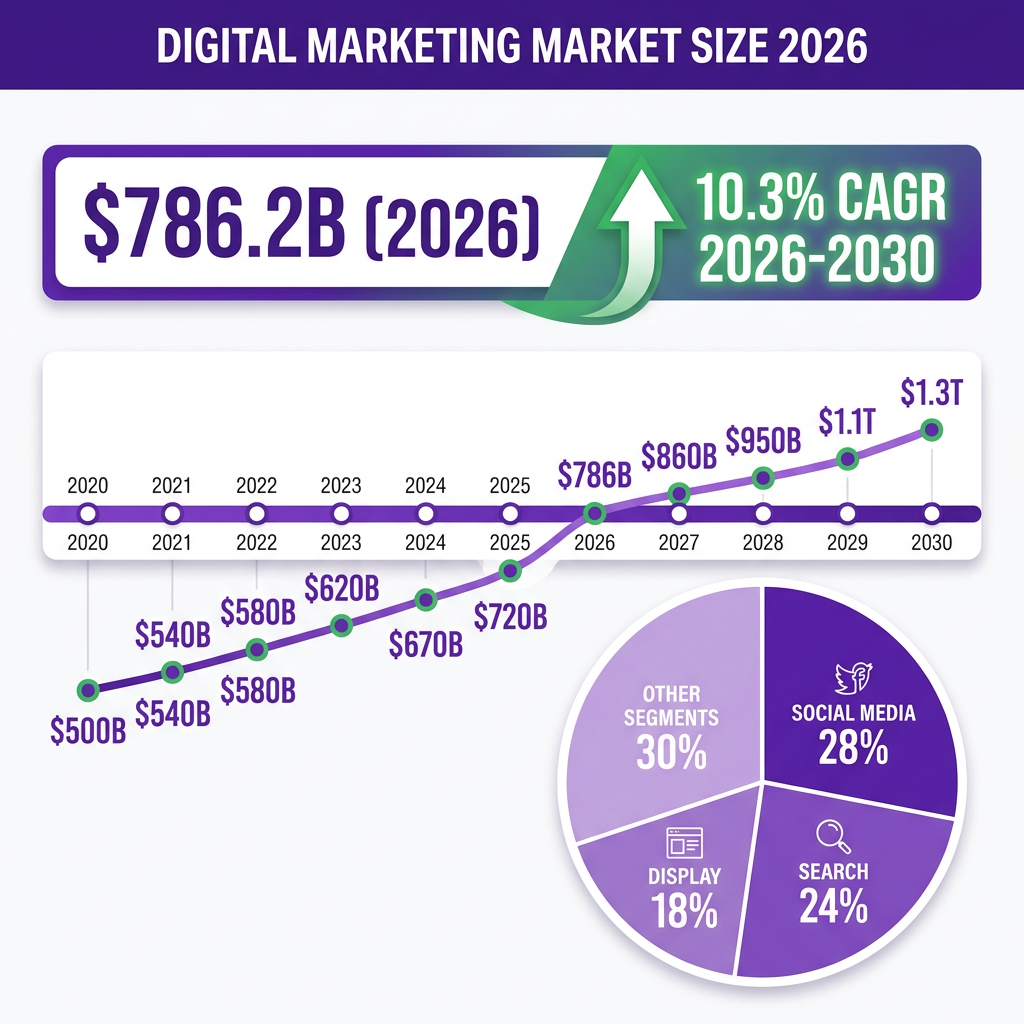
The global digital marketing market has evolved from a niche channel into the dominant force in advertising. In 2026, digital ad spend accounts for more than 65% of total media spend worldwide, cementing its position as the primary way businesses connect with consumers. This represents a compound annual growth rate (CAGR) of approximately 10.3%, with the market expected to reach $1.5 trillion by 2030.
The journey to this milestone has been remarkable. Digital ad spending stood at $601.8 billion in 2023, grew to approximately $700 billion in 2025, and is now poised to exceed $786 billion in 2026. This trajectory reflects not just increased budgets but a fundamental reallocation of resources as traditional media—print, radio, and even linear television—continue to lose share to digital channels.
Several factors are driving this explosive growth. First, the proliferation of smartphones and mobile internet access has created an always-connected consumer base. With over 5.2 billion people actively using social platforms in 2026—representing more than 64% of the world’s population—the addressable market for digital marketers has never been larger. Second, the sophistication of targeting and measurement tools has made digital advertising increasingly efficient, delivering measurable ROI that traditional media struggles to match.
The mobile revolution deserves special attention. Mobile advertising spending is expected to reach $495 billion in 2026, making up nearly half of all digital ad investments. This shift reflects changing consumer behavior: 57% of online purchases are now made on mobile devices, and 30% of all mobile searches are related to local stores. For marketers, mobile-first strategies are no longer innovative—they’re table stakes.
Looking at channel distribution, social media advertising captures the largest share of digital marketing revenue, followed closely by search advertising and display/video advertising. Social media ad spend alone is projected to grow to $219 billion in 2026, up 14% from 2024, making up more than 20% of total digital ad budgets. Video advertising will account for 38% of total digital ad budgets by the end of 2026, reflecting the format’s superior engagement and conversion performance.
Key Statistics and Data: 25 Numbers Every Marketer Must Know
Data drives decisions in modern marketing. Here are the essential statistics that should inform your 2026 strategy:
Market Size and Growth
- Global digital ad spend in 2026: $786.2 billion (SEO.com, 2025)
- Digital’s share of total media spend: 65%+
- Projected market size by 2030: $1.5 trillion
- Compound Annual Growth Rate (CAGR): 10.3%
- Mobile advertising spend: $495 billion (nearly 50% of digital)
- Social media ad spend: $219 billion (up 14% from 2024)
- Video advertising share: 38% of total digital ad budgets
Consumer Behavior and Engagement
- Global social media users: 5.2 billion (64% of world population)
- Average daily time on social platforms: 2 hours 28 minutes
- Mobile share of online purchases: 57%
- Local searches on Google: 46% of all searches
- Users preferring AI-powered search: 44% (vs. 31% traditional)
Platform-Specific Metrics
- Facebook monthly active users: 3.1 billion
- YouTube monthly active users: 2.9 billion
- Instagram monthly active users: 2.3 billion
- TikTok monthly active users: 1.6 billion
- TikTok engagement rate increase: +49% year-over-year
- LinkedIn engagement rate increase: +44% year-over-year
AI and Automation Impact
- Organizations deploying AI in marketing: 88% (up from 78% in 2024)
- Marketers using AI tools daily: 60%
- Marketers using AI for content generation: 93%
- Businesses with improved SEO from AI: 65%
- AI-driven conversion rate improvement: 20-30%
- Campaign launch time reduction with AI: 75%
Content Marketing Performance
- B2B content marketing ROI: £3 for every £1 invested
- Email marketing ROI: £30.50 for every £1 spent
- Companies with blogs seeing positive ROI: 13x more likely
- Website traffic from organic search: 53%
- Google’s #1 result CTR: 27.6%
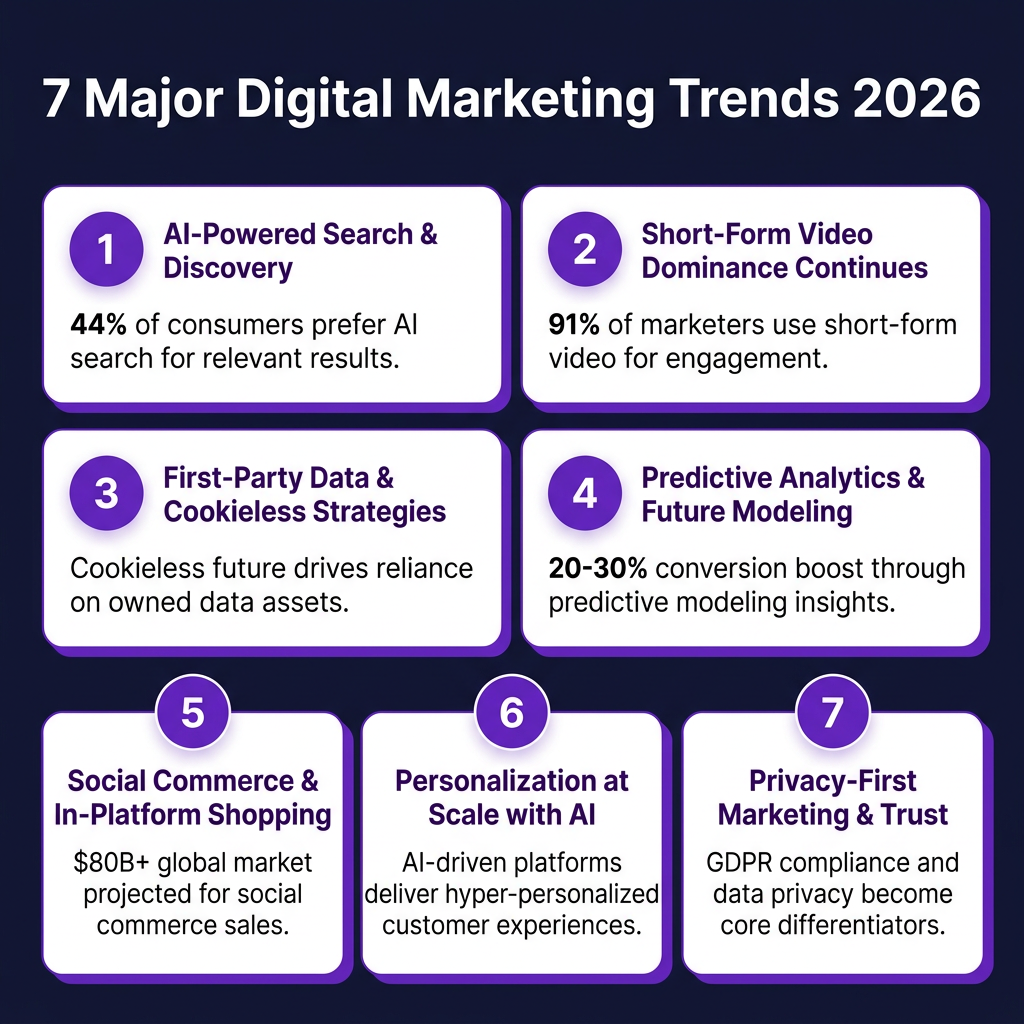
7 Major Trends Shaping Digital Marketing in 2026
The digital marketing landscape is being reshaped by seven powerful trends that every marketer must understand and adapt to. These aren’t passing fads—they represent fundamental shifts in technology, consumer behavior, and regulatory environments.
1. AI-Powered Search and Discovery
The search landscape has been fundamentally altered by AI. With 44% of users now preferring AI-powered search engines like ChatGPT, Gemini, and Claude over traditional Google search, the implications for SEO are profound. This shift represents more than a change in user preference—it’s a transformation in how information is discovered and consumed.
Marketers must now optimize for AI search and discovery, not just traditional search engine rankings. This means creating structured, authoritative content that AI systems can easily parse and cite. The concept of “Search Everywhere Optimization” has emerged as the new standard: making your business, products, and services discoverable wherever your audience is looking, whether that’s Google, AI chatbots, social platforms, or voice assistants.
2. Short-Form Video Dominance
Short-form video has become the most effective content format across all platforms. In 2026, 91% of marketers are expected to use short-form video, with 85% believing it’s the most effective format on social media. The statistics are compelling: 21% of marketers say short-form videos deliver the highest ROI of any content type.
TikTok leads this revolution with a 49% year-over-year increase in engagement rates, but Instagram Reels and YouTube Shorts are equally important. The optimal length for short-form video is between 31-60 seconds, and 47% of marketers say this format is more likely to go viral than any other. For brands, this means rethinking content strategies to prioritize video-first approaches.
3. First-Party Data and Cookieless Marketing
The deprecation of third-party cookies across all major browsers has forced a fundamental shift in how marketers collect and use data. First-party data—information collected directly from your own customers with their explicit permission—is now more valuable than ever. It’s more accurate, more compliant, and more stable than third-party behavioral data ever was.
Successful marketers in 2026 have rebuilt their measurement from the server layer up, constructed first-party data programs that create genuine consumer value in exchange for data consent, and shifted their media mix toward channels that don’t depend on third-party tracking. Server-side tracking, consent management platforms, and contextual targeting have become essential components of the modern marketing stack.
4. Predictive Analytics and AI Automation
Predictive analytics, powered by AI, is becoming integral to digital marketing strategies. By analyzing past consumer data patterns, AI can predict future purchasing behaviors and preferences, allowing marketers to anticipate customer needs at various touchpoints. The results are measurable: businesses using AI to optimize pricing see an average profit margin lift of 12%, and predictive AI improves conversion rates by 20-30%.
AI-driven campaigns launch 75% faster while delivering 47% better click-through rates and ROI improvements of up to 30%. With 88% of organizations now deploying AI in one or more business functions (up from 78% in 2024), the question is no longer whether to adopt AI but how to implement it most effectively.
5. Social Commerce and In-Platform Shopping
Social commerce has matured into a major revenue channel. With platforms like Instagram, TikTok, and Pinterest offering seamless in-app shopping experiences, the path from discovery to purchase has never been shorter. The social commerce market is now valued at over $80 billion, with continued rapid growth expected.
For marketers, this means treating social platforms not just as awareness channels but as full-funnel sales environments. Product tagging, shoppable posts, and live-stream commerce are becoming standard features of social media strategies. The integration of entertainment and shopping—sometimes called “shoppertainment”—represents a fundamental blurring of content and commerce.
6. Personalization at Scale
Personalization is the name of the marketing game in 2026, but achieving it at scale requires AI. Generic messaging no longer cuts through the noise. Consumers expect personalized experiences based on their preferences, behaviors, and contexts. AI enables this by processing vast amounts of data to deliver the right message to the right person at the right time.
However, personalization must be balanced with privacy concerns. The most successful brands are transparent about data usage and provide clear value in exchange for customer information. Zero-party data—information that customers intentionally and proactively share—is becoming increasingly valuable as it represents explicit consent and genuine interest.
7. Privacy-First Marketing
Data privacy has become a cornerstone of digital marketing strategies. With increasing regulatory scrutiny—from GDPR in Europe to state-level privacy laws in the US—and growing consumer awareness about data usage, privacy-first marketing is no longer optional. Brands that prioritize transparency and data protection are building trust and competitive advantage.
This trend intersects with all others. AI-powered personalization must respect privacy boundaries. First-party data strategies must include robust consent management. Even short-form video content must comply with platform-specific data policies. Privacy isn’t a separate initiative—it’s woven into every aspect of modern marketing.
Key Players and Competitive Landscape
The digital advertising market is dominated by a handful of tech giants, but 2026 marks a potential inflection point in their relative positions. Google, Meta, and Amazon are projected to account for 62.3% of 2026 digital ad spending globally, but the balance of power is shifting.
Meta: The New King of Digital Advertising
For the first time ever, Meta is expected to overtake Google in terms of total digital ad revenues by the end of 2026. According to eMarketer projections, Meta’s global net ad revenue will reach $243.46 billion, ahead of Google’s projected $239.54 billion. This represents a historic shift in the advertising landscape.
Meta’s strength lies in its suite of platforms—Facebook, Instagram, WhatsApp, and Messenger—which offer rich environments for advertisers to reach their target audiences through social media ads. The company’s detailed user data enables highly personalized advertising at scale. With Reels driving engagement growth and AI-powered ad targeting improving performance, Meta’s position looks strong for the foreseeable future.
Google: Still Dominant in Search
Despite losing the overall digital ad crown, Google remains the dominant force in search advertising. The company’s extensive search data provides unmatched intent-based targeting capabilities. YouTube, with over 2.9 billion monthly active users and 1 billion hours of video watched daily, represents a significant and growing advertising platform.
Google’s advertising revenue is projected to “remain steady at 11.9%” this year, implying a figure near $330 billion when including YouTube and network partners. The company’s challenge is adapting to the AI search revolution while maintaining its advertising dominance. Google’s AI Overviews and integration of generative AI into search represent both opportunities and threats to its traditional ad model.
Amazon: The E-Commerce Advertising Powerhouse
Amazon’s advertising business continues its rapid growth, projected to reach just over $82 billion in 2026, up from $68.6 billion in 2025. What makes Amazon unique is its consumer purchase insights—advertisers can target based on actual buying behavior, not just browsing history or demographic assumptions.
For product-based businesses, Amazon advertising has become essential. The platform’s sponsored product ads, display ads, and video ads offer multiple touchpoints throughout the customer journey. As e-commerce continues to grow, Amazon’s position in the advertising ecosystem strengthens.
Emerging Players and Challengers
Beyond the big three, several platforms are gaining advertising share. TikTok has exceeded 1.6 billion monthly active users and offers unique engagement opportunities, particularly with younger demographics. LinkedIn dominates B2B advertising with engagement rates up 44% year-over-year. Microsoft Advertising, Apple Search Ads, and retail media networks from Walmart, Target, and others are carving out significant niches.
The marketing technology landscape is equally dynamic. There are now 247 marketing startups with aggregate funding of $7.4 billion, averaging $107 million per company. Y Combinator alone has funded 136 marketing startups. This innovation ecosystem is constantly introducing new tools and approaches that challenge established players.

Challenges and Pain Points in 2026
Despite the opportunities, digital marketers face significant challenges in 2026. Understanding these pain points is essential for developing effective strategies.
1. Attribution Is Breaking
Marketing attribution is entering what many analysts describe as a structural crisis. Third-party cookie deprecation, privacy-first operating systems, fragmented customer journeys, AI-powered search interfaces, and increasing regulatory scrutiny are fundamentally weakening marketers’ ability to determine which campaign actually drives revenue.
For nearly two decades, digital marketing operated on the promise of perfect measurability. Clicks, impressions, conversions, ROAS, CAC, multi-touch attribution—these metrics connected user behavior across platforms and devices. But now, the connection is fraying. Brand marketing is regaining strategic importance precisely because not everything can be directly measured anymore.
2. Rising Ad Costs and Competition
As more businesses compete for digital attention, advertising costs continue to rise. Cost-per-click (CPC) and cost-per-thousand-impressions (CPM) have increased across most platforms, squeezing margins for advertisers. Small and medium businesses, in particular, struggle to compete with larger brands that can afford higher bids and more sophisticated optimization.
The solution requires smarter targeting, better creative, and improved conversion optimization. Marketers who can leverage first-party data and AI-powered optimization tools can maintain efficiency even as costs rise. Those who rely on basic targeting and generic creative will find their campaigns increasingly unprofitable.
3. Content Saturation and Attention Scarcity
The volume of content being produced has never been higher. With 93% of marketers using AI to generate content faster, the internet is being flooded with material of varying quality. This creates a paradox: more content than ever, but less attention available for any individual piece.
Breaking through requires exceptional quality, genuine originality, and deep audience understanding. The brands that succeed are those that create content that truly resonates—content that provides unique value, tells compelling stories, and builds authentic connections. Quantity without quality is a recipe for invisibility.
4. Platform Algorithm Volatility
Social media and search algorithms change constantly, often with little warning. An approach that drives significant traffic one month can become ineffective the next. This volatility makes it difficult to build sustainable organic strategies and forces marketers to maintain diversified channel portfolios.
The recent trend of declining organic reach on Instagram (average likes per post down 15% year-over-year) illustrates this challenge. Platforms increasingly prioritize content from accounts that drive engagement, creating a winner-take-most dynamic that favors established players with large audiences.
5. Privacy Regulations and Compliance
Navigating the complex landscape of privacy regulations—GDPR in Europe, CCPA in California, and an increasing patchwork of state-level laws in the US—requires significant resources and expertise. Non-compliance carries substantial financial and reputational risks.
Beyond legal compliance, marketers must build genuine trust with consumers about data usage. This requires transparent privacy policies, clear value exchanges for data collection, and robust security measures. Privacy isn’t just a legal requirement—it’s becoming a competitive differentiator.
Opportunities and Growth Strategies
Amidst the challenges, significant opportunities exist for marketers who adapt strategically. Here are the key growth strategies for 2026:
1. Embrace AI as a Strategic Partner
AI is no longer a novelty—it’s a necessity. The organizations seeing the greatest success are those that have integrated AI across their marketing workflows, from content generation to campaign optimization to customer service. The key is using AI for speed while maintaining human oversight for strategy and creativity.
Specific applications include: AI-powered content generation for scale, predictive analytics for targeting optimization, chatbots and conversational AI for customer engagement, automated A/B testing for creative optimization, and AI-driven personalization for improved conversion rates.
2. Build First-Party Data Assets
In a cookieless world, first-party data is the most valuable asset a marketer can build. This requires creating compelling reasons for customers to share their information—valuable content, exclusive offers, personalized experiences, and genuine community.
Strategies include: implementing server-side tracking for better data collection, building email lists through valuable lead magnets, creating loyalty programs that incentivize data sharing, developing communities that foster engagement and data collection, and using progressive profiling to build customer understanding over time.
3. Invest in Video-First Content
Video is now the largest line item in the average marketing content budget, and for good reason. It consistently outperforms every other format on engagement, conversion, and retention metrics. The key is developing video capabilities that can produce quality content at scale.
AI video tools are making this more accessible than ever, reducing production costs by 80% and cutting time-to-market from 3 weeks to 24 hours. Businesses using AI-driven video marketing see an 82% increase in ROI compared to traditional video creation. The optimal strategy combines short-form video for reach and engagement with longer-form content for education and conversion.
4. Optimize for AI Search and Discovery
With 44% of users preferring AI-powered search, optimizing for these new discovery mechanisms is critical. This requires a shift from traditional keyword-focused SEO to comprehensive, authoritative content that AI systems can cite and recommend.
Key tactics include: creating comprehensive content that answers complete questions, structuring content with clear headings and summaries, building topical authority through content clusters, ensuring technical excellence for crawlability, and monitoring how AI systems cite and reference your content.
5. Diversify Channel Mix
Over-reliance on any single platform creates vulnerability. Successful marketers in 2026 maintain presence across multiple channels—search, social, email, video, and emerging platforms. This diversification provides resilience against algorithm changes and captures audiences wherever they spend time.
The specific mix should reflect your audience’s preferences and behaviors. B2B companies might prioritize LinkedIn and search; consumer brands might focus on Instagram and TikTok; SaaS companies might emphasize content marketing and SEO. The key is being where your customers are, not where it’s most convenient for you.
Case Studies and Success Stories
Theory is valuable, but real-world examples demonstrate what’s possible. Here are three case studies illustrating successful digital marketing strategies in 2026:
Case Study 1: AI-Driven Personalization at Scale
A mid-sized e-commerce retailer implemented AI-powered personalization across their email and website experiences. By analyzing customer behavior and preferences, they created dynamic content that adapted to each visitor. The results were dramatic: conversion rates increased by 28%, average order value rose by 15%, and customer lifetime value improved by 35%. The key insight was that personalization at scale requires AI—the volume of variations and speed of optimization simply isn’t possible with manual approaches.
Case Study 2: Short-Form Video Transformation
A B2B SaaS company shifted their content strategy to prioritize short-form video on LinkedIn and YouTube. Rather than repurposing long-form content, they created native short videos designed for each platform’s unique characteristics. Within six months, their organic reach increased by 340%, engagement rates tripled, and qualified lead generation from social channels grew by 85%. The lesson: platform-native content outperforms repurposed material.
Case Study 3: First-Party Data Strategy
A direct-to-consumer brand faced declining performance as third-party cookies disappeared. They pivoted to a first-party data strategy, creating a loyalty program, interactive content experiences, and exclusive community access in exchange for customer data. Within a year, they had built a database of 500,000 engaged customers with rich preference profiles. Marketing efficiency improved by 45%, and customer acquisition costs dropped by 30%. The insight: customers will share data when they receive clear value in return.
Future Outlook: 2026-2030 Predictions
Looking ahead, several trends will shape the next phase of digital marketing evolution:
The Rise of AI Agents
By 2027, AI agents will handle significant portions of the customer journey—from initial research to purchase decisions. Marketers must optimize for AI agents as intermediaries between brands and consumers. This means ensuring your content is structured for AI consumption, your products are easily discoverable by AI systems, and your value propositions are clear enough for AI to communicate.
Programmatic Everything
By 2030, 84.9% of advertising revenue will be generated through programmatic advertising. The automation of media buying will extend to every channel and format. This requires marketers to develop sophisticated understanding of programmatic systems, data management platforms, and real-time bidding strategies.
Immersive Marketing
AR and VR will transform from novelty to necessity. As these technologies mature, immersive brand experiences will become standard expectations. Early adopters are already experimenting with virtual showrooms, AR product visualization, and metaverse brand presences. By 2030, these will be mainstream marketing channels.
Hyper-Personalization
The personalization of 2026 will seem primitive by 2030. AI will enable truly individualized experiences—websites that adapt in real-time to each visitor, content that adjusts based on mood and context, and offers that reflect not just purchase history but predicted future needs. The brands that master this will command significant competitive advantage.
The $1.5 Trillion Market
By 2030, the digital advertising market will reach $1.5 trillion. This growth will be driven by emerging markets, new formats, and the continued shift of budgets from traditional to digital channels. The marketers who build capabilities now—AI fluency, first-party data assets, video production, and privacy-compliant targeting—will be best positioned to capture this growth.
Email Marketing: The Channel That Refuses to Die
In an era dominated by AI, social media, and emerging technologies, email marketing remains the workhorse of digital marketing—and for good reason. The average return for every £1 invested in email marketing is £30.50, making it the top-performing ROI channel for B2C marketers and a critical component of any comprehensive strategy.
But email marketing in 2026 looks very different from even a few years ago. Open rate benchmarks that shaped strategy in 2024 are already unreliable, reshaped by DMARC enforcement, Apple Mail Privacy Protection maturity, AI-driven personalization at scale, and AMP email adoption. The overall average email open rate is now approximately 25.55% across all industries, but this figure masks significant variation.
The real story is in automation. Email flows massively outperform campaigns on revenue efficiency. While email campaigns drive the majority of send volume (94.7%), flows generate nearly 41% of total email revenue from just 5.3% of sends. The average revenue per recipient (RPR) for flows is nearly 18× higher than campaigns—proving that automation is the primary revenue engine in email marketing.
AI is transforming email marketing in profound ways. Predictive send-time optimization ensures messages arrive when recipients are most likely to engage. Dynamic content personalization adapts email content based on individual preferences and behaviors. Subject line optimization uses machine learning to predict which variations will drive the highest open rates. For marketers, this means better results with less manual effort—but it also means the bar for email marketing excellence keeps rising.
The Evolution of SEO in the AI Era
Search engine optimization has undergone more transformation in the past two years than in the previous decade. The emergence of AI-powered search has fundamentally altered how content is discovered, evaluated, and presented to users. Google’s AI Overviews, ChatGPT’s browsing capabilities, and Perplexity’s citation-based answers represent a new paradigm that marketers must understand.
The statistics tell a clear story: 53% of total website traffic still comes from organic search, and Google’s #1 result captures an average of 27.6% CTR. But the path to that #1 position has changed. Mobile-first indexing reigns supreme—Google prioritizes the mobile version of websites for indexing and ranking. Content quality has never been more critical, with high-quality, relevant content serving as a key ranking factor and driver of user engagement.
For 2026, successful SEO requires optimizing for AI search and discovery, not just traditional rankings. This means creating comprehensive, authoritative content that answers complete questions. It means structuring content with clear headings, summaries, and schema markup that AI systems can easily parse. It means building topical authority through content clusters that demonstrate expertise across entire subject areas.
Technical SEO remains foundational. Core Web Vitals—measuring loading performance, interactivity, and visual stability—directly impact rankings. Crawlability and indexation must be flawless. Site architecture should facilitate both user navigation and search engine understanding. The marketers who master these technical fundamentals while creating genuinely valuable content will dominate organic search in 2026 and beyond.
Influencer Marketing: From Novelty to Necessity
Influencer marketing has evolved from an experimental tactic to a core component of digital strategy. The industry grew from $1.7 billion in 2016 to $16.4 billion in 2022, and continued growth has brought the market to over $24 billion in 2026. Nearly half of marketers are reallocating budgets into influencer partnerships, recognizing the power of authentic recommendations over traditional advertising.
The nature of influencer partnerships has matured. The focus has shifted from follower counts to engagement rates, audience alignment, and authentic connection. Micro-influencers—those with smaller but highly engaged followings—often deliver better ROI than celebrity partnerships. The key is finding influencers whose values align with your brand and whose audience matches your target market.
AI is entering the influencer space as well. AI-generated influencers—virtual personalities created entirely through technology—are gaining followings and brand partnerships. While this raises questions about authenticity, it also opens new possibilities for controlled messaging and always-on content creation. The most successful brands will likely blend human and AI influencers based on campaign objectives and audience preferences.
Programmatic Advertising and the Automation Revolution
Programmatic advertising—the automated buying and selling of digital ad inventory—has become the dominant force in digital advertising. By 2030, 84.9% of advertising revenue will be generated through programmatic channels. This shift represents not just efficiency gains but fundamental changes in how advertising is planned, executed, and optimized.
The benefits of programmatic are compelling. Real-time bidding ensures ads are shown to the right people at the right time. Sophisticated targeting capabilities leverage first-party data, contextual signals, and behavioral patterns. Automated optimization continuously improves campaign performance without manual intervention. For marketers, this means better results with less time spent on tactical execution.
However, programmatic advertising requires new skills and approaches. Understanding demand-side platforms (DSPs), supply-side platforms (SSPs), and data management platforms (DMPs) is essential. Privacy regulations and cookie deprecation are forcing innovation in targeting methodologies. Brand safety and ad fraud remain concerns that require vigilance and sophisticated verification tools.
The future of programmatic lies in AI-driven optimization and connected TV (CTV). As streaming services adopt programmatic ad models, the distinction between digital and traditional television advertising blurs. Marketers who master programmatic now will be well-positioned as these channels converge and evolve.
The Rise of Retail Media Networks
Retail media networks—advertising platforms operated by retailers on their digital properties—represent one of the fastest-growing segments of digital advertising. Amazon leads this space with $82 billion in projected ad revenue for 2026, but Walmart, Target, Instacart, and others are rapidly expanding their offerings.
The appeal of retail media is clear: advertisers can reach consumers at the point of purchase intent, using first-party data about actual shopping behavior. This closes the loop between advertising and sales in ways that traditional digital advertising struggles to match. For retailers, media networks represent high-margin revenue streams that leverage existing customer relationships.
For marketers, retail media requires new strategies and capabilities. Each retailer’s platform has unique features, targeting options, and measurement approaches. Budget allocation between retail media and traditional digital channels requires careful analysis of customer journeys and attribution. As retail media grows, it will increasingly compete for share of wallet with Google, Meta, and other established players.
Voice Search and Conversational Marketing
Voice search continues its steady growth, with significant implications for SEO and content strategy. Users now ask full questions instead of typing short keywords. This shift requires content that answers natural language queries in comprehensive, conversational ways. Featured snippets and position zero have become even more valuable as voice assistants often read these responses aloud.
Beyond search, conversational marketing through chatbots and messaging apps has matured. AI-powered chatbots can handle complex customer interactions, from answering product questions to processing orders. WhatsApp Business, Facebook Messenger, and similar platforms offer direct channels to customers that bypass traditional advertising entirely.
The integration of voice and conversational interfaces into marketing strategies will accelerate. Brands that optimize for voice search, deploy effective chatbots, and leverage messaging platforms will create competitive advantages in customer acquisition and retention. The key is ensuring these automated interactions feel natural and genuinely helpful—not robotic or frustrating.
Marketing Technology Stack Evolution
The marketing technology landscape continues to expand and consolidate simultaneously. Marketing technology, which refers to software or systems marketers use to achieve their goals, takes second place in digital marketing investment with a 25.4% share. The average enterprise now uses dozens of marketing tools, creating both opportunities and challenges.
Integration has become the critical challenge. Point solutions that don’t connect to broader systems create data silos and inefficiencies. The most successful organizations are building integrated technology stacks where data flows seamlessly between platforms. Customer Data Platforms (CDPs) have emerged as central hubs that unify data from multiple sources and make it actionable across channels.
AI is being embedded throughout the marketing stack. Content management systems offer AI-powered writing assistance. Email platforms provide predictive send-time optimization. Analytics tools use machine learning to surface insights humans might miss. The marketers who master these AI-enhanced tools will operate at a scale and efficiency that competitors struggle to match.
Sustainability and Purpose-Driven Marketing
Consumers increasingly expect brands to take stands on social and environmental issues. Purpose-driven marketing—aligning brand messaging with values and causes—has moved from niche to mainstream. This isn’t just about corporate social responsibility; it’s about connecting with consumers who want their purchases to reflect their values.
However, authenticity is critical. Consumers can detect performative activism from genuine commitment. Brands must back their messaging with real action—sustainable supply chains, ethical labor practices, and meaningful community investment. The companies that successfully align profit with purpose are building lasting customer loyalty and competitive differentiation.
For digital marketers, this means telling stories that go beyond product features. It means showcasing real impact, not just aspirations. It means being transparent about challenges and progress, not just successes. The brands that master authentic purpose-driven marketing will attract the growing segment of consumers who vote with their wallets.
Key Takeaways
- The $786.2 billion digital marketing market represents a 10.3% CAGR, with mobile advertising ($495B) and social media ($219B) driving the most growth.
- AI is reshaping search—44% of users now prefer AI-powered search, requiring marketers to optimize for AI discovery, not just traditional SEO.
- Short-form video dominates—91% of marketers use it, with 85% calling it the most effective format and 21% reporting the highest ROI.
- First-party data is essential—cookie deprecation makes owned data assets more valuable than ever for targeting and personalization.
- Meta overtakes Google—for the first time, Meta’s ad revenue ($243.46B) will exceed Google’s ($239.54B) in 2026, signaling a shift in platform power.
- Attribution is breaking—privacy changes and fragmented journeys make measurement harder, requiring new approaches to ROI analysis.
- AI adoption is universal—88% of organizations use AI in marketing, with 93% using it for content generation and 60% using AI tools daily.
Sources and Citations
- eMarketer – Meta to Surpass Google in Digital Ad Revenues (April 2026)
- Statista Market Forecast – Digital Advertising Worldwide
- SEO.com – Digital Marketing Statistics 2025-2026
- Socialinsider – Social Media Engagement Benchmarks 2026
- Buffer – State of Social Media Engagement 2026 (
52M+ posts analyzed) - McKinsey & Co – AI Search Adoption Report 2026
- Taboola – AI Marketing Trends 2026
- Adobe – AI Marketing Statistics 2026
- Sopro.io – AI Sales and Marketing Statistics
- Klaviyo – Email Marketing Benchmarks 2026
- Kapwing – Video Marketing Statistics 2026
- First Page Sage – B2B Content Marketing Benchmarks 2026
- Expert Market Research – Digital Marketing Market Report 2026-2035
- Cognitive Market Research – Digital Marketing Market Analysis 2026
- Digital Marketing Institute – Digital Marketing Trends 2026
- LSEO – Top 10 Digital Marketing Trends for 2026
- Grofuse – Top 5 Digital Marketing Trends to Watch in 2026
- NewMedia.com – Social Media Marketing Statistics 2026
- Digital Applied – Email Marketing Statistics 2026
- Increasesmys.com – Digital Marketing 2026 Statistics
- EntrepreneursHQ – 91 Digital Marketing Industry Statistics 2026