Here’s a stat that’ll make you think: the median free-to-paid conversion rate for AI SaaS in 2026 is just 8%. That means 92 out of 100 people who try your AI app never pay you a dollar. The difference between an 8% and a 25% conversion rate isn’t the AI — it’s the pricing model, the checkout experience, and whether you’ve removed every possible friction from paying.
Building an AI app in 2026 is easier than ever. Monetizing it correctly? Still brutally hard. You’ve got to pick the right pricing model, handle global tax compliance, set up usage metering, and make checkout convert — all while keeping inference costs from eating your margin.
This guide walks through every piece: pricing models that actually work for AI products, what payment infrastructure to use, and how to sell globally without drowning in VAT registrations.
Why AI App Monetization Is Different from Traditional SaaS
Classic SaaS had near-zero marginal cost per user. Once you built the software, serving an extra customer was basically free. AI changes that equation completely.
Every GPT-4o call, every image generation, every vector search — it costs real money. A product doing 10,000 daily support queries using GPT-4o mini (500 input + 300 output tokens) burns roughly $518/month in model costs alone. Add cloud infra, SRE time, and support, and your margins look very different from a spreadsheet SaaS.
This means:
- Flat-rate pricing is a trap — heavy users kill your margin
- You need cost-aligned pricing that scales with usage
- Your checkout needs to handle credits, metered billing, and plan upgrades
- Global tax compliance matters from day one — AI products sell worldwide
The good news: there are proven pricing models that solve this. Let’s look at each one.
The 5 AI App Pricing Models in 2026
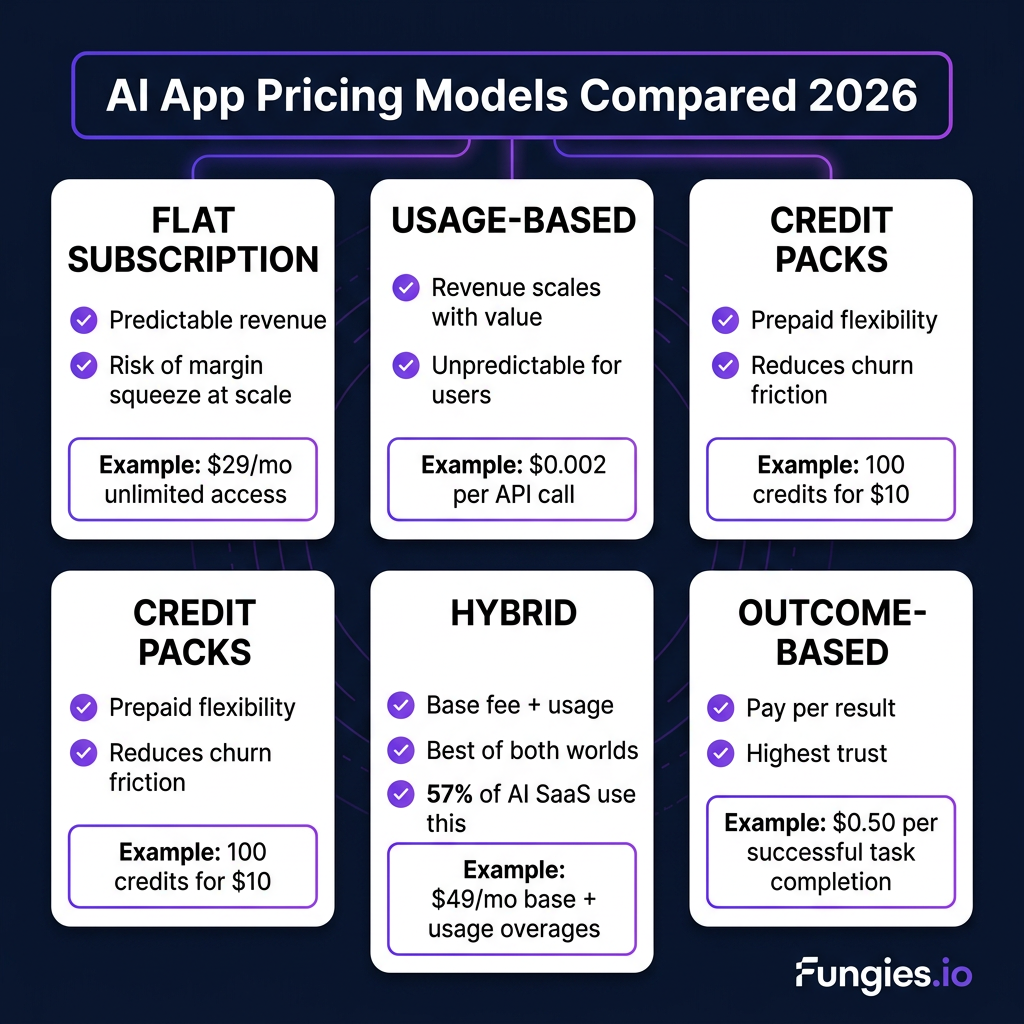
1. Flat Subscription
Classic SaaS pricing: charge $X/month for unlimited (or high-limit) access. Simple to understand, easy to sell.
When it works: When your inference costs are low and predictable. Think AI writing tools with short prompts, basic chatbots, or products using cheap open-source models.
When it kills you: Power users. If your top 10% of customers use 80% of your compute, flat pricing means you’re subsidizing your heaviest users with revenue from light ones. That’s a death spiral as you scale.
Real numbers: Median B2B SaaS starter plan is $29/user/month. AI tools typically price 2-3x higher due to inference costs — $49-99/month is common for AI-first products.
2. Usage-Based (Pay-Per-Call)
Charge per API call, per token, per image generated, per document processed. Revenue scales directly with usage, and your margins stay consistent.
When it works: Developer tools, API products, high-volume enterprise use cases where usage is predictable and measurable.
When it struggles: Consumer products. Most users hate surprise bills. Usage-based creates anxiety that kills conversion. OpenAI learned this — that’s why ChatGPT Plus is a flat $20/month despite the API being usage-based.
3. Credit Packs (Prepaid)
Sell bundles of credits. Users buy 100 credits for $10, spend them as they go, buy more when they run out. Popular in image generation, video tools, and AI agent marketplaces.
Why it works: Removes bill shock while preserving cost alignment. Users feel in control. You get cash upfront. Unused credits are pure margin.
Best for: Consumer AI apps, creative tools, one-off generation tasks. Midjourney, DALL-E API access, and most image generation tools use this model.
4. Hybrid: Subscription + Usage (The Winner)
Base monthly fee ($X/month) that includes a usage allowance, then charge for overages. This is what most successful AI SaaS ends up doing.
Why it’s the best: Subscription gives you predictable revenue. Usage charges protect your margin. Included credits reduce conversion friction. Users know roughly what they’ll pay.
Data: According to the 2026 SaaS monetization data from Bessemer Venture Partners, 57% of successful AI products use some form of hybrid pricing. Mid-market AI SaaS ARPU commonly runs $500-2,000/month using this model.
Example tiers:
- Starter: $49/month — includes 50,000 tokens, then $0.002 per 1k tokens
- Growth: $199/month — includes 300,000 tokens, then $0.0015 per 1k tokens
- Scale: $599/month — 1M tokens included, then $0.001 per 1k tokens (volume discount)
5. Outcome-Based
Charge per successful result: per lead generated, per support ticket resolved, per document summarized. Aligns incentives perfectly — you win when the customer wins.
The challenge: Measuring “success” is hard. What counts as a resolved ticket? What if the AI gets it 60% right? You also absorb cost risk on failed attempts.
Who’s using it: AI agents doing specific tasks — $0.50-2.00 per resolved customer query, $5-20 per qualified lead, $0.10-0.50 per document processed. Early-stage but growing fast.
AI App Pricing Benchmarks: What’s Actually Working
| Pricing Model | Best For | Median ARPU | Gross Margin Range | Churn Risk |
|---|---|---|---|---|
| Flat Subscription | Simple AI tools, low inference cost | $29-99/month | 50-70% | Medium |
| Usage-Based | API products, dev tools | Variable | 65-80% | Low (no lock-in) |
| Credit Packs | Consumer AI, creative tools | $10-50 one-time | 70-85% | Very Low |
| Hybrid | Mid-market SaaS, B2B AI | $200-2,000/month | 60-75% | Low |
| Outcome-Based | AI agents, task automation | $50-500/event | 40-65% | Very Low |
How to Set Up Payments for an AI App: 5 Steps
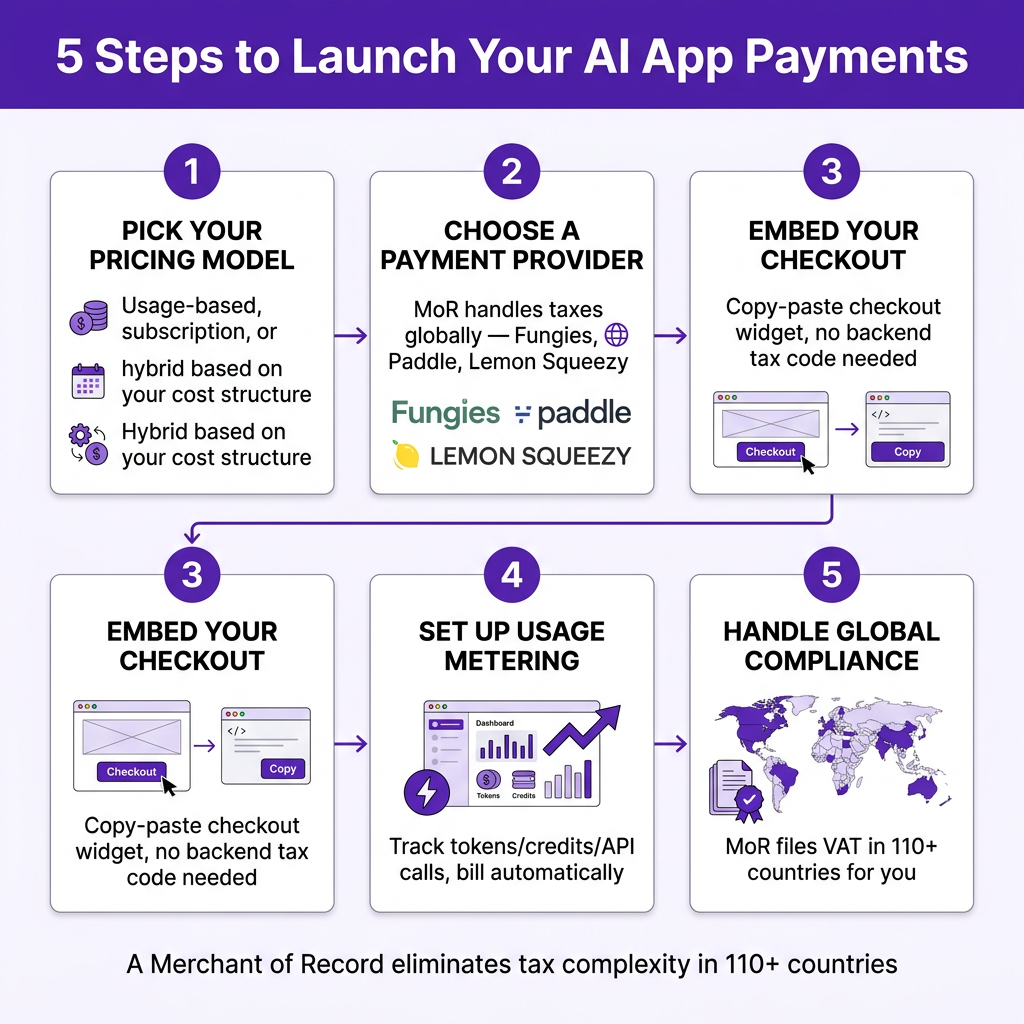
Step 1: Lock Your Pricing Model First
Don’t start with payment infrastructure — start with your pricing model. It determines everything: what billing platform you need, how you track usage, what your checkout looks like.
If you’re going hybrid (the most common choice), you need:
- A base subscription plan in your payment system
- Usage metering that tracks tokens/API calls/generations
- Automated overage billing at end of billing period
Step 2: Choose Your Payment Infrastructure
This is where most AI founders underestimate complexity. You have two real options:
Option A: Stripe + Tax Tools
Stripe is powerful and developer-friendly. But the moment you sell globally, you’re responsible for VAT in every country where you have customers. That means registering for EU VAT (no threshold for non-EU companies), Australian GST, UK VAT, Canadian GST, and 40+ other jurisdictions. You’ll spend $5,000-15,000 setting up registrations and $3,000-8,000/month on compliance team or tools to maintain them.
Option B: Merchant of Record (MoR)
A Merchant of Record like Fungies, Paddle, or Lemon Squeezy becomes the legal seller on every transaction. They collect VAT/GST on your behalf in 110+ countries, file it, and handle chargebacks. You pay a fee (typically 3-5% of revenue) and get to focus on building instead of tax compliance.
For most AI founders, especially early-stage or if you’re a solo dev, MoR wins. The compliance overhead of DIY is massive and scales with your revenue, not with your team size.
Step 3: Embed Your Checkout
Checkout is where you lose most potential revenue. Industry average checkout abandonment is 70%+. The fix: get your checkout embedded in your product, not on a separate payment page.
Modern MoR platforms let you embed checkout as a modal or widget directly in your app. Users click “Upgrade” → payment popup appears → done. No redirect, no context switch, no losing momentum.
Key checkout optimizations for AI apps:
- Show local currency — show prices in the user’s currency automatically
- Display usage limits clearly — “10,000 tokens/month” means more than “$29/month”
- Offer annual plans — typically 2-3x higher LTV; show monthly equivalent (“$19/month billed annually”)
- Add payment methods — credit card + PayPal at minimum; local methods for key markets
Step 4: Set Up Usage Metering
If you’re doing usage-based or hybrid pricing, metering is non-negotiable. You need to track:
- Request count per customer
- Token input/output per model call
- Compute time (for image/video generation)
- Customer ID and plan tier
The simplest approach: log every AI call to your database with customer ID, tokens used, model, and timestamp. Aggregate daily, compare against plan limits, trigger overage billing at month end.
More sophisticated: use a usage billing platform (Schematic, Flexprice, Metronome) that handles metering, plan limits, and billing events natively. They integrate with Stripe or your MoR via webhooks.
Step 5: Handle Global Tax from Day One
This is the step everyone skips until it’s too late. If you’re using an MoR, this is already handled — they register and collect VAT/GST in every market. If you’re on Stripe, you need a plan:
- EU VAT: Required from your first sale to an EU consumer. No revenue threshold for non-EU companies.
- UK VAT: £85,000 threshold for UK companies, but non-UK businesses: immediate registration required.
- Australian GST: A$75,000 threshold per year.
- US Sales Tax: Complex economic nexus rules by state — applies to SaaS in most states.
Merchant of Record vs DIY Payments: The Real Cost Comparison
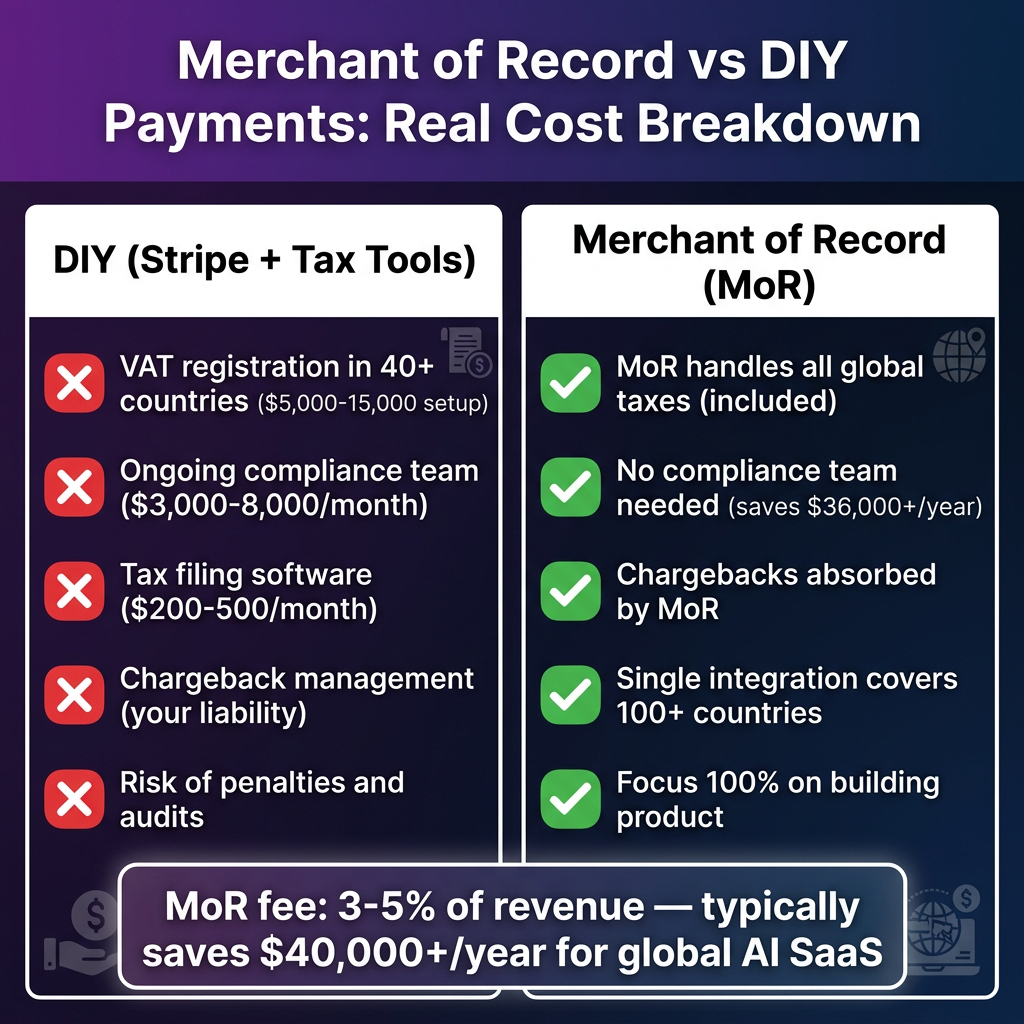
| Cost Category | DIY (Stripe + Tools) | Merchant of Record |
|---|---|---|
| Payment processing fee | 2.9% + $0.30 per transaction | 3-5% (all-in, varies by provider) |
| VAT registration (40+ countries) | $5,000-15,000 setup | Included |
| Ongoing compliance team/tools | $3,000-8,000/month | Included |
| Tax filing software (Avalara, TaxJar) | $200-500/month | Included |
| Chargeback management | Your liability + $15-25/dispute | MoR liability (included) |
| Currency conversion | 0.5-1.5% additional | Usually included |
| Annual savings vs DIY | — | $36,000-100,000+ |
The math is clear: for any AI app with meaningful global traffic, an MoR typically saves more than its fee costs — sometimes dramatically so. The break-even is usually around $20,000-30,000 in annual revenue, after which MoR is almost always cheaper than DIY when you count compliance costs honestly.
The AI App Monetization Stack: What to Use
| Layer | What You Need | Options (2026) |
|---|---|---|
| Payments + Tax | Process payments, handle global VAT/GST | Fungies (best for indie + AI), Paddle, Lemon Squeezy, FastSpring |
| Usage Metering | Track tokens, API calls, compute | Schematic, Flexprice, Metronome, or custom logging |
| Checkout UI | Embedded checkout widget | MoR’s built-in widget, or Paddle.js / Fungies embed |
| Subscription Management | Plan upgrades, downgrades, pauses | Usually built into your MoR |
| Revenue Analytics | MRR, churn, LTV tracking | ChartMogul, ProfitWell, or MoR dashboards |
Common Mistakes AI Founders Make with Monetization
1. Flat pricing too early
It feels simple and converts well at first. Then a power user appears and single-handedly costs you 3x what they pay. Add a usage cap or hybrid tier before this happens.
2. Ignoring VAT until year two
The EU’s VAT rules for digital services have no threshold for non-EU companies. You’re technically liable from your first sale. HMRC and EU tax authorities are actively pursuing AI SaaS companies in 2026. Don’t wait — either use an MoR or register proactively.
3. Too many pricing tiers
Three tiers max. Analysis paralysis is real. Most successful AI products: Free trial → Mid tier → Enterprise. That’s it.
4. Not showing annual billing prominently
Annual plans typically have 2x lower churn and 30-40% higher LTV. Put annual pricing as the default view, show the monthly equivalent, and add “Save 20%” badges. Most founders bury annual behind a toggle nobody clicks.
5. Building payment infrastructure from scratch
Stripe’s API is powerful, but building subscriptions, usage billing, upgrade flows, dunning emails, and tax compliance from scratch takes 3-6 months of engineering time. That’s 3-6 months not shipping features. Use an MoR or billing platform.
Key Takeaways
- Hybrid pricing wins for most AI SaaS — base subscription + usage overages protects margin while keeping conversion friction low. 57% of successful AI products use this model.
- Merchant of Record is almost always worth the fee — for AI apps with global users, MoR saves $36,000-100,000+/year in compliance costs and eliminates legal risk.
- Metering is non-negotiable — you can’t run hybrid pricing without tracking usage. Build or buy a metering layer before launch.
- Annual plans dramatically improve LTV — make them visible, default them, and discount them 15-25%. Most AI founders underprioritize this.
- Global compliance starts at sale one — EU VAT has no threshold for non-EU companies. An MoR handles this automatically; DIY requires immediate registration.
FAQ
What’s the best pricing model for an AI app in 2026?
Hybrid pricing — a base subscription with included credits plus usage-based overages — works best for most AI apps. It gives users predictable costs while protecting your margins from power users. 57% of successful AI SaaS products use some form of hybrid model in 2026.
Do I need to collect VAT if I’m selling AI software globally?
Yes. The EU, UK, Australia, Canada, and most developed markets require VAT/GST collection on digital services regardless of where the seller is based. The EU has no revenue threshold for non-EU companies — you’re liable from your first sale. Using a Merchant of Record (MoR) handles this automatically.
What’s the difference between Stripe and a Merchant of Record for AI apps?
Stripe processes payments but you remain the legal seller, responsible for all tax collection and compliance. A Merchant of Record (like Fungies, Paddle, or Lemon Squeezy) becomes the legal seller, taking on all tax liability, VAT registration, chargeback management, and compliance across 100+ countries. For global AI products, MoR typically saves more in compliance costs than its fee charges.
How do I handle usage billing for an AI app?
Log every AI API call with customer ID, tokens used, and timestamp. Aggregate usage daily, compare against plan limits, and trigger overage billing at end of billing period. For complex needs, dedicated metering platforms like Schematic, Flexprice, or Metronome integrate with your payment provider and handle limits, overages, and billing events automatically.
Start Selling Your AI App Globally — Without the Tax Headache
You’ve built something valuable. Don’t let payment complexity, VAT registrations, or checkout friction slow you down.
Fungies is a Merchant of Record built for indie founders and AI developers. Set up your checkout in minutes, sell globally with automatic tax compliance in 100+ countries, and keep more of what you earn.
Start selling your AI app with Fungies → Free to get started
References
- Bessemer Venture Partners. The AI Pricing and Monetization Playbook. bvp.com
- ChartMogul & Growth Unhinged. The SaaS Conversion Report 2026. chartmogul.com
- Schematic HQ. 9 Software Monetization Models for SaaS and AI Products (2026). schematichq.com
- First Page Sage. SaaS Freemium Conversion Rates: 2026 Report. firstpagesage.com
- Monetizely. The 2026 Guide to SaaS, AI, and Agentic Pricing Models. getmonetizely.com
- TaxDesk. VAT Compliance for AI Apps Companies: A global risk you can’t afford to ignore. taxdesk.com
- Zenskar. Token-Based Pricing for AI Products: The CFO’s Guide 2026. zenskar.com
- Artisan Growth Strategies. SaaS Conversion Rate Benchmarks 2026. artisangrowthstrategies.com