Creating a professional game website is essential for indie developers looking to showcase their work, build a community, and sell their games directly to players. With the global gaming market exceeding $200 billion in 2026, having your own game website gives you control over your brand, customer relationships, and revenue streams. But with so many options available, how do you choose the right game website maker for your needs?
In this comprehensive guide, we’ll compare the best game website makers available in 2026, analyzing their features, pricing, ease of use, and suitability for different types of developers. Whether you’re a solo indie creator or a small studio, this comparison will help you make an informed decision.
What to Look for in a Game Website Maker
Before diving into specific platforms, let’s establish the key criteria for evaluating game website makers:
1. Ease of Use
As a game developer, your primary focus should be creating great games, not wrestling with complex website builders. The best game website makers offer intuitive drag-and-drop interfaces, pre-designed templates optimized for gaming content, and minimal technical setup. Look for platforms that let you launch a professional site within hours, not weeks.
2. Payment Processing
Selling games directly requires robust payment infrastructure. Essential features include support for multiple payment methods (credit cards, PayPal, regional options), automatic tax calculation and remittance (VAT, sales tax), fraud protection, and instant payouts. Platforms that act as a Merchant of Record (MoR) handle all tax compliance automatically, saving you significant administrative burden.
3. Customization Options
Your game website should reflect your unique brand identity. Look for platforms offering customizable themes, custom domain support, CSS/HTML access for advanced styling, and the ability to embed trailers, screenshots, and gameplay videos seamlessly.
4. Marketing Tools
Building the website is only half the battle—you need tools to attract players. Key marketing features include SEO optimization, email list building, discount code creation, affiliate program support, and integration with social media platforms.
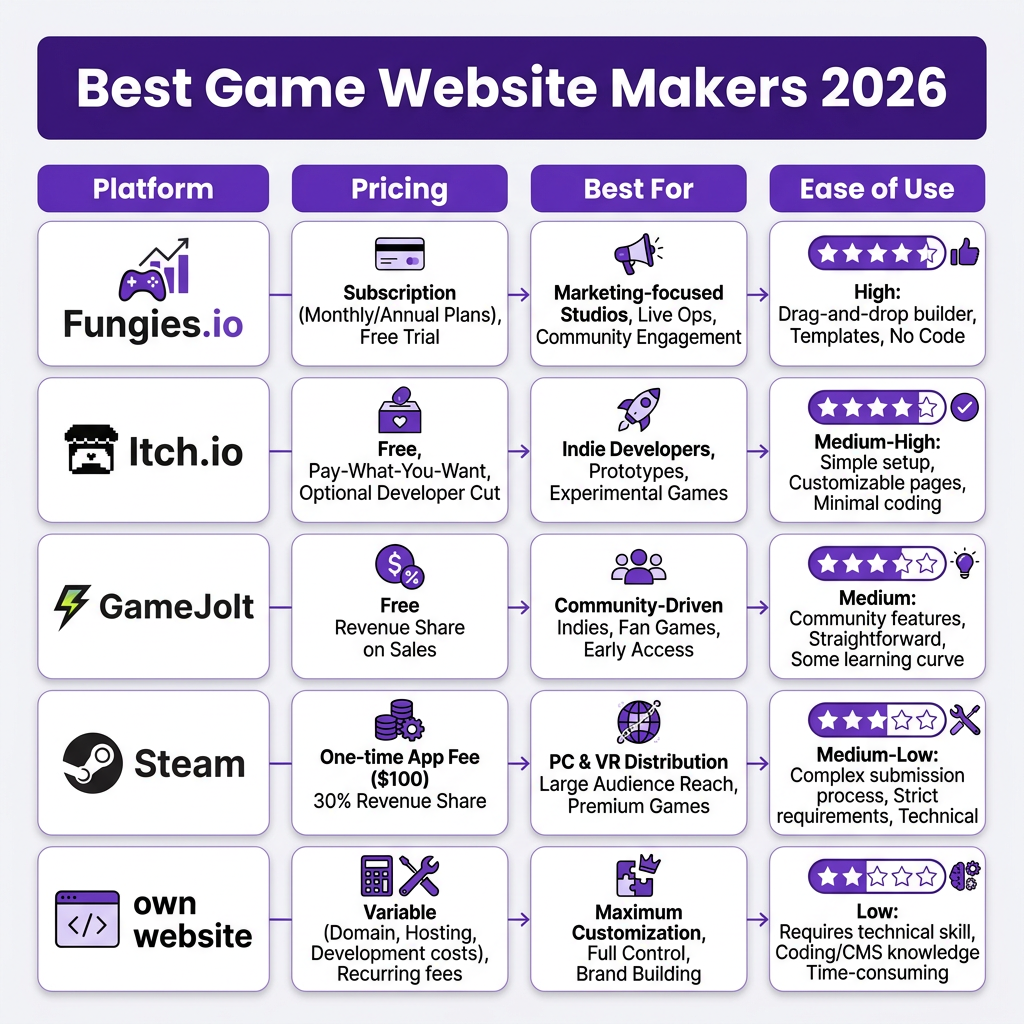
Top 5 Game Website Makers Compared
1. Fungies.io — Best for Indie Developers Who Want Full Control
Fungies.io stands out as a purpose-built platform for game developers who want to sell directly while maintaining complete brand control. As a Merchant of Record, Fungies handles all payment processing, tax compliance (VAT, sales tax), and regulatory requirements across 190+ countries.
Key Features:
- No-code website builder with gaming-focused templates
- Built-in payment processing with 50+ payment methods
- Automatic global tax compliance (MoR)
- Instant payouts to your bank account
- Custom domain support
- Game key distribution system
- Analytics dashboard and conversion tracking
- Discord community integration
Pricing: Transaction-based fees; no monthly subscription required.
Best For: Indie developers and small studios who want a professional storefront without the technical complexity of building from scratch or the restrictions of marketplace platforms.
2. Itch.io — Best for Early Access and Experimental Games
Itch.io has become the go-to platform for indie developers, especially those releasing experimental, artistic, or early-access games. The platform has a strong community of indie game enthusiasts and offers flexible pricing options.
Key Features:
- Pay-what-you-want pricing options
- Strong indie game community
- Easy file uploads and updates
- Game jam hosting capabilities
- Basic analytics
Pricing: 10% platform fee (can be reduced to 0% with custom contribution).
Best For: Developers releasing experimental games, prototypes, or those who want maximum pricing flexibility.
3. Steam — Best for Established Titles
Steam remains the dominant PC gaming platform with over 120 million monthly active users. While not a website maker per se, Steam provides a comprehensive store page system for games that pass their review process.
Key Features:
- Massive built-in audience
- Steam Workshop integration
- Achievement system and trading cards
- Robust multiplayer infrastructure
- Regional pricing tools
Pricing: 30% revenue share (reduces to 25% after $10M, 20% after $50M).
Best For: Polished, complete games that can pass Steam’s review process and compete in a crowded marketplace.
4. GameJolt — Best for Free-to-Play Browser Games
GameJolt focuses on browser-based and free-to-play games, with a younger demographic than most platforms. It’s particularly popular for HTML5 games, web-based experiences, and game jam entries.
Key Features:
- Strong browser game support
- Built-in ad monetization
- Active community forums
- Game jam integration
- Developer profiles and following system
Pricing: Free to publish; revenue share on ads and optional donations.
Best For: Developers creating free browser games or looking to build an audience before monetizing.
5. Custom Website (WordPress/Webflow) — Best for Maximum Control
Building your own website using platforms like WordPress, Webflow, or custom code gives you complete control over design, functionality, and customer data. However, this approach requires significantly more technical expertise and ongoing maintenance.
Key Features:
- Complete design freedom
- Full ownership of customer data
- No platform fees beyond hosting
- Custom functionality and integrations
Pricing: Variable hosting costs ($10-100/month) + payment processor fees (2.9% + $0.30 per transaction) + tax compliance service costs.
Best For: Developers with web development skills or budget to hire developers who want complete control.
How to Create Your Game Website: Step-by-Step
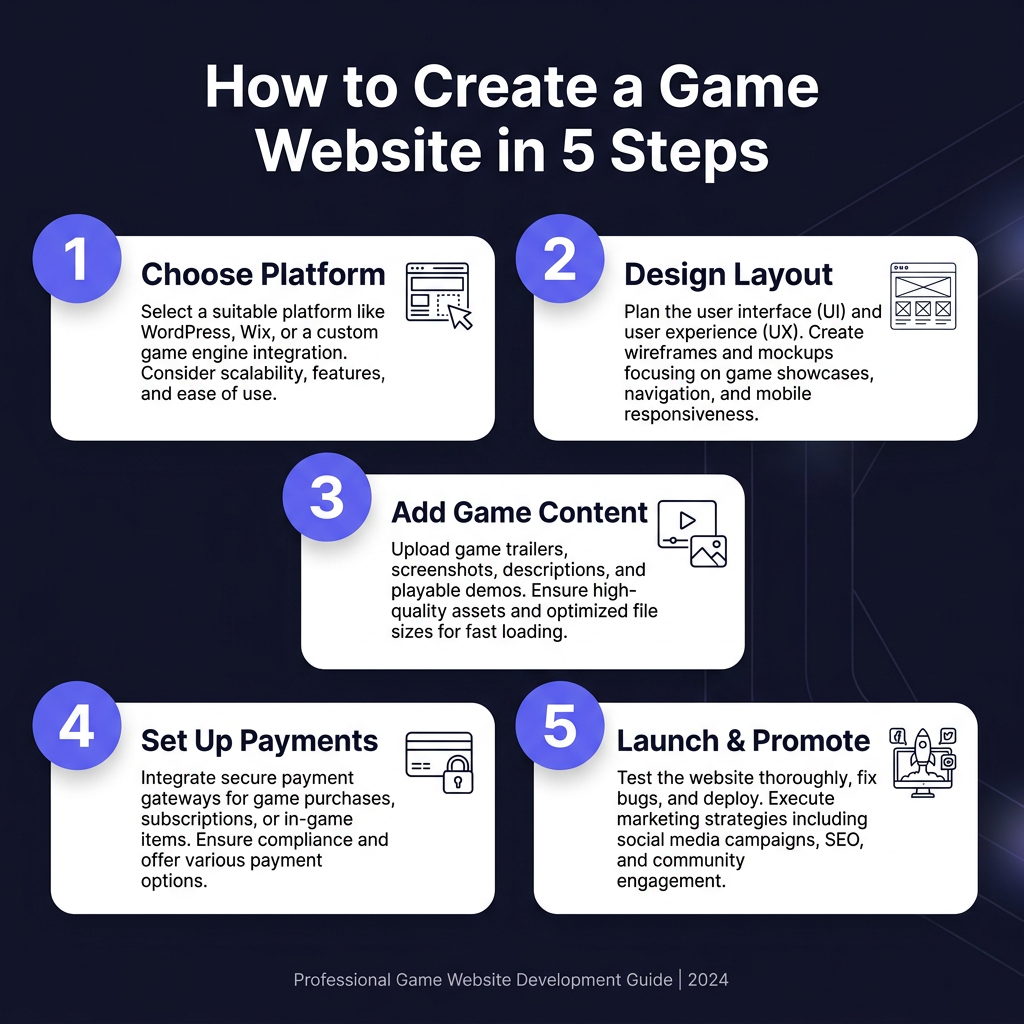
Once you’ve chosen your platform, follow these steps to launch your game website:
Step 1: Choose Your Platform
Based on the comparison above, select the platform that best fits your game’s stage, your technical skills, and your business goals. For most indie developers, we recommend starting with a specialized platform like Fungies.io that handles the technical complexity while giving you professional results.
Step 2: Design Your Layout
Select a template that matches your game’s aesthetic. Key pages to include: homepage with trailer, about/game description, media gallery (screenshots, videos), purchase/download page, and contact/support. Ensure your design is mobile-responsive—over 50% of gaming traffic comes from mobile devices.
Step 3: Add Your Game Content
Upload your game files, trailers, screenshots, and written descriptions. Optimize your images for web (compress without losing quality) and write compelling copy that highlights your game’s unique selling points. Include system requirements and clear calls-to-action.
Step 4: Set Up Payments
Configure your payment processing. If using a Merchant of Record platform like Fungies.io, this step is streamlined—simply connect your bank account. For other solutions, you’ll need to set up payment gateways, configure tax settings for different regions, and ensure PCI compliance.
Step 5: Launch and Promote
Before launching, test your entire purchase flow, verify all links work, and check mobile responsiveness. Once live, promote your website through social media, gaming forums, Discord communities, and relevant subreddits. Consider creating a press kit for gaming journalists and influencers.
FAQ: Game Website Makers
Do I need coding skills to create a game website?
No. Modern game website makers like Fungies.io offer no-code solutions with drag-and-drop interfaces and pre-designed templates specifically built for game developers. You can have a professional site live in hours without writing a single line of code.
How much does it cost to create a game website?
Costs vary by platform. Some like GameJolt are free to use. Others like Fungies.io charge transaction fees only when you make sales (no monthly fees). Custom websites require hosting ($10-100/month) plus payment processing fees. Steam takes 30% of revenue. Consider total cost of ownership including your time.
Can I sell games directly from my website?
Yes. Platforms like Fungies.io specialize in direct game sales with built-in payment processing, tax compliance, and instant key distribution. This approach lets you keep more revenue and own your customer relationships compared to marketplace sales.
What’s the difference between a game website maker and a marketplace?
A game website maker helps you create your own branded storefront that you control completely. A marketplace (like Steam) hosts your game alongside thousands of others. Website makers give you direct customer relationships and higher margins; marketplaces provide built-in traffic but take larger revenue shares.
Should I use multiple platforms?
Many successful indie developers use a multi-platform strategy: their own website for direct sales (highest margin), plus selective marketplace presence for discovery. Start with your own site to establish your brand, then expand to marketplaces that align with your game’s audience.
Conclusion: Choose the Right Game Website Maker for Your Goals
The best game website maker depends on your specific situation. For indie developers who want professional results without technical complexity, Fungies.io offers the ideal balance of ease-of-use, built-in payments, and global tax compliance. For experimental games, Itch.io provides flexibility and community. For established titles seeking maximum exposure, Steam remains essential despite higher fees.
Whatever platform you choose, remember that your game website is an investment in your long-term success as a developer. Own your audience, control your brand, and build direct relationships with your players. The tools have never been more accessible—start building your game website today.
Ready to Launch Your Game Website?
Join hundreds of indie developers using Fungies.io — the all-in-one platform for game websites with built-in payments, tax compliance, and global reach.
No credit card required