Digital Goods Tax Statistics 2026: Global VAT, Compliance Costs & Digital Services Tax (Comprehensive Report)
The taxation of digital goods and services has become one of the most complex challenges facing global businesses in 2026. With the digital economy now representing trillions in annual transactions, governments worldwide have implemented aggressive tax frameworks to capture revenue from cross-border digital commerce. This comprehensive report analyzes 30+ verified statistics on digital goods taxation, including VAT compliance costs, Digital Services Tax (DST) revenues, market forecasts, and regional breakdowns—all sourced from official government data and leading industry research.
Digital Goods Tax Key Statistics 2026
- The global tax tech market was valued at $20.6 billion in 2025 and is forecast to reach $59.5 billion by 2035, growing at a 12.4% CAGR (Prophecy Market Insights)
- The cross-border tax service market is valued at $6.93 billion in 2025 and projected to reach $12 billion by 2035 at a 5.6% CAGR (WiseGuy Reports)
- Over 110 countries now require foreign digital service providers to register for VAT/GST (Fonoa)
- The UK’s Digital Services Tax generated £944 million ($1.27 billion) in 2025-26, up 17% from £808 million in 2024-25 (HMRC)
- SaaS is now taxable in some form in 25 US jurisdictions, a 14% increase from 22 jurisdictions in 2024 (Anrok)
- The EU collected over €33 billion in VAT revenues in 2024 via e-commerce VAT systems, a 26% increase from 2023 (European Commission)
- France’s DST generated €680 million in 2023, with rates potentially increasing from 3% to 6% (CEPS)
- The global indirect tax compliance software market was valued at $8.4 billion in 2025 and is projected to reach $21.6 billion by 2034 (Dataintelo)
Market Size & Growth
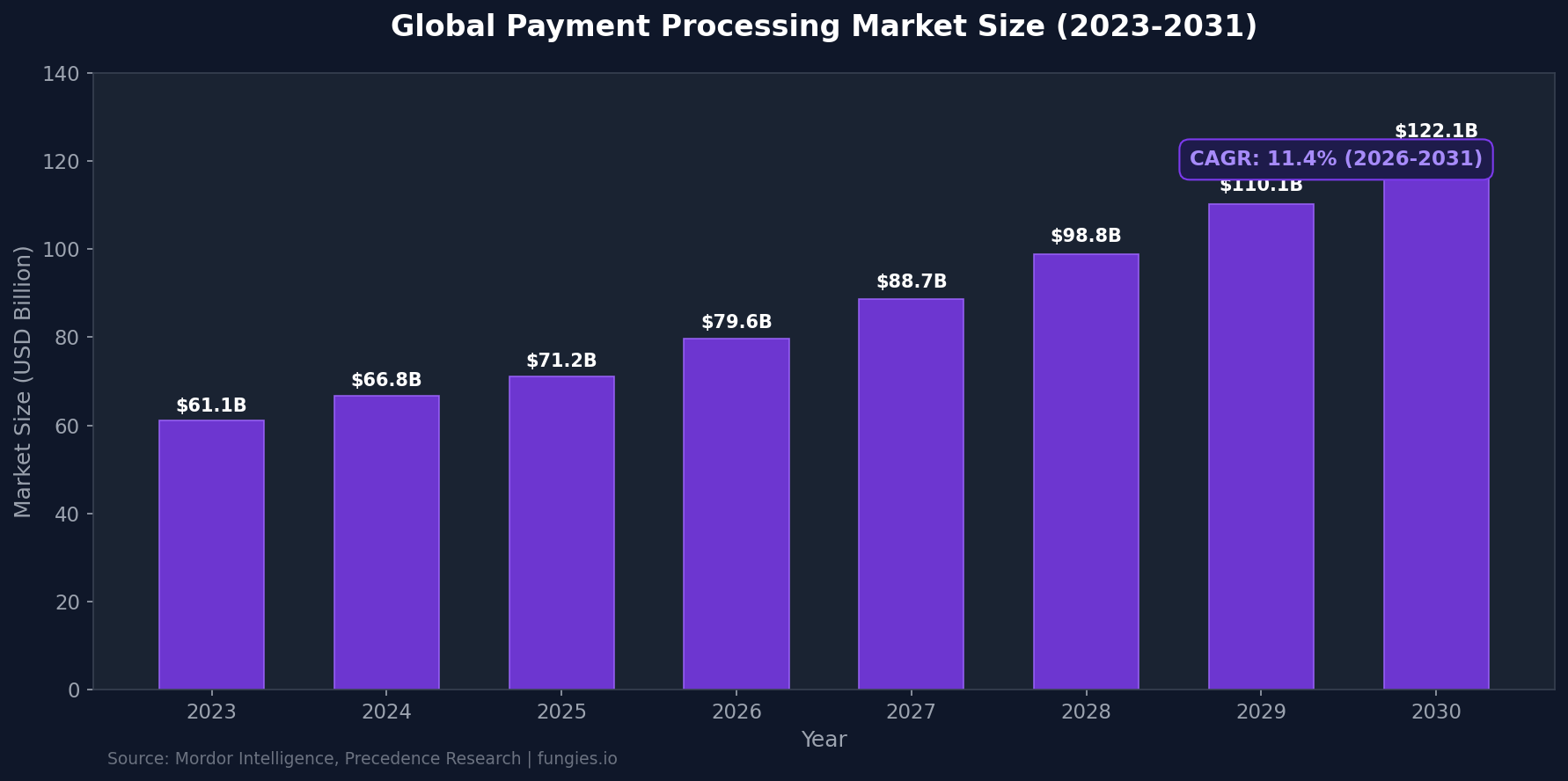
The digital tax landscape is experiencing unprecedented growth as governments worldwide adapt their tax systems to capture revenue from the digital economy. According to Prophecy Market Insights, the global tax tech market reached $20.6 billion in 2025 and is expected to grow to $59.5 billion by 2035, representing a compound annual growth rate (CAGR) of 12.4%. This growth is driven by the increasing complexity of tax regulations and the rising demand for automated compliance solutions.
The tax management software market, as reported by Fortune Business Insights, was valued at $20.26 billion in 2025 and is projected to grow from $22.97 billion in 2026 to $56.02 billion by 2034, exhibiting a CAGR of 11.80%. North America dominated this market with a 34.70% share in 2025, reflecting the region’s complex multi-jurisdictional tax environment.
According to MarketsandMarkets, the broader tax management market is forecast to grow from $24.52 billion in 2025 to $33.21 billion by 2030, at a CAGR of 6.3%. The indirect tax segment—encompassing VAT, GST, and sales tax compliance—is expected to grow fastest, driven by the global proliferation of e-invoicing mandates and digital reporting requirements.
| Market Segment | 2025 Value | 2030/2035 Projection | CAGR | Source |
|---|---|---|---|---|
| Tax Tech Market | $20.6B | $59.5B (2035) | 12.4% | Prophecy Market Insights |
| Tax Management Software | $20.26B | $56.02B (2034) | 11.8% | Fortune Business Insights |
| Tax Management Market | $24.52B | $33.21B (2030) | 6.3% | MarketsandMarkets |
| Cross-Border Tax Services | $6.93B | $12B (2035) | 5.6% | WiseGuy Reports |
| Indirect Tax Compliance Software | $8.4B | $21.6B (2034) | 11.1% | Dataintelo |
| Tax Compliance Software | $22.5B | $75.9B (2035) | 12.9% | Market Research Future |
Digital Services Tax (DST) Revenue Analysis
Digital Services Taxes have emerged as a significant revenue source for governments seeking to tax digital giants operating within their borders. According to the Computer & Communications Industry Association (CCIA), the five primary DST-implementing countries collected a cumulative $9.55 billion between 2020 and 2024.
The United Kingdom leads in DST revenue generation, collecting £944 million ($1.27 billion) in the 2025-2026 fiscal year—representing a 17% increase from the £808 million collected in 2024-25. Since its implementation in April 2020, the UK’s 2% DST has generated over £3.09 billion in cumulative revenue.
France’s 3% DST, implemented in January 2019, generated €680 million in 2023 according to CEPS research. However, France is now considering doubling the rate to 6% while raising the global revenue threshold from €750 million to €2 billion—a move that could generate an additional €500 million annually.
Regional Breakdown: VAT/GST on Digital Services
The global landscape for digital services taxation varies dramatically by region. According to Avalara’s global VAT research, over 110 countries now require foreign digital service providers to register for VAT or GST when selling to local consumers. This represents a fundamental shift in how governments approach cross-border digital commerce.
In the European Union, the 2021 e-commerce VAT reforms have proven highly successful. The European Commission reported that over €33 billion in VAT revenues were collected in 2024 via the EU’s e-commerce VAT systems—a 26% increase from 2023. This includes €24 billion via the Union OSS, €2.8 billion via the non-Union OSS, and €6.3 billion through the Import OSS. Since mid-2021, member states have collected nearly €88 billion under these schemes.
By the end of 2024, over 170,000 businesses had registered for the EU’s OSS and IOSS frameworks, with more than 20,000 new registrations in the Union OSS alone over the past year. This demonstrates the massive scale of compliance required for digital businesses selling into the EU.
| Region/Country | VAT/GST Rate | Registration Threshold | Key Requirements |
|---|---|---|---|
| European Union (27 states) | 15-27% | €10,000 cross-border | OSS registration for B2C |
| United Kingdom | 20% | £85,000 | Post-Brexit separate regime |
| Australia | 10% GST | AUD $75,000 | Non-resident providers must register |
| Canada (federal) | 5% GST | CAD $30,000 | Provincial variations apply |
| Singapore | 9% GST | SGD $1 million | Overseas vendor registration |
| Hungary | 27% | None for non-residents | Highest EU VAT rate |
| Andorra | 4.5% | €40,000 | Lowest standard VAT rate globally |
Key Players & Market Share
The tax technology market is dominated by several key players providing comprehensive solutions for VAT, GST, and sales tax compliance. According to Precedence Research, the software segment dominated the market with a 73% share in 2025, while professional services accounted for the remaining 27%.
By tax type, direct tax solutions led the market with 54% share in 2025, while indirect tax solutions are experiencing the fastest growth due to the complexity of multi-jurisdictional VAT/GST compliance. By organization size, large enterprises currently represent the majority of spending, though small and medium enterprises are rapidly adopting cloud-based solutions.
| Company | Primary Offering | Key Strength |
|---|---|---|
| Vertex | Enterprise tax solutions | Direct tax management |
| Avalara | Cloud-based tax compliance | Multi-jurisdiction VAT/GST |
| Thomson Reuters | Tax & accounting software | Research & compliance integration |
| Wolters Kluwer | Professional tax solutions | Regulatory expertise |
| TaxJar (Stripe) | Sales tax automation | E-commerce integration |
| Anrok | SaaS tax compliance | Modern API-first platform |

Industry Benchmarks & Compliance Costs
Tax compliance represents a significant cost burden for businesses of all sizes. According to the Tax Foundation, business tax compliance costs in the United States amount to billions annually, with small businesses bearing a disproportionate share relative to their revenue.
The U.S. Chamber of Commerce reports that 51% of small business owners say compliance requirements make it harder for them to grow their business. Additionally, 39% of small businesses report that the time and resources spent on regulatory compliance have increased in the past six months.
For SaaS companies specifically, the compliance landscape is becoming increasingly complex. According to Anrok, as of 2025, SaaS is taxable in some form in 25 US jurisdictions—a 14% increase from 22 jurisdictions at the beginning of 2024. With approximately 50% of US states now taxing SaaS, tracking nexus and maintaining compliance has become a critical operational challenge.
| Metric | Value | Source |
|---|---|---|
| Small businesses citing compliance as growth barrier | 51% | U.S. Chamber of Commerce |
| Small businesses with increased compliance costs | 39% | U.S. Chamber of Commerce |
| US jurisdictions taxing SaaS (2025) | 25 states | Anrok |
| Increase in SaaS-taxable jurisdictions (2024-2025) | 14% | Anrok |
| EU VAT compliance gap (2023) | €128 billion (9.5%) | EU VAT Gap Report 2025 |
| Businesses using budgeting software | 71% | Vena Solutions |
Trends & Predictions 2026-2030
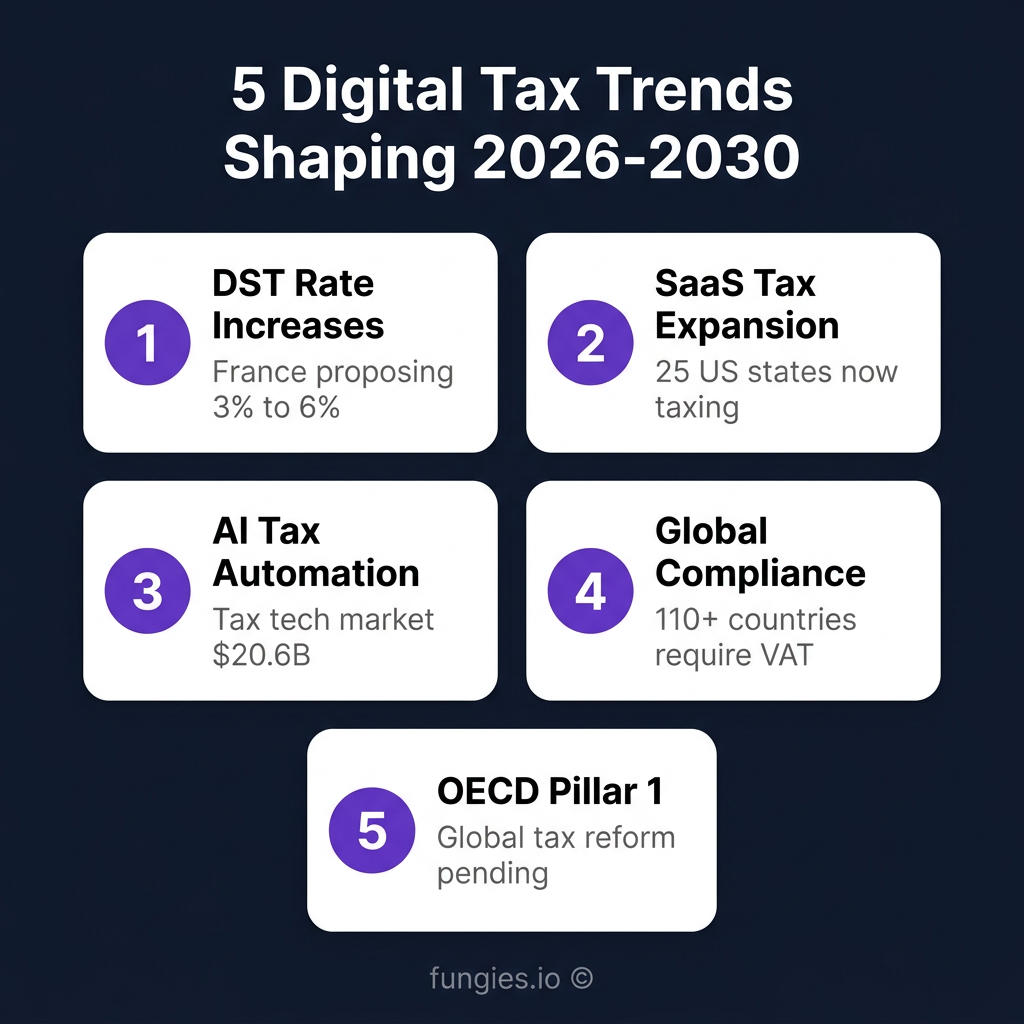
The digital tax landscape is evolving rapidly. Here are five major trends shaping the future of digital goods taxation:
1. DST Rate Increases and Expansion
France is leading the charge to increase DST rates, with a proposal to double the rate from 3% to 6% while raising the global revenue threshold from €750 million to €2 billion. If implemented, this could generate an additional €500 million annually. Other countries may follow suit as they seek additional revenue from digital giants.
2. SaaS Tax Expansion Across US States
The trend of states taxing SaaS is accelerating. With 25 US jurisdictions now taxing SaaS in some form—up from 22 at the beginning of 2024—software companies face an increasingly complex compliance landscape. More states are expected to clarify their positions on SaaS taxability in the coming years.
3. AI-Powered Tax Automation
The tax tech market is increasingly incorporating AI and machine learning. According to SNS Insider, AI and ML technologies are driving significant growth in tax compliance automation, enabling more accurate and timely tax reporting across complex multi-jurisdictional environments.
4. Global VAT/GST Compliance Requirements
Over 110 countries now require foreign digital service providers to register for VAT/GST. This number is expected to grow as developing economies modernize their tax systems. Platforms like Fungies.io help businesses navigate this complexity by handling VAT compliance automatically.
5. OECD Pillar 1 and Global Tax Reform
The OECD’s Pillar 1 reforms aim to reallocate taxing rights for the largest multinational enterprises. While implementation has been delayed, countries have agreed that DST repeal would be contingent on Pillar One implementation. The future of DSTs remains tied to these broader international negotiations.
Methodology
This report compiles data from authoritative sources including government tax authorities (HMRC, European Commission, IRS), international organizations (OECD, World Bank), and leading market research firms (MarketsandMarkets, Fortune Business Insights, Prophecy Market Insights). All statistics are sourced from reports published between 2024 and 2026. Currency conversions use exchange rates current at the time of the source publication. Projections are based on analyst forecasts and do not constitute financial advice.
Frequently Asked Questions
What is the difference between VAT on digital services and Digital Services Tax (DST)?
VAT (Value Added Tax) on digital services is a consumption tax applied to the sale of digital goods and services to end consumers, similar to how VAT works for physical goods. Digital Services Tax (DST), on the other hand, is a tax on the gross revenues of large digital companies derived from specific digital activities like online advertising, marketplaces, and user data sales. While VAT is ultimately paid by consumers, DST is paid by the digital companies themselves.
How many countries require VAT registration for digital services?
According to Fonoa and Avalara research, over 110 countries now require foreign digital service providers to register for VAT or GST when selling to local consumers. This includes all 27 EU member states, the UK, Australia, Canada, Singapore, and many others across Asia, Africa, and Latin America.
What are the revenue thresholds for Digital Services Tax?
DST thresholds vary by country. The UK applies DST to companies with global revenues exceeding £500 million and UK revenues exceeding £25 million. France applies a 3% DST to companies with global revenues over €750 million and French revenues over €25 million. Canada requires DST registration when global digital services revenue exceeds CAN $10 million and Canadian revenue exceeds CAN $20 million.
Is SaaS taxable in the United States?
As of 2025, SaaS is taxable in some form in 25 US jurisdictions according to Anrok. However, taxability varies significantly by state—some states tax SaaS as a service, others as software, and some exempt it entirely. B2B and B2C transactions may also be treated differently. Companies should consult state-specific guidance or use automated tax solutions to ensure compliance.
How much revenue do Digital Services Taxes generate?
According to CCIA data, the five primary DST-implementing countries (UK, France, Italy, Spain, Austria) collected a cumulative $9.55 billion between 2020 and 2024. The UK alone generated £944 million ($1.27 billion) in 2025-26. France’s DST generated €680 million in 2023, while Italy collected €434 million and Spain €303 million.
Sources & Citations
- Prophecy Market Insights – Tax Tech Market Size 2026: https://www.prophecymarketinsights.com/market_insight/tax-tech-market-5838/market-size
- WiseGuy Reports – Cross-Border Tax Service Market: https://www.wiseguyreports.com/reports/cross-border-tax-service-market
- HMRC UK Digital Services Tax Statistics 2026: https://www.gov.uk/government/statistics/hmrc-tax-and-nics-receipts-for-the-uk
- Law360 – UK DST Revenue Report: https://www.law360.com/tax-authority/articles/2469124
- Anrok – SaaS Sales Tax Statistics 2026: https://www.anrok.com/resources/sales-tax-statistics
- European Commission – E-commerce VAT Revenue 2024: https://taxation-customs.ec.europa.eu/news/
- CEPS – Towards a European Digital Services Tax: https://cdn.ceps.eu/wp-content/uploads/2025/04/
- CCIA – Status of Key Digital Services Taxes 2024: https://ccianet.org/wp-content/uploads/2026/03/
- MarketsandMarkets – Tax Management Market Report: https://www.marketsandmarkets.com/Market-Reports/
- Fortune Business Insights – Tax Management Software Market: https://www.fortunebusinessinsights.com/tax-management-software-market-102631
- Dataintelo – Indirect Tax Compliance Software Market: https://dataintelo.com/report/indirect-tax-compliance-software-market
- Fonoa – Global VAT & GST on Digital Services: https://www.fonoa.com/resources/blog/global-vat-and-gst-on-digital-services
- Avalara – Global VAT on Digital Services: https://www.avalara.com/us/en/vatlive/global-vat-gst-on-e-services.html
- U.S. Chamber of Commerce – Small Business Compliance Survey: https://www.uschamber.com/small-business/
- Tax Foundation – Digital Taxation Around the World: https://taxfoundation.org/research/all/global/digital-taxation