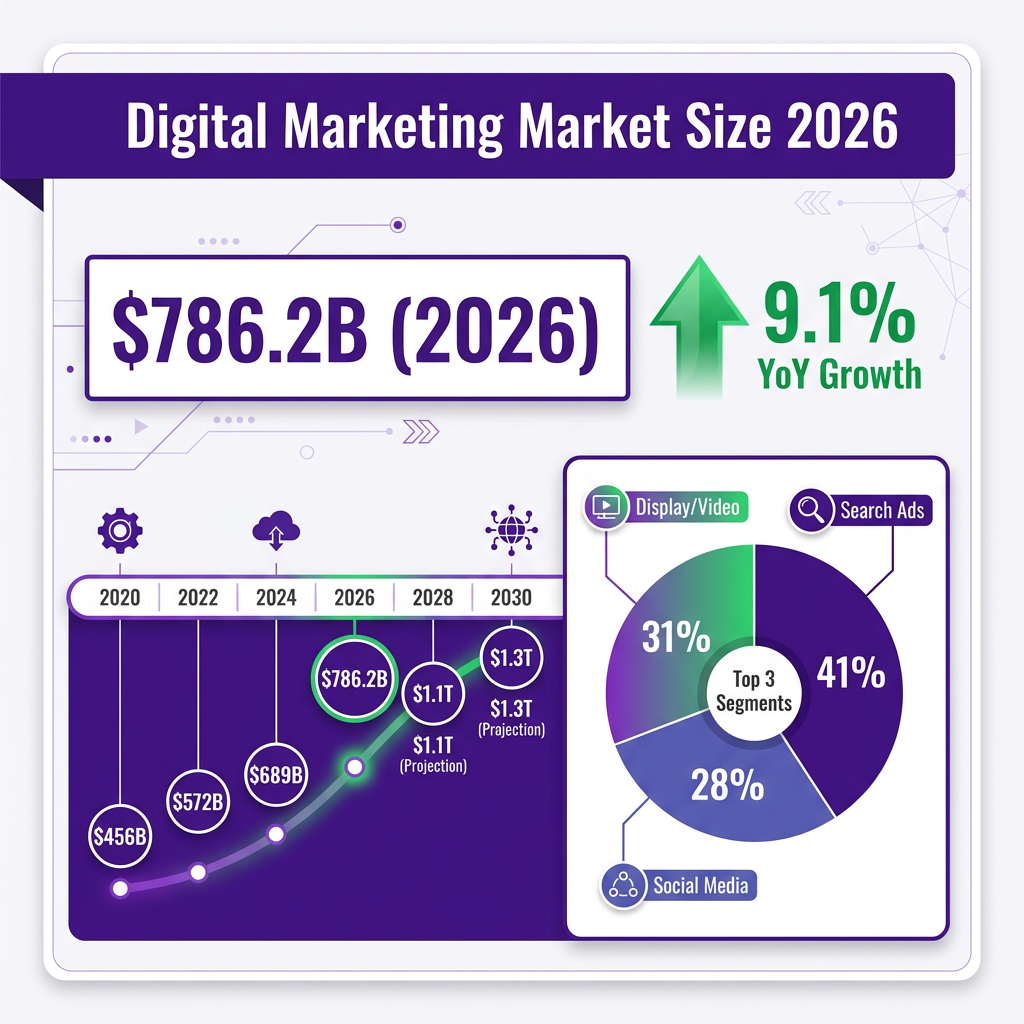
The global digital marketing industry has reached an unprecedented inflection point in 2026. With worldwide digital advertising spend hitting $786.2 billion this year—representing a remarkable 9.1% year-over-year increase—businesses are investing more than ever in online channels to reach, engage, and convert their target audiences. But this is not just about bigger budgets. The digital marketing landscape is undergoing a fundamental transformation driven by artificial intelligence, privacy regulations, shifting consumer behaviors, and the relentless pursuit of measurable ROI.
For marketers, business owners, and SaaS founders, understanding these shifts is not optional—it is survival. The strategies that worked in 2023 are already showing diminishing returns. The platforms that dominated are losing ground to new entrants. And the metrics that mattered are being redefined by AI-powered analytics and predictive modeling.
In this comprehensive analysis, we will dive deep into the digital marketing market of 2026—examining market size and growth trajectories, identifying the seven major trends reshaping the industry, analyzing the competitive landscape of key players, exploring the challenges marketers face, and uncovering the opportunities that smart businesses are already capitalizing on. Whether you are building a marketing strategy from scratch or optimizing an existing approach, this data-driven guide will give you the insights you need to make informed decisions.
Market Overview: The $786.2 Billion Digital Marketing Ecosystem
The digital marketing market has evolved from a niche channel to the dominant force in global advertising. According to the latest research from IMARC Group, the global digital marketing market size reached $456.7 billion in 2025 and is projected to grow at a compound annual growth rate (CAGR) of 10.99% through 2034, ultimately reaching $1.2 trillion by the end of the forecast period. This represents one of the most significant sustained growth trajectories in the entire technology sector.
The acceleration of digital marketing spend reflects a permanent shift in how businesses allocate their advertising budgets. Traditional media—print, radio, and even television—continue to lose share as marketers recognize that digital channels offer superior targeting, measurement, and ROI. According to data from WARC, global ad spend across all channels is expected to reach $1.3 trillion in 2026, with digital capturing an increasingly dominant share of that total.
Several macroeconomic factors are driving this growth. First, internet penetration continues to climb globally. Data from Data Portal indicates that approximately 5.35 billion people were using the internet in 2024, representing 66.2% of the global population. This massive addressable audience has transformed how businesses think about market reach—suddenly, even small businesses can access global markets with the right digital strategy.
Second, the proliferation of mobile devices has created new opportunities for always-on marketing. Mobile advertising now accounts for 54% of digital ad budgets, reflecting the reality that consumers spend more time on their smartphones than any other device. Mobile-first strategies are not just recommended—they are essential. The average person checks their phone 96 times per day, creating countless micro-moments for brands to connect with potential customers.
Third, the rise of e-commerce has created a direct link between digital marketing and revenue. With 57% of online purchases now made on mobile devices, the path from ad impression to transaction has never been shorter. This has elevated digital marketing from a brand-building exercise to a direct revenue driver, justifying increased investment from CFOs and CEOs who previously viewed marketing as a cost center. The ability to track every dollar spent to revenue generated has transformed marketing’s position in the corporate hierarchy.
Looking at regional distribution, North America remains the largest digital advertising market, driven by high internet penetration, mature e-commerce infrastructure, and the presence of major tech platforms. The United States alone accounts for over $263 billion in digital ad spend. However, Asia-Pacific is the fastest-growing region, with countries like India, Indonesia, and Vietnam showing explosive growth in digital adoption. For businesses looking to expand internationally, these emerging markets represent significant opportunities—though they require localized strategies that account for cultural differences and platform preferences.
Europe represents a mature but complex market, with strict privacy regulations (GDPR) shaping how marketers can collect and use data. Despite these constraints, European digital ad spend continues to grow, driven by e-commerce expansion and the shift of traditional media budgets online. Latin America and the Middle East/Africa are emerging as growth markets, with increasing smartphone penetration and improving digital infrastructure creating new opportunities for brands willing to invest in these regions.
Key Statistics and Data: 25 Numbers That Define Digital Marketing in 2026
Data is the currency of modern marketing. To help you benchmark your performance and understand the competitive landscape, here are 25 essential statistics that define the digital marketing industry in 2026:
Market Size and Growth
- $786.2 billion — Global digital advertising spend in 2026 (SEO.com, 2025)
- 9.1% — Year-over-year growth rate in global ad spend (WARC, 2026)
- $1.3 trillion — Projected global ad spend across all channels by 2026 (WARC)
- $1.2 trillion — Projected digital marketing market size by 2034 (IMARC Group)
- 10.99% — CAGR for digital marketing market 2026-2034 (IMARC Group)
- $472.5 billion — Digital marketing market value in 2025 (Hostinger)
- 13.6% — CAGR for digital marketing through 2033 (Hostinger)
Channel Distribution and Performance
- 40.9% — Share of search advertising in global digital ad market (SeoProfy)
- 54% — Share of budgets allocated to mobile advertising (SEO.com)
- 57% — Share of online purchases made on mobile devices (SEO.com)
- 46% — Share of local searches on Google (SEO.com)
- 41.4% — Search advertising share of total online ad spend (Oberlo)
- $306.7 billion — Projected search advertising expenditure in 2026 (Oberlo)
AI and Technology Adoption
- 78% — Organizations using AI across business functions (SQ Magazine)
- $91.57 billion — Generative AI market size in 2026 (SQ Magazine)
- 62% — Faster content production with generative AI (SQ Magazine)
- 92%+ — Digital marketers optimizing for AI-driven search (SeoProfy)
- 25% — Expected decrease in traditional search traffic by 2026 (Gartner)
- 50% — Expected decrease in traditional search traffic by 2028 (Gartner)
Consumer Behavior and Engagement
- 5.35 billion — Global internet users in 2024 (Data Portal)
- 66.2% — Global internet penetration rate (Data Portal)
- 20.5% — Global voice search usage rate (SQ Magazine)
- 157.1 million — U.S. voice search users (SQ Magazine)
- 2.25x — Higher reach for Reels compared to other content (SQ Magazine)
- 50%+ — Instagram ad inventory from Reels (SQ Magazine)
Marketing Investment and ROI
- 75%+ — Marketers planning to maintain or increase spend in 2026 (SeoProfy)
- 60% — Small businesses planning to increase marketing spend (SeoProfy)
- 18-22% — Average B2B email open rate (SQ Magazine)
- 25.7% — Global SMS marketing click-through rate (Dotdigital)
- 3.7% — Average email click-through rate globally (Dotdigital)
These numbers paint a clear picture: digital marketing is not just growing—it is becoming more sophisticated, more competitive, and more data-driven. Marketers who can interpret these statistics and adjust their strategies accordingly will have a significant advantage over those who rely on intuition or outdated playbooks. The gap between data-driven marketers and those operating on gut instinct is widening every quarter.
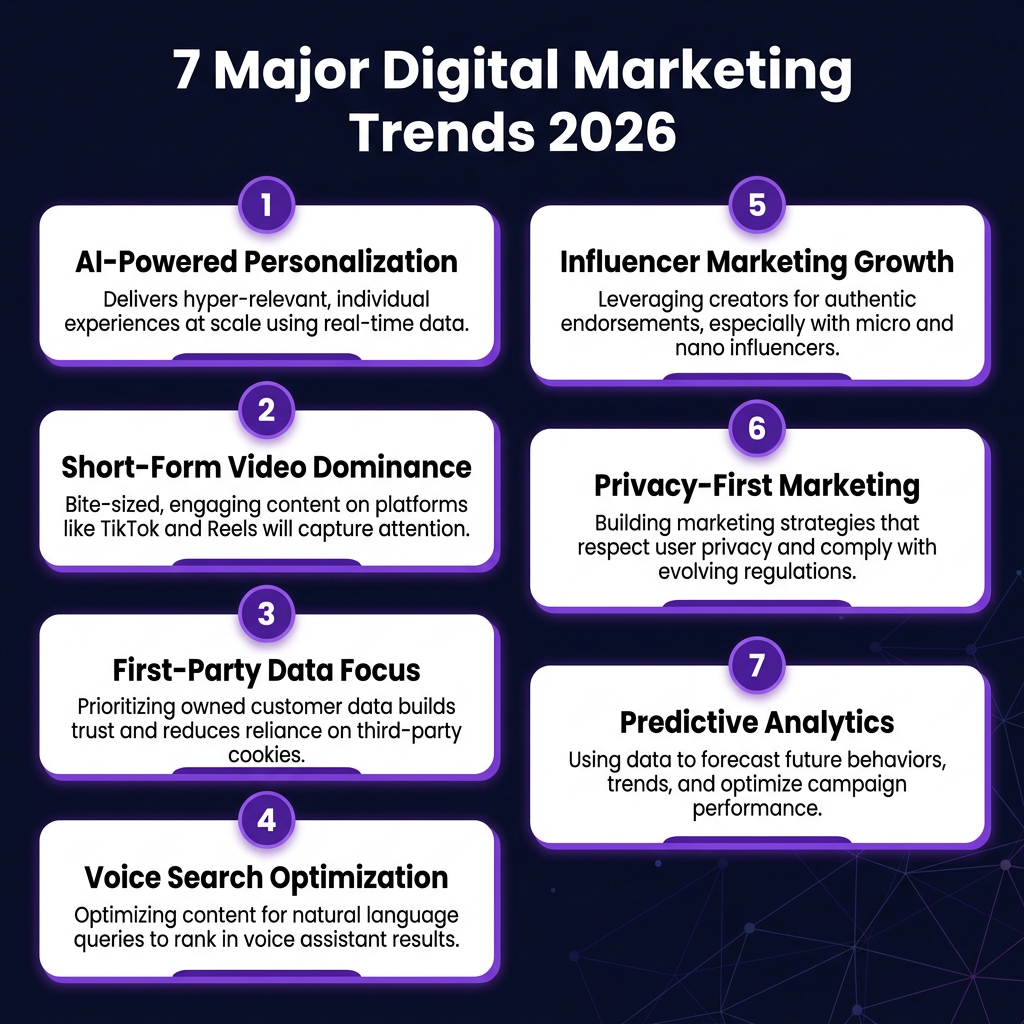
7 Major Trends Shaping Digital Marketing in 2026
The digital marketing landscape does not stand still. New technologies emerge, consumer behaviors shift, and platforms evolve. Here are the seven major trends that are defining digital marketing strategy in 2026:
1. AI-Powered Personalization at Scale
Artificial intelligence has moved from experimental to essential. In 2026, 78% of organizations are using AI across business functions, and marketing is leading the charge. AI-powered personalization allows marketers to deliver individualized experiences to millions of customers simultaneously—something that was impossible just a few years ago.
The applications are vast: AI can analyze customer behavior to predict purchase intent, automatically adjust website content based on visitor profiles, optimize email send times for maximum engagement, and generate personalized product recommendations. According to research, businesses using AI for personalization see conversion rate improvements of 20% or more compared to those using static content.
But the real breakthrough is in predictive analytics. Instead of reacting to customer behavior, AI enables marketers to anticipate it. By analyzing patterns in browsing history, purchase data, and engagement metrics, AI can predict which customers are likely to churn, which are ready to buy, and which need nurturing. This allows marketers to allocate resources more efficiently and intervene at the optimal moment. The shift from reactive to predictive marketing represents a fundamental change in how businesses approach customer relationships.
2. The Rise of Short-Form Video Content
Video has been important for years, but short-form video has become the dominant content format in 2026. Instagram Reels now generate 2.25x more reach than other content types and account for over 50% of Instagram ad inventory. TikTok continues to grow globally, and YouTube Shorts has emerged as a serious competitor. The average user spends 95 minutes per day on TikTok alone, representing a massive attention opportunity for brands.
The shift to short-form video reflects changing consumer attention spans and content consumption habits. Users want quick, engaging content that delivers value in 60 seconds or less. For marketers, this means rethinking content strategy—investing in video production capabilities, training teams on vertical video formats, and mastering the art of hooking viewers in the first three seconds. The first three seconds determine whether a viewer continues watching or scrolls past.
The data is compelling: brands that consistently publish short-form video content see higher engagement rates, better brand recall, and improved conversion metrics. The challenge is maintaining quality at scale—producing enough content to stay relevant without sacrificing production values or brand consistency. Successful brands are building in-house video teams and creating content calendars that prioritize video across all channels.
3. First-Party Data Strategy Becomes Critical
The deprecation of third-party cookies has forced a fundamental shift in how marketers collect and use data. In 2026, first-party data—information collected directly from customers with their consent—has become the most valuable asset in marketing. The brands that thrive are those that have built robust systems for collecting, analyzing, and activating this data.
This shift has several implications. First, businesses are investing heavily in data infrastructure—customer data platforms (CDPs), consent management systems, and analytics tools that can make sense of first-party data. Second, content marketing has taken on new importance as a way to build relationships and collect data through gated content, newsletters, and interactive experiences. Third, loyalty programs are being redesigned to incentivize data sharing, with customers receiving genuine value in exchange for their information.
Companies with robust first-party data strategies are outperforming their competitors. They can deliver more relevant experiences, measure attribution more accurately, and maintain customer relationships without relying on third-party intermediaries. The message is clear: own your data, or risk being cut off from your customers. This is particularly critical for SaaS companies and e-commerce brands that depend on personalized experiences to drive conversions.
4. Voice Search and Conversational AI
Voice search has reached critical mass, with 20.5% global usage and 157.1 million users in the United States alone. But it is not just about search—conversational AI is transforming how brands interact with customers across the entire journey. The shift to conversational interfaces represents one of the biggest changes in how consumers find information and make purchases.
Chatbots have evolved from simple FAQ tools to sophisticated AI assistants that can handle complex queries, process transactions, and provide personalized recommendations. Voice assistants like Alexa, Google Assistant, and Siri are becoming shopping channels in their own right. And the integration of AI into messaging apps has created new opportunities for conversational commerce. Brands that optimize for voice search and conversational experiences are capturing early-mover advantages.
For marketers, this means optimizing for natural language queries, developing voice-friendly content, and creating conversational experiences that feel human. It also means rethinking SEO—voice searches tend to be longer and more question-based than text searches, requiring different keyword strategies and content formats. The brands that master conversational marketing will have a significant advantage as these interfaces become the primary way consumers interact with technology.
5. Influencer Marketing Maturation
Influencer marketing has grown up. What started as a Wild West of sponsored posts and questionable metrics has evolved into a sophisticated channel with standardized measurement, long-term partnerships, and clear ROI tracking. In 2026, influencer marketing is a $24 billion industry, and it is showing no signs of slowing down. The channel has proven its ability to drive both brand awareness and direct response.
The key shift is from transactional to relational. Smart brands are building long-term partnerships with influencers who genuinely align with their values and audience. These partnerships create more authentic content, deeper audience trust, and better long-term results. Micro-influencers (10,000-100,000 followers) are particularly valuable—their engagement rates are higher than mega-influencers, and their audiences are more targeted. The average micro-influencer engagement rate is 3.86%, compared to 1.21% for mega-influencers.
Another trend is the rise of employee advocacy and internal influencers. Companies are recognizing that their own employees can be powerful brand ambassadors, often with more credibility than external influencers. Programs that encourage and enable employee sharing are becoming standard practice. Employee-generated content typically receives 8x more engagement than content shared through brand channels.
6. Privacy-First Marketing
Privacy regulations like GDPR in Europe and CCPA in California have set the standard, and more jurisdictions are following suit. In 2026, privacy-first marketing is not just about compliance—it is a competitive advantage. Consumers are increasingly privacy-conscious, and brands that respect their data preferences build stronger relationships. Trust has become the most valuable currency in digital marketing.
This trend manifests in several ways: transparent data practices, clear consent mechanisms, minimal data collection, and giving users control over their information. It also means finding ways to deliver personalized experiences without invasive tracking—contextual advertising, cohort-based targeting, and privacy-preserving measurement techniques. Apple’s App Tracking Transparency (ATT) framework has fundamentally changed mobile advertising, forcing marketers to find new ways to measure and optimize campaigns.
The brands that thrive in this environment are those that build trust through transparency. They communicate clearly about how data is used, provide genuine value in exchange for information, and make it easy for customers to manage their preferences. In a world of increasing privacy restrictions, trust is the ultimate marketing currency. Brands that violate this trust face not just regulatory penalties but permanent damage to their reputation.
7. Predictive Analytics and AI-Driven Optimization
The final major trend is the mainstream adoption of predictive analytics. Marketers are no longer just reporting on what happened—they are predicting what will happen and adjusting strategies in real-time. AI-powered tools can forecast campaign performance, predict customer lifetime value, identify churn risks, and optimize budget allocation across channels. This shift from descriptive to predictive analytics is transforming how marketing decisions are made.
This shift requires new skills and new mindsets. Marketers need to become comfortable with data science concepts, understand the limitations of AI predictions, and learn to balance algorithmic recommendations with human judgment. The most successful teams are those that combine AI processing power with human creativity and strategic thinking. Marketing is becoming a discipline that sits at the intersection of art and science.
The impact is measurable: companies using predictive analytics for marketing see 15-20% improvements in campaign performance, better customer retention, and more efficient resource allocation. As AI tools become more accessible, predictive capabilities will become standard practice rather than competitive advantage. The question is no longer whether to adopt predictive analytics, but how quickly you can implement it across your marketing organization.
Key Players and Competitive Landscape
The digital marketing ecosystem is dominated by a handful of tech giants, but the competitive landscape is more dynamic than it appears. Understanding who the key players are and how they are positioned can inform your platform strategy and budget allocation. The concentration of power among a few platforms creates both opportunities and risks for marketers.
The Triopoly: Google, Meta, and Amazon
Google, Meta (Facebook and Instagram), and Amazon continue to capture the majority of digital ad spend. Together, they account for approximately 65% of global digital advertising revenue. Each has distinct strengths and weaknesses that marketers must understand to allocate budgets effectively.
Google dominates search advertising, which remains the largest digital channel at 40.9% of total spend. With $306.7 billion in projected search ad revenue for 2026, Google’s position is formidable. The company has successfully expanded into display (through Display Network and YouTube), shopping (Google Shopping), and app advertising. Google’s advantage is intent—users on Google are actively searching for solutions, making them high-value prospects. The integration of AI into Google Ads has improved automated bidding and creative optimization, though privacy changes have challenged some of their traditional targeting capabilities.
Meta (Facebook, Instagram, WhatsApp) leads in social advertising and remains the go-to platform for audience targeting and brand building. Despite challenges from TikTok and privacy changes, Meta’s scale is unmatched—with nearly 4 billion monthly active users across its platforms. The company’s investment in AI has improved ad targeting and creative optimization, helping advertisers achieve better results even with less data. Meta’s Advantage+ shopping campaigns use AI to automate targeting, creative, and placement decisions, delivering strong results for e-commerce advertisers.
Amazon has emerged as the third major player, particularly in retail and e-commerce. Amazon Advertising allows brands to reach shoppers at the point of purchase intent—a unique and valuable position. The platform has expanded beyond Amazon’s own properties to include programmatic advertising across the web. For product-based businesses, Amazon Advertising is increasingly essential. The platform’s closed-loop attribution allows advertisers to track ad spend directly to sales, providing clear ROI measurement.
Emerging Platforms and Challengers
While the triopoly dominates, several platforms are gaining ground and creating new opportunities for marketers:
TikTok has become impossible to ignore, particularly for brands targeting younger demographics. The platform’s algorithm delivers exceptional engagement, and its ad products have matured significantly. TikTok Shop is creating new e-commerce opportunities, blurring the lines between content and commerce. The platform’s For You Page algorithm gives every piece of content a chance to go viral, democratizing reach in ways that other platforms don’t.
LinkedIn remains the dominant B2B advertising platform. With professional targeting capabilities that no other platform can match, LinkedIn is essential for SaaS companies, professional services, and enterprise sales. The platform has invested heavily in video, newsletters, and thought leadership tools. LinkedIn’s audience is uniquely valuable—users are in a professional mindset, making them more receptive to B2B messaging.
Microsoft Advertising (Bing) has gained relevance through its integration with OpenAI and ChatGPT. As AI search becomes more important, Microsoft’s position could strengthen. The platform also offers unique value for reaching professional audiences and specific demographics that under-index on Google. Bing users tend to be older and have higher household incomes, making them valuable for certain products and services.
Retail Media Networks—advertising platforms operated by retailers like Walmart, Target, and Instacart—are the fastest-growing segment of digital advertising. These platforms offer closed-loop attribution (the ability to track ads directly to purchases) and access to valuable first-party data. For CPG brands and retailers, these networks are becoming essential. The growth of retail media is reshaping how consumer brands think about their advertising mix.
Marketing Technology Vendors
Beyond advertising platforms, the marketing technology landscape includes thousands of vendors across categories like:
- Marketing Automation: HubSpot, Salesforce Marketing Cloud, Adobe Marketo, Oracle Eloqua
- Email Marketing: Mailchimp, Klaviyo, SendGrid, Constant Contact
- Analytics: Google Analytics 4, Adobe Analytics, Mixpanel, Amplitude
- SEO Tools: SEMrush, Ahrefs, Moz, BrightEdge
- Social Media Management: Hootsuite, Sprout Social, Buffer, Sprinklr
- Customer Data Platforms: Segment, Tealium, Treasure Data, mParticle
- Content Management: WordPress, Contentful, Sanity, Strapi
The trend in martech is consolidation—platforms are expanding their capabilities to become all-in-one solutions, while point solutions are being acquired or struggling to compete. For marketers, this means fewer vendors to manage but also potential lock-in to specific ecosystems. The average enterprise uses 91 different marketing tools, creating complexity that many organizations are trying to reduce through consolidation.

Challenges and Pain Points in Digital Marketing
Despite the opportunities, digital marketing in 2026 is not without challenges. Understanding these pain points can help you anticipate problems and develop strategies to overcome them. The marketers who succeed are those who face these challenges head-on rather than hoping they will disappear.
Challenge 1: Attribution and Measurement Complexity
As privacy regulations limit tracking and consumers use multiple devices, attribution has become increasingly complex. According to recent surveys, 51% of marketers cite measurement and attribution as their top investment priority—reflecting the difficulty of proving ROI in a fragmented landscape. The ability to accurately measure marketing impact has never been more important or more difficult.
The problem is multifaceted: cookie deprecation reduces tracking accuracy, walled gardens (platforms that don’t share data) make cross-platform measurement difficult, and the customer journey is increasingly non-linear. A customer might see an Instagram ad, search for reviews on Google, click a retargeting ad, and finally purchase after receiving an email—all on different devices. Traditional last-click attribution fails to capture this complexity.
Solutions include: investing in first-party data infrastructure, using incrementality testing to measure true impact, adopting media mix modeling (MMM) that doesn’t rely on user-level tracking, and accepting that perfect attribution is impossible—focusing instead on directional insights. The most sophisticated marketers are using multiple measurement approaches and triangulating results to get the most accurate picture of marketing impact.
Challenge 2: Rising Customer Acquisition Costs
As competition increases and targeting becomes less precise, customer acquisition costs (CAC) are rising across most channels. This is particularly acute on Facebook and Instagram, where privacy changes have reduced targeting effectiveness. Many businesses report CAC increases of 20-40% over the past two years. For businesses with thin margins, this trend threatens profitability.
The implications are significant: businesses with thin margins or low customer lifetime values (LTV) may find that paid acquisition is no longer profitable. This is forcing a shift toward organic channels, retention marketing, and product-led growth strategies that reduce dependence on paid ads. The LTV:CAC ratio has become the north star metric for many marketing organizations.
To address rising CAC, marketers are: improving conversion rates through CRO, increasing customer lifetime value through retention programs, diversifying channel mix to find undervalued inventory, and investing in brand building that reduces dependence on direct response advertising. The most successful companies are taking a holistic approach—optimizing the entire funnel rather than just pouring more money into the top.
Challenge 3: Content Saturation and Attention Scarcity
The democratization of content creation—enabled by AI tools and user-friendly platforms—has led to an explosion of content. Consumers are overwhelmed with information, and attention has become the scarcest resource. Breaking through the noise requires exceptional creativity, significant investment, or both. The average person is exposed to between 6,000 and 10,000 ads per day.
This challenge is particularly acute for smaller businesses that can’t compete with the content budgets of large enterprises. The bar for content quality has been raised—mediocre content no longer cuts through, and AI-generated content without human oversight can damage brand credibility. Authenticity and originality have become the differentiators that matter.
Successful strategies include: focusing on niche audiences where competition is lower, investing in original research and thought leadership, leveraging user-generated content, and building community rather than just broadcasting messages. The brands that win are those that create genuine value for their audiences rather than just adding to the noise.
Opportunities and Growth Strategies
While challenges exist, the digital marketing landscape of 2026 offers significant opportunities for businesses that can adapt and execute effectively. Here are three major growth strategies to consider:
Opportunity 1: AI-Augmented Marketing Operations
The businesses seeing the highest returns in 2026 are those that have successfully integrated AI into their marketing operations—not as a replacement for human creativity, but as a force multiplier. AI can handle routine tasks (ad optimization, A/B testing, reporting) while humans focus on strategy, creativity, and relationship building. This human-AI collaboration is the future of marketing.
Specific applications include: using AI for creative generation and variation, implementing predictive lead scoring, automating personalized email sequences, and leveraging AI-powered chatbots for customer service. Companies that have implemented AI-powered personalization report 20-30% improvements in conversion rates. The efficiency gains allow marketing teams to do more with less.
The key is starting with specific use cases rather than trying to AI-enable everything at once. Identify repetitive tasks that consume significant time, evaluate AI solutions for those specific problems, and measure results rigorously before expanding. The most successful implementations treat AI as a tool to augment human capabilities rather than replace them.
Opportunity 2: Community-Led Growth
As acquisition costs rise, community-led growth has emerged as a powerful alternative. Building a community of engaged users who advocate for your brand, create content, and support each other can drive sustainable growth at a fraction of the cost of paid acquisition. Community members become your most valuable marketing channel.
Successful community strategies include: creating exclusive spaces for customers (Discord servers, Facebook Groups, forums), hosting virtual and in-person events, recognizing and rewarding top contributors, and integrating community into the product experience. SaaS companies like Notion, Figma, and Linear have built powerful growth engines through community. Their communities have become moats that competitors cannot easily cross.
The investment is significant—community building requires dedicated resources and long-term commitment—but the returns compound over time. A thriving community becomes a moat that competitors can’t easily replicate. Community members have higher retention rates, higher lifetime value, and lower support costs than non-community customers.
Opportunity 3: Emerging Markets and Underserved Niches
While competition intensifies in mature markets, significant opportunities exist in emerging markets and underserved niches. Asia-Pacific is the fastest-growing region for digital marketing, with countries like India, Indonesia, and Vietnam showing explosive growth in internet adoption and e-commerce. These markets represent the next billion consumers.
Similarly, many niche B2B markets remain underserved by digital marketing. Industries that have traditionally relied on sales teams and trade shows are increasingly open to digital approaches, creating first-mover advantages for companies that establish digital presence early. The strategy requires localization—understanding cultural nuances, platform preferences, and buying behaviors in each market. But for businesses willing to invest in understanding these markets, the growth potential is substantial.
Case Studies: Digital Marketing Success Stories
Theory is valuable, but real-world examples provide the most actionable insights. Here are three case studies that illustrate successful digital marketing strategies in 2026:
Case Study 1: EcoTech Solutions — AI-Powered Content Strategy
EcoTech Solutions, a B2B sustainability software company, faced the challenge of educating a market that was still early in its adoption curve. Rather than relying on traditional demand generation, they built an AI-powered content engine that created personalized educational experiences for different buyer personas.
The strategy involved: using AI to analyze search intent and identify content gaps, creating modular content that could be dynamically assembled based on visitor profiles, implementing predictive analytics to identify high-intent prospects, and nurturing leads with personalized email sequences.
Results: 300% increase in organic traffic, 150% increase in qualified leads, 40% reduction in cost per acquisition. The key insight was that AI enabled personalization at a scale that would have been impossible with manual processes.
Case Study 2: FashionForward — Influencer and Community Integration
FashionForward, an online boutique targeting Gen Z consumers, built their marketing strategy around micro-influencers and community engagement rather than traditional advertising. They identified 100 micro-influencers in the fashion space and built long-term partnerships rather than running one-off campaigns.
The approach included: giving influencers creative freedom to maintain authenticity, creating a branded hashtag campaign that encouraged user-generated content, building a Discord community for their most engaged customers, and integrating influencer content across all marketing channels.
Results: 250% increase in social media engagement, 180% increase in referral traffic, 35% improvement in customer lifetime value. The community became a self-sustaining growth engine, with members recruiting new customers organically.
Case Study 3: SaaS Platform — Product-Led Growth with Data
A B2B SaaS company (name withheld for privacy) shifted from a sales-led to a product-led growth model, using data and experimentation to optimize every touchpoint. They implemented a free trial with usage limits, then used behavioral data to identify upgrade triggers.
The implementation included: instrumenting their product to track every user action, building predictive models to identify users likely to upgrade, creating automated nurture sequences based on usage patterns, and A/B testing pricing and packaging continuously.
Results: 60% of new revenue from product-led conversions, 45% reduction in customer acquisition cost, 3x improvement in trial-to-paid conversion rate. The data-driven approach allowed them to optimize the entire funnel based on actual user behavior rather than assumptions.
Future Outlook: Digital Marketing 2027-2030
Looking beyond 2026, several trends will shape the future of digital marketing through 2030:
The AI Transformation Accelerates
By 2030, AI will be deeply embedded in every aspect of marketing. Gartner predicts that traditional search traffic will decrease by 50% by 2028 as AI-powered search and conversational interfaces become the norm. This will require fundamental changes to SEO strategy, with a focus on optimizing for AI-generated answers rather than traditional blue links.
Marketing automation will evolve from rule-based to intelligence-based, with AI systems making real-time decisions about content, targeting, and budget allocation. The role of the marketer will shift from execution to strategy—defining goals and guardrails while AI handles implementation.
The $1.5 Trillion Milestone
Industry forecasts suggest that global digital advertising spend will surpass $1.5 trillion by 2030, representing a near-doubling from 2026 levels. This growth will be driven by emerging markets, new ad formats (particularly in immersive environments like AR and VR), and the continued shift of traditional media budgets to digital.
Digital media will capture nearly 65% of global ad spend by 2030, cementing its position as the dominant advertising medium. The distinction between “digital” and “traditional” marketing will become increasingly meaningless as nearly all marketing becomes digitally enabled in some form.
Privacy and First-Party Data
The privacy landscape will continue to evolve, with more jurisdictions implementing regulations modeled on GDPR and CCPA. Third-party cookies will become a relic of the past, and first-party data strategies will be the only viable approach for personalization at scale.
Brands that have invested in building direct relationships with customers and collecting first-party data will have a significant advantage. Those that relied on third-party data and intermediaries will struggle to maintain relevance and effectiveness.
Immersive and Interactive Experiences
As AR and VR technologies mature, marketing will become increasingly immersive. Virtual try-ons, 3D product demonstrations, and interactive brand experiences will become standard rather than novel. The metaverse—however it ultimately takes shape—will create new opportunities for brand engagement and commerce.
The key for marketers will be finding the right balance between innovation and accessibility. Not every customer will have access to cutting-edge hardware, so experiences must be designed to work across a range of devices and platforms.
Key Takeaways
As we look at the digital marketing landscape of 2026 and beyond, several key insights emerge:
- Digital marketing is a $786.2 billion industry growing at 9.1% annually, with projections to reach $1.2 trillion by 2034. The sector shows no signs of slowing down.
- AI is transforming every aspect of marketing, from personalization and predictive analytics to content creation and campaign optimization. Marketers who don’t adopt AI will be left behind.
- First-party data is the new currency. With third-party cookies disappearing, businesses must build direct relationships with customers and invest in data infrastructure.
- Short-form video dominates content. Instagram Reels, TikTok, and YouTube Shorts are where attention is concentrated, and marketers must adapt their content strategies accordingly.
- Privacy-first marketing is a competitive advantage. Consumers increasingly value brands that respect their privacy and handle data responsibly.
- Community-led growth offers an alternative to rising acquisition costs. Building engaged communities creates sustainable competitive advantages.
- Attribution remains challenging but solvable. Marketers must invest in first-party data, incrementality testing, and media mix modeling to measure true impact.
- Emerging markets offer significant growth opportunities, particularly in Asia-Pacific. Localization and cultural understanding are key to success in these markets.
Sources and Citations
- IMARC Group — Global Digital Marketing Market Report 2025-2034
- WARC — Global Ad Spend Forecast 2026
- SEO.com — Digital Marketing Statistics 2026
- SQ Magazine — Digital Marketing Statistics 2026: Big Insights
- Hostinger — 47 Essential Digital Marketing Statistics for 2026
- SeoProfy — 113 Digital Marketing Statistics for 2026
- Dotdigital — Global Benchmark Report 2026
- Data Portal — Global Internet Usage Statistics 2024
- Oberlo — Digital Ad Spend Statistics 2024-2028
- Gartner — Search Traffic Predictions 2026-2028
- Precedence Research — Digital Ad Spending Market Size Forecast 2034
- Marketer Milk — 8 Top Marketing Trends in 2026
- WSI World — Top Digital Marketing Trends for 2026
- Google Think — Top Digital Marketing Trends and Predictions for 2026
Last updated: June 23, 2026. Market data and statistics are compiled from publicly available research reports and industry publications.
Digital Marketing Channel Deep Dive
Understanding the nuances of each digital marketing channel is essential for building an effective strategy. Here is a detailed breakdown of the major channels and their performance characteristics in 2026:
Search Engine Marketing (SEM)
Search advertising remains the cornerstone of digital marketing, capturing 40.9% of total digital ad spend. Google continues to dominate with over 90% market share in search, though Microsoft Bing has gained ground through its AI integration. The average cost-per-click (CPC) varies dramatically by industry, ranging from $1-2 in retail to $50+ in legal and insurance sectors.
The major shift in 2026 is the integration of AI into search ads. Google’s Performance Max campaigns use machine learning to optimize across all Google properties, while Responsive Search Ads automatically test different headline and description combinations. Marketers who master these automated solutions see 20-30% better results than those using traditional manual campaigns.
Social Media Advertising
Social media advertising has evolved beyond simple demographic targeting to sophisticated behavioral and interest-based segmentation. Meta’s platforms (Facebook, Instagram) remain the largest social ad channels, but TikTok has emerged as the fastest-growing platform, particularly for reaching Gen Z and millennial audiences.
The key metric for social advertising has shifted from impressions to engagement rate. Platforms now prioritize content that generates meaningful interactions (comments, shares, saves) over passive views. This has forced marketers to create more engaging, authentic content rather than polished but impersonal ads.
Email Marketing
Despite being one of the oldest digital channels, email marketing continues to deliver exceptional ROI. In 2026, the average ROI for email marketing is $42 for every $1 spent—higher than any other digital channel. However, success requires sophisticated segmentation and personalization.
Behavioral triggers have become essential: welcome sequences for new subscribers, abandoned cart emails for e-commerce, re-engagement campaigns for inactive users, and milestone messages for loyal customers. Automated email sequences now account for 30% of email revenue while requiring minimal ongoing effort.
Content Marketing and SEO
Organic search remains a critical channel, though the landscape has shifted with AI-generated search results. Google’s AI Overviews now appear at the top of many search results, reducing click-through rates to traditional organic listings. SEO strategy has evolved to focus on earning citations in these AI summaries rather than just ranking in the traditional blue links.
Content marketing has become more strategic, with a focus on creating comprehensive resources that establish authority and earn backlinks. The most successful content strategies combine SEO optimization with genuine thought leadership—answering questions that competitors haven’t addressed and providing unique insights based on original research.
Marketing Technology Stack Recommendations
Building the right marketing technology stack is crucial for executing a modern digital marketing strategy. Here are recommendations for different business sizes and needs:
For Small Businesses (Under 50 Employees)
- CRM/Email: HubSpot Marketing Hub or Mailchimp
- Analytics: Google Analytics 4 (free)
- Social Media: Buffer or Hootsuite
- SEO: Ubersuggest or Ahrefs Lite
- Design: Canva Pro
Total estimated cost: $500-1,000/month. Focus on integrated solutions that minimize complexity while providing essential capabilities.
For Mid-Market Companies (50-500 Employees)
- Marketing Automation: HubSpot Enterprise or Marketo
- Analytics: Google Analytics 4 + Mixpanel or Amplitude
- SEO: SEMrush or Ahrefs
- Social: Sprout Social or Hootsuite Enterprise
- CDP: Segment or mParticle
- Personalization: Optimizely or Dynamic Yield
Total estimated cost: $5,000-15,000/month. This tier requires dedicated marketing operations staff to manage the stack effectively.
For Enterprise Organizations (500+ Employees)
- Marketing Automation: Adobe Marketo or Salesforce Marketing Cloud
- Analytics: Adobe Analytics + custom data warehouse
- CDP: Tealium or Treasure Data
- Personalization: Adobe Target or Optimizely Full Stack
- Attribution: Nielsen Visual IQ or Rockerbox
- Content: Contentful or Sitecore
Total estimated cost: $50,000-200,000+/month. Enterprise stacks require dedicated teams for implementation, management, and optimization.
Action Steps for Marketers
Based on the trends and insights covered in this analysis, here are specific action steps marketers should take in 2026:
Immediate Actions (Next 30 Days)
- Audit your first-party data collection and identify gaps in your data strategy
- Implement AI-powered personalization on your highest-traffic pages
- Launch a short-form video content pilot on one platform (TikTok, Reels, or Shorts)
- Review and update your privacy policy and consent mechanisms
- Conduct an attribution audit to understand your current measurement capabilities
Short-Term Initiatives (Next 90 Days)
- Build a community engagement strategy with dedicated resources
- Implement predictive lead scoring in your marketing automation platform
- Optimize for voice search by creating FAQ-style content
- Develop an influencer partnership program focused on micro-influencers
- Create a privacy-first marketing playbook for your team
Long-Term Strategic Priorities (Next 12 Months)
- Transition to a fully first-party data strategy with a customer data platform
- Implement advanced attribution modeling (MMM + incrementality testing)
- Build an AI-augmented content production workflow
- Expand into emerging markets with localized strategies
- Develop immersive marketing capabilities (AR/VR) for future readiness