The digital marketing landscape has undergone a seismic transformation. What started as banner ads and email blasts has evolved into a $662.3 billion global industry powered by artificial intelligence, privacy-first strategies, and short-form video dominance. In 2026, Meta has officially surpassed Google as the world’s largest digital advertising platform—a shift that signals fundamental changes in how brands connect with consumers.
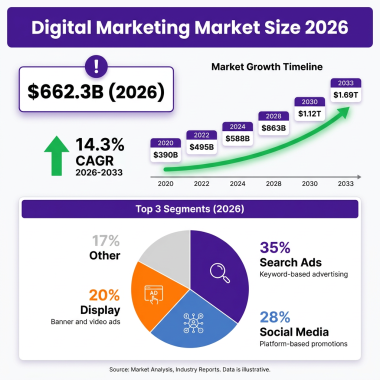
This isn’t just another year of incremental growth. The digital marketing market is projected to reach $1.69 trillion by 2033, growing at a compound annual growth rate (CAGR) of 14.3%. But the real story isn’t the numbers—it’s how AI adoption, cookie deprecation, and platform dynamics are forcing marketers to completely rethink their strategies.

Market Overview: The $662.3 Billion Digital Marketing Ecosystem
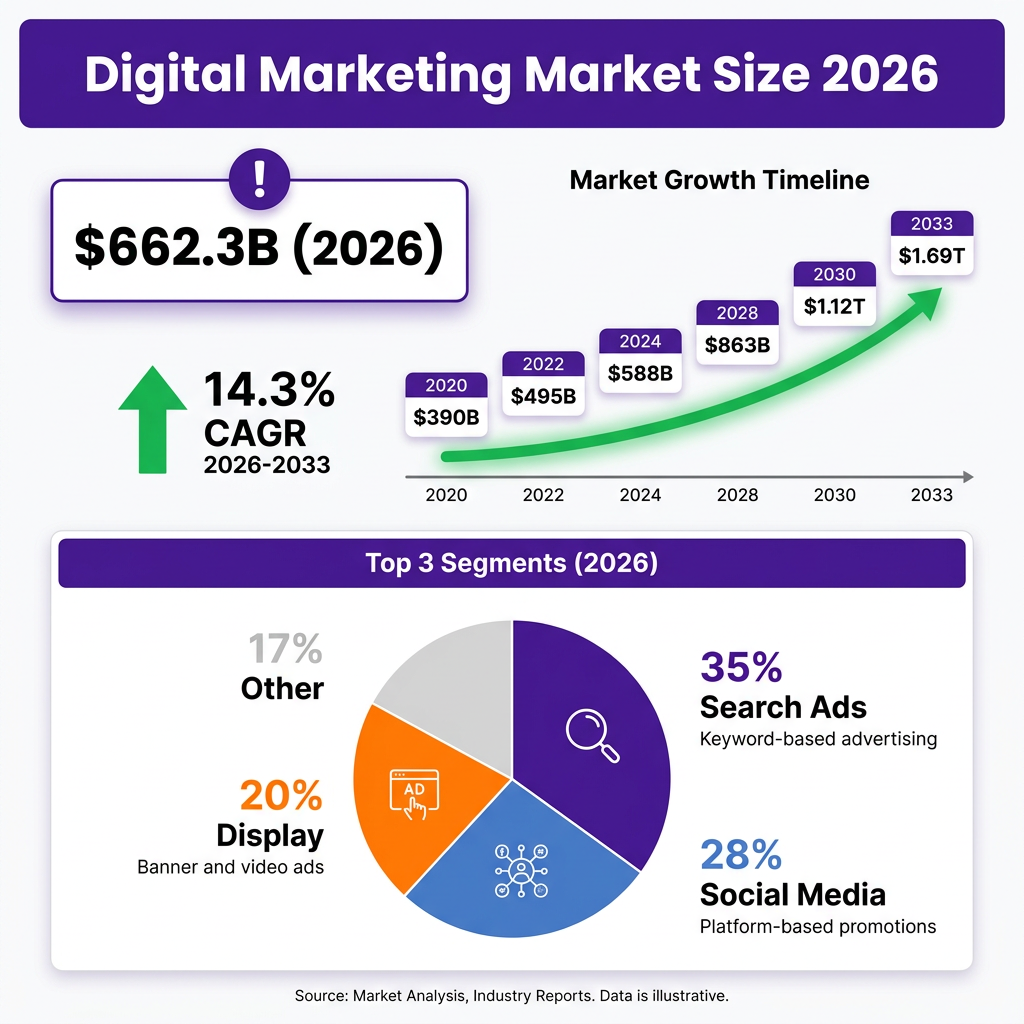
The global digital advertising market has reached an inflection point. According to Grand View Research, the market size was valued at $567.9 billion in 2025 and is projected to grow to $662.3 billion in 2026. This represents a year-over-year growth rate that outpaces traditional media by a significant margin, cementing digital as the dominant force in advertising spend.
The trajectory is unmistakable: by 2033, the market will nearly triple to $1.69 trillion. This explosive growth is driven by several converging factors: the proliferation of mobile devices, the maturation of programmatic advertising, the rise of AI-powered targeting, and the continued shift of consumer attention from traditional to digital channels.
Breaking down the market by channel reveals where the money is flowing. Search advertising maintains its position as the largest segment, accounting for approximately 35% of total digital ad spend. Social media advertising follows closely at 28%, with display advertising capturing 20% of the market. The remaining 17% is distributed across video advertising, mobile marketing, email marketing, and emerging channels like connected TV and programmatic audio.
The regional distribution of digital marketing spend tells its own story. North America continues to dominate, accounting for roughly 38% of global digital ad revenue. The Asia-Pacific region follows at 32%, driven by massive markets in China, India, and Southeast Asia. Europe represents 22% of the market, while Latin America and the Middle East/Africa regions account for the remaining 8% combined.
What’s particularly notable is the growth rate disparity between regions. While North America and Europe are growing at a steady 10-12% annually, the Asia-Pacific region is expanding at 18-20% per year. This suggests a gradual rebalancing of the global digital marketing landscape over the coming decade, with emerging markets playing an increasingly significant role.
The COVID-19 pandemic permanently altered consumer behavior, accelerating digital adoption by an estimated 5-7 years. This shift hasn’t reversed—even as physical retail has recovered, consumers have maintained their digital shopping habits. E-commerce now represents 22% of global retail sales, up from 14% in 2019, and this figure is projected to reach 30% by 2030. Every percentage point of e-commerce growth translates directly into increased digital marketing investment.
Key Statistics and Data: The Numbers That Matter
Understanding the digital marketing landscape requires diving deep into the data. Here are the statistics that define the industry in 2026:
Global Market Size and Growth: The digital advertising market reached $662.3 billion in 2026, up from $567.9 billion in 2025. This represents a 16.6% year-over-year growth rate. The market is projected to maintain a 14.3% CAGR through 2033, when it will reach $1.69 trillion. Digital advertising now accounts for 67% of all global media spend, up from 52% in 2020.
AI Adoption in Marketing: 77% of marketing teams now use AI tools for at least one core function, a dramatic increase from 50% in 2023. Content creation leads AI adoption at 68% of marketers, followed by email personalization at 57%, and ad optimization at 52%. The generative AI market specifically for marketing applications reached $91.57 billion in 2026, with 62% of marketers reporting faster content production as a primary benefit.
Social Media Marketing: TikTok maintains its position as the most engaging platform with an average engagement rate of 8%, significantly higher than Instagram’s 1.8% and X’s 0.09%. Instagram Reels generate 2.25x more reach than static posts and account for over 50% of Instagram’s ad inventory. Short-form video has driven a 16% increase in average session lengths across social platforms globally. Approximately 43.8% of TikTok users report making a purchase after seeing a product on the platform.
Email Marketing Performance: Despite predictions of its demise, email marketing continues to deliver exceptional ROI. The average open rate across all industries is 28.6%, with top performers achieving 42.4%. B2B cold email campaigns average a 44% open rate, with elite campaigns exceeding 65%. Email personalization powered by AI has increased click-through rates by an average of 14%. The average click-to-open rate (CTOR) stands at 10.8%.
Search and SEO: Google maintains 89.85% of global search traffic. However, AI Overviews now appear in up to 25% of queries, significantly impacting traditional organic click-through rates. SEO click-through rates for top positions have shifted: while traditional organic results still achieve up to 39.8% CTR, AI Overview appearances reduce this to 13-20%. ChatGPT Search has emerged as a new player, though its CTR remains under 1%.
Influencer Marketing: The global influencer marketing industry reached $32.55 billion in 2026, growing at a 33.11% CAGR. Nano-influencers (1,000-10,000 followers) now represent 75.9% of Instagram’s influencer base and achieve 2.71% engagement rates—50% higher than micro-influencers. Micro and nano-influencers will claim 45.5% of total influencer marketing spending in 2026, up from 32% in 2023.
Privacy and Cookie Deprecation: Third-party cookies are effectively dead, with Safari and Firefox blocking them by default and Chrome’s global consent prompt resulting in over 85% of users opting out. First-party data strategies have become essential, with 78% of organizations prioritizing first-party data collection. Contextual targeting has seen a resurgence, with spending increasing 34% year-over-year.
Mobile Marketing: Mobile devices account for 58.7% of global website traffic. Mobile ad spend reached $387 billion in 2026, representing 58% of total digital ad spend. Location-based mobile advertising is growing at 24% annually, driven by improved targeting capabilities and privacy-compliant approaches.
Video Marketing: Video content accounts for 82% of all internet traffic. YouTube remains the dominant platform with 2.7 billion monthly active users. Connected TV (CTV) advertising is the fastest-growing video segment, expanding at 28% annually as cord-cutting accelerates. Live video generates 18% higher conversion rates than pre-recorded content.
Programmatic Advertising: Programmatic ad spend reached $418 billion in 2026, representing 63% of all digital ad spend. Real-time bidding (RTB) accounts for 42% of programmatic spend, while private marketplace (PMP) deals represent 38%. AI-powered programmatic optimization has improved targeting efficiency by an average of 23%.
Major Trends Shaping Digital Marketing in 2026
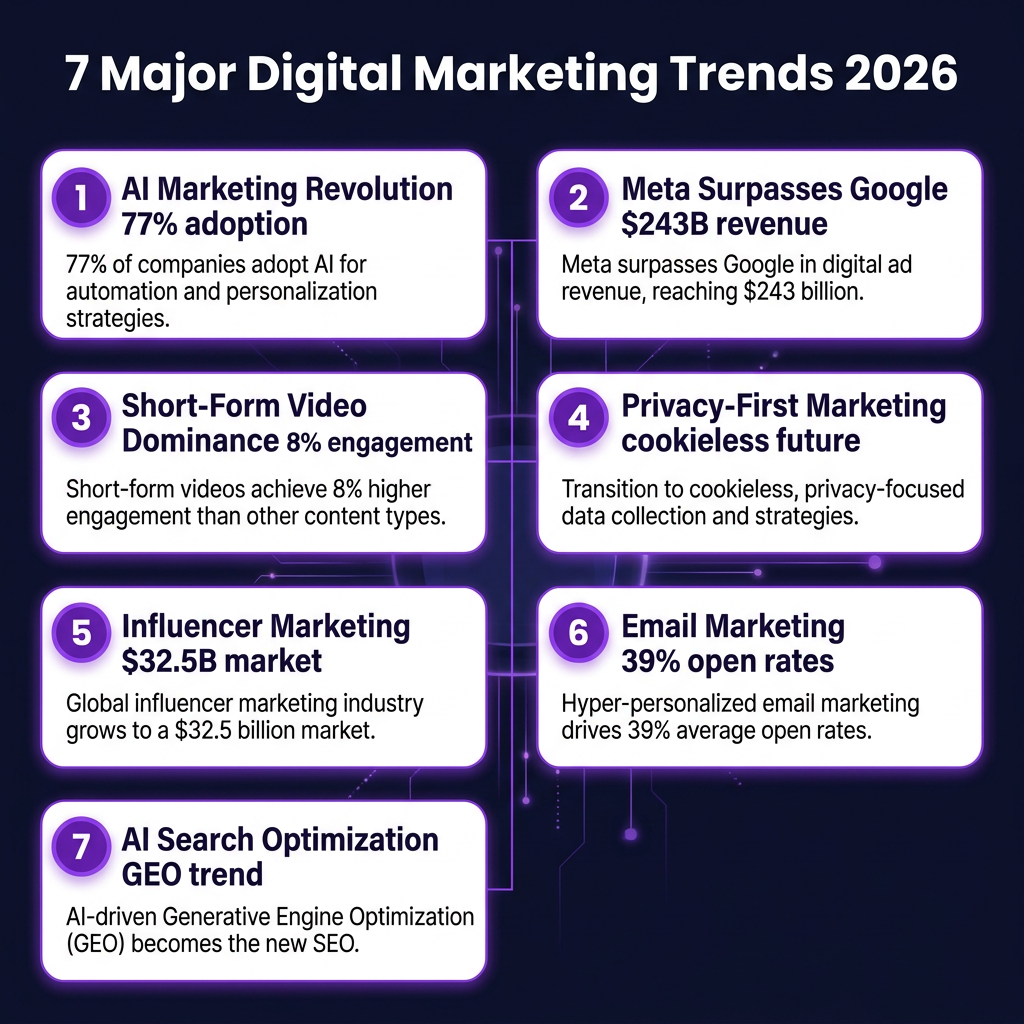
The digital marketing landscape is being reshaped by seven major trends that are fundamentally altering how brands connect with consumers:
1. The AI Marketing Revolution
Artificial intelligence has transitioned from experimental technology to operational necessity. With 77% of marketing teams now using AI tools, the question is no longer whether to adopt AI, but how to implement it effectively. The shift from “AI automation” to “AI elevation” is the defining characteristic of 2026—marketers are using AI not just to do things faster, but to do things that weren’t possible before.
Content creation remains the dominant AI use case, with 68% of marketers leveraging generative AI for blog posts, social media content, email copy, and ad creative. But the sophistication has increased dramatically. Marketers are moving beyond simple prompt-and-publish workflows to integrated AI systems that maintain brand voice, ensure factual accuracy, and optimize for specific business outcomes.
AI-powered personalization has reached new heights. Email marketers using AI for personalization report 57% higher engagement rates on average. Dynamic content optimization—where AI adjusts website content in real-time based on visitor behavior—is now used by 34% of enterprise marketers. Predictive analytics, powered by machine learning, enables marketers to anticipate customer needs and deliver relevant messages before customers even search for solutions.
The emergence of AI agents represents the next frontier. These autonomous systems can execute complex marketing tasks—from audience research to campaign optimization—without human intervention. While still in early adoption, 23% of enterprise marketing teams are experimenting with AI agents for specific use cases like social media monitoring and competitive analysis.
2. Meta Surpasses Google: The Platform Power Shift
For the first time in digital advertising history, Meta has overtaken Google as the world’s largest advertising platform. In 2026, Meta is projected to generate $243.46 billion in net worldwide ad revenue, compared to Google’s $239.54 billion. This seismic shift reflects broader changes in consumer behavior and the growing dominance of social commerce.
Meta’s growth rate is unprecedented for a company of its scale—24.1% in 2026, accelerating from 22.1% in 2025. Google’s growth, while still healthy at 11.9%, simply can’t match Meta’s momentum. The combined Meta-Google duopoly now controls 53.2% of global digital ad spend, with Amazon a distant third at 9.0% ($82.07 billion).
This shift has profound implications for marketers. Social media advertising—particularly short-form video—is now the primary growth driver in digital marketing. Instagram Reels and TikTok have trained consumers to engage with video content, and advertisers are following the eyeballs. The lines between social media and e-commerce continue to blur, with in-app purchasing becoming standard across platforms.
3. Short-Form Video Dominance
Short-form video has become the default content format for digital marketing. TikTok’s success has forced every major platform to adapt, resulting in Instagram Reels, YouTube Shorts, and a fundamental shift in how brands approach content creation. The statistics are staggering: short-form video generates 2.25x more reach than static posts, and users spend 16% more time in apps that prioritize short-form content.
TikTok maintains the highest engagement rates in the industry at 8%, with the platform’s algorithm-driven content discovery creating unprecedented opportunities for organic reach. Instagram Reels now account for over 50% of Instagram’s ad inventory, and Reels ads generate 35% higher engagement than traditional feed ads. YouTube Shorts has crossed 2 billion monthly logged-in users, making it the fastest-growing content format in YouTube’s history.
The implications for marketers are clear: video-first strategies are no longer optional. Brands that fail to adapt to short-form video are effectively invisible to younger demographics. The good news is that production barriers have never been lower—AI-powered editing tools and smartphone cameras enable professional-quality content creation at minimal cost.
4. Privacy-First Marketing
The death of third-party cookies has forced a fundamental rethinking of digital marketing strategy. With Safari and Firefox blocking third-party cookies by default, and Chrome’s global consent prompt resulting in over 85% opt-out rates, the era of cookie-based tracking is effectively over. Marketers must now build strategies around first-party data and privacy-compliant targeting.
First-party data has become the most valuable asset in marketing. Organizations with robust first-party data strategies report 2.3x higher marketing ROI compared to those relying on third-party data. The shift requires significant investment in data infrastructure, customer data platforms (CDPs), and consent management systems—but the returns justify the investment.
Contextual targeting has experienced a renaissance. As cookie-based behavioral targeting becomes less viable, marketers are returning to context-based advertising—placing ads based on the content being consumed rather than the user’s browsing history. Advanced contextual targeting powered by AI can now understand content sentiment and relevance with remarkable accuracy, delivering targeting performance that rivals behavioral approaches.
5. The Rise of Micro and Nano Influencers
The influencer marketing landscape has democratized. While celebrity influencers with millions of followers still command attention, the real growth is in micro (10,000-100,000 followers) and nano (1,000-10,000 followers) influencers. These smaller creators deliver higher engagement rates, more authentic connections with their audiences, and significantly better ROI for brands.
Nano-influencers achieve an average engagement rate of 2.71%, compared to 1.8% for micro-influencers and 0.5% for macro-influencers. They represent 75.9% of Instagram’s influencer base, creating a vast pool of potential partners for brands. Perhaps most importantly, nano-influencer partnerships cost 70-80% less than macro-influencer deals while delivering comparable or better results.
The shift toward smaller influencers reflects a broader trend: consumers are increasingly skeptical of polished, commercial content. They crave authenticity and relatability—qualities that nano-influencers deliver in abundance. Brands are responding by building long-term ambassador programs with dozens or hundreds of smaller creators rather than one-off deals with celebrities.
6. Email Marketing Renaissance
Reports of email marketing’s death have been greatly exaggerated. In fact, email is experiencing a renaissance driven by AI-powered personalization, automation, and the growing recognition that owned channels provide stability in an increasingly volatile digital landscape. The average email open rate of 28.6% and click rate of 6.21% demonstrate that email remains one of the most effective marketing channels.
AI has transformed email marketing from batch-and-blast to hyper-personalized communication. Marketers using AI for email personalization report 57% higher engagement rates. Predictive send-time optimization—using AI to determine when each individual subscriber is most likely to open emails—has increased open rates by an average of 12%. Dynamic content that adapts based on subscriber behavior and preferences is now standard practice for leading brands.
The return to owned channels is a defining trend of 2026. As social media algorithms become less predictable and paid acquisition costs rise, marketers are prioritizing channels they control. Email lists, SMS subscribers, and community platforms provide direct access to audiences without algorithmic intermediaries. This shift reflects a maturation of digital marketing strategy—brands are building sustainable, owned assets rather than renting attention from platforms.
7. AI Search and Generative Engine Optimization
Search is undergoing its most significant transformation since Google’s launch. AI Overviews now appear in up to 25% of queries, providing users with AI-generated summaries at the top of search results. ChatGPT Search and other AI search tools are capturing an increasing share of queries, particularly for complex, research-oriented searches. The implications for SEO are profound.
Generative Engine Optimization (GEO) has emerged as a new discipline. Unlike traditional SEO, which focuses on ranking in blue links, GEO optimizes content for inclusion in AI-generated responses. This requires different strategies: structured data, clear entity relationships, and content that AI systems can easily parse and cite. Early adopters of GEO are seeing significant traffic from AI search sources.
Voice search continues to grow, with 20.5% of global internet users now using voice search regularly. The 25-34 age demographic leads adoption, using voice search for everything from product research to local business discovery. Optimizing for voice requires a shift toward conversational, long-tail keywords and featured snippet optimization.
Key Players and Competitive Landscape
The digital marketing ecosystem is dominated by a handful of technology giants, but the competitive dynamics are shifting rapidly. Understanding the key players and their strategies is essential for marketers navigating this landscape.
Meta: The New Advertising King
Meta’s ascension to the top of the digital advertising market represents a historic shift. With projected ad revenue of $243.46 billion in 2026, Meta has overtaken Google through a combination of factors: the dominance of Instagram Reels, the continued strength of Facebook’s ad platform, and the company’s aggressive investment in AI-powered ad targeting.
Meta’s Advantage+ shopping campaigns have been particularly successful, using AI to automate campaign creation and optimization. The company’s AI investments—reportedly over $30 billion annually—are paying dividends in ad performance. Meta’s ad platform now offers some of the most sophisticated targeting capabilities in the industry, rivaling Google’s dominance in performance marketing.
However, Meta faces challenges. Regulatory scrutiny continues, particularly in Europe where the Digital Services Act imposes new restrictions on ad targeting. The company’s heavy dependence on iOS devices makes it vulnerable to Apple’s privacy changes. And TikTok’s continued growth, despite regulatory threats, represents a genuine competitive threat in the social advertising space.
Google: Defending the Search Empire
Despite losing the top spot in overall digital advertising, Google remains a dominant force with $239.54 billion in projected 2026 ad revenue. Search advertising continues to deliver unmatched intent-based targeting—users searching for specific terms represent high-intent prospects that social advertising struggles to match.
Google’s response to the AI search challenge has been aggressive. AI Overviews, while controversial among publishers, represent Google’s attempt to maintain relevance in an AI-first search landscape. The company’s Gemini AI integration across Search, Ads, and Analytics is creating a more unified, AI-powered marketing platform.
YouTube remains a crown jewel in Google’s portfolio. With 2.7 billion monthly active users and growing Shorts engagement, YouTube is the dominant platform for video advertising. Connected TV viewing on YouTube has exploded, capturing ad dollars shifting from traditional television. Google’s integration of YouTube with its broader advertising ecosystem creates powerful cross-channel targeting capabilities.
Amazon: The Commerce Advertising Giant
Amazon’s advertising business has grown to $82.07 billion in 2026, representing 9.0% of global digital ad spend. What makes Amazon unique is its closed-loop attribution—advertisers can directly measure the impact of ads on sales, something that’s notoriously difficult on other platforms. This measurement advantage has made Amazon essential for e-commerce brands.
Amazon’s ad platform has expanded beyond its own marketplace. Amazon DSP (Demand Side Platform) enables advertisers to reach Amazon shoppers across the web, while Amazon Publisher Services provides inventory for third-party publishers. The company’s advertising ambitions clearly extend beyond its e-commerce roots.
TikTok: The Disruptor
TikTok has achieved what seemed impossible: breaking the Meta-Google duopoly. With engagement rates of 8%—far exceeding any other major platform—TikTok has become essential for brands targeting younger demographics. The platform’s algorithm-driven content discovery creates opportunities for organic reach that simply don’t exist on other platforms.
TikTok Shop has transformed the platform from pure entertainment to a commerce destination. With 43.8% of users reporting purchases after seeing products on the platform, TikTok has cracked the social commerce code that eluded Facebook and Instagram. The platform’s native shopping features reduce friction and capture impulse purchases in ways that traditional e-commerce cannot match.
Regulatory uncertainty remains TikTok’s biggest challenge. Threats of bans in the US and other markets have made some brands hesitant to invest heavily in the platform. However, TikTok’s growth has continued despite these concerns, and the platform’s cultural influence shows no signs of waning.
Microsoft and LinkedIn: The B2B Powerhouse
Microsoft’s advertising business, centered on Bing and LinkedIn, has gained momentum through AI integration. Bing’s partnership with OpenAI has created a differentiated search experience that’s capturing market share from Google. While still small in absolute terms, Bing’s growth rate of 18% annually is noteworthy.
LinkedIn remains the dominant platform for B2B marketing. With 1 billion members and growing engagement, LinkedIn has become essential for account-based marketing, thought leadership, and B2B lead generation. LinkedIn video views have risen 22% year-over-year, reflecting broader trends in content consumption.

Challenges and Pain Points
Despite the industry’s growth, digital marketers face significant challenges in 2026. Understanding these pain points is crucial for developing effective strategies.
1. Privacy Regulations and Cookie Deprecation
The elimination of third-party cookies has created a measurement crisis. Marketers who relied on cookie-based attribution are struggling to understand which campaigns are actually driving results. The transition to first-party data requires significant investment in data infrastructure, and many organizations are finding the learning curve steep.
Privacy regulations continue to expand. GDPR in Europe, CCPA in California, and new laws in countries around the world are creating a complex compliance landscape. The cost of compliance—both in terms of technology and legal resources—is substantial. Violations can result in fines that reach 4% of global revenue, making compliance a board-level concern.
The impact on targeting is significant. Without third-party cookies, reach and frequency management become challenging. Retargeting campaigns see reduced effectiveness. Lookalike audiences based on third-party data are less accurate. Marketers must rebuild their targeting strategies from the ground up.
2. Rising Customer Acquisition Costs
Customer acquisition costs (CAC) have risen dramatically across all digital channels. Meta’s CPMs have increased 40% over the past two years. Google’s cost-per-click continues to rise in competitive categories. The days of cheap digital advertising are over, and marketers must find ways to improve efficiency.
The rising cost of acquisition makes retention more important than ever. Brands are shifting budget from acquisition to retention, investing in loyalty programs, customer success, and lifecycle marketing. The economics are clear: retaining an existing customer costs 5-7x less than acquiring a new one.
Creative fatigue is exacerbating the CAC problem. As consumers are exposed to more ads than ever, creative performance degrades faster. Marketers must produce more creative assets to maintain performance, increasing costs and operational complexity. AI-powered creative tools help, but they can’t fully replace human creativity.
3. AI Content Saturation
The proliferation of AI-generated content has created a noise problem. With 68% of marketers using AI for content creation, the internet is being flooded with AI-generated articles, social posts, and videos. Much of this content is generic, repetitive, and fails to provide genuine value.
Consumers are developing AI fatigue. Early excitement about AI-generated content has given way to skepticism. Audiences can increasingly recognize AI-generated content and are gravitating toward authentic, human-created material. Brands that rely too heavily on AI risk appearing impersonal and inauthentic.
Search engines are responding to AI content saturation. Google’s algorithms increasingly prioritize content with demonstrable expertise, experience, and authority—qualities that AI struggles to replicate. The E-E-A-T framework (Experience, Expertise, Authoritativeness, Trustworthiness) has become essential for SEO success.
Opportunities and Growth Strategies
Despite the challenges, 2026 presents significant opportunities for marketers who adapt to the new landscape. Here are the strategies driving growth:
1. First-Party Data Excellence
Organizations that invest in first-party data infrastructure are seeing substantial returns. The key is creating value exchanges that encourage customers to share their data willingly. Loyalty programs, exclusive content, personalized experiences, and community access are all effective incentives.
Customer Data Platforms (CDPs) have become essential technology. These systems unify data from multiple sources—website, app, email, in-store—to create comprehensive customer profiles. With a CDP, marketers can deliver consistent, personalized experiences across all touchpoints while maintaining privacy compliance.
The brands winning with first-party data treat it as a strategic asset. They invest in data quality, governance, and activation capabilities. They build cross-functional teams that can translate data insights into marketing action. And they maintain transparency with customers about how data is used, building trust that enables deeper relationships.
2. AI-Augmented Creativity
The most successful marketers in 2026 aren’t replacing human creativity with AI—they’re augmenting it. AI handles repetitive tasks, generates initial concepts, and optimizes performance, while humans provide strategic direction, emotional intelligence, and brand stewardship.
This hybrid approach delivers the best of both worlds: the scale and speed of AI combined with the authenticity and emotional resonance of human creativity. Brands using AI-augmented workflows report 40% faster content production and 25% better performance compared to purely human or purely AI approaches.
The key is establishing clear governance frameworks. AI should be used for specific, well-defined tasks within a structured workflow. Brand guidelines, quality standards, and approval processes ensure that AI-generated content meets brand standards. Human oversight catches errors, adds emotional nuance, and ensures strategic alignment.
3. Community-Led Growth
As acquisition costs rise, community-led growth has emerged as a sustainable alternative. Brands are building owned communities—on platforms like Discord, Slack, Circle, and proprietary platforms—that create network effects and drive organic growth.
Communities provide multiple benefits: they reduce customer acquisition costs through referrals and word-of-mouth, they increase retention by creating social connections, they generate user-generated content that feeds marketing channels, and they provide direct feedback that drives product improvement.
The most successful community strategies treat community as a product, not a marketing channel. They invest in community management, create programming that delivers value, and foster genuine connections among members. The result is a sustainable growth engine that becomes more valuable over time.
Case Studies and Success Stories
Case Study 1: EcoTech’s Content Marketing Transformation
EcoTech, a sustainable technology company, faced the challenge of educating consumers about complex environmental technologies. Their breakthrough came from a comprehensive content marketing strategy that combined AI-powered content creation with human expertise.
The company created a series of engaging blog posts, videos, and interactive tools that demonstrated the environmental benefits of their products. AI tools helped scale content production, but every piece was reviewed and enhanced by subject matter experts who added real-world insights and emotional storytelling.
The results were remarkable: a 300% increase in social media shares, 150% growth in organic search traffic, and a 45% reduction in customer acquisition costs. The key insight was that AI enabled scale, but human expertise provided the credibility and emotional connection that drove engagement.
Case Study 2: FashionForward’s AI Personalization
FashionForward, an online boutique specializing in trendy apparel, implemented advanced AI-driven personalization in 2026 to enhance the customer experience. The challenge was delivering personalized recommendations at scale without losing the human touch that defined their brand.
The solution combined AI-powered product recommendations with personalized email campaigns and dynamic website content. Machine learning algorithms analyzed browsing behavior, purchase history, and real-time inventory to deliver relevant suggestions. But the system was designed to augment, not replace, human curation—fashion experts reviewed AI recommendations and added seasonal trends and style advice.
The results demonstrated the power of AI-augmented personalization: conversion rates increased 35%, average order value grew 22%, and customer lifetime value improved 40%. Email open rates reached 42%—well above industry averages—because customers knew the content would be relevant to their interests.
Case Study 3: B2B SaaS Company’s LinkedIn Video Strategy
A B2B SaaS company struggling with high customer acquisition costs pivoted to a LinkedIn video strategy focused on thought leadership and educational content. Rather than promotional videos, they created in-depth tutorials, industry analysis, and behind-the-scenes content featuring their team.
The strategy leveraged LinkedIn’s algorithm changes that favored video content. By posting consistently—three times per week—they built a following of engaged professionals in their target market. The videos were repurposed across channels: YouTube for long-form content, short clips for Instagram and TikTok, and audio versions for podcasts.
Within six months, the company had generated 2.5 million video views, 15,000 new LinkedIn followers, and—most importantly—320 qualified sales conversations. The cost per lead was 60% lower than their previous paid advertising strategy, and the leads were higher quality because they had already consumed educational content and understood the company’s value proposition.
Future Outlook and Predictions
The digital marketing landscape will continue evolving rapidly through 2030. Here are the key predictions for the coming years:
2026-2028: The AI Integration Phase
AI will become fully integrated into marketing operations. By 2028, 90% of marketing teams will use AI tools as standard practice. The distinction between “AI marketing” and “marketing” will disappear—AI will simply be how marketing works. This integration will drive significant efficiency gains, with AI handling 60-70% of routine marketing tasks.
AI agents will become mainstream, autonomously managing significant portions of marketing operations. These agents will handle campaign optimization, content distribution, and customer communication with minimal human oversight. Marketers will shift from execution to strategy, focusing on brand positioning, creative direction, and customer experience design.
2028-2030: The Consolidation Era
The digital marketing landscape will see significant consolidation. The number of marketing technology vendors will shrink by 40% as larger platforms acquire specialized tools and integrate their capabilities. Marketers will benefit from more unified platforms but may lose some flexibility and customization options.
Privacy regulations will globalize, with most major markets adopting comprehensive privacy frameworks similar to GDPR. This will create a more level playing field but will require significant compliance investments. First-party data strategies will become table stakes—brands without robust first-party data capabilities will struggle to compete.
2030 and Beyond: The Post-Platform Era
Looking further ahead, we may see the emergence of a “post-platform” marketing landscape. As consumers grow weary of algorithm-driven content feeds, there’s potential for a shift toward decentralized, community-owned platforms. Web3 technologies could enable new models of content creation and distribution that bypass traditional platforms entirely.
Immersive technologies—AR, VR, and spatial computing—will create entirely new marketing channels. By 2030, immersive advertising could represent 10-15% of total digital ad spend. Brands that begin experimenting with these technologies now will have a significant advantage as they mature.
The digital marketing market is projected to reach $1.69 trillion by 2033, but the composition of that market will look very different from today. Channels that don’t exist yet will capture significant share. New business models will emerge. And the skills required for marketing success will continue to evolve.
Regional Market Analysis
The global digital marketing landscape varies significantly by region, with distinct characteristics, growth rates, and opportunities in each market. Understanding these regional differences is essential for marketers operating internationally.
North America: The Mature Market Leader
North America remains the largest digital advertising market, accounting for 38% of global spend. The United States alone represents over $350 billion in digital ad revenue, making it the single largest national market. However, growth rates have moderated to 10-12% annually as the market matures.
The North American market is characterized by high digital penetration, sophisticated advertisers, and advanced measurement capabilities. Programmatic advertising adoption is highest here, with 75% of digital ad spend flowing through programmatic channels. Privacy regulations, particularly in California with CCPA, are shaping targeting strategies and driving investment in first-party data infrastructure.
Key trends in North America include the rapid growth of connected TV advertising, the dominance of Meta and Google in the duopoly, and the emergence of retail media networks led by Amazon, Walmart, and Target. The region also leads in AI adoption, with 82% of enterprise marketers using AI tools compared to the global average of 77%.
Asia-Pacific: The Growth Engine
The Asia-Pacific region is the fastest-growing digital marketing market, expanding at 18-20% annually. China represents the largest market in the region, with digital ad spend exceeding $200 billion. However, India’s market is growing fastest at 25% annually, driven by rapid internet penetration and mobile adoption.
The APAC market has unique characteristics that differentiate it from Western markets. Mobile-first is the default strategy—mobile accounts for 72% of digital ad spend in the region, compared to 58% globally. Super-apps like WeChat, LINE, and Grab dominate, creating integrated ecosystems that combine social, commerce, and financial services.
Live commerce has emerged as a major trend in APAC, particularly in China where it accounts for 15% of e-commerce sales. Influencer marketing is more mature, with sophisticated creator economies and higher consumer trust in influencer recommendations. Marketers entering APAC markets must adapt to these platform dynamics and consumer behaviors.
Europe: The Privacy-First Laboratory
Europe represents 22% of global digital ad spend, with the UK, Germany, and France as the largest markets. The region has become a testing ground for privacy-first marketing, with GDPR setting the global standard for data protection and the Digital Services Act introducing new regulations for platform accountability.
European marketers have been forced to innovate in response to strict privacy regulations. First-party data strategies are most advanced here, with 85% of organizations prioritizing first-party data collection. Contextual targeting has seen significant investment, with European companies leading development of AI-powered contextual solutions.
The European market also shows interesting platform dynamics. While Meta and Google remain dominant, local players like TikTok have gained significant share. Retail media is growing rapidly, with European retailers building advertising businesses that rival Amazon’s. The region’s focus on sustainability is also shaping marketing, with 67% of European consumers preferring brands with strong environmental commitments.
Latin America and Middle East/Africa: Emerging Opportunities
These regions represent 8% of global digital ad spend combined but offer the highest growth potential. Latin America’s digital ad market is growing at 15% annually, driven by Brazil and Mexico. The Middle East and Africa region, while smaller, is growing at 20% annually as internet infrastructure improves.
Mobile dominates these markets even more than in APAC—mobile accounts for 78% of digital ad spend in Latin America and 85% in Africa. Social media platforms, particularly WhatsApp, Facebook, and Instagram, are the primary digital touchpoints. E-commerce is growing rapidly from a small base, creating opportunities for early movers.
Marketers targeting these regions face unique challenges including payment infrastructure limitations, logistics complexities, and diverse language requirements. However, the growth potential makes these markets increasingly attractive for global brands willing to invest in understanding local contexts.
Key Takeaways
- The digital marketing market reached $662.3 billion in 2026 and is projected to grow to $1.69 trillion by 2033, representing a 14.3% CAGR.
- Meta has officially surpassed Google as the world’s largest digital advertising platform, with $243.46 billion in projected 2026 ad revenue compared to Google’s $239.54 billion.
- AI adoption has reached mainstream status with 77% of marketing teams using AI tools, transforming everything from content creation to personalization.
- Short-form video dominates engagement, with TikTok maintaining 8% engagement rates and Instagram Reels generating 2.25x more reach than static posts.
- Privacy-first marketing is now essential—third-party cookies are effectively dead, and first-party data strategies have become competitive necessities.
- Nano and micro-influencers deliver superior ROI, with nano-influencers achieving 2.71% engagement rates and representing 75.9% of Instagram’s influencer base.
- Email marketing continues to deliver exceptional results with 28.6% average open rates, driven by AI-powered personalization and automation.
- AI search is transforming SEO, with AI Overviews appearing in 25% of queries and Generative Engine Optimization emerging as a new discipline.
- Rising customer acquisition costs are forcing brands to prioritize retention and community-led growth over pure acquisition strategies.
- The most successful marketers in 2026 combine AI scale with human creativity, using technology to augment rather than replace human expertise.
Sources and Citations
- Grand View Research – Digital Advertising Market Size Report 2026: https://www.grandviewresearch.com/industry-analysis/digital-advertising-market-report
- MediaPost – Meta Set To Surpass Google In 2026 Ad Revenue: https://www.mediapost.com/publications/article/414285/meta-set-to-surpass-google-in-2026-ad-revenue.html
- Hostinger – 47 Essential Digital Marketing Statistics for 2026: https://www.hostinger.com/tutorials/digital-marketing-statistics
- Digital Marketing Institute – Digital Marketing Trends 2026: https://digitalmarketinginstitute.com/blog/digital-marketing-trends-2026
- AdAI – AI Marketing Statistics 2026: https://adai.news/resources/statistics/ai-marketing-statistics-2026
- Goat Agency – 59 Social Media Marketing Statistics You Need to Know 2026: https://goatagency.com/blog/social-media-marketing-statistics
- The Influencer Marketing Factory – TikTok vs Instagram Engagement Rates 2026: https://theinfluencermarketingfactory.com/tiktok-instagram-er
- Archive.com – Influencer Marketing Growth Statistics for 2026: https://archive.com/blog/influencer-marketing-growth-statistics
- ActiveCampaign – 2026 Email Benchmarks: https://www.reddit.com/r/ActiveCampaign/comments/1r1et0q/2026_email_benchmarks_how_do_your_open_click/
- MoEngage – Average Email Open Rates by Industry 2026: https://www.moengage.com/blog/average-email-open-rate
- SeoProfy – 126 SEO Statistics 2026: https://seoprofy.com/blog/seo-statistics
- HubSpot – SEO Trends for 2026: https://blog.hubspot.com/marketing/evolution-of-search
- Expert Market Research – Digital Marketing Market Report 2026-2035: https://www.expertmarketresearch.com/reports/digital-marketing-market
- Research and Markets – Digital Advertising Market Report 2026: https://www.researchandmarkets.com/reports/5939640/digital-advertising-market-report
- Precedence Research – Creator Economy Market Size 2026-2035: https://www.precedenceresearch.com/creator-economy-market