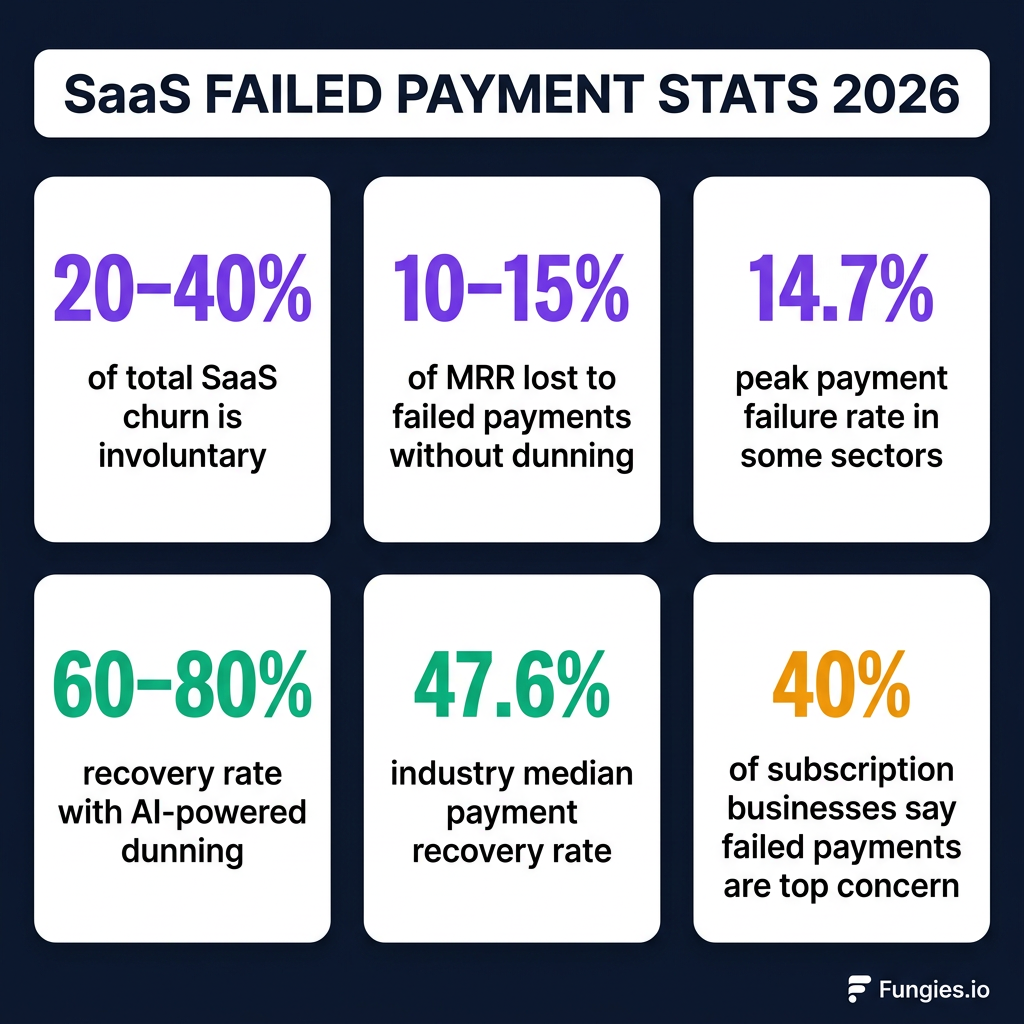
Failed payments are quietly eating your revenue right now. Not dramatically — just a steady drip of 10–15% of MRR disappearing every month while you’re focused on acquisition. And here’s the kicker: 20–40% of total SaaS churn is involuntary. These aren’t customers who wanted to leave. They just had a card expire.
Dunning management is the system that catches those failures before they become permanent cancellations. In 2026, with AI-powered retry logic and multi-channel outreach, companies that do this well recover 60–80% of failed payments. Those that don’t recover maybe 20% — if they’re lucky.
This guide covers everything: what dunning management is, how to build a strategy that actually works, which tools to use, and where a Merchant of Record fits into the picture.
What Is Dunning Management (and Why Most SaaS Companies Get It Wrong)
Dunning management is the automated process of recovering failed subscription payments — through smart retries, customer notifications, and outreach campaigns — before payment failures turn into lost subscribers.
The name comes from “dunning letters” — the old-school practice of sending increasingly stern payment demand letters. Modern dunning is nothing like that. It’s quiet, automated, and when done right, the customer barely notices their payment failed.
Here’s what most SaaS companies get wrong:
- They retry at random intervals. Retrying every 24 hours for 5 days ignores decline-code intelligence. A card declined for “insufficient funds” has different retry logic than one declined for “card expired.”
- They wait too long to notify the customer. Sending a “payment failed” email 3 days after the failure is too late. The customer may have already tried to use your product and hit a paywall.
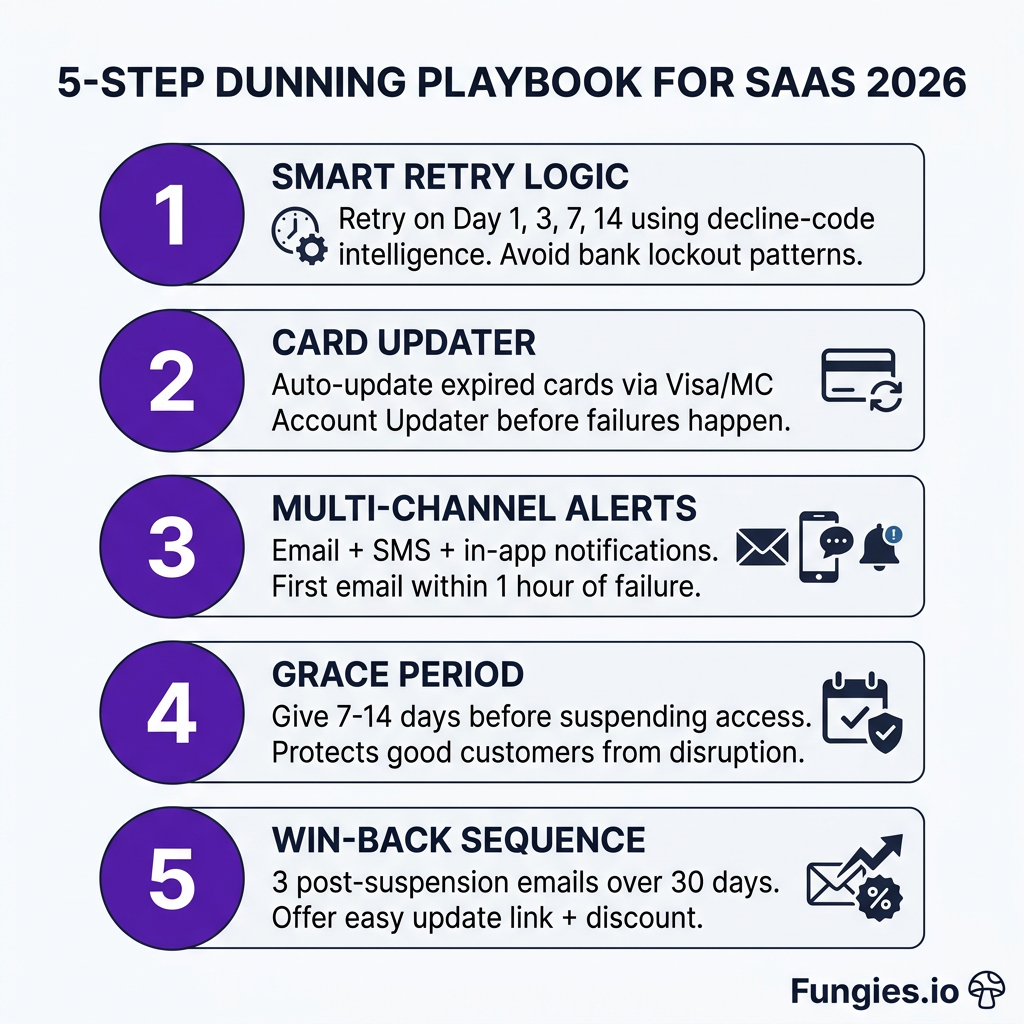
- They suspend access immediately. Hard-locking a customer out the moment a payment fails destroys goodwill. A 7–14 day grace period is standard for a reason.
- They treat all failures equally. A long-time annual subscriber who hits a temporary decline deserves different treatment than a new monthly subscriber on their first charge.
Payment failure rates can reach 14.7% in some sectors. For a $100K MRR SaaS, that’s potentially $14,700/month in revenue at risk every billing cycle. Before acquiring a single new customer, you’re leaking that much.
The Three Phases of Dunning Management
Phase 1: Pre-Dunning (Before the Failure Happens)
The best dunning is the dunning you never need. Pre-dunning strategies prevent payment failures before they occur:
- Card Account Updater: Visa and Mastercard both offer Account Updater services. When a customer gets a new card, their issuer pushes the updated details to merchants automatically. This prevents a huge chunk of “card expired” failures. Paddle, Stripe, and Fungies all integrate with this.
- Expiry reminders: Send a “your card expires next month” email 30 days before expiry. Include a direct link to update billing. Simple and effective.
- 3DS pre-authentication: For European customers, proactive 3DS authentication before renewal prevents bank-triggered declines from SCA requirements.
Phase 2: Active Recovery (After the Failure)
When a payment fails, you have a window. Here’s how to use it:
Retry logic: The industry standard is Day 1, Day 3, Day 7, Day 14 — but smart dunning tools adjust this based on decline codes. “Insufficient funds” suggests retrying at the end of the month when paychecks land. “Do not honor” requires a different approach entirely. AI-driven retry logic, used by tools like Churnkey and Redux, can boost recovery rates by 20–30% over static schedules.
Customer communication: First notification should go out within 1 hour of failure — not the next morning. Use email as the primary channel, but supplement with in-app banners and SMS for high-value subscribers. Keep the tone helpful, not threatening. “We couldn’t process your payment” performs better than “Your account is past due.”
Frictionless update flow: The payment update link in your email should open directly to a card update form — not a login page, not a dashboard. Every extra click reduces conversion. Stripe’s customer portal and Paddle’s customer self-serve flow handle this well.
Phase 3: Post-Suspension Win-Back
If a customer’s access is suspended after the grace period, it’s not necessarily game over. A 3-email win-back sequence over 30 days can recover 15–25% of suspended accounts. The formula:
- Day 1 (suspension day): “Your access has been paused — update here to get back in.”
- Day 7: “We miss you — here’s what you’re missing. Your data is safe.” Consider a small discount (10–15%) for annual customers.
- Day 30: Final notice with clear data deletion timeline. Creates urgency.
Dunning Management by Merchant of Record vs. DIY
This is where it gets interesting for SaaS founders. You have two paths:
DIY dunning with a payment processor (Stripe, Braintree): You build and manage the dunning logic yourself. Stripe Billing has built-in retry logic, but it’s basic — no AI, limited multi-channel outreach, no decline-code intelligence out of the box. You’ll need a dedicated dunning tool on top.
Dunning via Merchant of Record: When you use an MoR like Fungies, Paddle, or FastSpring, they own the payment relationship — and with that comes built-in payment recovery. The MoR handles retry logic, card updaters, and in many cases, customer communication. You don’t have to build or manage a dunning stack.
For most indie SaaS founders and early-stage teams, the MoR route wins. You’re not just outsourcing dunning — you’re outsourcing tax compliance, fraud, chargebacks, and payment infrastructure all at once. The dunning functionality comes bundled.
| Approach | Dunning Quality | Setup Effort | Additional Cost | Best For |
|---|---|---|---|---|
| Stripe Billing (basic) | Basic retry logic only | Low | None extra | Simple SaaS, US-only |
| Stripe + Churn Buster | Advanced AI-powered | Medium | $149–$399/mo | Established SaaS >$50K MRR |
| Stripe + Churnkey | Advanced AI-powered | Medium | 0.5% of recovered rev | High-volume subscriptions |
| Paddle (with Retain) | Good, Paddle-native | Low | Bundled | Paddle merchants |
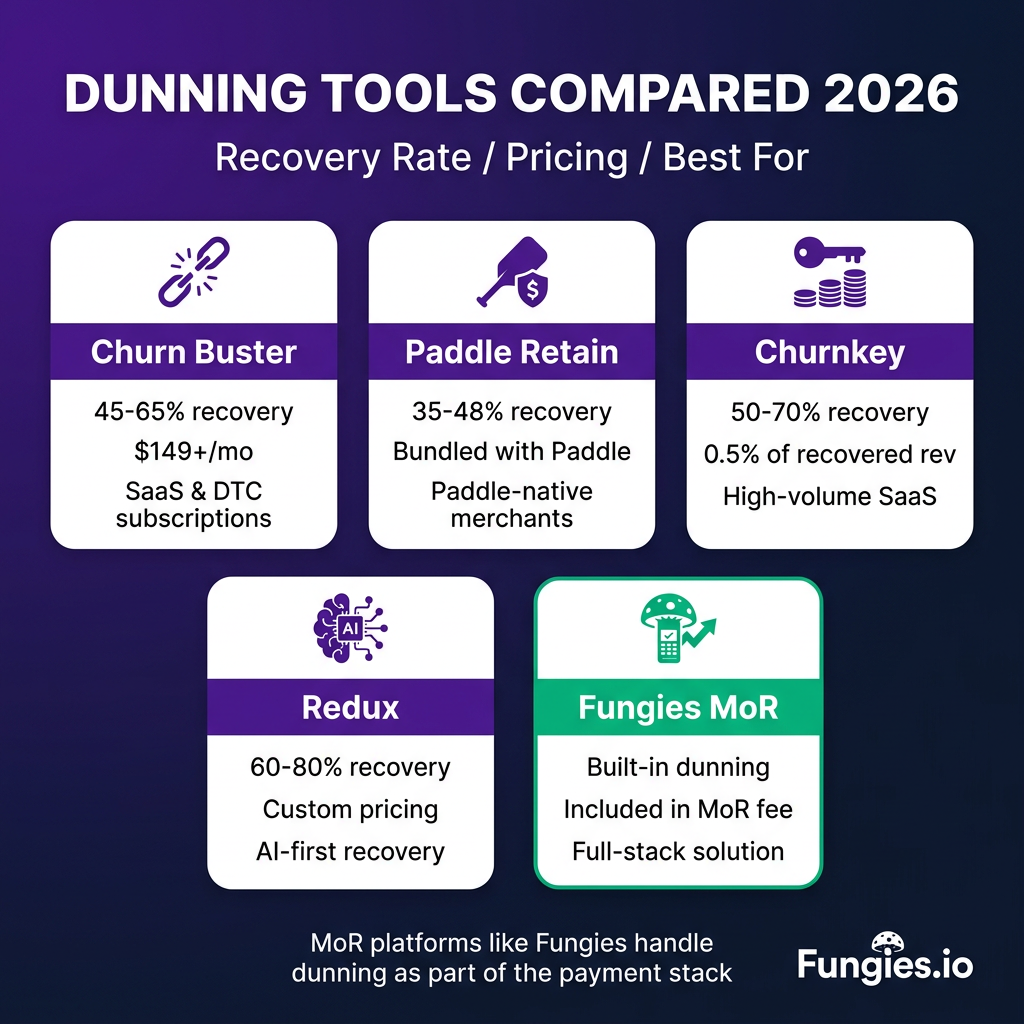
| Fungies MoR | Built-in, managed | Very low | Included in MoR fee | Indie SaaS, global reach |
The Best Dunning Management Tools in 2026
If you’re on Stripe and handling dunning yourself, here are the tools worth evaluating:
Churn Buster
One of the most battle-tested dunning platforms. Recovery rates of 45–65% of failed payments. Strong email sequencing, decline-code awareness, and Shopify/Recharge integrations. Pricing starts at $149/month. Best for SaaS and subscription e-commerce businesses above $30K MRR. Their reporting is excellent — you’ll know exactly how much you’ve recovered.
Churnkey
AI-powered dunning with a performance-based pricing model: 0.5% of recovered revenue. That aligns incentives — they only make money when you make money. Recovery rates of 50–70%. Strong cancel flow (they prevent voluntary churn too, not just involuntary). Good for high-volume SaaS.
Redux Payments
The newest entrant with the boldest claims: 60–80% recovery rates using “Silent-First AI” recovery — meaning they attempt recovery without alerting the customer in most cases, only escalating to email/SMS when necessary. Custom pricing. Worth evaluating if you’re doing significant monthly volume.
Baremetrics Recover
Part of the Baremetrics analytics suite. If you’re already using Baremetrics for SaaS metrics, their dunning add-on integrates cleanly. Recovery rates are solid — around 35–50%. Best if you want analytics and dunning in one platform.
Paddle Retain
Built directly into Paddle Billing at no extra cost. If you’re a Paddle merchant, this is a no-brainer — it handles smart retries, card updaters, and cancellation flows. Recovery rates of 35–48%. Not available outside the Paddle ecosystem.
Writing Dunning Emails That Actually Convert
Most dunning emails are terrible. They’re cold, robotic, and make customers feel like delinquents. Here’s what works:
Subject Line Principles
- Don’t mention “payment failed” in the subject — opens tank
- Use: “Quick update on your [Product] account” or “Action needed for [Product]”
- For win-backs: “[First name], we saved your data” gets high open rates
Email 1: Within 1 Hour of Failure
Tone: calm, helpful, non-judgmental. Include: what happened (in plain language), a single CTA (update card), a reassurance that their data is safe and access continues during the grace period. Keep it short — under 150 words.
Email 2: Day 3 (if still unresolved)
Remind them gently. Mention the grace period countdown. Some teams include a “reply to this email if you need help” option — this catches customers who are confused about which card to use, or who want to switch plans.
Email 3: Day 7 (final warning before suspension)
More direct. Clear deadline. One-click update link. Consider offering a 10% discount on next renewal for long-time customers — this is especially effective for annual subscribers who’ve been with you 12+ months.
Email 4: Day 14 (suspension notice)
Factual. Access paused. Data safe for 30 days. Link to update card and restore instantly. Keep it clean — no guilt-tripping.
Measuring Dunning Performance: The Metrics That Matter
Vanity metrics won’t tell you if your dunning is working. Track these:
| Metric | Definition | Industry Benchmark | Target |
|---|---|---|---|
| Payment Recovery Rate | % of failed payments recovered | 47.6% (median) | >60% |
| Involuntary Churn Rate | MRR lost to payment failures / total MRR | ~1% monthly | <0.5% |
| Days to Recovery | Avg days from failure to successful charge | 4–7 days | <5 days |
| Email Recovery Rate | % recovered from email campaigns | 20–35% | >30% |
| Card Updater Hit Rate | % of expiries caught by auto-updater | 30–50% | >40% |
If your involuntary churn rate is above 2% monthly, your dunning is broken. At $100K MRR, that’s $2,000/month ($24K/year) disappearing from non-technical reasons. Fix it before optimizing anything else.
Dunning for Global SaaS: The Tax and Compliance Angle
Here’s a layer most dunning guides ignore: if you’re selling globally without an MoR, failed payment recovery gets complicated fast.
When a payment fails in Germany, retrying it triggers potential VAT implications depending on when the charge eventually succeeds. If you’re managing your own global tax compliance, your dunning sequence has to account for this. It’s another reason many global SaaS companies choose an MoR over DIY — when Fungies or Paddle processes the payment (and the retry), they own the tax liability on that transaction.
For companies selling to customers in 50+ countries, a Merchant of Record handling dunning isn’t just convenient — it’s the safer legal choice. There’s no question of which entity is liable if a retry charges a customer in a country with unusual digital services tax rules.
Key Takeaways
- Involuntary churn is 20–40% of total SaaS churn — fixing your dunning is often more valuable than optimizing acquisition.
- Smart retry logic beats static schedules — use decline-code intelligence to retry at the right time for each failure type.
- First notification within 1 hour of failure, not the next day. Speed matters.
- Grace periods protect relationships — 7–14 days before suspending access keeps good customers from churning over a temporary issue.
- Merchant of Record platforms bundle dunning — if you’re evaluating Fungies, Paddle, or FastSpring, built-in payment recovery is part of the value prop.
FAQ: Dunning Management for SaaS
What is the best dunning management software for SaaS in 2026?
It depends on your stack. If you’re on Stripe, Churn Buster ($149+/mo) and Churnkey (0.5% of recovered revenue) are top choices. If you’re using an MoR like Paddle or Fungies, built-in dunning is included. Redux Payments is worth evaluating for high-volume AI-first recovery. The “best” tool is the one integrated with your billing system — dunning that lives outside your payment flow adds latency and reduces recovery rates.
How often should I retry a failed payment?
The industry standard is Day 1, Day 3, Day 7, and Day 14. But the optimal schedule depends on the decline code. Insufficient funds failures should retry at predictable paycheck dates. Expired card failures should trigger an immediate card update request rather than retries. AI-powered dunning tools dynamically adjust retry timing based on these signals — and typically outperform static schedules by 20–30%.
What’s the difference between voluntary and involuntary churn?
Voluntary churn is a customer’s active decision to cancel — they found a better alternative, outgrew your product, or budget got cut. Involuntary churn is unintentional: a card expired, a bank declined a charge, or funds weren’t available at renewal. Involuntary churn is fixable with dunning; voluntary churn requires product and retention work. Benchmark your involuntary churn rate separately from voluntary — they need different solutions.
Does a Merchant of Record handle dunning for you?
Yes — most MoR platforms handle payment recovery as part of their service. Paddle bundles “Retain” (their dunning product) with Paddle Billing. FastSpring has built-in retry logic. Fungies, as an MoR, manages the payment relationship including retry sequences and card updaters. When an MoR handles dunning, they also own the tax implications of successful retries across jurisdictions — which removes a significant compliance burden from your team.
Ready to Fix Your Payment Recovery?
Dunning management isn’t glamorous. It won’t show up in a product launch tweet or a funding announcement. But recovering 60–80% of failed payments instead of 20% could be the highest-ROI change you make to your revenue stack this year.
If you’re building a SaaS product and want payment recovery, tax compliance, and global checkout handled as one integrated stack — that’s exactly what Fungies is built for. No separate dunning tool required, no multi-vendor billing nightmare.
References
- Finsi.ai — Best Dunning Management Software (2026)
- Baremetrics — Dunning Management: The Complete Guide for SaaS (2026)
- Churn Buster — 8 Best Dunning Management Software Solutions for 2026
- Slicker HQ — What Is a Good Involuntary Churn Rate? SaaS Benchmarks
- Kaplan Collection Agency — 55 SaaS and B2B Payment Statistics for 2025
- Digital Applied — Failed-Payment Recovery: The 2026 Dunning Playbook
- Redux Payments — Redux vs. Churnkey vs Paddle/ProfitWell Retain (2026)
- Alguna — Dunning Management for SaaS: Reducing Involuntary Churn
- Paddle — Paddle Retain: Dunning Software