Two years ago, running a flagship LLM API cost $10 per million input tokens. Today, you can get better performance for a quarter of that price — and a perfectly adequate model for a hundredth. The collapse in LLM API pricing has reshaped what’s economically feasible with AI, from side-project chatbots to enterprise-scale document processing pipelines chewing through millions of pages monthly.
DeepSeek blew up the pricing floor. OpenAI responded with aggressive cuts across the GPT-5 family. Google dangled free tiers that actually work. Anthropic dropped Opus pricing by 67% and expanded its context window to 1M tokens. The result? Choosing the wrong model for your workload can cost you 100x more than necessary for the same quality output.

Why LLM API Pricing Matters More Than Ever in 2026
The spread between cheap and premium models now exceeds 1,000x. A request that costs $0.0001 on Gemini Flash runs $0.10+ on GPT-5.2 Pro. That makes model selection one of the highest-leverage decisions in any AI product. Getting this wrong by even one tier can mean the difference between a profitable feature and one that bleeds cash every month.
Here’s what the pricing landscape looks like in April 2026:
- Gemini 2.5 Flash-Lite: $0.10/$0.40 per 1M tokens — cheapest actively supported model
- DeepSeek V3.2: $0.28/$0.42 per 1M tokens — best value with 90% cache discounts
- GPT-5.4: $2.50/$10 per 1M tokens — best overall balance of capability and cost
- Claude Sonnet 4.6: $3/$15 per 1M tokens — best for complex instruction following
- Claude Opus 4.6: $5/$25 per 1M tokens — premium accuracy with 1M context window
The 7 Best LLM APIs Ranked by Value
I’ve analyzed pricing, capabilities, and real-world performance to rank the top LLM APIs available in 2026. This isn’t about benchmark scores — it’s about what you actually get for your money.
1. DeepSeek V3.2 — Best Bang for Your Buck
Pricing: $0.28 per 1M input tokens / $0.42 per 1M output tokens
DeepSeek single-handedly forced the entire industry to cut prices. At under $0.50 per million tokens, V3.2 delivers surprisingly capable performance for tasks that would have cost $10+ two years ago. The 90% cache discount makes repeated-context workloads almost free.
Best for: High-volume applications, chatbots, content generation, prototyping
Context window: 64K tokens
2. Gemini 2.5 Flash-Lite — Cheapest Production Option
Pricing: $0.10 per 1M input tokens / $0.40 per 1M output tokens
Google’s Gemini Flash-Lite is now the cheapest actively supported model from a major provider. At $0.10 per million input tokens, it’s hard to beat for simple classification, routing, and light extraction tasks. Plus, Google offers generous free tiers that actually work for prototyping.
Best for: Simple classification, routing, extraction, high-volume workloads
Context window: 1M tokens
3. GPT-5.4 — Best Overall Balance
Pricing: $2.50 per 1M input tokens / $10 per 1M output tokens
Launched in March 2026, GPT-5.4 sits between GPT-5 and GPT-5.2 — offering strong reasoning at a competitive price. OpenAI’s broad lineup lets you match cost to capability with precision, all on the same API and billing account.
Best for: General-purpose applications, agents, coding assistance
Context window: 200K tokens
4. Claude Sonnet 4.6 — Best for Complex Instructions
Pricing: $3 per 1M input tokens / $15 per 1M output tokens
Anthropic’s Sonnet remains the workhorse for production applications. Where Claude differentiates is behavior consistency — Claude models follow complex, multi-constraint instructions more reliably than competitors. That reliability gap reduces retries and manual overrides in production.
Best for: Production apps requiring reliable instruction following, analysis, structured output
Context window: 200K tokens
5. GPT-5 Nano — Cheapest OpenAI Option
Pricing: $0.05 per 1M input tokens / $0.40 per 1M output tokens
GPT-5 Nano competes directly with Gemini Flash on price while living inside the OpenAI ecosystem. For teams already invested in OpenAI’s function calling format and structured output modes, switching providers to save a few cents rarely makes sense.
Best for: High-volume simple tasks within OpenAI ecosystem
Context window: 128K tokens
6. Claude Opus 4.6 — Premium Accuracy
Pricing: $5 per 1M input tokens / $25 per 1M output tokens
The big news this spring: Opus 4.6 now ships with a 1M token context window, matching GPT-4.1 and approaching Gemini 2.5 Pro territory. Anthropic dropped Opus pricing by 67% from the previous version, making it competitive with GPT-5.2 on cost while maintaining its edge in instruction-following and safety.
Best for: Tasks where accuracy directly impacts revenue or safety, long-document analysis
Context window: 1M tokens
7. GPT-5.2 Pro — Maximum Capability
Pricing: $21 per 1M input tokens / $168 per 1M output tokens
Reserve this for tasks where mistakes are expensive. At $21 per million input tokens, GPT-5.2 Pro is 420x more expensive than GPT-5 Nano. Use it sparingly — only when accuracy is worth the premium.
Best for: Hardest reasoning tasks, critical decision-making, research-grade applications
Context window: 200K tokens
Complete LLM API Pricing Comparison Table (April 2026)
| Model | Input/1M | Output/1M | Context | Best For |
|---|---|---|---|---|
| Gemini 2.5 Flash-Lite | $0.10 | $0.40 | 1M | Cheapest production option |
| GPT-5 Nano | $0.05 | $0.40 | 128K | High-volume simple tasks |
| GPT-5 Mini | $0.25 | $2.00 | 200K | Fast, affordable general use |
| DeepSeek V3.2 | $0.28 | $0.42 | 64K | Best value overall |
| Gemini 2.5 Flash | $0.15 | $0.60 | 1M | High volume + reasoning |
| GPT-4o Mini | $0.15 | $0.60 | 128K | Multimodal budget option |
| GPT-5 | $1.25 | $10.00 | 128K | General flagship |
| o4-mini | $1.10 | $4.40 | 200K | Best value reasoning |
| GPT-5.2 | $1.75 | $14.00 | 200K | Coding, agents |
| GPT-5.4 | $2.50 | $10.00 | 200K | Best overall balance |
| Claude Sonnet 4.6 | $3.00 | $15.00 | 200K | Complex instruction following |
| Claude Opus 4.6 | $5.00 | $25.00 | 1M | Premium accuracy |
| o3 | $2.00 | $8.00 | 200K | Mid-tier reasoning |
| GPT-5.2 Pro | $21.00 | $168.00 | 200K | Maximum capability |
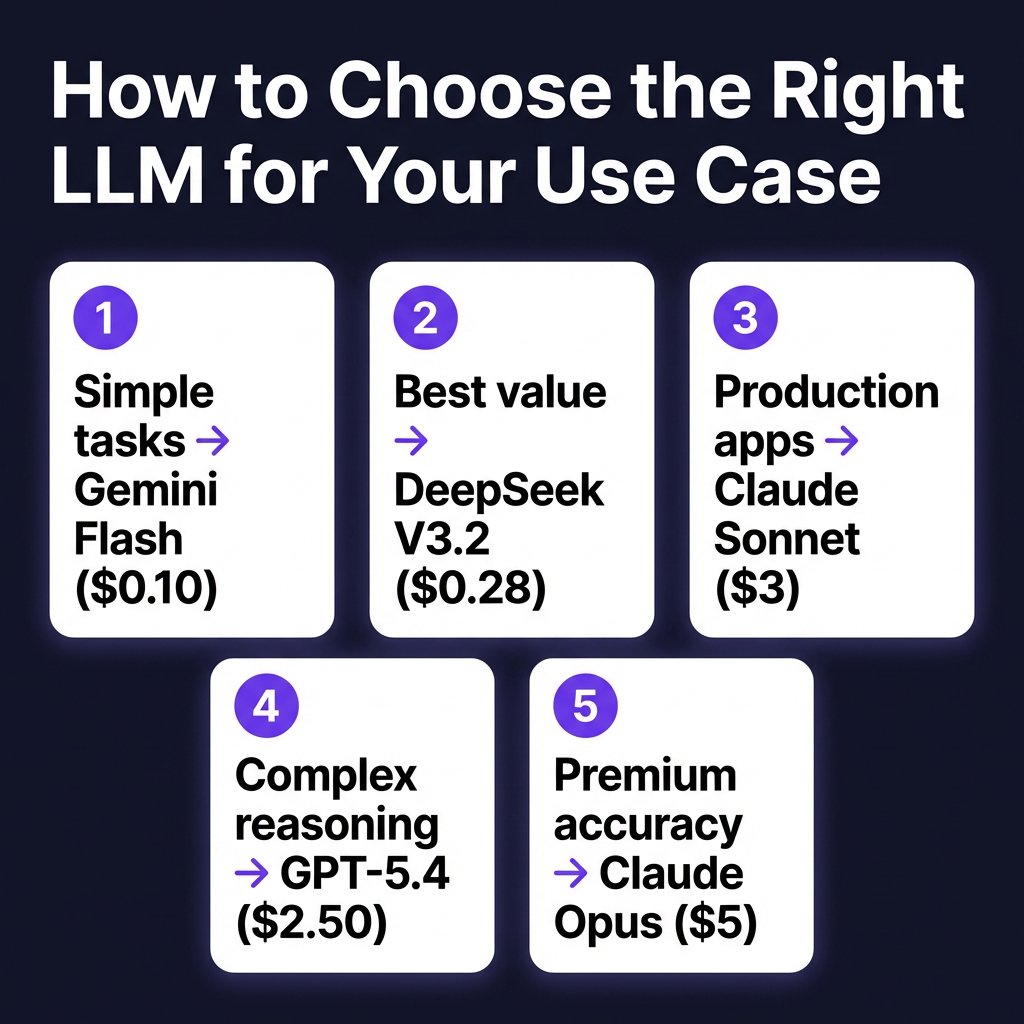
How to Choose the Right LLM API for Your Use Case
The right model depends on what you’re building, not what scores highest on benchmarks. Here’s my decision framework:
Simple Tasks: Classification, Routing, Extraction
Use Gemini 2.5 Flash-Lite at $0.10/$0.40 per million tokens. It’s hard to beat for basic NLP tasks. If you’re already in the OpenAI ecosystem, GPT-5 Nano at $0.05/$0.40 is equivalent.
Best Value for Production Workloads
DeepSeek V3.2 at $0.28/$0.42 delivers 90% of flagship performance at 10% of the cost. The 90% cache discount makes it even cheaper for repeated-context workloads. This is my default recommendation for new projects.
Complex Applications Requiring Reliability
Claude Sonnet 4.6 at $3/$15 follows nuanced instructions more faithfully than competitors. If your app requires multi-step reasoning with constraints, the extra cost pays for itself in reduced error handling.
Maximum Accuracy for Critical Tasks
Reserve Claude Opus 4.6 ($5/$25) or GPT-5.2 Pro ($21/$168) for tasks where accuracy directly impacts revenue or safety. The 1M context window on Opus 4.6 makes it ideal for long-document analysis.
Cost Optimization Strategies That Actually Work
Smart developers don’t just pick the cheapest model — they optimize how they use it. Here are proven strategies to cut your LLM API costs by 50-90%:
1. Use Caching Aggressively
Cached input tokens cost roughly 10% of standard input price across providers. For workloads with repeated context (like customer support bots), caching can cut costs by 90%.
2. Batch Non-Real-Time Workloads
OpenAI’s Batch API gives 50% off all models for async workloads processed within 24 hours. Stacking batch + caching can cut costs by 90%+ compared to synchronous, uncached calls.
3. Route by Complexity
Run 80-95% of calls on a cheaper model (Mini/Flash tier), and escalate only the hard cases. A simple classifier can route requests to the appropriate model tier.
4. Start Free, Then Optimize
Google Gemini’s free tier and local models like Llama 4 cost nothing for prototyping. Start here, measure actual usage patterns, then optimize for production.
Key Takeaways: LLM API Pricing in 2026
- The gap between cheapest and most expensive models exceeds 1,000x — choosing wrong is expensive
- DeepSeek V3.2 offers the best value at $0.28/$0.42 per million tokens
- Gemini 2.5 Flash-Lite is the cheapest production option at $0.10/$0.40
- GPT-5.4 hits the sweet spot for most applications at $2.50/$10
- Caching and batching can reduce costs by 90% on any provider
- Route requests by complexity — use cheap models for simple tasks, premium only when necessary
Frequently Asked Questions
What is the cheapest LLM API in 2026?
Gemini 2.5 Flash-Lite at $0.10 per million input tokens and $0.40 per million output tokens is the cheapest actively supported model from a major provider. GPT-5 Nano from OpenAI is slightly cheaper on input at $0.05 but has the same output pricing.
Which LLM API offers the best value for money?
DeepSeek V3.2 offers the best value at $0.28/$0.42 per million tokens. It delivers surprisingly capable performance for a fraction of flagship pricing, with 90% cache discounts making repeated-context workloads almost free.
Is Claude more expensive than GPT?
Claude Sonnet 4.6 ($3/$15) is comparable to GPT-5.4 ($2.50/$10). Claude Opus 4.6 ($5/$25) is cheaper than GPT-5.2 Pro ($21/$168) but more expensive than GPT-5.2 ($1.75/$14). Anthropic dropped Opus pricing by 67% in early 2026 to remain competitive.
How can I reduce my LLM API costs?
Use caching (reduces input costs by 90%), batch non-real-time workloads (50% discount), route requests by complexity (use cheaper models for simple tasks), and choose the right model tier for your use case. Combining these strategies can cut costs by 90%+.
What is the best LLM API for coding in 2026?
GPT-5.2 ($1.75/$14) and Claude Sonnet 4.6 ($3/$15) are both excellent for coding. GPT-5.2 is faster and cheaper, while Claude Sonnet follows complex instructions more reliably. Many developers use both — GPT-5.2 for everyday coding and Claude for complex refactoring.
Conclusion: Make Data-Driven LLM Choices
The LLM API pricing landscape in 2026 offers unprecedented choice — and unprecedented risk of overspending. The difference between Gemini Flash-Lite and GPT-5.2 Pro is 1,000x in cost for the same request. That makes model selection a critical business decision, not just a technical one.
Start with the cheapest model that might work. Measure actual performance on your specific tasks. Optimize with caching and batching. Only upgrade to premium tiers when you have data showing the extra cost delivers measurable value.
Building AI-powered applications? You’ll need a payment solution that handles global transactions as smoothly as these LLMs handle text generation. Get started with Fungies.io — the Merchant of Record platform that handles payments, tax compliance, and checkout for SaaS and digital products worldwide.
References
- OpenAI API Pricing — Official pricing for GPT-5 family and o-series models
- Anthropic Claude Pricing — Claude Opus 4.6, Sonnet 4.6, and Haiku pricing
- Google Gemini API Pricing — Gemini 2.5 Flash and Pro pricing tiers
- DeepSeek API Pricing — DeepSeek V3.2 pricing and cache discounts
- TLDL LLM Pricing Guide — Comprehensive pricing comparison and analysis
\n