Here’s a stat that should wake you up: 62% of developers working on agentic workflows in 2026 chose their framework based on production control needs, not hype. Yet most teams still pick frameworks based on GitHub stars alone.
I’ve spent the last three months testing AI agent frameworks across real production scenarios. The difference between a framework that ships and one that stalls isn’t features—it’s how well it matches your team’s workflow, infrastructure, and long-term maintenance capacity.
This guide ranks the 8 best AI agent frameworks for developers in 2026 based on production deployments, GitHub activity, enterprise adoption, and actual developer feedback. No fluff. Just frameworks that work.
What Makes an AI Agent Framework “Production-Ready” in 2026?
Before diving into the rankings, let’s establish what separates toy frameworks from production tools:
- State Management: Can it handle long-running workflows without losing context?
- Observability: Can you debug what your agents are doing in production?
- Human-in-the-Loop: Can you pause and intervene when needed?
- MCP Support: Does it work with the emerging Model Context Protocol standard?
- Cost Predictability: Can you estimate and control LLM token costs?
These aren’t nice-to-haves. They’re the difference between a demo that impresses stakeholders and a system that runs for months without surprises.
The 8 Best AI Agent Frameworks Ranked
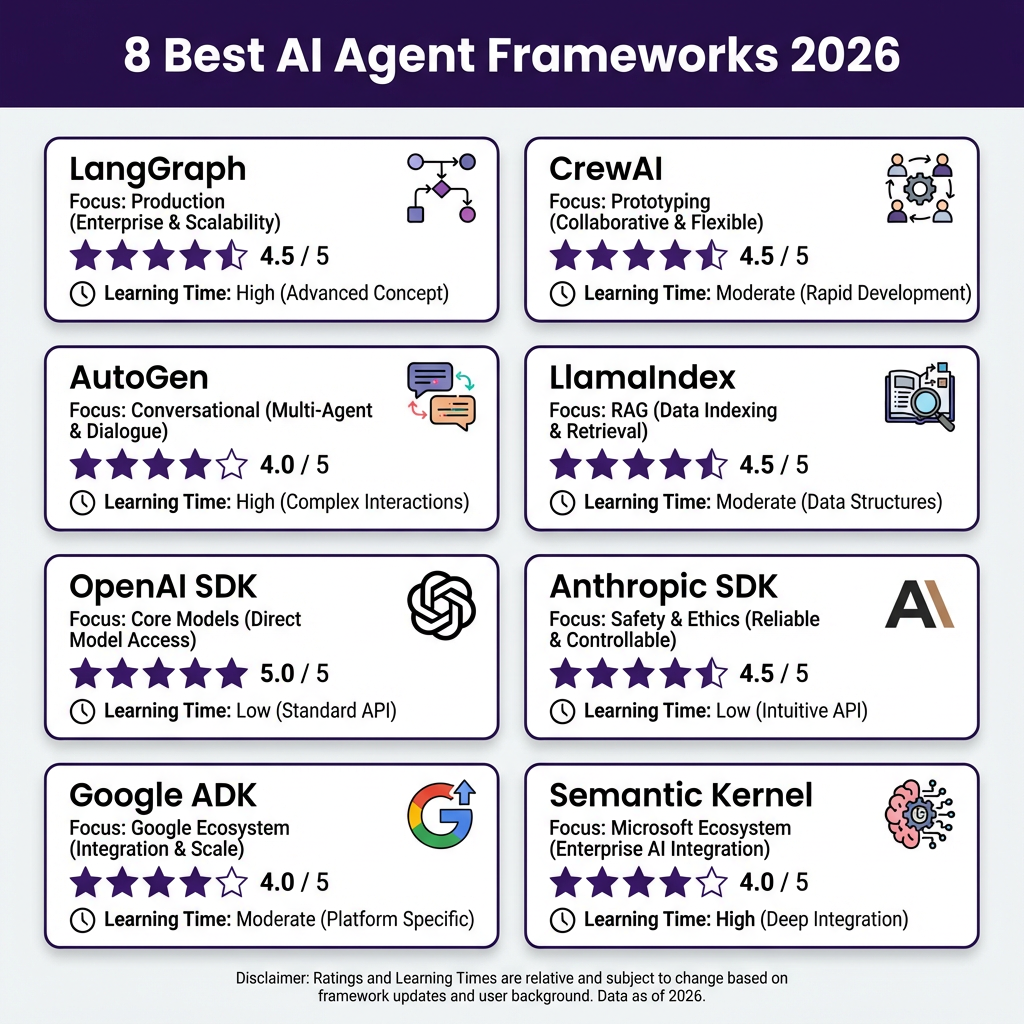
1. LangGraph — Best for Production Control
GitHub Stars: 15,000+ | Language: Python | License: MIT
LangGraph is the framework most likely to still be working correctly when your system hits real users, real edge cases, and real compliance reviews. It models complex workflows as directed cyclic graphs—giving you explicit control over every state transition.
Key Strengths:
- Native MCP support with built-in tool filtering
- Production-ready safety guardrails
- Support for 100+ LLMs
- Deployments at Klarna, Cisco, and Vizient
- Fine-grained control over loops, branching, and state persistence
When to Use: Complex multi-agent pipelines, customer support workflows with escalation paths, any system requiring fault tolerance and audit trails.
Learning Curve: 7-14 days (requires graph-based programming skills)
2. CrewAI — Best for Rapid Prototyping
GitHub Stars: 28,000+ | Language: Python | License: MIT
CrewAI gets multi-agent workflows running in under an hour with ~20 lines of code. It uses a role-based architecture where you define “crews” of specialized agents that collaborate on tasks.
Key Strengths:
- Fastest time-to-first-agent (1-2 days for junior developers)
- Intuitive role-based agent design
- Built-in task delegation and handoffs
- Strong community and documentation
- Native MCP support (added in 2026)
When to Use: Content pipelines, research automation, business workflows with clear handoffs between specialists.
Trade-off: Less control over execution flow compared to LangGraph. You’ll hit walls when workflows need complex conditional logic.
3. AutoGen — Best for Conversational Multi-Agent Systems
GitHub Stars: 42,000+ | Language: Python | License: MIT
Microsoft’s AutoGen pioneered conversational multi-agent patterns. Agents talk to each other to solve tasks—making it ideal for scenarios requiring debate, consensus-building, or collaborative problem-solving.
Key Strengths:
- Flexible agent communication patterns
- Excellent for prototyping novel agent behaviors
- Strong Microsoft ecosystem integration
- Human-in-the-loop support
When to Use: Group decision-making systems, research teams, scenarios requiring agent debate and consensus.
Caution: AutoGen 2.0 has higher cost risk due to unbounded conversation loops. Production deployments require custom infrastructure development.
4. LlamaIndex — Best for RAG-Powered Agents
GitHub Stars: 40,000+ | Language: Python | License: MIT
LlamaIndex started as a data framework for LLMs but has evolved into a capable agent platform. Its core strength is connecting agents to structured data sources—databases, APIs, and document stores.
Key Strengths:
- Best-in-class data ingestion and indexing
- Excellent documentation and community
- Strong observability tools
- Works seamlessly with LangGraph for complex workflows
When to Use: Knowledge-heavy applications, enterprise search, agents that need to query structured data.
Limitation: Agent features are less mature than core RAG capabilities. Can be complex for simple use cases.
5. OpenAI Agents SDK — Best for OpenAI Ecosystem
Released: March 2026 | Language: Python | License: Apache 2.0
OpenAI’s official SDK is a lightweight framework for building agents that plan, use tools, and execute multi-step tasks. It offers tight integration with OpenAI models but limited flexibility for other providers.
Key Strengths:
- Native integration with GPT-5, o3, and future OpenAI models
- Built-in tracing and observability
- Simple API for tool calling and multi-step execution
- Fast adoption speed (2-3 days)
When to Use: Teams already committed to OpenAI models, rapid prototyping, applications where model flexibility isn’t required.
Trade-off: Vendor lock-in. The SDK is optimized for OpenAI models—switching providers requires significant refactoring.
6. Anthropic Agent SDK — Best for Claude Workflows
Released: 2025 | Language: Python | License: MIT
Anthropic’s SDK focuses on building reliable agents with Claude models. It emphasizes safety, steerability, and long-context handling—Claude’s core strengths.
Key Strengths:
- Optimized for Claude’s 200K+ context window
- Strong reasoning and instruction-following
- Built-in computer use capabilities
- Low cost risk (predictable token usage)
When to Use: Complex reasoning tasks, long-document processing, applications requiring high reliability.
Note: Anthropic is also behind MCP (Model Context Protocol), making this SDK a natural choice for teams adopting the emerging standard.
7. Google ADK (Agent Development Kit) — Best for Google Cloud
Released: 2026 | Language: Python | License: Apache 2.0
Google’s ADK is designed for building agents that integrate with Google Cloud services, Vertex AI, and Gemini models. It’s the clear choice for teams already in the Google ecosystem.
Key Strengths:
- Native Gemini model integration
- Seamless Google Cloud deployment
- Built-in monitoring via Cloud Monitoring
- Support for multi-modal agents
When to Use: Google Cloud deployments, multi-modal applications, teams using BigQuery or Firebase.
Learning Curve: 3-5 days (moderate complexity)
8. Microsoft Semantic Kernel — Best for Enterprise .NET
GitHub Stars: 24,000+ | Languages: Python, C#, Java | License: MIT
Semantic Kernel is Microsoft’s enterprise-focused framework with strong Azure integration and multi-language support. It’s the go-to choice for .NET shops and Microsoft-centric organizations.
Key Strengths:
- Multi-language support (Python, C#, Java)
- Native Azure AI and OpenAI integration
- Planners for complex goal-oriented tasks
- Enterprise-grade security and compliance
When to Use: Enterprise .NET applications, Azure deployments, teams requiring multi-language support.
Limitation: More verbose than Python-native frameworks. The C# implementation is more mature than Python.

Complete Framework Comparison Table
| Framework | Best For | Learning Curve | Production Ready | MCP Support | Cost Risk |
|---|---|---|---|---|---|
| LangGraph | Complex workflows | 7-14 days | ⭐⭐⭐⭐⭐ | ✅ Native | Low |
| CrewAI | Rapid prototyping | 1-2 days | ⭐⭐⭐ | ✅ Native | Medium |
| AutoGen | Conversational agents | 3-5 days | ⭐⭐⭐⭐ | ⚠️ Partial | High |
| LlamaIndex | RAG + data agents | 5-7 days | ⭐⭐⭐⭐ | ✅ Yes | Low |
| OpenAI Agents SDK | OpenAI ecosystem | 2-3 days | ⭐⭐⭐ | ⚠️ Limited | Medium |
| Anthropic Agent SDK | Claude workflows | 3-5 days | ⭐⭐⭐⭐ | ✅ Native | Low |
| Google ADK | Google Cloud | 3-5 days | ⭐⭐⭐ | ⚠️ Partial | Medium |
| Semantic Kernel | Enterprise .NET | 5-7 days | ⭐⭐⭐⭐ | ✅ Yes | Low |
How to Choose the Right Framework
Here’s the decision tree I use with teams:
Step 1: Define Your Constraints
- Timeline: Need something working this week? → CrewAI or OpenAI SDK
- Complexity: Multi-step workflows with loops? → LangGraph
- Data: Heavy RAG requirements? → LlamaIndex
- Ecosystem: Locked into a cloud provider? → Their native SDK
Step 2: Evaluate Team Fit
- Python team: Any framework works
- .NET team: Semantic Kernel
- Junior developers: CrewAI, OpenAI SDK
- Senior engineers: LangGraph, AutoGen
Step 3: Plan for Production
Ask these questions before committing:
- How will we debug agent failures in production?
- What’s our strategy for handling rate limits?
- Can we swap LLM providers if costs change?
- How do we version and test agent behavior?
Frameworks with strong observability (LangGraph, LlamaIndex, Anthropic SDK) make these questions easier to answer.
Emerging Trend: The MCP Standard
In 2026, the Model Context Protocol (MCP) is becoming the “USB-C of AI agents”—a universal standard for connecting agents to tools. Anthropic open-sourced MCP and donated it to the Linux Foundation. Native MCP support has shipped in CrewAI, Vercel AI SDK, Mastra, and Microsoft Agent Framework within the last six months.
Why this matters: MCP decouples your agent framework from your tool ecosystem. You can swap frameworks without rewriting tool integrations. This reduces vendor lock-in and future-proofs your architecture.
Frameworks without MCP support (or with limited support) are increasingly risky bets.
Key Takeaways
- LangGraph wins for production control and complex workflows—accept the learning curve
- CrewAI is unbeatable for rapid prototyping and role-based agent teams
- AutoGen excels at conversational multi-agent scenarios but requires careful cost management
- LlamaIndex is the data layer you need for knowledge-heavy applications
- Cloud SDKs (OpenAI, Anthropic, Google, Microsoft) make sense when you’re already committed to their ecosystems
- MCP support is becoming table stakes for framework selection
FAQ
Which AI agent framework is easiest to learn?
CrewAI has the gentlest learning curve—most developers get their first multi-agent workflow running in 1-2 days. The role-based abstraction is intuitive and requires minimal boilerplate.
Can I combine multiple frameworks?
Yes. A common pattern is using CrewAI for high-level process orchestration while calling LangGraph agents for specific tasks needing complex state management. LlamaIndex also integrates well with LangGraph for RAG-heavy workflows.
What’s the best framework for startups?
Start with CrewAI for speed. If you hit complexity walls, migrate to LangGraph. The skills transfer—both use Python and have similar agent concepts.
Are these frameworks free?
All frameworks listed are open-source (MIT or Apache 2.0). Your costs come from LLM API usage—not the frameworks themselves. LangGraph and CrewAI offer paid cloud platforms for managed deployments, but the core frameworks are free.
Which framework has the best community?
LlamaIndex and CrewAI have the most active communities for getting help. LangGraph has strong enterprise adoption but a steeper learning curve. AutoGen benefits from Microsoft’s backing and documentation investment.
Conclusion
The “best” AI agent framework depends on your timeline, team skills, and production requirements. There’s no one-size-fits-all answer.
My recommendation: Start with CrewAI if you need to ship fast. Move to LangGraph when you need production control. Use LlamaIndex when data is central to your agent’s value. And always check for MCP support—it’s the difference between a framework that integrates and one that isolates.
The frameworks that will dominate in 2027 aren’t just the ones with the best features today—they’re the ones building toward standards, observability, and ecosystem interoperability. Choose accordingly.
Ready to build AI-powered features for your SaaS? Get started with Fungies.io—the Merchant of Record platform that handles payments, tax compliance, and checkout so you can focus on shipping AI features.
References
- OpenAgents: CrewAI vs LangGraph vs AutoGen Comparison (2026)
- AutoGen vs CrewAI vs LangGraph 2026 Comparison Guide
- Top AI Agent Frameworks in 2026: A Production-Ready Comparison
- Turing: Detailed Comparison of Top 6 AI Agent Frameworks
- AI Agent Frameworks 2026: OpenAI Agents SDK vs Anthropic MCP
- Chanl: AI Agent Frameworks Compared—Which Ones Ship?
- Benchmarking AI Agent Frameworks: Performance Analysis
- NxCode: CrewAI vs LangChain 2026 Comparison