Here’s a number that might shock you: a SaaS company doing $1M in annual revenue could pay anywhere from $50,000 to $100,000+ in payment processing and compliance fees depending on which merchant of record they choose. That’s a difference of an entire employee’s salary just from picking the wrong pricing structure.
I’ve spent years analyzing payment infrastructure for digital businesses, and the truth is most founders don’t fully understand what they’re actually paying for when they sign up with a merchant of record. The headline rate is rarely the full story.

What Is a Merchant of Record, Really?
A merchant of record (MoR) is the legal entity that sells your product to the end customer. Their name appears on credit card statements. They handle the money. And most importantly, they take on the legal liability for every transaction.
This isn’t just payment processing. When you use Stripe or PayPal, you’re the merchant of record. That means you’re responsible for sales tax collection, VAT compliance, fraud prevention, chargebacks, and regulatory requirements in every country where you sell.
An MoR flips this model. They become the seller. They handle tax registration in 100+ countries. They manage disputes. They deal with the accounting complexity of global commerce. You get a simplified payout minus their fee.
The trade-off? You pay a percentage of every sale, typically between 5% and 10%, compared to the 2.9% + $0.30 you might pay with a basic payment processor.
Breaking Down Merchant of Record Pricing Models
Not all MoR pricing is created equal. Here’s what you need to understand before comparing providers.
The All-Inclusive Percentage Model
This is the most common structure. You pay a flat percentage of each transaction, and everything is included: payment processing, tax compliance, fraud protection, and platform features.
Example: Paddle charges 5% + $0.50 per transaction. On a $100 sale, you pay $5.50 in fees and receive $94.50. No monthly costs. No separate tax software subscriptions. No chargeback fees.
The Tiered + International Surcharge Model
Some providers advertise a low base rate but add fees for international transactions. This is where costs can surprise you.
Example: Lemon Squeezy charges 5% + $0.50 base, but adds 1.5% for international payments. If 40% of your customers are outside your home country (common for SaaS), your effective rate becomes closer to 5.6% + $0.50.
The Volume-Based Negotiated Model
Enterprise-focused MoRs like FastSpring don’t publish fixed rates. They negotiate based on your transaction volume, business model, and risk profile.
Typical ranges fall between 5% and 8% for established businesses, with potential monthly platform fees for high-touch support or custom integrations. You’ll need to request a quote, which makes quick comparisons difficult.
True Cost Comparison: 5 Major MoR Providers in 2026
Let’s look at what you’ll actually pay with each major provider. These numbers assume a $50 average transaction value with a mix of domestic (60%) and international (40%) customers.
| Provider | Base Fee | International | Monthly Cost | Effective Rate* |
|---|---|---|---|---|
| Paddle | 5% + $0.50 | Included | $0 | 6.0% |
| Lemon Squeezy | 5% + $0.50 | +1.5% | $0 | 6.6% |
| FastSpring | 5-8% (custom) | Included | Possible | 6.5-9.0% |
| Gumroad | 10% + $0.50 | Included | $0 | 11.0% |
| Fungies | 5% + $0.50 | Included | $0 | 6.0% |
On a $50 transaction, that difference between 6% and 11% means $2.50 less per sale. Scale that to 1,000 transactions per month, and you’re looking at $2,500 monthly — or $30,000 annually — just from choosing the right provider.
Hidden Costs Most Founders Miss
The headline rate is just the beginning. Here are the fees that catch businesses off guard.
Payout Fees
Some MoRs charge to send you your own money. Lemon Squeezy charges 1% for payouts to non-US bank accounts and $0.50 per US payout. If you’re receiving weekly payouts, that’s $26-$52 annually just in transfer fees before you factor in the percentage.
Currency Conversion Margins
When your customer pays in euros but you want dollars, someone takes a cut on the exchange. Most MoRs don’t disclose this margin, but it typically ranges from 1-3% above the interbank rate. On a €1,000 sale, that could be €10-€30 in hidden costs.
Chargeback and Dispute Fees
Here’s where MoRs differ significantly. Paddle includes chargeback handling in their base fee. Some providers pass through chargeback fees ($15-25 per dispute) or charge additional percentages for high-risk transactions.
If you sell software to international customers, expect 0.5-1% chargeback rates. On $100K monthly volume, that’s $500-$1,000 in potential dispute costs that may or may not be covered.
Platform Lock-In Costs
This is the one nobody talks about. Moving your subscription business from one MoR to another is painful. You can’t migrate active subscriptions easily. Customers often need to re-enter payment details. You might lose 10-20% of your MRR during a platform switch.
So that “savings” from switching providers needs to be substantial enough to justify the migration risk and customer friction.
When Does an MoR Make Financial Sense?
Not every business needs a merchant of record. Here’s my framework for deciding.
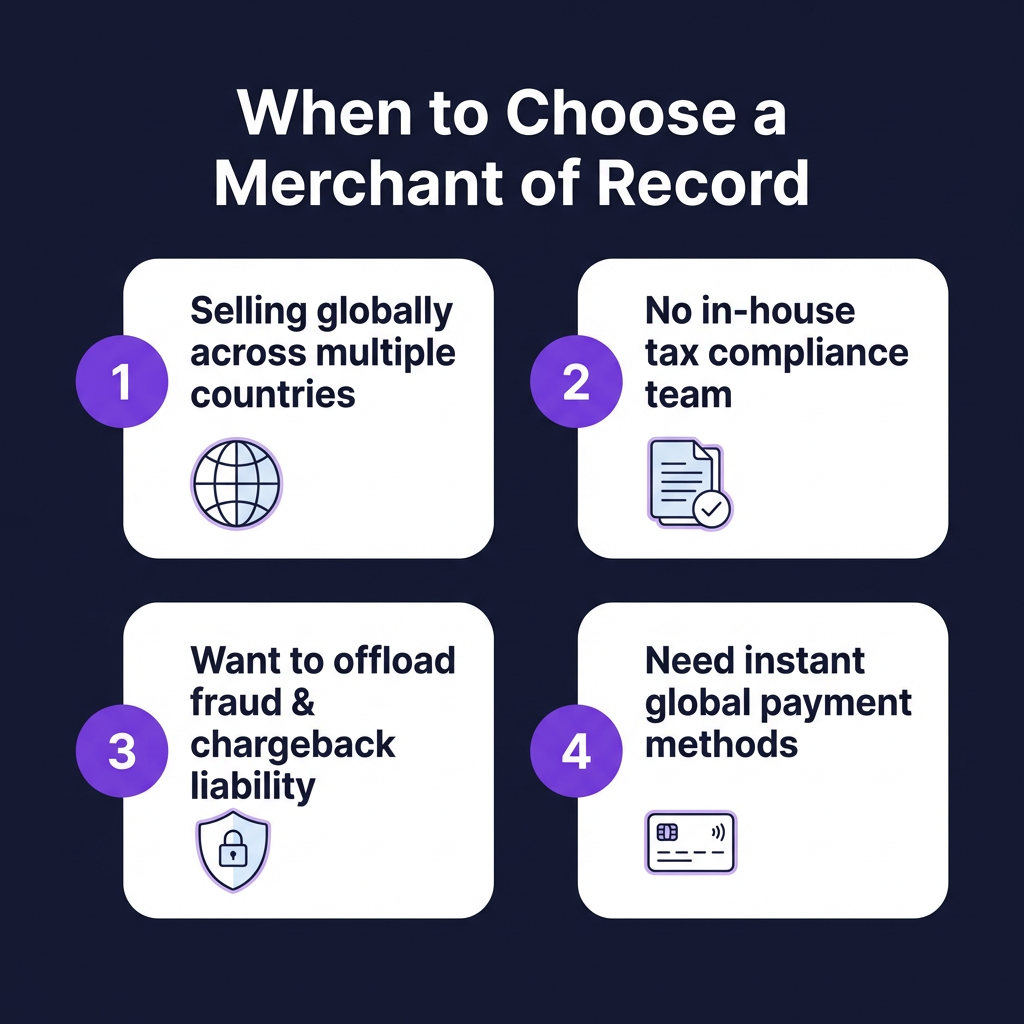
Choose an MoR When:
- You sell to multiple countries. If more than 20% of revenue comes from outside your home country, the tax compliance savings alone justify the higher transaction fees.
- You don’t have a finance/tax team. Hiring a tax specialist costs $60K-$100K annually. An MoR replaces that headcount.
- You’re pre-Series A. Early-stage companies should focus on product-market fit, not tax registration in the EU.
- You sell high-risk digital products. Software, SaaS, and digital goods have higher fraud rates. MoRs have better fraud prevention than basic processors.
Skip the MoR When:
- You only sell domestically. If 95% of customers are in one country, you can handle tax compliance yourself for cheaper.
- You have high transaction values. On $500+ average orders, that 5-6% fee hurts more than Stripe’s 2.9% + $0.30.
- You need deep payment customization. MoRs control the checkout experience. If you need custom flows, you might feel constrained.
- You already have tax infrastructure. If you’ve already registered for VAT and have compliance processes, adding an MoR is redundant.
Calculating Your True Break-Even Point
Let’s run the numbers on a realistic SaaS scenario.
Scenario: $30/month subscription, 500 customers, 35% international, $15K MRR
| Cost Category | Stripe + TaxJar | Merchant of Record |
|---|---|---|
| Payment processing | $435/mo (2.9% + $0.30) | Included |
| Tax compliance software | $200/mo (TaxJar) | Included |
| Tax registration/filing | $500/mo (accountant) | Included |
| Fraud prevention | $150/mo (Radar) | Included |
| MoR fee (5.5% effective) | N/A | $825/mo |
| Total monthly cost | $1,285 | $825 |
In this scenario, the MoR saves $460 monthly ($5,520 annually) while eliminating compliance headaches. The break-even point typically falls around $8K-$12K MRR for SaaS businesses with international customers.
Red Flags in MoR Pricing Pages
After reviewing dozens of providers, here are warning signs that a pricing structure might cost more than advertised:
- “Contact us for pricing” without rate ranges. This usually means enterprise-level minimums or variable rates that favor the provider.
- International fees buried in documentation. If you have to dig through help articles to find international pricing, expect surprises.
- Separate fees for “platform” vs “processing.” Some providers split their fees to appear cheaper than competitors.
- Monthly minimums or setup fees. These are rare in modern MoRs but still exist in legacy providers.
- No mention of payout schedules or fees. Weekly payouts with per-transfer fees add up fast.
Negotiating Better MoR Rates
Most founders don’t realize MoR rates are negotiable. Here’s how to get better pricing:
Leverage Your Growth Trajectory
If you’re growing 20%+ month-over-month, mention it. MoRs want successful customers who will scale. A provider might offer 4.5% instead of 5% if they believe you’ll 10x your volume in two years.
Compare Competing Quotes
Get quotes from three providers. Use Paddle’s published 5% + $0.50 as a baseline. If FastSpring quotes 7%, ask why they’re 40% more expensive for the same service.
Commit to Volume Minimums
Some providers offer tiered pricing: 5.5% under $50K/month, 5.0% over $50K, 4.5% over $100K. If you’re confident in your projections, commit to a minimum volume for a better rate.
Ask About Startup Programs
Many MoRs have startup-friendly pricing for YC companies, Techstars alumni, or businesses under $10K MRR. These programs often waive fees for the first $10K in processed volume.
The Future of MoR Pricing: Trends for 2026
The merchant of record landscape is evolving rapidly. Here’s what I’m watching:
Stripe’s Entry as an MoR
Stripe now offers “Stripe Managed Payments” which includes tax compliance in select markets. This blurs the line between payment processor and MoR. Expect competitive pressure to drive down MoR fees industry-wide.
Regional MoRs Gaining Ground
Specialized providers focused on specific regions (EU, APAC) often offer better local payment methods and lower fees for businesses concentrated in those markets. If 80% of your customers are in Europe, a EU-focused MoR might beat global providers on both cost and conversion rates.
Usage-Based Billing Complexity
As more SaaS companies adopt usage-based pricing, MoRs are adapting their fee structures. Some now offer lower percentages on metered billing transactions since they’re often higher value and lower risk than subscription signups.
FAQ: Merchant of Record Pricing
Is a 5% MoR fee too expensive compared to Stripe’s 2.9%?
Not when you factor in everything included. Stripe’s 2.9% + $0.30 is just payment processing. Add TaxJar ($200+/mo), a tax accountant ($500+/mo), fraud prevention ($100+/mo), and your time managing compliance. For most international SaaS businesses, the all-in MoR fee is actually cheaper.
Can I negotiate merchant of record fees?
Yes, especially if you’re processing $30K+ monthly or growing quickly. Get quotes from multiple providers and use them as leverage. Volume commitments and annual prepayments can also unlock better rates.
What’s the cheapest merchant of record for small transactions?
For transactions under $10, the fixed $0.50 component matters more than the percentage. A $5 sale with 5% + $0.50 means $0.75 in fees (15% effective). At this price point, Gumroad’s 10% flat fee might actually be cheaper, though you lose the tax compliance benefits.
Do MoRs charge extra for refunds?
Most modern MoRs don’t charge extra for processing refunds, but you don’t get back the original transaction fee either. If you refund a $100 sale that incurred a $5.50 fee, you’re out the $5.50. Some legacy providers charge additional refund processing fees—avoid these.
How do I calculate my true effective rate?
Add up: (1) published transaction fees, (2) international surcharges weighted by your customer mix, (3) payout fees, (4) any monthly platform fees divided by your transaction volume. Divide total fees by total revenue processed to get your true effective percentage.
Final Thoughts: Making the Right Choice
Merchant of record pricing isn’t just about finding the lowest percentage. It’s about understanding the total cost of accepting payments globally, including the time and risk you’re offloading.
For most SaaS companies under $1M ARR with international customers, an MoR at 5-6% all-in is almost always cheaper than the DIY alternative once you factor in tax compliance, fraud prevention, and your own time.
The key is running the numbers for your specific situation. Don’t just compare headline rates. Model your actual transaction volume, international mix, and compliance costs. Then negotiate from a position of knowledge.
If you’re ready to simplify your global payments and tax compliance, get started with Fungies—5% + $0.50 per transaction with no hidden international fees, no monthly costs, and full tax compliance included.
Sources and References
- Paddle Pricing — Official pricing page
- Lemon Squeezy Fees — Platform and payout fee documentation
- FastSpring Pricing — Enterprise MoR pricing model
- Gumroad Pricing — 10% flat fee structure
- Stripe Tax Pricing — 0.5% per transaction for tax calculation
- TaxJar: What is a Merchant of Record — Tax compliance context
- Nexway MoR Guide — Global sales compliance overview