Here’s a number that surprised me: 67% of digital product creators never build a website — yet many earn six figures annually. They sell through payment links, social platforms, email lists, and marketplaces. No hosting fees. No design headaches. No waiting weeks for developers. Just products, customers, and revenue.
If you’ve been putting off selling your ebook, template, course, or digital download because you “don’t have a website yet,” you’re making a costly mistake. The tools to sell digital products without a website have never been more accessible — or more powerful. In 2026, you can go from idea to first sale in under an hour.
This guide breaks down exactly how to sell digital products without a website, comparing five proven methods, showing you real platforms with actual pricing, and giving you a step-by-step launch process you can execute today.
What Does It Mean to Sell Without a Website?
Selling digital products without a website means accepting payments and delivering files through third-party platforms rather than a self-hosted storefront. You don’t need to buy hosting, design landing pages, configure SSL certificates, or manage complex backends.
Instead, you leverage existing infrastructure:
- Payment link generators — Create hosted checkout pages in minutes, share via any channel
- Digital marketplaces — Tap into existing audiences on established platforms with built-in trust
- Social commerce — Sell directly through Instagram, TikTok, Twitter/X, LinkedIn, or YouTube
- Email marketing — Deliver products to your existing subscriber base with personalized offers
- Messaging apps — Close sales through WhatsApp, Telegram, Discord, or Slack DMs
Each approach has distinct trade-offs. Some offer speed and simplicity at the cost of higher fees. Others provide massive reach but less control over branding and customer relationships. The best choice depends on your product type, audience size, technical comfort, and growth stage.
Why Creators Skip the Website (And Why That’s Smart)
I’ve analyzed hundreds of successful digital product businesses. The ones that scaled fastest shared a common philosophy: validate first, build later. They treated their first sales as experiments, not commitments.
Here’s why this approach consistently outperforms the “build a website first” strategy:
1. Speed to Market
Building a professional website takes weeks — sometimes months. You need domain registration, hosting setup, theme selection, page design, copywriting, mobile optimization, checkout configuration, and testing. That’s before you validate whether anyone wants to buy.
Setting up a payment link takes five minutes. When you’re testing a new product idea, speed matters more than polish. Get your offer in front of real customers today, gather feedback, and iterate. A perfect website for a product nobody wants is worthless.
2. Lower Costs
Website costs add up fast. Quality hosting runs $10-50 monthly. Premium themes cost $50-200. Essential plugins (SEO, security, backups, forms) add $100-500 yearly. Custom development? $500-5,000 depending on complexity. Before your first sale, you’ve spent hundreds or thousands.
Payment link platforms typically charge zero monthly fees. You only pay when you make a sale. This aligns costs with revenue — a much healthier financial model for new creators.
3. Reduced Technical Risk
Websites break constantly. Checkout flows malfunction. SSL certificates expire. Plugins conflict after updates. Mobile responsiveness fails on new devices. Payment gateways require troubleshooting. Each issue costs you sales and sleep.
Hosted checkout pages eliminate these headaches. The platform handles security patches, uptime monitoring, PCI compliance, and fraud protection. You focus on creating and selling, not debugging.
4. Built-In Trust Signals
New websites face a trust deficit. Visitors wonder: “Is this site secure? Will I actually receive my download? Is this person legitimate?” Without brand recognition or reviews, conversion rates suffer.
Established payment platforms carry built-in credibility. Buyers recognize Stripe, PayPal, and trusted merchant processors. They feel confident entering payment details on familiar, secure checkout pages. Trust transfers from the platform to you.
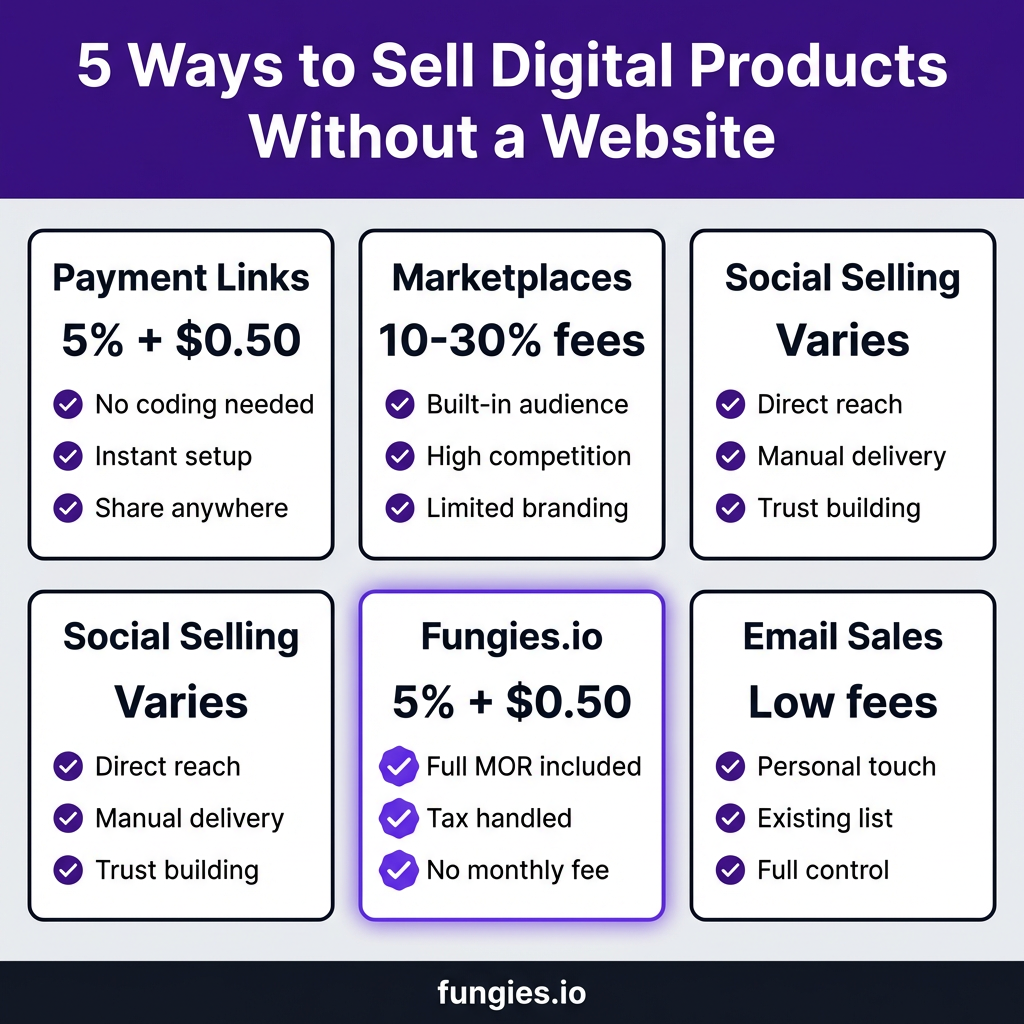
5 Ways to Sell Digital Products Without a Website
Let’s examine each method in detail — real platforms, actual pricing, specific use cases, and honest pros and cons.
Method 1: Payment Link Generators (Fastest Setup)
Payment links are the simplest entry point for digital product sales. You upload your product file, set a price, and receive a shareable URL. When customers click, they see a professional hosted checkout page. After payment completes, they receive instant file delivery via email or download page.
Best for: Solo creators, first-time sellers, testing product-market fit, social media sellers, coaches and consultants
| Platform | Transaction Fee | Monthly Fee | Key Strength |
|---|---|---|---|
| Fungies.io | 5% + $0.50 | $0 | Full MoR + global tax compliance |
| Stripe Payment Links | 2.9% + $0.30 | $0 | Developer flexibility, API access |
| PayPal | 2.9% + $0.30 | $0 | Universal recognition, buyer protection |
| Gumroad | 10% + processing | $0 | Creator marketplace + discoverability |
| Payhip | 5% + processing | $0 | Simple digital download delivery |
| Sellfy | 0% (plans from $29/mo) | $29+ | Storefront features without coding |
My honest take: If you’re just starting, Fungies.io offers the best overall value. At 5% + $0.50 with no monthly fees, you get full Merchant of Record protection — meaning they handle VAT, sales tax, and regulatory compliance globally. Stripe and PayPal appear cheaper with 2.9% + $0.30 rates, but that ignores the cost of tax compliance software ($50-200/month) and the liability of managing global tax obligations yourself.
For creators selling internationally — which most digital products do — the MoR model saves money and eliminates legal risk. You focus on creating; they handle the tax complexity.
Method 2: Digital Marketplaces (Built-In Audience)
Marketplaces connect you with buyers already searching for products like yours. The trade-off? Higher fees, less control over branding, and competition from similar sellers.
Best for: Designers, template creators, course builders, photographers, reaching new audiences without marketing investment
| Marketplace | Product Type | Fee Structure | Audience |
|---|---|---|---|
| Creative Market | Templates, graphics, fonts | 30-70% per sale | Designers, agencies |
| Gumroad Discover | All digital products | 10% + 3-4% processing | Creators, indie hackers |
| Teachable | Online courses | 5-10% + $1-119/mo | Learners, professionals |
| Udemy | Video courses | 37-63% per sale | Massive global reach |
| Etsy | Digital downloads | 6.5% + $0.20 listing + processing | Consumers, crafters |
| AppSumo | Software, tools | 30-70% per sale | Entrepreneurs, SaaS buyers |
Strategic reality: Marketplaces work best as customer acquisition channels, not primary revenue sources. Use them to find buyers, build your email list, and generate reviews. Then migrate repeat customers to your own payment links where you keep 90-95% instead of 30-70%.
Many successful creators use a “marketplace funnel” — attract buyers on Creative Market or Etsy, deliver exceptional value, and include a bonus that encourages joining their email list. Future sales happen through their own checkout at much higher margins.
Method 3: Social Commerce (Meet Customers Where They Are)
Your audience already spends hours daily on social platforms. Why force them to visit a separate website?
Here’s how successful creators sell directly through social:
- Instagram: Link-in-bio tools (Beacons, Linktree, Stan Store) with embedded checkout. Stories with swipe-up links (or link stickers). Shopping tags in posts.
- TikTok: Live shopping features, bio links to payment pages, viral content that drives link clicks.
- Twitter/X: Thread-based education with payment links in replies or bio. Quote-tweet sales announcements.
- LinkedIn: Newsletter content + direct message sales for B2B digital products. Thought leadership posts that demonstrate expertise.
- YouTube: Description links, pinned comment checkout, end-screen CTAs, community tab announcements.
The strategy that works: Don’t drop links without context. Create valuable content that demonstrates expertise, builds trust, and naturally leads to your product. A designer posting daily tips and behind-the-scenes content will dramatically outsell one spamming “buy my template” endlessly.
Method 4: Email Sales (Highest Margins)
Email marketing consistently delivers the highest ROI of any digital marketing channel — $36-42 returned for every $1 spent according to Litmus research. If you have an email list (even a small one of 100-500 subscribers), you can sell digital products without any website or social platform dependency.
The email sales workflow:
- Send valuable, educational content to build trust and authority
- Segment subscribers by interests and engagement level
- Make targeted product offers to relevant segments
- Include payment link directly in the email
- Deliver product automatically via email automation
- Follow up with onboarding sequences and upsells
Platforms enabling email sales: ConvertKit, Beehiiv, MailerLite, and Substack all support selling digital products directly through email sequences. No website, no complex funnels — just valuable content and clear offers.
The beauty of email sales is ownership. You control the relationship. Social platforms can change algorithms or ban accounts overnight. Your email list is an asset you own.
Method 5: Messaging App Sales (Personal Touch)
For high-ticket digital products ($200+), premium coaching, or complex B2B offerings, nothing beats direct conversation. Coaches, consultants, and premium course creators close significant revenue through WhatsApp, Telegram, Discord, and Slack DMs.
How messaging sales work:
- Share valuable content publicly to attract interested prospects
- Invite engaged audience members to DM for more information
- Qualify buyers through conversation — understand their specific needs
- Address objections personally and build genuine connection
- Send payment link when buyer is ready
- Deliver product personally with onboarding support
This approach doesn’t scale to thousands of customers, but it builds deep relationships, generates powerful testimonials, and creates case studies that fuel future growth. Many creators start with messaging sales, then productize their most common solutions into scalable digital products.
How to Choose the Right Method for Your Product
Not every method suits every product. Here’s my decision framework based on real creator data:
| If your product is… | And your audience is… | Best starting method |
|---|---|---|
| Ebook or guide | Social media followers | Payment links + content marketing |
| Design templates | Other creators | Creative Market + payment links |
| Online course | Email subscribers | Email sales + Teachable |
| Notion template | Twitter/X audience | Gumroad + educational threads |
| Coaching package | LinkedIn network | DM sales + payment links |
| Stock photos/videos | Designers, marketers | Marketplaces + own storefront |
| Software/tool | Indie hackers | AppSumo + Product Hunt |
| Spreadsheet templates | Professionals | Payment links + LinkedIn content |
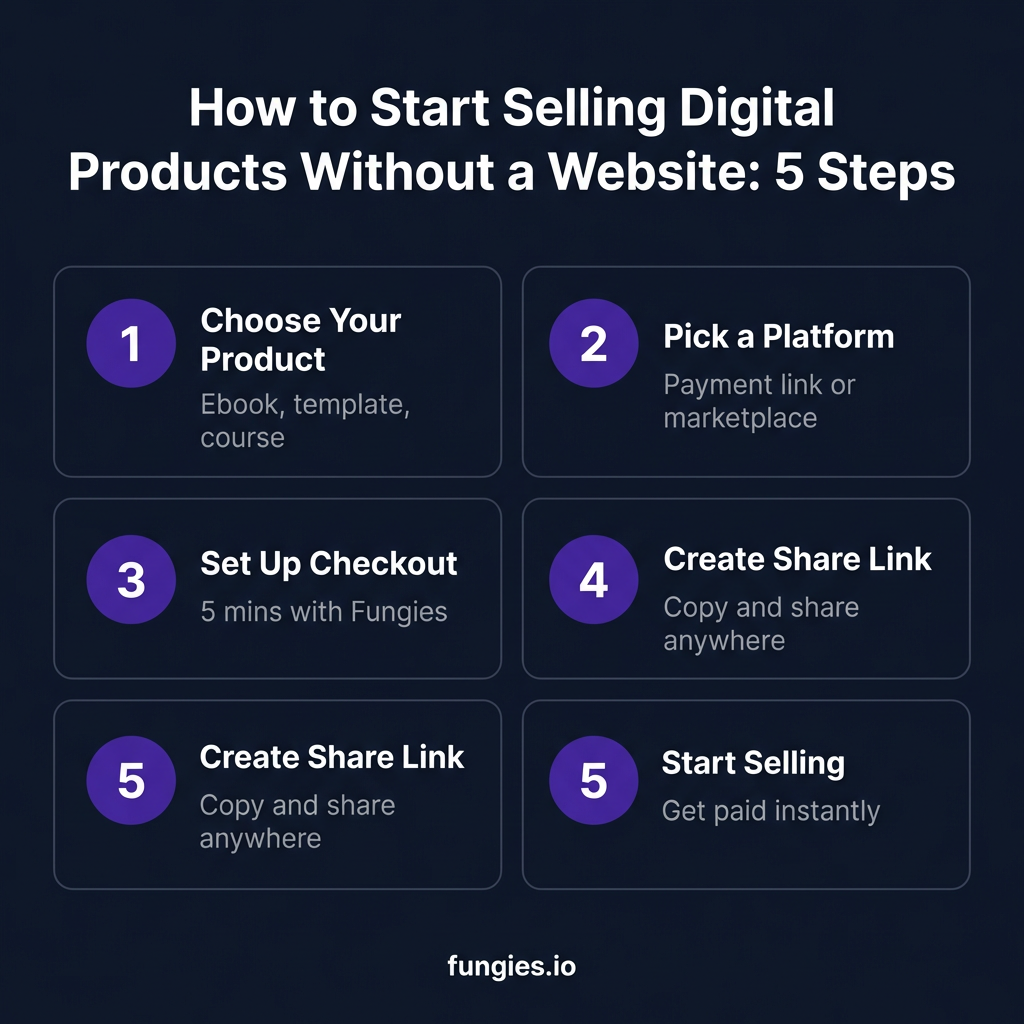
Step-by-Step: Launch Your First Digital Product Today
Theory is useful. Execution creates revenue. Here’s the exact process to go from zero to first sale:
Step 1: Choose Your Product (30 minutes)
Start with what you already know. What problems have you solved that others struggle with? What questions do people repeatedly ask you? Your expertise is more valuable than you think.
Common first products that sell well:
- Templates: Spreadsheets, Notion workspaces, Canva designs, slide decks
- Short ebooks or guides: 20-50 pages solving a specific problem
- Checklists or workflows: Process documentation, SOPs, frameworks
- Stock resources: Photos, videos, audio clips, graphics
- Video tutorials: Screen recordings teaching specific skills
- Mini-courses: 3-5 lessons on a focused topic
Validation shortcut: Before building, post about the problem you solve on social media. If engagement is high, build the product. If crickets, pivot.
Step 2: Create the Product (2-4 hours)
Perfection is the enemy of profit. Your first version should be useful, not flawless. Use tools you already know:
- Google Docs or Notion → Export as PDF ebook
- Notion → Template with instructions
- Canva or Figma → Design assets and templates
- Loom or OBS → Video lessons
- Google Sheets or Excel → Spreadsheets with formulas
Spend maximum 4 hours on version one. You can improve it based on customer feedback. You can’t improve something nobody buys.
Step 3: Set Up Your Checkout (10 minutes)
Sign up for a payment link platform. Upload your product file. Set your price. Copy your unique checkout link.
With Fungies.io, the process is:
- Create free account at app.fungies.io
- Click “New Product” and add name/description
- Upload your digital file
- Set your price (recommend $19-49 for first product)
- Get your shareable checkout link
That’s it. No coding, no design, no configuration. Your checkout page is live and ready to accept payments globally.
Step 4: Write Your Sales Copy (1 hour)
You don’t need a long-form sales page. A simple social post or email can generate sales. Use this proven structure:
- Hook: Identify the specific problem (“Struggling with X?”)
- Agitate: Why common solutions fail or fall short
- Solve: Introduce your product as the better way
- Proof: Results, testimonials, or your credentials
- CTA: Clear next step with your payment link
Example: “I spent 6 months figuring out how to optimize my Notion workspace. Then I built a template that does it automatically. 200+ people are using it to save 5+ hours weekly. Grab it here: [link]”
Step 5: Launch and Iterate (Ongoing)
Share your link. See what happens. Track clicks, conversions, and feedback.
If nobody clicks, your hook needs work. If people click but don’t buy, your offer or pricing needs adjustment. If people buy and love it, double down and create more products.
Most creators quit after one attempt. The ones who succeed treat early launches as learning experiments. Each iteration gets better.
Common Mistakes to Avoid
After analyzing hundreds of digital product launches, I’ve identified patterns in what causes failure:
Mistake 1: Waiting for Perfection
Your first product won’t be your best product. Launch something good enough, gather real customer feedback, and improve. Perfectionism has killed more promising businesses than bad products ever will. A 70% solution that ships beats a 95% solution that never launches.
Mistake 2: Ignoring Tax Compliance
Selling digital products globally triggers VAT, sales tax, and digital services tax obligations in multiple jurisdictions. If you use Stripe or PayPal directly, you’re responsible for calculating, collecting, and remitting these taxes — a complex and expensive burden.
This is why I recommend Merchant of Record platforms for international sellers. They become the legal seller of record, handling all tax compliance automatically. You receive payouts net of fees and taxes, with no additional compliance work.
Mistake 3: Competing on Price
Don’t race to the bottom. A $29 ebook delivers more perceived value than a $5 ebook. Price based on the transformation you provide, not your production costs. Customers pay for outcomes, not hours worked.
I’ve seen creators increase prices 3x and see conversion rates stay the same — because higher prices signal higher quality.
Mistake 4: Building Before Validating
Spending weeks building a comprehensive course before testing demand is backwards. Smart creators pre-sell their idea first. If people pay, they build the product. If nobody pays, they pivot without wasted effort.
This approach also funds your creation. Customer payments finance the time you spend building.
Mistake 5: Ignoring Customer Success
Selling is just the beginning. If customers don’t use and benefit from your product, they won’t recommend it, review it, or buy from you again. Include onboarding instructions, offer support, and check in with buyers.
Successful digital product businesses run on referrals and repeat purchases. Prioritize customer success from day one.
FAQ: Selling Digital Products Without a Website
Do I need a business license to sell digital products?
Requirements vary by location. In the US, most states don’t require a specific license for digital product sales, but you may need to register your business and collect sales tax. Internationally, VAT registration thresholds vary by country. If you use a Merchant of Record platform like Fungies, they handle business registration and tax compliance as the legal seller, significantly simplifying your obligations.
Can I sell digital products internationally without a website?
Absolutely. Payment link platforms support global transactions in multiple currencies. Ensure your platform handles currency conversion and tax compliance. Fungies supports 250+ payment methods across 200+ countries with automatic VAT, GST, and sales tax handling — making global sales as simple as domestic ones.
What’s the cheapest way to sell digital products?
For low volume (under $1,000/month), Gumroad or Payhip with no monthly fees work well. For higher volume, Fungies at 5% + $0.50 often beats competitors when you factor in included tax compliance. Stripe’s lower processing rate (2.9% + $0.30) seems cheaper until you add tax software ($50-200/month) and the cost of compliance management.
How do customers receive their digital products?
Most platforms deliver files automatically after payment confirmation. Customers receive an email with a secure download link valid for a limited time. Some platforms also enable direct delivery through messaging apps or customer account dashboards. Fungies delivers via email with branded download pages.
Can I sell subscription digital products without a website?
Yes. Platforms like Fungies, Gumroad, and Stripe Payment Links support recurring billing and subscriptions. You can sell monthly memberships, template clubs, ongoing content access, or software subscriptions without building custom subscription infrastructure.
What types of digital products sell best?
Currently, Notion templates, AI prompts, spreadsheet templates, and short educational courses perform exceptionally well. The key is solving a specific, painful problem for a defined audience. Generic products struggle; targeted solutions thrive.
Bottom Line: Start Selling Today
You don’t need a website to build a profitable digital product business. You need a product people want, a way to accept payments, and the willingness to put your offer in front of potential customers.
Payment links have democratized digital commerce. What once required developers, designers, hosting, and thousands in setup costs now takes minutes and zero upfront investment. The barriers to entry have never been lower.
But tools don’t create success — action does. Stop researching. Stop planning. Create one simple digital product today, set up a payment link with Fungies, and share it with your audience.
Your first sale is closer than you think. And that first sale changes everything — it proves your concept, validates your expertise, and builds the confidence that leads to the next sale, and the next.
The creators earning six figures from digital products aren’t smarter or more talented than you. They simply started.