Here’s a number that should keep every SaaS founder up at night: 83% of satisfied customers say they’d refer your product, but only 29% actually do. That gap? It’s not a marketing problem. It’s a growth hacking problem.
I’ve spent years watching SaaS companies burn through ad budgets while ignoring the compounding growth engines sitting right in front of them. The truth is, sustainable SaaS growth isn’t about outspending competitors—it’s about engineering systems that turn every user into a potential growth multiplier.
What Is SaaS Growth Hacking, Really?
Growth hacking gets a bad rap. People picture shady tactics, spammy referral schemes, and shortcuts that don’t last. But that’s not what we’re talking about here.
Real growth hacking is a scientific, experiment-driven approach to scaling. You form a hypothesis, run a test, measure results, and double down on what works. It’s about finding scalable, repeatable ways to accelerate growth—not chasing viral stunts.
The difference between traditional marketing and growth hacking? Speed and measurability. Traditional marketing plans quarterly. Growth hackers iterate weekly. Traditional marketing chases brand awareness. Growth hackers chase compounding loops.
Why Most SaaS Companies Plateau (And How to Break Through)
Most SaaS companies hit a wall around $1M ARR. Not because the market’s saturated. Not because they ran out of money. They plateau because what got them to their first 100 customers won’t get them to 1,000.
Here’s what I see happening repeatedly:
- Over-reliance on paid acquisition: When Meta CAC climbs 40% year-over-year, your unit economics collapse.
- No viral loops built in: Your product is a dead end. Users love it, but they never invite others.
- Leaky buckets: You acquire users but lose them just as fast through poor onboarding and activation.
- Ignoring existing customers: You’re so focused on new logos, you forget your best acquisition channel is already paying you.
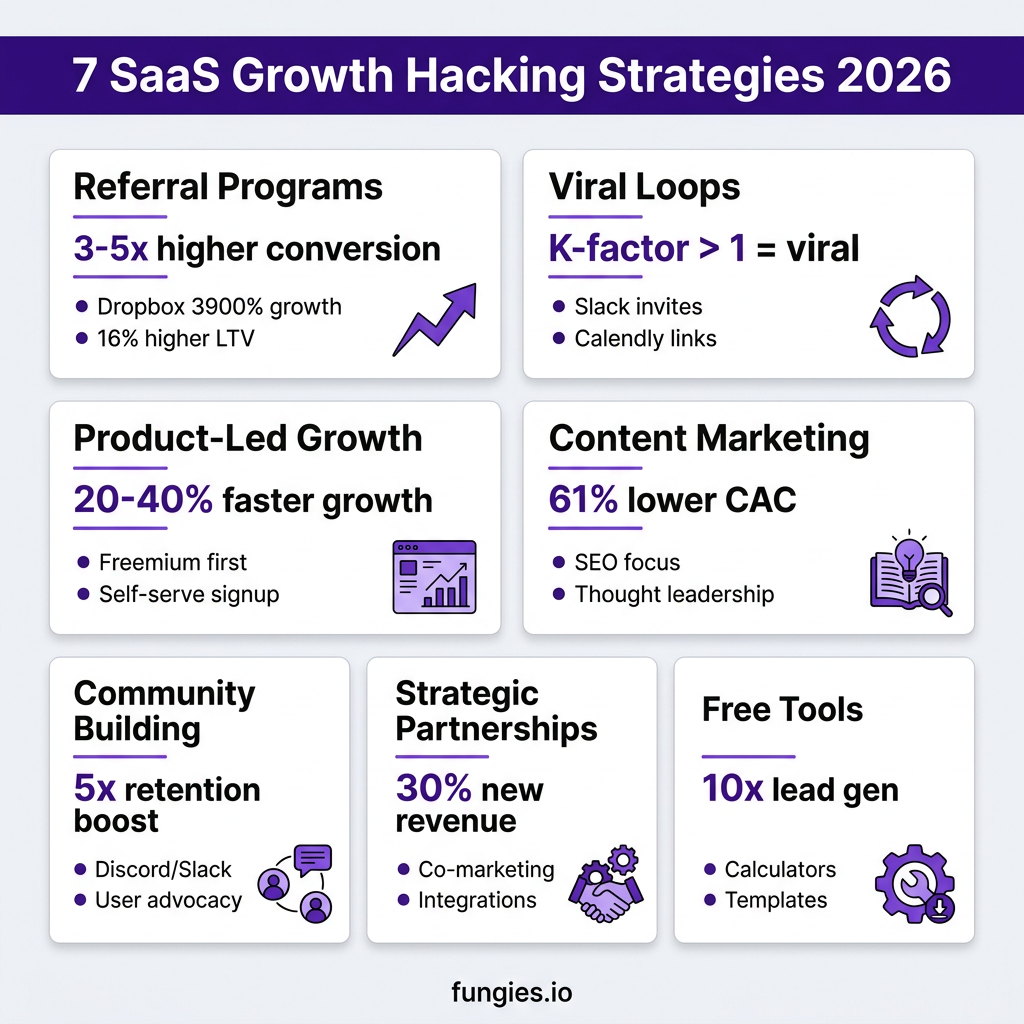
The fix? Build growth systems that compound. Let’s break down the seven strategies actually moving the needle in 2026.
Strategy 1: Referral Programs That Actually Convert
Let’s start with the data because it’s compelling:
- Referred customers convert at 3-5x higher rates than paid channels
- They have 16% higher lifetime value (Wharton School of Business)
- 25% higher first purchase values and 37% better retention
- SaaS companies attribute 20-40% of new customers to referral channels
But here’s the catch: most referral programs fail because they’re an afterthought. They’re buried in a settings menu with a generic “Give $10, Get $10” offer that nobody cares about.
The companies winning with referrals—Dropbox, Notion, Airtable—make sharing part of the core product experience. Dropbox’s referral program famously drove 3,900% growth in 15 months. How? They offered meaningful value (500MB extra storage) and made the sharing process frictionless.
How to Build a Referral Program That Works
- Two-sided rewards: Both the referrer and referee should get value. One-sided incentives feel transactional.
- Timing matters: Ask for referrals when satisfaction peaks—right after a successful product milestone, not randomly.
- Make it visible: Your referral program should be discoverable in-product, not hidden in emails.
- Automate everything: Manual tracking kills participation. Use tools like GrowSurf, ReferralCandy, or build it native.
Average SaaS referral program participation rates sit between 2-8% of active customers. Top performers hit 15%+. The gap isn’t luck—it’s intentional design.
Strategy 2: Engineering Viral Loops Into Your Product
Viral coefficient (K-factor) measures how many new users each existing user brings. When K > 1, you’ve achieved viral growth—each user brings in more than one new user.
Here’s the formula:
Viral Coefficient = Average Invites per User × Conversion Rate
Most SaaS companies have K-factors between 0.1 and 0.3. That’s fine—it still amplifies other channels. But the best-in-class products engineer experiences where sharing is natural:
- Slack: Every workspace invite is a viral touchpoint. You can’t use Slack alone.
- Calendly: Every meeting link shared promotes Calendly to new potential users.
- Loom: Every video has a “Recorded with Loom” watermark and CTA.
- Notion: Sharing pages and templates creates natural viral spread.
The key insight? Viral loops work best when they’re instrumental to the product experience, not bolted on as marketing features.
Strategy 3: Product-Led Growth (PLG) Done Right
Product-led growth isn’t just offering a free trial. It’s a complete go-to-market strategy where the product becomes your primary growth engine.
Here’s what’s working in 2026:
- Time-to-value under 60 seconds: Users expect instant gratification. Every 10-minute delay in time-to-value reduces trial conversion by 8%.
- Freemium with clear upgrade triggers: Not generous indefinite access—strategic limits that create natural upgrade moments.
- Self-serve with sales assist: Let users start alone, then offer human help at the right moment (usually $200-500/month products).
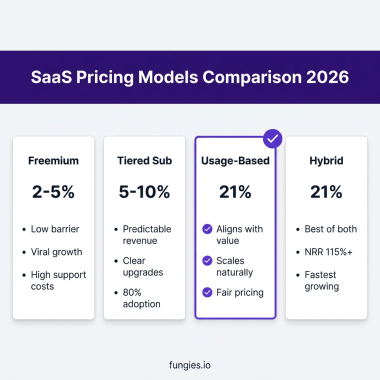
- Usage-based pricing: Align revenue with value received. Per-seat is dying; per-task and per-outcome are rising.
PLG companies grow 20-40% faster than sales-led counterparts at similar stages. But—and this is crucial—PLG requires sophisticated analytics. You need to understand user behavior, drop-off points, and value moments, not just traffic and conversions.
Strategy 4: Content Marketing That Cuts CAC by 61%
A multi-channel approach combining content marketing, targeted ads, email nurture, and sales outreach cut CAC by 61% for one B2B SaaS fintech company. Content isn’t just blog posts—it’s a full-funnel strategy.
Here’s the framework:
- Top of funnel (TOFU): Educational content that ranks. Think “how to” guides, industry research, and thought leadership.
- Middle of funnel (MOFU): Comparison content. “Best X for Y” articles, alternatives pages, detailed feature breakdowns.
- Bottom of funnel (BOFU): Decision-enablement. Case studies, ROI calculators, implementation guides.
Elite SaaS companies keep acquisition costs below $600 through referrals and self-serve channels. Content marketing is the engine that makes this possible.
Strategy 5: Community-Led Growth
Community isn’t a Slack channel you set up and ignore. It’s an intentional strategy that can drive 5x retention boosts and create genuine competitive moats.
The best SaaS communities I’ve seen share these traits:
- They exist where users already are: Discord for developers, Slack for B2B operators, Circle for course creators.
- They provide value beyond the product: Job boards, networking, exclusive content, early access.
- They’re moderated, not managed: The best communities are peer-driven. Your role is facilitation, not control.
- They create user advocates: Active community members become your most powerful marketing channel.
Webflow, Notion, and Figma all have thriving communities that drive significant organic growth. It’s not accidental—it’s engineered.
Strategy 6: Strategic Partnerships and Integrations
Partnerships can drive 30% of new revenue for mature SaaS companies. But most companies approach partnerships wrong—they chase logos instead of value.
Here’s what actually works:
- Integration partnerships: Build into ecosystems where your users already work. Zapier, Slack, Salesforce—be where the workflows happen.
- Co-marketing campaigns: Partner with complementary (not competing) tools for joint webinars, content, and promotions.
- Reseller and affiliate programs: For B2B SaaS, affiliate programs can generate $50k+ monthly revenue representing 15% of total revenue.
- Strategic integrations: Become essential infrastructure for larger platforms.
The key is finding partners with overlapping audiences but non-competing products. If you’re a project management tool, partner with time-tracking apps, communication tools, and file storage—not other PM tools.
Strategy 7: Free Tools as Lead Magnets
This is one of my favorite underrated strategies. Free tools—calculators, generators, templates, graders—can drive 10x lead generation compared to traditional ebooks and whitepapers.
Examples that work:
- HubSpot’s Website Grader: Millions of leads from a simple free tool.
- CoSchedule’s Headline Analyzer: Drives massive top-of-funnel traffic.
- Buffer’s Pablo: Image creation tool that promotes their main product.
- Clearbit’s Connect: Free email finder that upsells to their data platform.
The formula is simple: build a lightweight tool that solves one specific problem your target audience has. Gate the full results behind an email capture. Nurture those leads toward your core product.
The Growth Hacking Framework: How to Execute
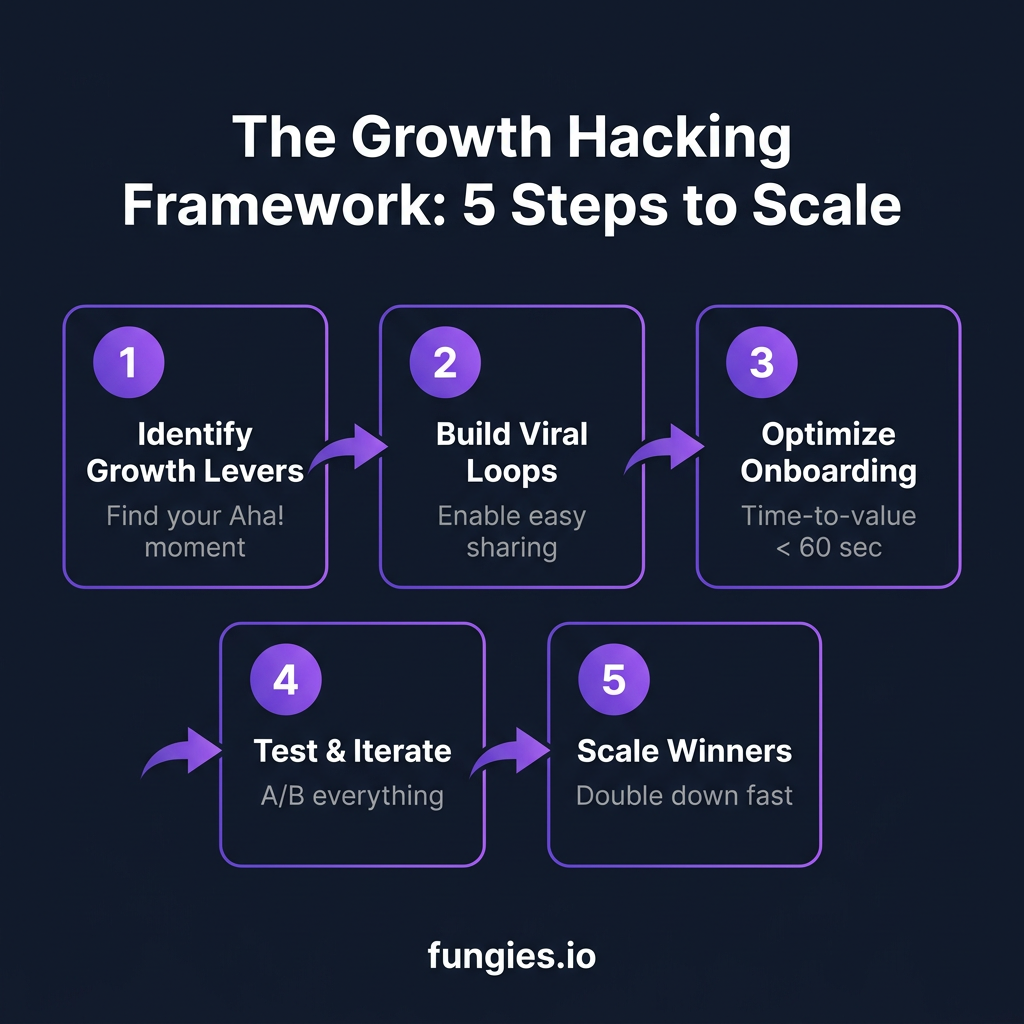
Knowing the strategies is one thing. Executing them is another. Here’s the framework we use at Fungies:
Step 1: Identify Your Growth Levers
Find your “Aha!” moment—the specific action that correlates with retention. For Facebook, it was adding 7 friends in 10 days. For Slack, it was 2,000 messages sent. What’s yours?
Step 2: Build Viral Loops
Make sharing instrumental to product use. Every user should have a natural reason to invite others.
Step 3: Optimize Onboarding
Get users to value in under 60 seconds. Remove friction. Use progressive disclosure. Guide, don’t overwhelm.
Step 4: Test and Iterate
Run experiments weekly. A/B test everything. Measure religiously. Kill what doesn’t work; double down on what does.
Step 5: Scale Winners
When you find something that works, pour fuel on it. Most companies spread too thin. Winners focus.
Comparison: Growth Hacking vs. Traditional Marketing
| Dimension | Traditional Marketing | Growth Hacking |
|---|---|---|
| Timeline | Quarterly planning | Weekly iteration |
| Focus | Brand awareness | Compounding loops |
| Measurement | Lag metrics (MQLs, pipeline) | Lead metrics (activation, K-factor) |
| Budget allocation | Fixed channel budgets | Dynamic based on performance |
| Success metric | Impressions, reach | Revenue per user, CAC payback |
| Team structure | Siloed departments | Cross-functional pods |
FAQ: SaaS Growth Hacking
What’s a good viral coefficient for SaaS?
Most SaaS companies have K-factors between 0.1 and 0.3. Anything above 0.5 is strong. K > 1 means true viral growth where each user brings in more than one new user. Most “viral” SaaS companies actually have K-factors around 0.2-0.4—they’re not purely viral, but viral loops significantly amplify other channels.
How long does it take to see growth hacking results?
Referral programs typically show results in 30-60 days. Content marketing takes 3-6 months to compound. Viral loop optimization is ongoing. The key is running multiple experiments in parallel and killing losers quickly.
Should early-stage startups focus on growth hacking?
Before product-market fit, focus on learning, not growth hacking. After PMF, growth hacking becomes essential. The mistake is trying to scale before you’ve solved retention. Fix the leaky bucket first.
What’s the biggest growth hacking mistake?
Copying tactics without understanding the strategy. Dropbox’s referral program worked because of their specific product and audience. Blindly copying it without adapting to your context will fail. Start with your users, not someone else’s playbook.
How do I measure growth hacking success?
Track these core metrics: Viral Coefficient (K-factor), Customer Acquisition Cost (CAC), Customer Lifetime Value (LTV), CAC Payback Period, Activation Rate, and Net Revenue Retention (NRR). Build dashboards that update in real-time.
Conclusion: Build Your Growth Engine
Growth hacking isn’t about shortcuts. It’s about building systematic, compounding growth engines that turn every user interaction into a potential acquisition channel.
The companies winning in 2026 aren’t outspending their competitors—they’re out-engineering them. They’re building products that sell themselves, communities that advocate for them, and referral loops that compound over time.
Start with one strategy. Test it rigorously. Measure everything. Then scale what works.
And if you’re looking to monetize your SaaS product globally without the headache of tax compliance, payment processing, and international regulations, check out Fungies.io. We handle the financial infrastructure so you can focus on growth.