The creator economy has officially outgrown its “side hustle” origins. In 2026, this $250 billion ecosystem supports over 207 million active creators worldwide, with influencer marketing spend alone exceeding $32 billion annually. What started as a hobby for bedroom YouTubers and Instagram influencers has evolved into a legitimate career path, a major economic force, and a fundamental shift in how content is produced, distributed, and monetized.
But here’s what most people miss: the creator economy isn’t just about viral TikTok dances or luxury unboxing videos. It’s about autonomous media entrepreneurs building diversified businesses with multiple revenue streams. It’s about solo creators operating as full-fledged media companies, complete with production teams, brand partnerships, subscription models, and equity deals. The line between “creator” and “media company” has never been blurrier—and that’s exactly why this market is exploding.
Market Overview: The $250 Billion Creator Economy Ecosystem
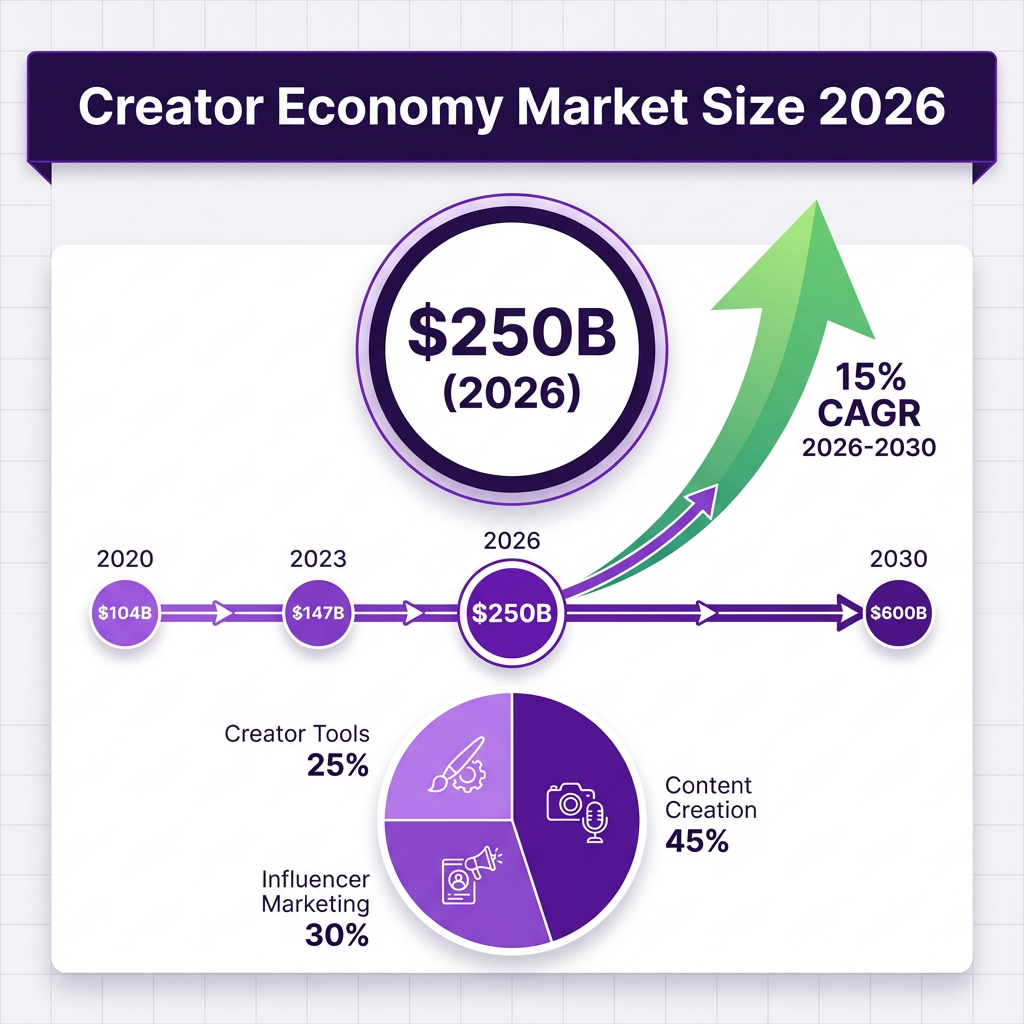
The creator economy market size has reached unprecedented levels in 2026. According to multiple industry analyses, the global creator economy is now valued at approximately $250 billion, with projections suggesting it could reach $480-600 billion by 2030. This represents a compound annual growth rate (CAGR) of roughly 15-27.5%, depending on which forecast model you follow.
To understand how we got here, let’s look at the trajectory. In 2020, the creator economy was estimated at around $104 billion. By 2023, it had grown to approximately $156 billion. The pandemic accelerated digital content consumption, platforms invested heavily in creator monetization tools, and brands shifted advertising budgets from traditional media to influencer partnerships. The result? A market that nearly doubled in just six years.
Goldman Sachs Research has been particularly bullish on the sector, predicting the creator economy could approach half a trillion dollars by 2027. Their analysis points to two primary growth drivers: increased spending on influencer marketing and platform payouts fueled by the monetization of short-form video platforms through advertising. The investment bank expects the 50 million global creators to grow at a 10-20% compound annual growth rate over the next five years.
The market segmentation reveals interesting patterns. Content creation tools and platforms account for approximately 45% of the market, influencer marketing services represent about 30%, and creator tools/software capture the remaining 25%. This distribution highlights a crucial insight: while creators are the face of the economy, the infrastructure supporting them—editing software, analytics platforms, monetization tools, and management services—represents equally significant business opportunities.
Geographic distribution shows the United States and China as the two largest markets, but emerging economies in Southeast Asia, Latin America, and Africa are experiencing the fastest growth rates. India, in particular, has become a powerhouse for creator talent, with English-language content creators from the country commanding premium rates in global markets. The democratization of smartphone access and affordable data plans has enabled creators from previously underserved regions to enter the global marketplace.
The professionalization of the creator economy is perhaps the most significant trend of 2026. No longer are creators dependent solely on platform ad revenue. The most successful creators now operate diversified business models that include brand partnerships, subscription revenue, merchandise sales, affiliate marketing, digital product sales, live events, and even venture capital investments. This diversification has made creator businesses more stable and attractive to investors who previously viewed the space as too volatile.
Key Statistics and Data: 25 Numbers That Define the Creator Economy in 2026
Data tells the real story of the creator economy. Here are the statistics that matter most for understanding this market in 2026:
Market Size and Growth:
- The global creator economy market is valued at $250 billion in 2026
- Projections indicate the market will reach $480-600 billion by 2030
- Compound annual growth rate (CAGR) ranges from 15% to 27.5% depending on forecast model
- Influencer marketing spend alone exceeds $32 billion annually
- The market has grown from $104 billion in 2020 to $250 billion in 2026—a 140% increase
Creator Population:
- Over 207 million active creators worldwide
- Approximately 50 million creators earn some form of income from their content
- Creator population growing at 10-20% CAGR
- 48% of creators operate as solo entrepreneurs, handling all aspects of their business alone
- Only 34% of creators earn their primary income from platform ads
Platform Statistics:
- YouTube: 2.5-2.9 billion monthly active users, 55% ad revenue share for long-form creators
- TikTok: ~2 billion global monthly active users, 170 million in the US
- Instagram: 2 billion+ monthly active users
- Average engagement rates: TikTok 2.5-4.64%, YouTube 1.5-3.5%, Instagram 0.45-0.6%
- TikTok creators earn $0.40-1.00 per 1,000 views plus Shop affiliate commissions
Creator Earnings:
- Average male content creator earns $66,200 per year (NeoReach data)
- Instagram creators average $81,700 annually—$19,000 more than YouTube creators
- TikTok creators generate average annual earnings of $44,250
- Most successful YouTube creators earn 60-70% of revenue from ads
- Most short-form creators earn primary income from brand deals, not platform ads
Content and Engagement:
- Travel and vlog content rising from 17% to 58% of creator output
- Carousels lead Instagram engagement rates in 2026
- Community-led business models emerging as most sustainable foundation for creator income
- 37% of early-stage creators cite avoiding burnout as a major challenge
Investment and Funding:
- Creator economy startups raised significant funding in 2025-2026
- ShopMy (creator-driven shopping platform) raised $169M total, including $70M Series C in August 2025
- GRIN (creator marketing software) raised $145M total, including $110M Series B
- Average funding per creator economy startup: $21.8 million
- Unilever announced 50% of marketing spend will go to influencers, hiring 20,000+ creator partners
These numbers reveal a maturing market where professional creators are building sustainable businesses, platforms are competing fiercely for creator talent, and brands are shifting significant advertising budgets to influencer partnerships. The creator economy has moved from experimental marketing channel to core business strategy.
Major Trends Shaping the Creator Economy in 2026
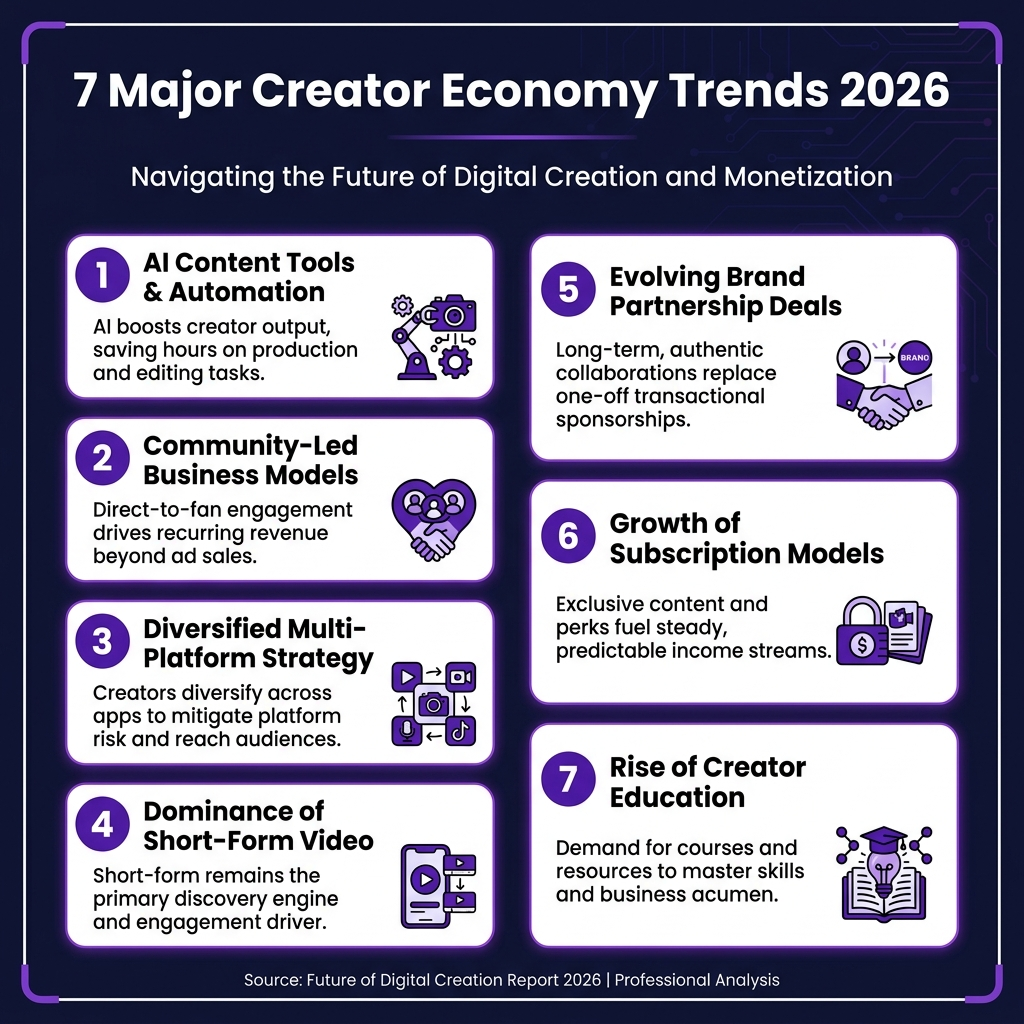
The creator economy is evolving rapidly. Here are the seven major trends defining the space in 2026:
1. AI-Powered Creator Tools
Artificial intelligence has become the creator’s most valuable assistant. From AI-powered research and scripting tools to automated video editing and thumbnail generation, creators are leveraging AI to dramatically increase their output while maintaining quality. Tools like Runway for AI video generation, Superly for viral content optimization, and various AI writing assistants have become standard in the creator toolkit. The most successful creators in 2026 aren’t those who resist AI—they’re the ones who integrate it seamlessly into their workflows, using it to handle repetitive tasks while focusing their human creativity on what matters most: authentic connection with their audience.
2. Community-Led Business Models
Platform dependency has always been the creator’s biggest risk. In 2026, the smartest creators are building owned communities through platforms like Circle, Discord, and Patreon. These community-led business models provide predictable recurring revenue, deeper audience relationships, and insulation from algorithm changes. The data supports this shift: community-led creators report higher lifetime value per fan, better retention rates, and more stable income compared to those relying solely on platform monetization. As one industry analyst noted, “owned memberships are emerging as the most sustainable foundation for creator income.”
3. Multi-Platform Strategy
The days of being a “YouTuber” or “Instagram influencer” are over. Successful creators in 2026 operate across multiple platforms simultaneously, repurposing content for different audiences and monetization models. A single piece of long-form content might become a YouTube video, TikTok clips, Instagram Reels, a podcast episode, a newsletter, and a Twitter thread. This multi-platform approach diversifies revenue streams, reduces platform risk, and maximizes reach. The key is understanding each platform’s unique audience and optimizing content accordingly rather than simply cross-posting identical content everywhere.
4. Short-Form Video Dominance
Short-form video continues to dominate content consumption across all platforms. TikTok’s success has forced YouTube (Shorts), Instagram (Reels), and even LinkedIn to prioritize short-form content in their algorithms. For creators, this means mastering the art of hooking viewers in the first three seconds, delivering value quickly, and creating content that can stand alone without context. The format favors authenticity over production value—raw, relatable content often outperforms highly polished videos. However, the challenge is standing out in an increasingly crowded space where millions of creators are competing for the same attention.
5. Sophisticated Brand Partnerships
Brand partnerships have evolved from simple product placements to sophisticated, long-term collaborations. In 2026, the most valuable creator-brand relationships look more like equity partnerships than traditional sponsorships. Creators are becoming brand ambassadors with multi-year contracts, co-creating products, taking equity stakes, and participating in profit-sharing arrangements. Brands have realized that one-off sponsored posts deliver diminishing returns compared to authentic, ongoing partnerships where creators genuinely love and use the products they promote. This shift benefits both parties: creators get more stable income and upside potential, while brands get more authentic advocacy and better ROI.
6. Subscription and Membership Models
Ad revenue is unpredictable and platform-dependent. Smart creators are building direct-to-consumer revenue through subscriptions, memberships, and premium content. Platforms like Substack, Patreon, and YouTube Memberships enable creators to monetize their most dedicated fans directly. The math is compelling: a creator with 1,000 true fans paying $10/month generates $120,000 annually—often more than they’d earn from millions of ad-supported views. This trend is accelerating as creators realize that a smaller, highly engaged audience is more valuable than a large, passive one.
7. Creator Education and Professionalization
Being a creator is no longer just about making content—it’s about running a business. In 2026, we’re seeing the rise of creator education, with established creators teaching newcomers through courses, coaching programs, and mentorship. This professionalization extends to all aspects of the business: legal services for contract negotiation, financial planning for tax optimization, mental health support for burnout prevention, and business coaching for scaling operations. The creators who treat their work as a serious business, not just a creative outlet, are the ones building sustainable, long-term careers.
Key Players and Competitive Landscape
The creator economy ecosystem consists of multiple layers, each with its own set of dominant players. Understanding this competitive landscape is essential for anyone looking to enter or invest in the space.
Content Platforms
YouTube remains the gold standard for long-form video monetization. With 2.5-2.9 billion monthly active users and a 55% ad revenue share model for creators, it’s the platform of choice for creators building sustainable businesses. YouTube’s strength is its searchability—content continues generating views (and revenue) years after publication. In 2026, YouTube is experiencing a “long-form resurgence” as audiences seek deeper content after years of short-form dominance.
TikTok has transformed content consumption with its algorithm-driven discovery and short-form format. With approximately 2 billion global users and 170 million in the US, it offers unmatched viral potential. However, its monetization remains weaker than YouTube’s, with creators earning $0.40-1.00 per 1,000 views plus Shop affiliate commissions. The platform faces regulatory uncertainty in the US, with divestiture deadlines creating anxiety for creators who’ve built their businesses there.
Instagram has evolved from a photo-sharing app to a comprehensive creator platform with Reels, Stories, Shopping, and Subscriptions. With 2 billion+ monthly active users, it offers strong brand partnership opportunities, though its organic reach has declined as the platform prioritizes paid promotion. Instagram creators average $81,700 annually—the highest of any platform—primarily through brand deals rather than platform payouts.
Creator Tools and Infrastructure
Runway has emerged as the leader in AI video generation, enabling creators to produce professional-quality content without expensive equipment or technical skills. The platform’s ability to generate, edit, and enhance video using AI has made it indispensable for creators looking to scale their output.
Stan Store and Beacons provide creators with link-in-bio solutions that turn social media profiles into full e-commerce stores. These platforms handle everything from digital product sales to appointment booking, enabling creators to monetize their audience directly.
GRIN and Aspire are leading creator marketing platforms that connect brands with creators and manage campaign execution at scale. GRIN has raised $145 million in funding, reflecting investor confidence in the creator marketing infrastructure space.
Emerging Players
ShopMy has raised $169 million to build a creator-driven shopping platform that connects top creators with leading brands. The platform enables creators to earn affiliate commissions while providing brands with authentic product endorsements.
Ceartas has developed AI-driven content protection technology that saves creators millions annually by detecting and removing unauthorized use of their content. As content theft becomes more prevalent, protection tools like Ceartas are becoming essential.
Euka AI is an affiliate marketing platform helping brands find and partner with creators more efficiently, using AI to match brands with creators whose audiences align with their target demographics.

Challenges and Pain Points in the Creator Economy
Despite its impressive growth, the creator economy faces significant challenges that threaten its sustainability and accessibility. Understanding these pain points is crucial for creators, platforms, and investors alike.
1. Creator Burnout and Mental Health
The creator economy runs on a brutal treadmill. Algorithms reward consistency, engagement requires constant availability, and the pressure to produce fresh content never stops. A large majority of creators report experiencing burnout—not occasionally, but structurally. The model rewards constant output, continuous engagement, and emotional labor that traditional jobs don’t require. Thirty-seven percent of early-stage creators cite avoiding burnout as a major challenge. The always-on nature of social media means creators are never truly off work; comments, DMs, and trends demand attention 24/7. Without the boundaries of traditional employment, many creators struggle to maintain work-life balance, leading to mental health issues, creative exhaustion, and career-ending breakdowns.
2. Platform Dependency and Algorithm Changes
Creators build their businesses on platforms they don’t control. When algorithms change—which they do constantly—creators can see their reach and revenue plummet overnight. A YouTube creator who optimized for search might lose traffic when the algorithm prioritizes watch time. An Instagram creator who built a following through photos might see engagement crash when the platform shifts to video. This platform dependency creates fundamental business risk. The creators who survive are those who build direct relationships with their audience through email lists, communities, and owned platforms—but many creators, especially newcomers, lack the resources or knowledge to diversify effectively.
3. Income Inequality and Winner-Take-All Dynamics
The creator economy is not a meritocracy where effort equals reward. It’s a power law distribution where a small percentage of creators earn the vast majority of revenue. While top creators make millions, the median creator earns little or nothing. Only 34% of creators earn their primary income from platform ads, meaning the majority rely on other sources or treat creation as a side hustle. This inequality creates a challenging environment where newcomers struggle to gain traction, mid-tier creators fight to break through, and even successful creators worry about maintaining their position. The “creator middle class”—those earning a comfortable living but not becoming celebrities—is smaller than the headlines suggest.
4. Monetization Complexity
Making money as a creator is more complex than it appears. Creators must juggle multiple revenue streams—ads, sponsorships, affiliates, merchandise, subscriptions, digital products—each with its own logistics, tax implications, and platform requirements. Forty-eight percent of creators operate solo, handling content creation, business management, accounting, legal compliance, and audience engagement alone. This complexity favors creators with business skills, financial resources, and professional networks—advantages that correlate with existing privilege. The result is that the creator economy, despite its democratizing promise, often reproduces existing inequalities.
5. Content Theft and IP Protection
As content becomes more valuable, theft becomes more prevalent. Creators routinely find their videos reuploaded without permission, their images used in ads without compensation, and their brands impersonated by scammers. Enforcing intellectual property rights is expensive and time-consuming, putting individual creators at a disadvantage against bad actors. While tools like Ceartas are emerging to address this problem, content theft remains a significant drain on creator revenue and a source of constant frustration.
Opportunities and Growth Strategies
Despite the challenges, the creator economy offers enormous opportunities for those who approach it strategically. Here are the key growth strategies for 2026:
1. Niche Down for Premium Pricing
The era of generalist creators is ending. The most successful creators in 2026 are those who own specific niches—whether that’s AI tools for accountants, fitness for busy parents, or investment strategies for tech workers. Niche creators command higher rates from brands targeting their specific audience, build stronger community loyalty, and face less competition than generalists. The strategy is counterintuitive: by narrowing your audience, you increase your value to that audience and the brands who want to reach them. A creator with 50,000 highly engaged followers in a specific niche often earns more than a creator with 500,000 generalist followers.
2. Build Owned Audiences
Platform audiences are rented; owned audiences are assets. Smart creators are building email lists, Discord communities, and membership platforms where they control the relationship with their audience. This strategy provides multiple benefits: insulation from algorithm changes, direct monetization opportunities, higher engagement rates, and valuable data about your most dedicated fans. The goal is to use social platforms for discovery while moving your best fans to platforms you control. A creator with 10,000 email subscribers has a more stable business than one with 100,000 Instagram followers.
3. Develop Multiple Revenue Streams
The most resilient creator businesses have diversified revenue. Instead of relying solely on YouTube ad revenue or brand sponsorships, successful creators combine multiple income sources: platform ads, brand deals, affiliate marketing, merchandise, digital products, courses, consulting, speaking engagements, and investments. This diversification protects against changes in any single revenue source and creates compounding effects—your course students become consulting clients, your consulting clients become brand partners, your brand partners become investors. The goal is to build a creator business, not just a content channel.
4. Leverage AI for Scale
AI is not replacing creators—it’s amplifying them. The creators winning in 2026 are those who use AI to handle repetitive tasks (editing, transcription, thumbnail generation, content repurposing) while focusing their human creativity on strategy, community building, and authentic connection. The competitive advantage is no longer who can produce the most content, but who can produce the best content most efficiently. AI tools enable solo creators to operate like full production teams, dramatically reducing the barrier to entry and enabling smaller creators to compete with larger operations.
5. Think Like a Media Company
The line between creator and media company has dissolved. Top creators in 2026 operate as full media businesses with production teams, business development staff, legal counsel, and financial planning. They create content across multiple formats (video, audio, text, live), distribute across multiple platforms, and monetize through multiple channels. This professionalization requires thinking beyond content creation to business strategy, team building, and long-term planning. The creators building sustainable careers are those who invest in their business infrastructure, not just their content quality.
Case Studies: Creator Economy Success Stories
Theory is useful, but real examples prove what’s possible. Here are three case studies illustrating different paths to creator economy success in 2026:
Case Study 1: The Multi-Platform Educator
A former software engineer built a creator business teaching coding skills across multiple platforms. Starting with YouTube tutorials, they expanded to a podcast, newsletter, online courses, and a Discord community. Their strategy: use free content for discovery, paid communities for retention, and courses for monetization. The result: $500,000+ annual revenue with a team of three, serving 50,000+ students. Key insight: educational content has evergreen value and high willingness to pay, making it ideal for the subscription and course model.
Case Study 2: The Niche Fitness Creator
A personal trainer focused exclusively on fitness for busy executives, creating short-form content on LinkedIn and Instagram rather than competing in the saturated general fitness space. By targeting high-income professionals with limited time, they commanded premium rates for coaching ($500+/month) and brand partnerships with luxury fitness brands. With just 25,000 followers, they earn $200,000+ annually—more than many creators with 10x the audience. Key insight: niche audiences with purchasing power are more valuable than large, general audiences.
Case Study 3: The AI Tool Reviewer
Recognizing the AI tool explosion in 2025-2026, a tech enthusiast positioned themselves as the go-to reviewer for AI productivity tools. They built authority through in-depth YouTube reviews, launched a newsletter with 100,000+ subscribers, and monetized through affiliate commissions (earning 20-30% on AI tool subscriptions), sponsored reviews, and their own AI tool directory. Annual revenue exceeded $1 million within 18 months. Key insight: riding major technology waves while providing genuine value creates massive opportunities for early movers.
Future Outlook: The Creator Economy 2026-2030
What does the future hold for the creator economy? Based on current trends and expert forecasts, here’s what to expect through 2030:
Market Growth Projections
The creator economy is projected to reach $480-600 billion by 2030, representing a CAGR of 15-27.5%. Goldman Sachs predicts the market could approach half a trillion dollars by 2027, driven by continued growth in influencer marketing spend, platform payouts, and creator tools adoption. The creator population is expected to grow from 207 million to over 300 million by 2030, with emerging markets contributing the fastest growth.
Platform Evolution
Platforms will continue competing for creator talent through better monetization tools, lower fees, and more transparent algorithms. We expect to see: more direct creator-to-fan monetization features, better analytics and audience insights, improved content protection against theft, and more sophisticated AI tools for content creation and optimization. The platforms that treat creators as valued partners rather than content suppliers will win the talent wars.
Professionalization Acceleration
Being a creator will become increasingly professionalized, with established career paths, industry standards, and professional services. We’ll see more creator unions and associations, standardized contract terms for brand deals, professional education programs, and mainstream acceptance of creator as a legitimate career choice. The “gig economy” stigma will fade as creator businesses demonstrate their economic significance and stability.
AI Integration Deepens
AI will become deeply integrated into every aspect of creator work, from content ideation and scripting to production, distribution, and monetization. This will enable smaller creators to compete with larger operations and enable entirely new content formats that weren’t previously possible. However, it will also raise questions about authenticity and create new competitive dynamics around who can best leverage AI tools.
Regulatory Developments
As the creator economy grows, so will regulatory attention. We expect increased scrutiny of platform practices, creator labor rights, content moderation, advertising disclosure requirements, and tax compliance. Creators will need to become more sophisticated about legal and regulatory compliance, and platforms will face pressure to provide better support for creator businesses.
Key Takeaways
- The creator economy has grown to $250 billion in 2026, with projections of $480-600 billion by 2030
- Over 207 million active creators worldwide are building businesses across multiple platforms and revenue streams
- AI-powered tools, community-led business models, and multi-platform strategies are the defining trends of 2026
- Creator burnout, platform dependency, and income inequality remain significant challenges requiring attention
- The most successful creators treat their work as media businesses, not just content channels, with diversified revenue and professional infrastructure
Sources and Citations
- Creator Economy Statistics 2026: 120+ Data Points – Yahoo Finance
- The Creator Economy Could Approach Half-a-Trillion Dollars by 2027 – Goldman Sachs
- Creator Economy Market Size to Hit USD 2084.57 Billion by 2035 – Precedence Research
- Creator Economy Statistics for 2026 – Circle Blog
- 8 Trends That Will Define the Creator Economy in 2026 – Stan Store
- Creator Economy: Key Trends from 2025 & Predictions for 2026 – LinkedIn
- Creator Economy Statistics And Market Size 2026 – Companies History
- Creator Earnings Reports Guide 2026 – InfluenceFlow
- Creator Economy Statistics and Facts for 2025-26 – Hopp
- Top Creator Economy Startups by Fundraising (2026) – New Market Pitch
- Top Creator Economy Startups in 2026: 30 Companies to Watch
- 41+ Creator Economy Statistics 2026 (Market Size & Trends) – DemandSage
- The Creator Economy In 2026: The Era Of Consolidation – Forbes
- For creators, the biggest threat to business growth isn’t burnout – eMarketer
- The Creator Economy in 2026 Is Breaking And Evolving – Medium
- Creator Economy to Reach $600B by 2030 – Yahoo Finance
- The Creator Economy Will Fuel The Future of Advertising – Creative Salon
Deep Dive: How Creators Actually Make Money in 2026
Understanding the creator economy requires understanding its monetization mechanics. While headlines focus on millionaire influencers, the reality is more nuanced. Let’s break down exactly how creators generate revenue in 2026.
Platform Ad Revenue
YouTube remains the most reliable platform for ad revenue, sharing 55% of advertising income with creators for long-form content. A creator generating 1 million monthly views might earn $2,000-5,000 depending on niche, audience demographics, and seasonality. Finance and business content commands higher CPMs (cost per thousand views) than entertainment, with rates ranging from $5-20+ per thousand views in high-value niches. However, ad revenue alone is rarely sufficient for full-time income unless a creator achieves massive scale.
TikTok’s Creator Fund and similar programs pay significantly less—roughly $0.40-1.00 per 1,000 views. A viral video with 10 million views might generate only $4,000-10,000, making platform payouts insufficient as a primary income source for most TikTok creators. This explains why short-form creators prioritize brand deals over platform monetization.
Brand Partnerships and Sponsorships
Brand deals represent the largest revenue source for most professional creators. Rates vary dramatically based on follower count, engagement rate, niche, and content quality. Nano-influencers (1,000-10,000 followers) might charge $100-500 per post, while micro-influencers (10,000-100,000) command $500-5,000. Macro-influencers (100,000-1 million) can charge $5,000-50,000, and mega-influencers (1 million+) regularly earn $50,000-500,000+ for major campaigns.
However, follower count is becoming less important than engagement and conversion. A creator with 50,000 highly engaged followers in a purchasing mindset might deliver better ROI for brands than one with 500,000 passive viewers. This shift is driving the trend toward long-term ambassador relationships rather than one-off sponsored posts.
Affiliate Marketing
Affiliate commissions allow creators to earn a percentage of sales generated through their recommendations. Amazon Associates offers 1-10% depending on product category, while software and digital product affiliates often earn 20-50%. A creator recommending a $100/month SaaS tool with a 30% recurring commission could earn $30/month per customer—compounding significantly at scale.
The most successful affiliate creators build genuine authority in their niche, recommending only products they use and believe in. This authenticity drives higher conversion rates and long-term trust. Creators in the tech, finance, and business niches often find affiliate marketing more lucrative than brand deals due to higher commission rates and recurring revenue potential.
Digital Products and Courses
Selling digital products—courses, templates, ebooks, presets, and tools—has become a cornerstone of creator monetization. Unlike sponsored content, digital products provide 100% margin (minus platform fees) and can generate passive income for years after creation. A $200 course selling to 1,000 customers generates $200,000 in revenue—equivalent to months of brand deal work.
Educational creators are particularly well-positioned for this model. A coding tutorial creator might sell advanced courses, a photographer might sell Lightroom presets, a designer might sell Figma templates. The key is creating products that solve specific problems for your audience, priced according to the value delivered rather than production cost.
Subscriptions and Memberships
Recurring revenue through subscriptions provides predictable income and deeper audience relationships. Patreon, YouTube Memberships, Substack, and Circle enable creators to offer exclusive content, community access, and direct interaction in exchange for monthly fees ranging from $5-100+.
The math is compelling: 1,000 subscribers at $10/month generates $120,000 annually. This stability allows creators to invest in higher-quality content, hire team members, and build long-term businesses rather than chasing viral moments. Subscription models also align creator incentives with audience value—creators succeed by delivering ongoing value, not just capturing attention.
Speaking and Consulting
Established creators often expand into speaking engagements, consulting, and advisory roles. Speaking fees range from $5,000 for emerging creators to $100,000+ for major influencers at corporate events. Consulting engagements might command $500-2,000 per hour for creators with demonstrated expertise in their field.
This revenue stream leverages the authority built through content creation. A creator who has spent years teaching their audience about a topic becomes a recognized expert, opening doors to high-value offline opportunities that complement their online business.
The Rise of Creator-Led Commerce
One of the most significant developments in the 2026 creator economy is the shift toward creator-led commerce. Creators are no longer just promoting brands—they’re building their own.
MrBeast’s Feastables chocolate bar, Emma Chamberlain’s coffee brand, and countless smaller creator product lines demonstrate this trend. By leveraging their audience trust and distribution, creators can launch products with built-in demand that would cost traditional brands millions in marketing to achieve.
The infrastructure supporting this shift has matured significantly. Platforms like Shopify, Stan Store, and Beacons enable creators to launch e-commerce operations without technical expertise. Print-on-demand services eliminate inventory risk for merchandise. Dropshipping and fulfillment partnerships handle logistics. The barrier to becoming a creator-entrepreneur has never been lower.
However, success requires more than audience size. Creator-led brands that thrive are those where the product genuinely aligns with the creator’s expertise and audience needs. A fitness creator launching workout equipment makes sense; the same creator launching unrelated tech gadgets likely fails. Authenticity remains the currency of the creator economy.
Regional Variations in the Creator Economy
The creator economy is global, but its characteristics vary significantly by region.
North America
The US and Canada represent the most mature creator economy markets, with established infrastructure, high brand spending, and sophisticated audiences. American creators command the highest rates globally, with CPMs and sponsorship fees significantly above other regions. However, competition is fiercest here, and audience growth has slowed as markets saturate.
Europe
European creator markets are fragmented by language and regulation, but collectively represent significant opportunity. GDPR compliance adds complexity for data-driven monetization, but European audiences show strong engagement and purchasing power. The UK, Germany, France, and Nordic countries lead in creator economy development, with growing ecosystems in Eastern Europe.
Asia-Pacific
Asia represents both the largest and fastest-growing creator economy region. China’s creator ecosystem operates largely independently due to platform restrictions, with Douyin (TikTok’s Chinese version), Xiaohongshu, and Bilibili dominating. India’s creator economy has exploded with affordable data and smartphone penetration, producing English-language creators who compete globally. Southeast Asian markets show particular promise for growth.
Latin America and Africa
These regions represent the next frontier of creator economy growth. Brazil, Mexico, Nigeria, and South Africa have developed vibrant creator ecosystems, with creators often building massive audiences before monetization infrastructure catches up. As payment systems and brand investment expand in these markets, early-mover creators are positioned for significant upside.
Conclusion: The Future is Creator-Led
The creator economy in 2026 is not a trend—it’s a fundamental restructuring of how media is produced, distributed, and consumed. The $250 billion market represents a shift from institutional gatekeepers to individual creators, from mass broadcasting to niche communities, from advertising-supported content to direct audience relationships.
For creators, the opportunity has never been greater—but neither has the competition. Success requires treating creation as a business, diversifying revenue streams, building owned audiences, and continuously adapting to platform and market changes. The creators who thrive are those who combine creative talent with business acumen, leveraging AI and other tools to scale their impact.
For brands, the creator economy offers unprecedented access to engaged, trusting audiences. But success requires moving beyond transactional sponsorships to genuine partnerships that provide value to both creators and their communities. The brands that win are those that understand creators are media businesses, not just advertising channels.
For investors, the creator economy infrastructure—tools, platforms, and services supporting creators—represents a massive opportunity. As the market grows from $250 billion to a projected $600 billion by 2030, the companies enabling creator success will capture significant value.
The creator economy is still young. The platforms, business models, and industry standards of 2026 will likely look quaint by 2030. But the fundamental shift—from institutions to individuals, from gatekeepers to creators—is irreversible. The future of media is creator-led, and that future is already here.