Over 3.5 billion people live in Africa, Southeast Asia, and Latin America. Many of them are increasingly online, buying digital products, SaaS subscriptions, and software tools. Yet most indie developers and digital product sellers set up a Stripe account, accept Visa and Mastercard, and wonder why conversion rates in Lagos, Jakarta, and São Paulo are near zero.
The problem isn’t your product. It’s your payment stack.
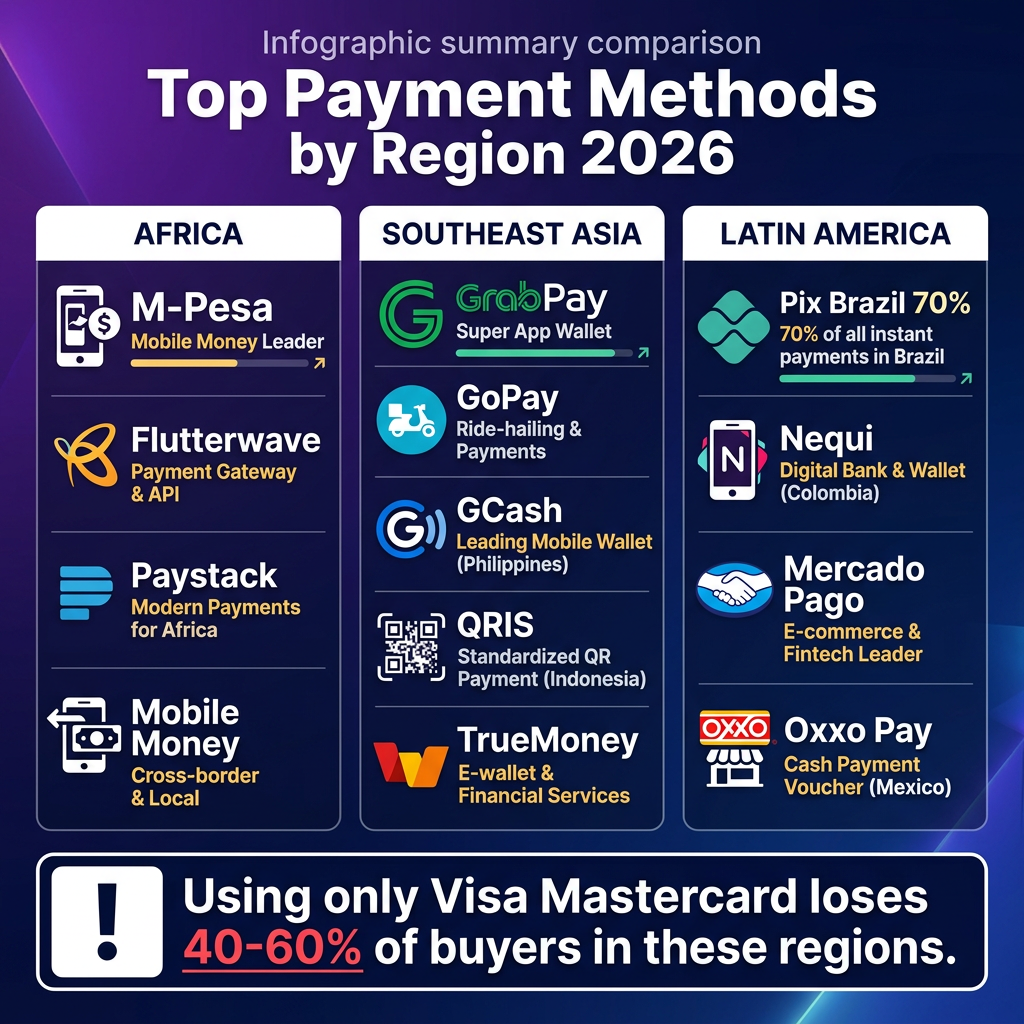
If you’re only accepting Visa and Mastercard, you’re locking out 40–60% of potential buyers in these regions. Pix dominates Brazil with 70% of digital transactions. M-Pesa is the default in Kenya and Tanzania. GCash and GrabPay are what Filipino and Indonesian users reach for first. These aren’t edge cases — they’re the mainstream.
This guide breaks down exactly how to sell digital products in Africa, Southeast Asia, and LATAM — the payment methods that work, the compliance traps to avoid, and how a Merchant of Record makes global expansion genuinely simple for a solo founder or small team.
Why Emerging Markets Are the Biggest Opportunity Most Sellers Ignore
The numbers are hard to argue with. Southeast Asia’s ecommerce market hit $159 billion GMV in 2024 with 15% year-over-year growth, according to e-Conomy SEA. Latin America’s digital commerce market sits at $185 billion, with Brazil and Mexico leading. Africa’s ecommerce market has crossed $180 billion with a 1.4 billion population skewing dramatically young and mobile-first.
Combined, that’s over $500 billion in digital commerce across markets where most Western-focused digital sellers either aren’t present at all or are losing huge amounts of potential revenue to checkout friction.
Here’s what the opportunity looks like region by region:
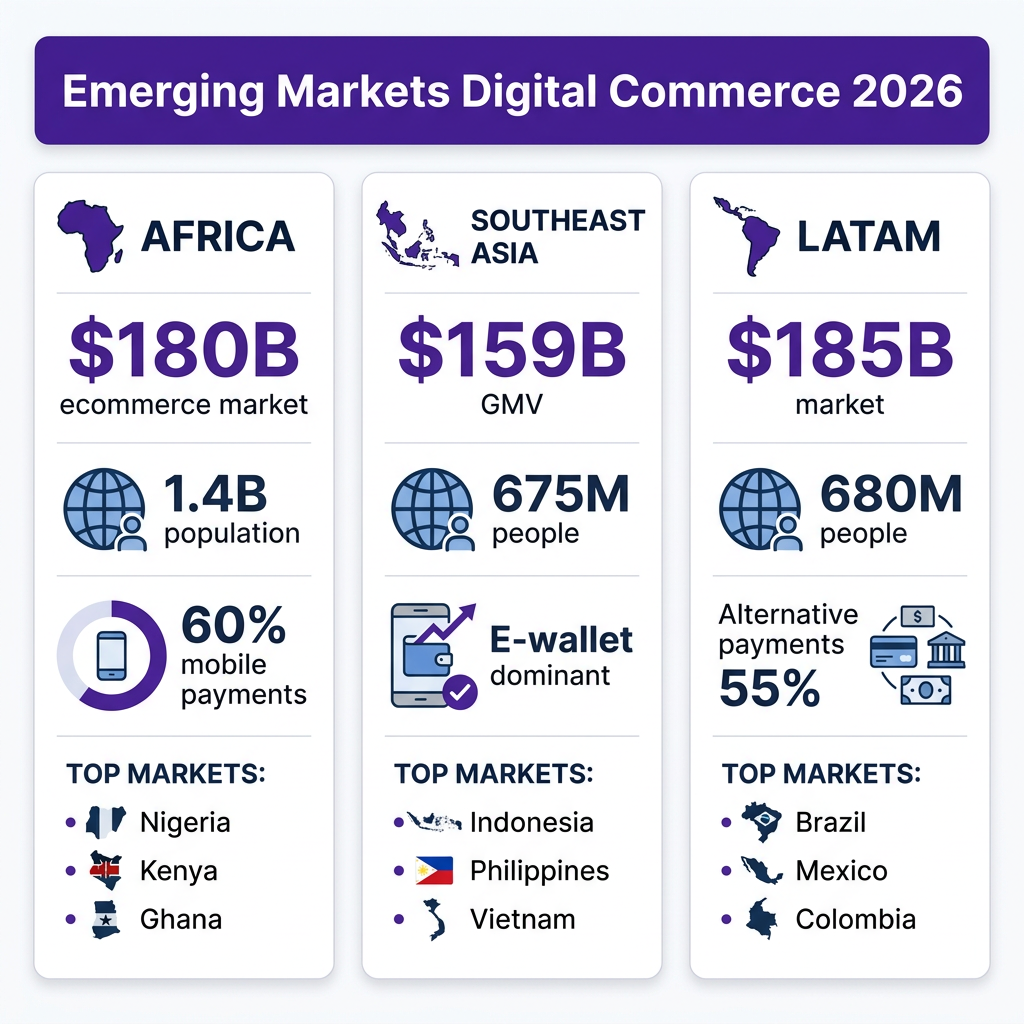
The key characteristic across all three regions: card penetration is low, mobile penetration is high. Users in these markets often have smartphones before they have credit cards. They’ve built their financial lives around mobile money, digital wallets, and bank transfer rails — not Visa. If your checkout doesn’t support their preferred method, they leave.
Africa: Mobile Money Is the Payment Stack
Africa’s digital economy is mobile-first in a way that’s hard to overstate. In Kenya, M-Pesa processes more transactions than Visa and Mastercard combined. In Nigeria, Flutterwave and Paystack have built the rails that merchants use to reach 200+ million consumers. In Ghana, South Africa, and across Sub-Saharan Africa, mobile money isn’t a niche — it’s the norm.
Top Markets and Payment Methods
| Country | Population | Primary Payment Methods | Key Notes |
|---|---|---|---|
| Nigeria | 220M | Paystack, Flutterwave, bank transfer, USSD | Fastest-growing digital market in Africa; strong creator economy |
| Kenya | 55M | M-Pesa, Airtel Money, bank cards | M-Pesa covers 85%+ of adults; mobile-first by default |
| Ghana | 33M | MTN Mobile Money, Vodafone Cash, bank transfer | Over 55% of adults use mobile money |
| South Africa | 60M | Ozow, SnapScan, Visa/Mastercard, bank EFT | Higher card penetration than rest of Africa; strong ecommerce |
| Egypt | 105M | Fawry, InstaPay, Visa/Mastercard | Fast-growing digital economy; Fawry has 70M+ users |
Tax Compliance in Africa for Digital Products
This is where it gets complicated fast. Nigeria has introduced VAT on digital services (7.5%) for foreign providers with a digital presence. South Africa has had a Digital Services Tax since 2014 — if you earn R1 million (~$55,000 USD) or more from South African customers, you need to register for VAT and remit. Kenya’s Digital Service Tax was 1.5% of gross revenue from digital transactions.
The practical challenge: most African countries define thresholds differently, registration processes vary, and enforcement is inconsistent but increasingly aggressive. This is exactly the kind of compliance burden a Merchant of Record eliminates. When Fungies.io is your MoR, we’re the legal seller. We handle tax registration and remittance so you don’t have to track which Nigerian VAT threshold you’ve hit.
Southeast Asia: The $159B Market Running on E-Wallets
Southeast Asia has 675 million people across 11 countries, each with their own dominant payment ecosystems. EBANX expanded into Thailand, Indonesia, Malaysia, Vietnam, and Turkey in April 2026 specifically to capitalize on a USD 610 billion digital opportunity — a clear signal that this market is hitting an inflection point.
Country-by-Country Payment Breakdown
| Country | Population | Dominant Payment Methods | Key Wallet/Rail |
|---|---|---|---|
| Indonesia | 277M | GoPay, OVO, Dana, QRIS bank transfer | QRIS (QR standard) is universal across wallets |
| Philippines | 115M | GCash, Maya (PayMaya), bank transfer | GCash has 81M+ registered users |
| Vietnam | 98M | MoMo, ZaloPay, bank transfer, QR | MoMo is dominant with 31M+ users |
| Thailand | 72M | PromptPay, TrueMoney, Rabbit LINE Pay | PromptPay is nationwide instant transfer standard |
| Malaysia | 33M | GrabPay, Touch ‘n Go eWallet, FPX bank transfer | FPX is bank-to-bank standard used in most checkouts |
| Singapore | 5.9M | PayNow, GrabPay, Visa/Mastercard | High card penetration; PayNow is instant bank transfer |
Why Standard Payment Processors Fail Here
If you’re running Stripe alone, you’re only reaching the ~20-30% of Southeast Asian users with international Visa/Mastercard cards. The rest — the majority — use local wallets, QR codes, or bank transfers that Stripe doesn’t natively support without expensive third-party integrations.
Paddle covers Southeast Asia as part of its global MoR footprint. Dodo Payments added 220+ country coverage including SEA markets. Fungies.io handles payments across SEA via our global payment method network, so your buyers in Jakarta can pay with GoPay and your buyers in Manila can use GCash — without you building any custom integrations.
Tax Complexity: VAT on Digital Services
Indonesia introduced VAT (11%) on digital services from foreign providers in 2020 — one of the first SEA countries to do so. Thailand has a 7% VAT for foreign digital service providers with 1.8M THB (~$50,000 USD) annual revenue. Vietnam introduced a 10% VAT on digital services in 2021. The Philippines has VAT at 12% for digital services exceeding PHP 3M (~$52,000 USD).
As a solo founder, tracking these thresholds across 6 countries while building features is not viable. A Merchant of Record handles all of it.
Latin America: Alternative Payments Are the Mainstream
LATAM has over 680 million people and a digital commerce market exceeding $185 billion. But calling Latin American payment methods “alternative” is misleading. Pix — Brazil’s instant bank transfer — now handles 70% of digital transactions in the country. In Colombia, Nequi (Bancolombia’s digital wallet) has more users than many traditional banks. In Mexico, OXXO Pay lets unbanked users pay for digital products at convenience stores — a channel that drives significant volume.
Country-by-Country Payment Breakdown
| Country | Population | Primary Payment Methods | Key Note |
|---|---|---|---|
| Brazil | 215M | Pix (70%), credit cards (installments/parcelamento), boleto | Pix is mandatory for licensed institutions; instant, free, 24/7 |
| Mexico | 130M | OXXO Pay, SPEI bank transfer, Visa/MC | OXXO Pay is 50M+ user cash-at-convenience-store channel |
| Colombia | 52M | Nequi, Daviplata, PSE bank transfer, Visa/MC | Nequi has 18M+ users; PSE is universal bank standard |
| Argentina | 46M | Mercado Pago, Cuenta DNI, debit cards | Mercado Pago is region-wide fintech with 100M+ users |
| Chile | 19M | WebPay, Khipu, Visa/Mastercard | WebPay is Chile’s national payment network |
| Peru | 33M | Yape, Plin, bank transfers | Yape (BCP) has 14M+ users; most popular P2P/digital payment |
The Brazil Parcelamento Problem
Here’s something that catches many international sellers off guard: in Brazil, offering payment installments (parcelamento) dramatically increases conversion. Brazilian consumers expect to pay in 2-12x installments even for digital products priced under $50. It’s a cultural norm built into the credit card ecosystem. Sellers who don’t offer installment options see conversion rates 30-40% lower than local competitors.
Platforms like Paddle and Fungies.io handle Brazilian installments natively. This alone can unlock significant revenue from the world’s 10th largest economy.
LATAM Tax: ICMS, ISS, and Withholding
Brazil has one of the most complex tax systems in the world. Digital services face ISS (municipality services tax, 2-5%) and potentially ICMS-DIFAL on B2C transactions. Mexico requires digital service providers with Mexican customers to register for VAT (16%). Colombia charges VAT at 19% on digital services. Argentina has had a “digital services” VAT at 21% since 2018.
None of this is theoretical. Tax authorities in Brazil, Mexico, and Colombia have been actively pursuing foreign digital sellers since 2021. A Merchant of Record like Fungies.io absorbs these obligations — we’re the legal seller, so it’s our tax liability, not yours.
How a Merchant of Record Solves All of This
Let’s be direct about what the alternatives look like without a Merchant of Record:
- Register for VAT/GST/digital services tax in each country separately
- File quarterly or monthly tax returns in Nigeria, Brazil, Indonesia, etc.
- Build or integrate local payment method connectors for Pix, M-Pesa, GCash
- Handle FX risk as currencies fluctuate
- Manage chargebacks and fraud across dozens of local payment networks
- Maintain legal entities in multiple jurisdictions (required in some markets)
For a small team or solo founder, this is a full-time legal and finance operation. It’s why most indie developers default to “US + EU only” and leave massive markets completely untapped.
A Merchant of Record handles every one of these items. Here’s how the flow works with Fungies.io specifically:
- Customer buys your digital product — in their local currency, via their preferred payment method
- Fungies.io is the legal seller — we appear on their receipt, collect tax, manage compliance
- We remit taxes — in the relevant jurisdiction, on your behalf, automatically
- You receive a clean payout — net of fees, in your currency, on schedule
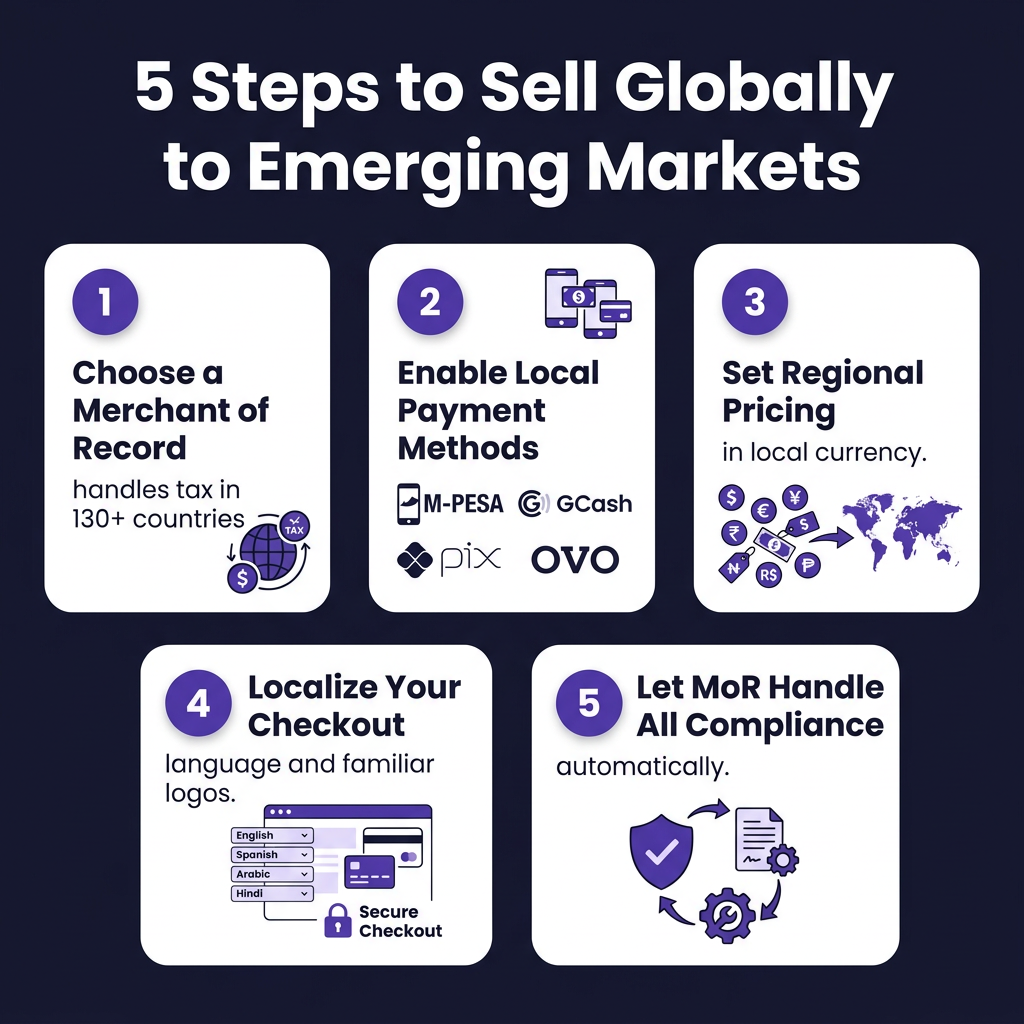
The practical result: you can turn on Brazil, Indonesia, Nigeria, and 130+ other countries in minutes. Not months. No legal setup, no tax registration, no compliance headache.
Setting Up for Emerging Market Sales: Step by Step
Step 1: Choose the Right MoR Platform
Not all MoR platforms cover emerging markets equally. Here’s how the main players stack up for Africa, SEA, and LATAM coverage:
| Platform | Africa Coverage | SEA Coverage | LATAM Coverage | Local Payment Methods | Fees |
|---|---|---|---|---|---|
| Fungies.io | ✅ Including M-Pesa, Flutterwave | ✅ GCash, GoPay, GrabPay | ✅ Pix, OXXO, Mercado Pago | ✅ 30+ local methods | 4% + $0.40 |
| Paddle | ⚠️ Limited local methods | ✅ Core coverage | ✅ Core coverage | ⚠️ Primarily cards | 5% + $0.50 |
| Dodo Payments | ✅ 190+ countries | ✅ Including India SEA | ✅ Core coverage | ✅ 30+ methods | 4% + $0.40 (+1.5% intl) |
| FastSpring | ⚠️ Limited | ✅ Core coverage | ✅ Core coverage | ⚠️ Primarily cards | Custom (5-8%) |
| Gumroad | ⚠️ Very limited | ⚠️ Limited | ⚠️ Limited | ❌ Cards/PayPal only | 10% |
Step 2: Localize Your Pricing
Charging USD in markets where purchasing power is 5-10x lower than the US creates immediate friction. A $29/month SaaS tool is reasonable in San Francisco. In Lagos or Jakarta, it can represent a significant chunk of monthly income.
Purchasing Power Parity (PPP) pricing isn’t charity — it’s revenue optimization. Consider offering:
- Regional pricing tiers — Brazil, India, Indonesia, Nigeria, and Turkey pricing at 40-70% of US prices
- Local currency display — show NGN, IDR, BRL, MXN; don’t force USD conversion math
- Lower entry points — lifetime deals or lower-tier plans that match local market expectations
Tools like Stripe’s Adaptive Pricing and Paddle’s local pricing flags support this. With Fungies.io, you can set regional pricing directly in your store configuration.
Step 3: Don’t Force Email-Only Signups
In many emerging markets, users are more comfortable with social login (Google, Apple) than email/password registration. Reduce signup friction in your checkout flow. Every extra step loses buyers who aren’t fully committed.
Step 4: Offer Installment Options Where Relevant
Brazil is the obvious case, but installment expectations exist across LATAM. If you’re selling anything above ~$20, offering 3x or 6x installment options (even if you build in the cost) can meaningfully improve conversion. Some MoR platforms handle this automatically.
Step 5: Test Your Checkout in Target Markets
Literally open your checkout on a mobile device with a VPN set to Lagos, Jakarta, and São Paulo. See what payment options appear. See if the page loads fast enough (mobile connections are often slower). See if local payment logos are visible. If you see only “Visa, Mastercard, PayPal” — you’re leaving conversion on the table.
Common Mistakes That Kill Emerging Market Conversions
1. Cards-only checkout — The single biggest conversion killer. If you don’t accept local wallets and bank transfers, most users in these regions will drop off.
2. USD-only pricing without local display — Forcing users to mentally convert is friction. It also signals “this isn’t for you.” Show prices in local currency.
3. Ignoring mobile UX — 60%+ of ecommerce in Africa happens on mobile. Your checkout must be fully responsive and fast on 3G/4G connections.
4. No local payment method logos in checkout — Trust signals matter. Showing familiar payment logos (M-Pesa, GCash, Pix) tells local buyers the checkout will work for them.
5. Assuming compliance is optional — It isn’t. Brazil, Mexico, Nigeria, Indonesia — all have active enforcement of digital services tax obligations. Use a Merchant of Record to be covered from day one.
Key Takeaways
- Africa, Southeast Asia, and LATAM represent $500B+ in digital commerce — most of it underserved by Western-focused sellers
- Cards-only checkout excludes 40-60% of potential buyers in these regions; local payment methods are non-negotiable
- Tax compliance is real and increasingly enforced — Brazil, Indonesia, Nigeria, and Mexico all have digital services tax frameworks
- A Merchant of Record handles tax registration, remittance, local payment methods, and chargebacks across 130+ countries automatically
- PPP pricing and local currency display can increase conversion rates by 30-50% in price-sensitive markets
FAQ
Do I need to register a legal entity in Brazil or Nigeria to sell digital products there?
Not if you use a Merchant of Record. The MoR is the legal seller in those jurisdictions — they hold the tax registrations and handle compliance. You’re effectively selling wholesale to the MoR, who resells to the end customer. This is precisely the structure that makes global selling viable for solo founders and small teams without enterprise legal infrastructure.
What happens if I just ignore the tax obligations and sell via Stripe?
In the short term, probably nothing. In the medium term, you’re exposed. Brazil has been actively pursuing foreign digital sellers since 2021. Indonesia’s DJP (tax authority) has issued compliance orders to foreign providers. The risk compounds with revenue growth — a $100K/year side project in some jurisdictions triggers mandatory registration and potential back taxes plus penalties. The cost of a MoR’s percentage fee is almost always lower than retroactive compliance costs.
Is M-Pesa available for international merchants or only local Kenyan businesses?
M-Pesa integration is available to international merchants via intermediaries like Flutterwave, Chipper Cash, and direct M-Pesa for Business APIs. Some MoR platforms, including Fungies.io, offer M-Pesa as a supported payment method as part of their global payment method network — so you don’t need to integrate it separately.
How does Brazilian Pix work for international sellers?
Pix is Brazil’s central bank-run instant payment system. For international sellers, it’s accessible via Brazilian payment aggregators and MoR platforms with Brazilian presence. When integrated via a Merchant of Record, you don’t need a Brazilian CNPJ (business registration) — the MoR’s local entity handles it. The buyer pays via Pix; you receive a clean payout in USD/EUR. It’s seamless from the seller’s perspective.
Conclusion
The $500B+ digital commerce opportunity in Africa, Southeast Asia, and Latin America isn’t a future opportunity — it’s current, growing, and largely uncaptured by most independent software sellers and digital product creators.
The barrier isn’t product-market fit. It’s payment infrastructure and compliance complexity. With the right Merchant of Record, those barriers disappear. You turn on local payment methods, get automatic tax compliance in 130+ countries, and start reaching buyers who’ve been locked out of your checkout by friction you didn’t even know existed.
Ready to sell globally without the tax and payment headaches? Start with Fungies.io — free to set up, no monthly fees, built for indie developers and digital product sellers.
References
- e-Conomy SEA 2024 Report — Google, Temasek, Bain & Company: Southeast Asia GMV $159B (2024)
- EBANX Press Release, April 2026: Expansion into Thailand, Indonesia, Malaysia, Vietnam, Turkey
- Bamboo Payment Systems, 2026: How Latin America Really Pays in 2026
- 2C2P: How Southeast Asia Buys and Pays 2026
- Rebill: Digital Wallets in Latin America by Country (2026)
- PayRetailers: 2026 Payment Trends Reshaping LATAM
- Kobocourse: Digital Products for African Creators Guide 2026
- Lengow: Top African Marketplaces 2026
- Fungies.io: Tax-Compliant Payments for Digital Products and SaaS — https://fungies.io