Here’s a number that keeps SaaS founders up at night: the average SaaS company loses 3-7% of its customers every single month. In a subscription business, that math gets ugly fast. A 5% monthly churn rate means you’re losing nearly half your customer base every year. You’d have to run just to stay in place.
I’ve spent years watching companies pour money into acquisition while their existing customers slip out the back door. It’s backwards. Reducing churn by just 1% can increase your company’s valuation by 20-30% according to SaaS Capital’s 2025 data. Yet most founders treat retention as an afterthought.
What Is SaaS Customer Retention (And Why It Matters More Than Acquisition)
Customer retention is the percentage of customers who stick with your product over a given period. Simple concept. Massive implications.
In SaaS, you don’t just want retention—you want negative churn. That’s when your existing customers expand their spend faster than you lose others. Companies with Net Revenue Retention (NRR) above 120% grow 2.5x faster than those stuck at 100% or below.
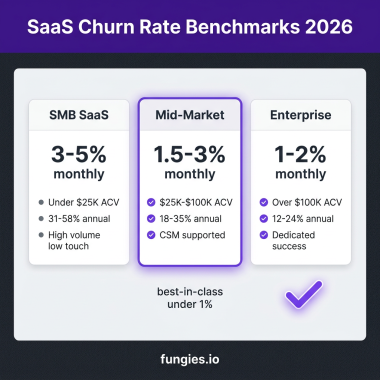
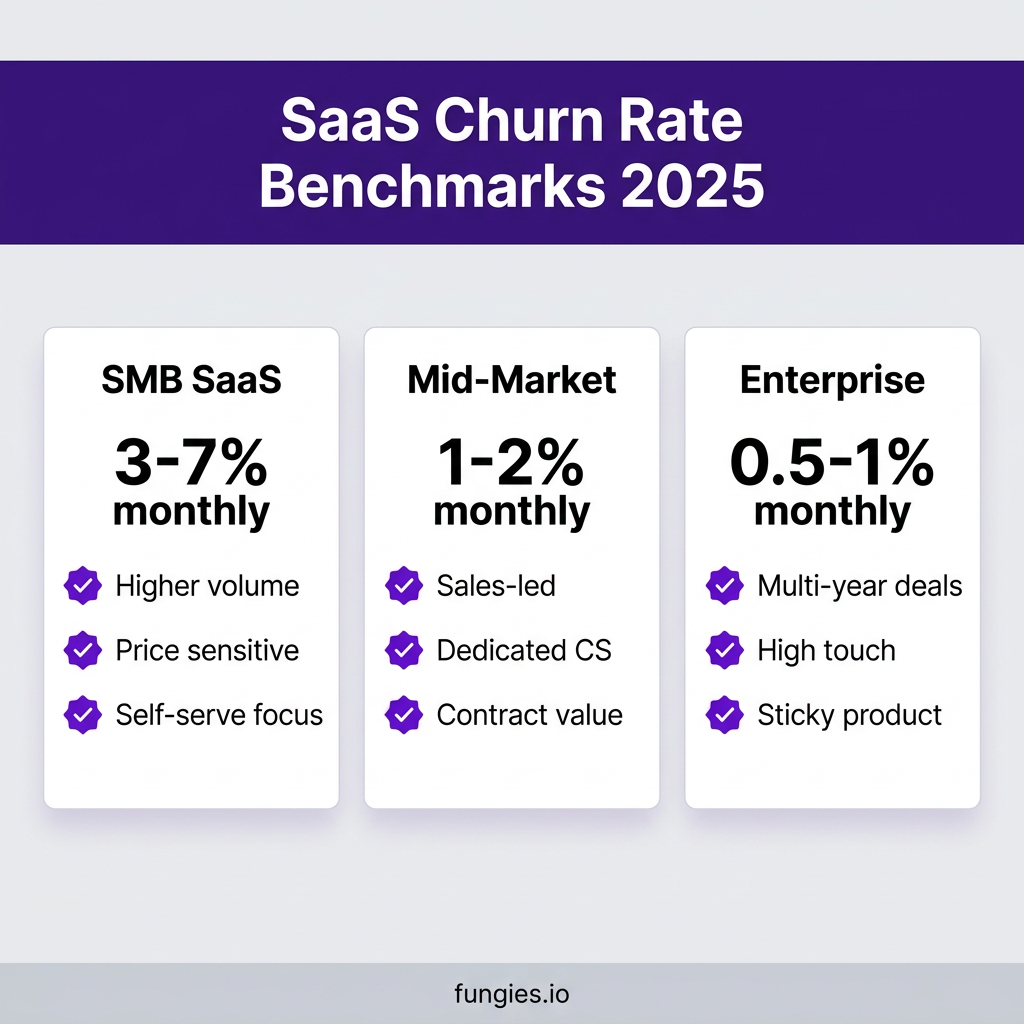
The 2025 Recurly Churn Report puts median B2B SaaS annual churn at 3.5%. But here’s what separates the winners from the losers:
| Company Size | Good Monthly Churn | Annual Churn | NRR Target |
|---|---|---|---|
| SMB SaaS | 3-5% | 30-45% | 100-110% |
| Mid-Market | 1-2% | 12-24% | 110-120% |
| Enterprise | 0.5-1% | 6-12% | 120%+ |
If you’re above these benchmarks, you’re bleeding revenue. The cost of acquiring a new customer is 5-25x more expensive than retaining an existing one. Every customer you save drops straight to your bottom line.
Why SaaS Customers Churn (The Real Reasons)
Before you can fix churn, you need to understand why customers leave. In my experience, these are the top culprits:
1. Poor Onboarding (40% of Early Churn)
Most customers churn in the first 90 days. Not because your product is bad—because they never experienced the value. If a user can’t get to their “aha moment” within the first session, you’ve already lost them.
2. Lack of Product Adoption
Customers who use only one feature are 3x more likely to churn than power users. Feature adoption isn’t just a vanity metric—it’s a churn predictor. Data from Wudpecker shows that 70%+ feature usage doubles retention likelihood.
3. No Perceived Value
This one’s painful. Sometimes customers simply don’t see the ROI. They’re paying $500/month but can’t articulate what they’re getting. When budget cuts come (and they always do), these are the first subscriptions to go.
4. Involuntary Churn (Failed Payments)
According to Recurly’s 2025 data, 0.8% of annual churn is involuntary—expired credit cards, failed payments, banking issues. That’s customers who want to stay but get kicked out by technical problems. Completely preventable.
7 Proven SaaS Customer Retention Strategies
Now let’s get tactical. These are the strategies that actually move the needle based on 2025 data and real-world results.
Strategy 1: Optimize Time-to-Value (TTV)
Your goal: get customers to their first win as fast as humanly possible. Every minute of friction increases churn risk.
- Cut signup fields to the absolute minimum
- Use progressive profiling—collect data as they engage, not upfront
- Pre-populate accounts with sample data or templates
- Show value before asking for payment details
Companies that reduce TTV by 25% see a proportional decrease in early-stage churn. It’s that direct.
Strategy 2: Build a Data-Driven Health Score
Stop guessing which customers are at risk. Build a health score based on:
- Login frequency (daily/weekly/monthly)
- Feature adoption breadth
- Support ticket volume and sentiment
- NPS responses
- Expansion revenue history
Flag accounts that drop below a threshold. Your customer success team should reach out before the cancellation email hits your inbox.
Strategy 3: Implement Proactive Customer Success
The best retention strategy? Prevent problems before they happen. Proactive outreach beats reactive support every time.
- Schedule quarterly business reviews (QBRs) for mid-market+ accounts
- Send usage reports showing ROI and value delivered
- Alert customers to features they’re not using that could help
- Celebrate milestones (“You’ve processed 10,000 orders!”)
Companies with dedicated customer success managers see 15-25% higher retention rates. The ROI is undeniable.
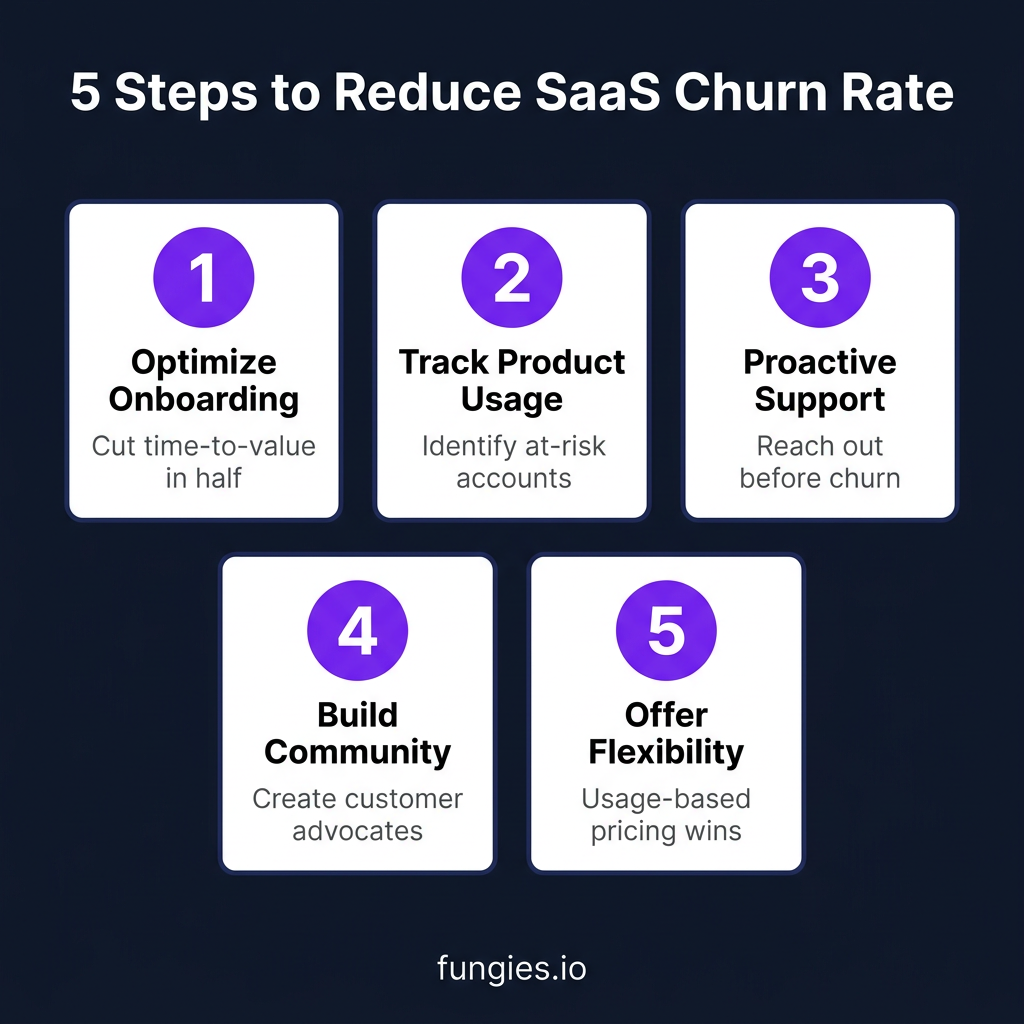
Strategy 4: Create a Customer Community
Community is a moat. When customers connect with each other, your product becomes stickier. They’re not just buying software—they’re joining a tribe.
- Launch a Slack or Discord community for power users
- Host virtual events, AMAs, and training sessions
- Create a certification program that builds expertise
- Facilitate peer connections and case study sharing
Community-led growth isn’t just trendy—it’s effective. Customers with community connections have 2x higher lifetime value.
Strategy 5: Offer Flexible Pricing and Payment Options
Rigidity kills retention. In 2025, customers expect flexibility. Consider:
- Usage-based pricing for variable workloads
- Annual discounts to improve cash flow and lock in commitment
- Pause options instead of cancellations
- Downgrade paths that keep customers in your ecosystem
The 2025 Pavilion Benchmarks Report shows that consumption and outcome-based pricing increases as companies scale. Flexibility retains customers who might otherwise churn.
Strategy 6: Fix Involuntary Churn
This is low-hanging fruit. Implement:
- Smart dunning sequences (retry failed payments 3-5 times)
- Pre-expiration credit card notifications
- Multiple payment methods per account
- Grace periods before account suspension
A good dunning system can recover 30-50% of failed payments. That’s revenue you were literally throwing away.
Strategy 7: Double Down on Expansion Revenue
Retention isn’t just about preventing churn—it’s about growing existing accounts. The 2025 Benchmarkit report shows expansion ARR now represents 40% of total new ARR for scaling SaaS companies.
- Build upsell triggers into your product (feature gates, usage limits)
- Train sales/CS teams on expansion plays
- Create add-on products and premium tiers
- Monitor product usage for expansion signals
Companies above $50M ARR get over 50% of new revenue from existing customers. That’s the power of negative churn.
How to Measure Retention Success
You can’t improve what you don’t measure. Track these metrics religiously:
| Metric | Formula | What It Tells You |
|---|---|---|
| Logo Retention | Customers at end / Customers at start | How many accounts you’re keeping |
| Gross Revenue Retention | Starting MRR – Churn / Starting MRR | Revenue kept without expansion |
| Net Revenue Retention | Starting MRR + Expansion – Churn / Starting MRR | Total revenue growth from base |
| Customer Lifetime Value | ARPU × Gross Margin / Churn Rate | Total value of a customer |
| Time-to-Value | Time to first success milestone | Onboarding effectiveness |
According to High Alpha’s 2025 SaaS Benchmarks, top-quartile companies achieve NRR above 120% and GRR above 95%. If you’re below these numbers, you have work to do.
FAQ: SaaS Customer Retention
What is a good churn rate for SaaS?
For B2B SaaS, a good monthly churn rate is below 1% (under 5% annually). SMB-focused products can tolerate 3-5% monthly, while enterprise should aim for 0.5-1% monthly. Anything higher and you’re in dangerous territory.
What’s the difference between gross and net retention?
Gross Revenue Retention (GRR) measures revenue kept from existing customers excluding expansion. Net Revenue Retention (NRR) includes upsells and cross-sells. GRR above 90% is solid; NRR above 110% indicates healthy growth.
How do I reduce churn in the first 90 days?
Focus entirely on time-to-value. Cut onboarding friction, provide in-app guidance, schedule kickoff calls, and celebrate early wins. The first 90 days determine the next 900.
Is customer success worth the investment?
Absolutely. Companies with dedicated customer success teams see 15-25% higher retention. For a $1M ARR business, that’s $150K-250K in saved revenue annually. The math works.
What’s the #1 retention metric to track?
Net Revenue Retention. It captures the full picture—churn, expansion, and contraction. NRR above 100% means you’re growing without adding new customers. That’s the holy grail of SaaS.
Conclusion: Retention Is Growth
Here’s the truth: you can’t out-acquire bad retention. Pouring water into a leaky bucket is just wasting water.
The companies winning in 2025 aren’t just growing fast—they’re keeping what they have. They’re obsessed with time-to-value, proactive success, and expansion revenue. They treat retention as a growth channel, not a cost center.
If you take one thing from this guide: fix your onboarding. 40% of churn happens in the first 90 days. Get customers to value faster, and everything else gets easier.
Now go plug those leaks.
Ready to scale your SaaS with better retention? Create your free Fungies account and start building a checkout experience that converts—and keeps customers coming back.