In 2026, 43% of SaaS founders still start with Stripe — then quietly switch 18 months later when their accountant’s bill lands. The debate between Stripe, Paddle, and Merchant of Record platforms isn’t really about payment processing. It’s about who owns your tax liability, how much compliance overhead you can stomach, and whether your “cheaper” option actually is cheaper when everything is added up.
This guide breaks down the real differences between Stripe, Paddle, Dodo Payments, Creem, and Fungies.io — with actual numbers, not marketing copy.
The Fundamental Divide: Payment Processor vs. Merchant of Record
Before comparing fees, you need to understand what these platforms actually are — because they’re solving different problems.
Stripe is a payment processor. It moves money from your customer’s card to your bank account. Everything else — VAT registration in the EU, US sales tax nexus, GST in Australia, chargebacks, refund liability — that’s your problem. You remain the merchant of record, which means you’re the legal seller in every transaction.
Paddle, Dodo Payments, Creem, and Fungies are Merchants of Record. They become the legal seller. Your customer buys from Paddle (or whichever MoR you chose), Paddle collects the tax, remits it to 50+ tax authorities, handles the chargeback dispute, and sends you what’s left. You get clean revenue with no compliance overhead.
This difference matters enormously at scale — and even at smaller volumes if you’re selling globally.

Fee Breakdown: What You Actually Pay in 2026
Let’s kill the myth that Stripe is cheap. Here’s what each platform actually costs at a $100 transaction from a European customer:
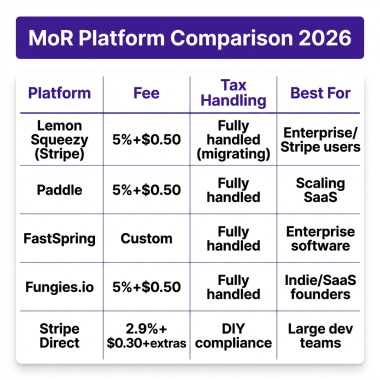
| Platform | Base Fee | Intl. Surcharge | Tax Tool | Effective Rate | MoR? |
|---|---|---|---|---|---|
| Stripe | 2.9% + $0.30 | +1.5% | Stripe Tax: +0.5% | ~4.9–5.4% | ❌ No |
| Paddle | 5% + $0.50 | Included | Included | ~5–5.5% | ✅ Yes |
| Dodo Payments | 4% + $0.40 | +1.5% intl. | Included | ~5.5–6% | ✅ Yes |
| Creem | 3.9% + $0.40 | Included | Included | ~4.3% | ✅ Yes |
| Fungies.io | 5% flat | Included | Included | ~5% | ✅ Yes |
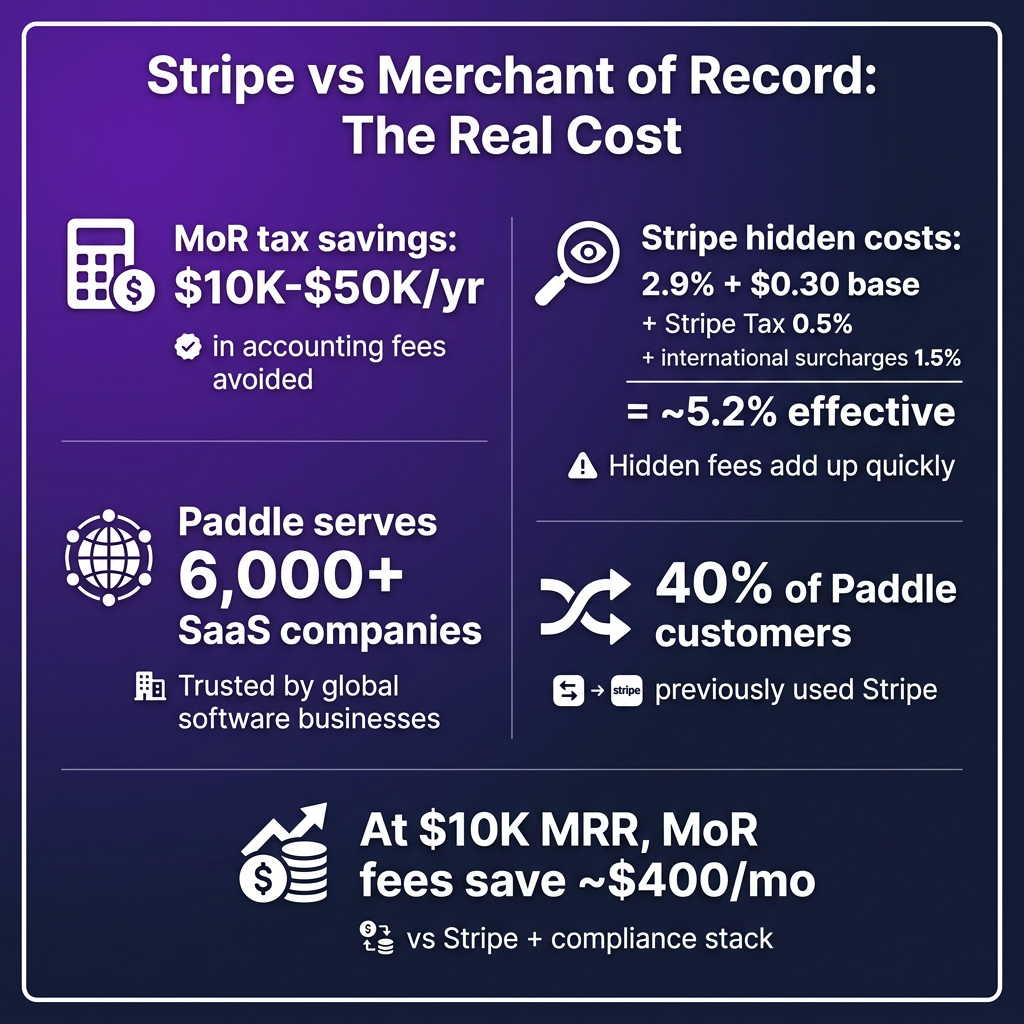
The real kicker with Stripe: even at “just” 2.9% + $0.30, once you add international surcharges (1.5%), currency conversion (0.5–1%), Stripe Tax (0.5%), and the accounting cost to file returns in each jurisdiction ($5,000–$20,000/year for a 10-country footprint), you’re often spending more than with a MoR platform — while doing 10x the work.
Stripe: When It Still Makes Sense
Stripe isn’t dead. It’s still the right choice in specific situations:
- B2B SaaS with invoicing: You’re selling to companies with VAT IDs who self-certify their tax status. Reverse charge rules apply, your compliance burden drops dramatically.
- Single-market focus: US-only sales to US companies? Stripe plus a simple nexus calculator handles it fine.
- You need deep API customization: Stripe’s API surface is unmatched. If you’re building complex billing logic — usage-based pricing with custom overage tiers, multi-product bundles, enterprise contract billing — Stripe gives you the most control.
- You have a finance person: At $500K+ ARR with a dedicated ops hire, the compliance overhead is manageable and the fee savings add up.
But for the solo founder or small team selling a $29/month SaaS to customers in 15 countries? Stripe is a trap. You’ll spend more on compliance tooling and accountants than you save on transaction fees.
Paddle: The Established Enterprise MoR
Paddle is the default choice for serious SaaS companies that want MoR benefits without thinking too hard. 6,000+ companies use it. It’s processed billions in software revenue. It works.
The tradeoffs:
- 5% + $0.50 per transaction — slightly higher than newer competitors
- Checkout customization is limited — you get Paddle’s checkout, not yours
- Approval process — Paddle reviews your product before you can go live
- Enterprise-leaning features — great for $1M+ ARR SaaS, overkill for MVPs
Paddle recently launched Paddle Billing (separate from its original offering) with more flexible APIs. It’s moving toward developer-friendliness. But it still carries enterprise pricing and a corporate feel that can frustrate indie hackers.
Best for: Mid-market SaaS ($50K–$500K MRR), global customer base, teams that want zero compliance involvement and don’t mind paying a premium for reliability.
Dodo Payments: The Newer Global MoR
Dodo Payments launched in 2023 and quickly found a niche with founders who wanted MoR coverage at lower rates than Paddle. At 4% + $0.40 domestic (with international at +1.5%), it’s genuinely cheaper than Paddle for US-focused products.
Key differentiators:
- 180+ countries coverage
- Usage-based billing support — great for AI tools with token/credit pricing
- Purchasing Power Parity (PPP) pricing built in
- Strong focus on AI SaaS monetization
The catch: international fees add up fast. A EU customer on a $49/month subscription costs you 5.5% effective rate — slightly more than Paddle when everything’s included. Still, for AI tools with credit-based pricing or early-stage founders testing global markets, Dodo offers a compelling entry point.
Best for: AI SaaS tools, usage-based pricing models, founders targeting emerging markets.
Creem: The Developer-Friendly Lean MoR
Creem is the newest player and explicitly targets indie hackers and early-stage SaaS founders. Their standout differentiator: 0% fees on your first $1,000 processed. After that, it’s 3.9% + $0.40 — the lowest rate of any full MoR platform in 2026.
What Creem does well:
- Lowest effective fees among MoR platforms (~4.3% all-in for most transactions)
- Clean developer API with modern documentation
- Built-in affiliate/referral tools
- Fast onboarding — no approval waitlist like Paddle
The tradeoffs: Creem is newer, which means less enterprise track record and smaller support team. For high-volume SaaS, Paddle’s stability is worth the extra 0.7%.
Best for: Indie hackers, pre-seed SaaS, AI tool builders, anyone launching fast and wanting MoR coverage without approval friction.
Fungies.io: MoR Built for Developers and Small Teams
Fungies positions itself at the intersection of what indie developers actually need: a full Merchant of Record with no monthly fee, 5% transaction rate, and a focus on developer experience.
| Feature | Stripe | Paddle | Dodo Payments | Creem | Fungies.io |
|---|---|---|---|---|---|
| Monthly fee | $0 | $0 (pay-as-go) | $0 | $0 | $0 |
| Transaction fee | 2.9% + $0.30 | 5% + $0.50 | 4% + $0.40 | 3.9% + $0.40 | 5% flat |
| Tax compliance | Manual (or Stripe Tax) | Full MoR | Full MoR | Full MoR | Full MoR |
| Checkout embed | Customizable | Paddle-hosted | Customizable | Customizable | Embeddable |
| Subscription mgmt | Stripe Billing | Built-in | Built-in | Built-in | Built-in |
| Chargeback protection | You handle it | Full MoR covers | Full MoR covers | Full MoR covers | Full MoR covers |
| Countries | 46+ | 200+ | 180+ | 100+ | 50+ |
| Best for | B2B SaaS / US-first | Mid-market global | AI tools / global | Indie / early-stage | Dev tools / digital |
Fungies shines for developers selling digital products, game assets, and software subscriptions who want a clean MoR setup without navigating enterprise approval processes. The flat 5% rate is transparent — no international surcharges, no currency conversion fees eating into your margin.
The Hidden Cost Nobody Talks About: Your Time
Here’s the number that changes the calculation for most founders: accounting and compliance overhead.
If you use Stripe and sell to EU customers, you need VAT registration (or use OSS), quarterly EU VAT returns, US sales tax nexus tracking across states, and year-end reconciliation. Budget $5,000–$15,000/year in accounting fees for a modest global footprint. Add Stripe Tax at 0.5% per transaction and the “cheap” 2.9% becomes the most expensive option at the table.
With any MoR platform, that $5,000–$15,000 goes away. They handle it. It’s built into their fee.
At $10K MRR selling globally:
- Stripe (total cost): ~$490/month in processing + ~$1,200/month in compliance = ~$1,690/month
- Paddle: ~$550/month, fully compliant, no accounting add-ons
- Creem: ~$430/month, fully compliant
The MoR wins by $1,000–$1,200/month at $10K MRR. That’s real money.
How to Actually Decide
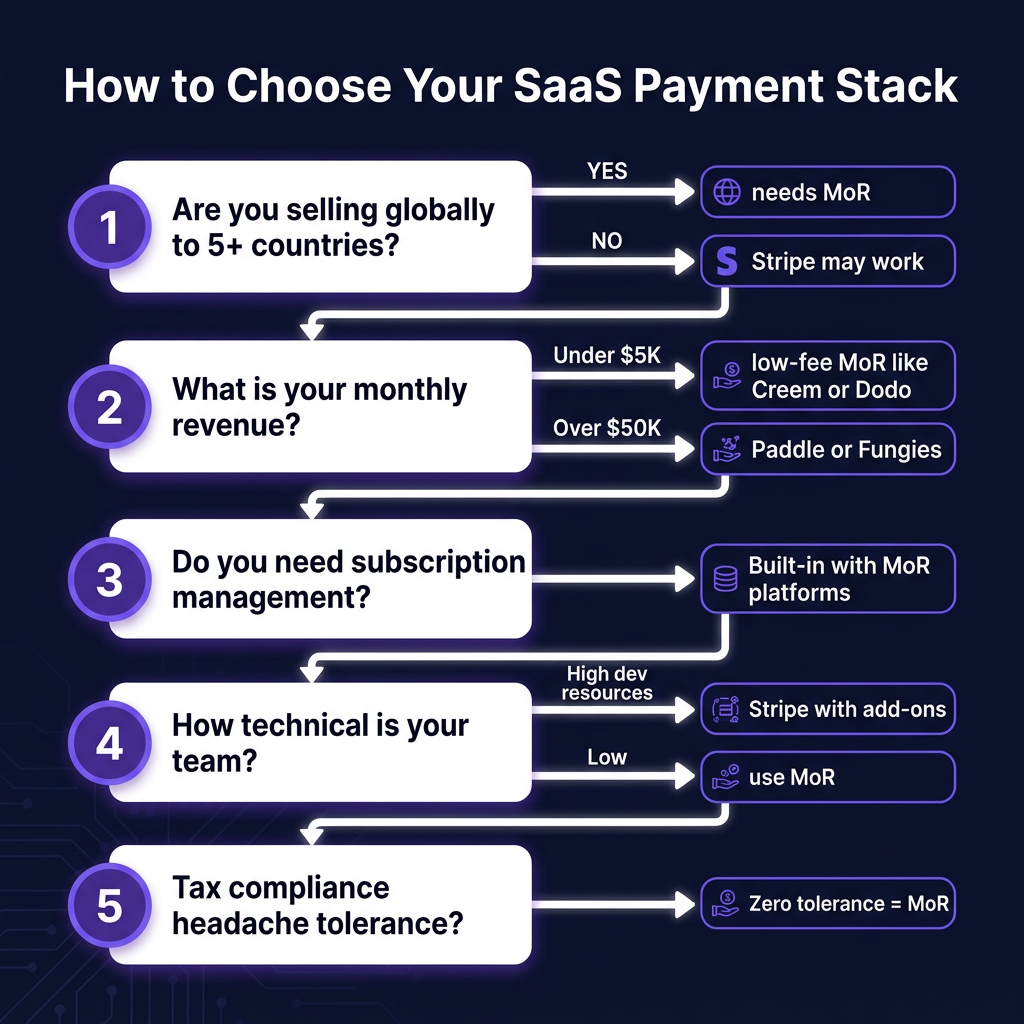
Ask yourself five questions:
- Are you selling to customers in 5+ countries? If yes, a MoR is almost certainly cheaper in total cost. If US-only B2B, Stripe works fine.
- What’s your MRR? Under $5K: Creem (0% first $1K, then 3.9% + $0.40). $5K–$100K: Fungies or Creem. $100K+: Paddle or negotiate with FastSpring.
- Do you have a dedicated ops/finance person? Yes: Stripe is manageable. No: don’t touch Stripe for global sales.
- How technical is your team? Need deep customization? Stripe. Want it working in 30 minutes? Any MoR.
- What are you selling? SaaS subscriptions + digital products: Fungies or Creem. Enterprise software + invoicing: Paddle or FastSpring. AI tools with usage billing: Dodo Payments.
Key Takeaways
- Stripe’s advertised 2.9% is often 5%+ in real-world global use once you add international fees, Stripe Tax, and compliance costs
- Merchant of Record platforms (Paddle, Creem, Dodo, Fungies) own your tax liability — you don’t file anything, period
- Creem offers the lowest MoR transaction fee in 2026 at 3.9% + $0.40, with 0% on first $1,000
- Paddle is battle-tested for mid-market SaaS but carries enterprise overhead at small scale
- Fungies.io offers a flat 5% MoR rate with embeddable checkout, zero monthly fee, and strong developer tooling for digital products and SaaS
FAQ
Is Stripe a Merchant of Record?
No. Stripe is a payment processor. When you use Stripe, you remain the merchant of record and are legally responsible for collecting and remitting all applicable taxes (VAT, GST, US sales tax) in every jurisdiction where you have customers. Stripe Tax can help you calculate and collect taxes, but you still need to file the returns — or hire an accountant to do it.
What is the cheapest Merchant of Record for SaaS in 2026?
Creem currently offers the lowest rates among full MoR platforms at 3.9% + $0.40 per transaction, with zero fees on your first $1,000 processed. Dodo Payments is competitive at 4% + $0.40 for domestic transactions. Fungies.io offers a flat 5% rate with no international surcharges. Paddle sits at 5% + $0.50.
When should I switch from Stripe to a Merchant of Record?
Switch when: you’re getting customers from multiple countries and spending time on tax compliance; when your effective Stripe rate (including international fees, Stripe Tax, and accounting costs) exceeds 5%; when you’re launching globally and don’t want compliance headaches from day one; or when a chargeback dispute absorbs more than 2 hours of your time per month.
Can I use Paddle and Stripe together?
Some companies do — Stripe for US B2B enterprise (with proper invoicing and reverse charge), Paddle or another MoR for B2C and international sales. But splitting your payment stack adds integration complexity. Most teams find it simpler to pick one and optimize from there.
Conclusion
The Stripe vs. Merchant of Record debate isn’t about ideology. It’s math. If you’re selling globally and spending time on tax compliance, you’re overpaying. Merchant of Record platforms exist to absorb that cost — and for most SaaS founders in 2026, the all-in cost of a MoR is lower than the Stripe stack once you account for compliance.
If you’re early-stage, Creem or Fungies give you MoR coverage with no upfront commitment. If you’re scaling into enterprise, Paddle or FastSpring. If you’re building AI tools with usage billing, Dodo Payments deserves a serious look.
Ready to drop the compliance headache and start selling globally without thinking about VAT? Start with Fungies.io — free to set up, no monthly fees, full MoR coverage from day one.