61% of SaaS companies now include some form of usage-based pricing in their billing stack. That number was 45% in 2021. Something shifted — and it wasn’t just a trend.
The shift happened because flat-rate subscriptions stopped making sense for infrastructure-heavy, API-driven products. When your cost structure is variable — compute, tokens, API calls — charging a fixed monthly fee creates a mismatch. You either price too high and lose customers, or price too low and kill your margins.
Usage-based pricing (UBP) fixes that alignment. But implementing it without rebuilding your entire billing stack? That’s where most founders get stuck.
This guide covers the pricing models, the tooling, the implementation steps, and the tradeoffs. No fluff. Just what you need to go from “we should probably do usage-based” to “it’s live.”
What Is Usage-Based Pricing (and Why It’s Winning)
Usage-based pricing means customers pay based on what they actually consume — API calls, tokens processed, storage used, seats activated, data transferred. Instead of a fixed fee, the bill reflects real activity.
It goes by several names: metered billing, consumption-based pricing, pay-as-you-go. Same idea, different contexts.
The reason it’s winning comes down to three things:
- Lower adoption barrier — A startup can start at $0 and scale up as they grow. No seat commitment required.
- Expansion revenue without sales — As customers grow, their bills grow. Net Revenue Retention (NRR) for UBP companies regularly hits 120%+ vs ~109% median for pure subscription models (Bessemer Venture Partners, 2025).
- Price-value alignment — Customers pay proportional to the value they receive. That reduces churn from “why am I paying for this when I barely use it.”
Public SaaS companies with predominantly usage-based pricing are growing at 25% vs 15% for subscription-only peers (OpenView Partners SaaS Benchmarks 2026). That’s not a coincidence.

The 5 Usage-Based Pricing Models (With Real Examples)
Not all usage-based pricing works the same way. Here are the five main models and when each makes sense:
1. Pay-As-You-Go
Pure consumption pricing. Every unit costs the same. No minimums, no tiers. OpenAI charges per 1M tokens. Twilio charges per SMS sent. AWS charges per compute-hour.
Best for: Developer tools, APIs, early-stage products with unpredictable customer scale. Risk: Revenue unpredictability. One big customer leaving removes a big chunk of MRR overnight.
2. Prepaid Credits
Customers buy a block of credits upfront. They consume them at their own pace. Credits expire (typically 12 months). Midjourney, Cursor, and many AI tools use this model.
Best for: AI products, video/image generation tools, anything with bursty usage patterns. Advantage: Cash flow is positive upfront. You recognize revenue as credits are consumed.
3. Tiered Usage
Different rate per unit at different volume thresholds. 0–10K API calls: $0.002/call. 10K–100K: $0.001/call. 100K+: $0.0005/call. Stripe, Cloudflare, and most infrastructure SaaS use this.
Best for: Products where unit costs drop at scale. Rewards high-usage customers without a fixed commitment.
4. Seat + Usage Hybrid
A base subscription fee per seat (predictable) plus usage-based charges for consumption (variable). HubSpot does this: per-seat CRM access plus per-email send fees. Intercom charges per seat plus per-message-sent.
Best for: Products with a mix of fixed features (dashboards, user management) and variable consumption (API calls, emails, AI features). This is the most common enterprise-friendly model.
5. Committed Spend / Annual Commits
Customer commits to a minimum spend ($1,000/month, $12,000/year) in exchange for a discount on usage rates. Common in cloud infrastructure (AWS Reserved Instances), and increasingly in SaaS. Orb and Metronome both support this natively.
Best for: Mid-market and enterprise customers who want price certainty. Gives you revenue predictability without locking them into rigid seats.
Comparison: Usage-Based Pricing Models at a Glance
| Model | Revenue Predictability | Expansion Potential | Customer Risk Tolerance | Best Stage |
|---|---|---|---|---|
| Pay-As-You-Go | Low | High | Low (no commitment) | Early/PLG |
| Prepaid Credits | Medium | Medium | Low | AI tools, early SaaS |
| Tiered Usage | Medium | High | Low-Medium | API products, dev tools |
| Seat + Usage Hybrid | High | High | Medium | SMB to Enterprise |
| Committed Spend | Very High | Medium | Medium-High | Mid-market, Enterprise |
How to Implement Usage-Based Pricing: 5 Steps
Here’s the honest implementation path. It’s not trivial, but it’s not a full rebuild either — if you choose the right tools.

Step 1: Define Your Billing Metric
The most important decision. Your billing metric needs to be:
- Tied to value — customers should intuitively understand why they’re paying more as they use more
- Measurable at the infrastructure level — you need to count it reliably, at scale
- Not gameable — customers shouldn’t be able to manipulate it to avoid bills
Common UBP metrics by product type:
- AI/LLM products: tokens processed, API calls, inference runs
- Developer tools: API requests, builds, deployments, compute-hours
- Analytics SaaS: events tracked, queries run, data volume
- Communication tools: messages sent, emails delivered, notifications triggered
- Storage/file products: GB stored, bandwidth, file operations
Step 2: Instrument Your Code
Every billable action needs to emit a usage event. This sounds simple — it’s not. The hard part is reliability. You need:
- Exactly-once delivery — dropped events = underbilling. Duplicate events = overbilling. Both are bad.
- Idempotency keys on your event ingestion so retries don’t double-count
- Async event emission — don’t block your API response waiting for billing confirmation
- Buffering and batching — if you’re sending millions of events, you need to batch them to avoid rate limits on the billing platform
A minimal event payload looks like this:
{
  "customerId": "cus_abc123",
  "eventName": "api_call",
  "timestamp": "2026-05-19T10:00:00Z",
  "idempotencyKey": "req_xyz789",
  "properties": {
    "endpoint": "/v1/generate",
    "tokens_used": 1200,
    "model": "pro"
  }
}
Step 3: Choose Your Billing Infrastructure
This is where most teams get stuck. You have four broad options:
Option A: Build on Stripe Billing — Stripe has metered billing support but it’s subscription-first architecture. Works fine for simple per-unit pricing at lower volumes. Rate limits at 100 events/sec become an issue around 10M metered calls/month. Good starting point for most SaaS products under $2M ARR.
Option B: Purpose-built metering platforms — Orb, Lago, Amberflo, m3ter, Schematic. These are designed specifically for complex usage-based pricing. Orb handles tiered pricing, ramp schedules, committed spend, and custom contract terms. Lago is open-source and self-hostable (data stays in your infra). Schematic adds entitlement management on top of billing. Typical cost: $500–$2,000/month, or revenue percentage.
Option C: Self-build — A database table of usage events + a billing aggregation job + Stripe invoicing. Viable for simple pricing. Becomes a nightmare at scale or when pricing gets complex. Don’t do this unless you have a specific reason.
Option D: Merchant of Record with UBP — Platforms like Fungies.io act as the MoR (handling global taxes, compliance, refunds) while also supporting usage-based billing models. The advantage: you don’t need to worry about EU VAT, US sales tax, or India GST on your metered charges. All of that gets handled. Worth considering if you’re selling globally and don’t want to deal with tax compliance on top of billing complexity.
Step 4: Configure Pricing Logic and Tiers
Once metering is wired up, you configure the pricing rules:
- Set your unit rates per metric
- Define tier breakpoints if using tiered pricing
- Configure overage rules for hybrid seat+usage plans
- Set up prepaid credit pools if applicable
- Define billing cadence (monthly in arrears is standard; credit depletion triggers immediate billing for prepaid)
One thing founders miss: hard limits vs. soft limits. A hard limit cuts off service when a customer hits their quota. A soft limit lets them continue (and charges overage). Enterprise customers expect soft limits with notification. Startups appreciate hard limits to control spend. You need both options.
Step 5: Monitor Expansion Revenue and Unit Economics
Usage-based pricing changes your key metrics. The traditional MRR/churn lens doesn’t tell the full story. You need to track:
- Net Revenue Retention (NRR) — should be 110%+ if UBP is working. Customers expanding automatically.
- Usage cohort analysis — which cohorts are growing vs. stagnating in consumption?
- Bill shock rate — % of customers who get a bill 2x+ larger than the previous month. High bill shock = churn risk.
- Floor revenue — the minimum you can count on. Usage can go down.
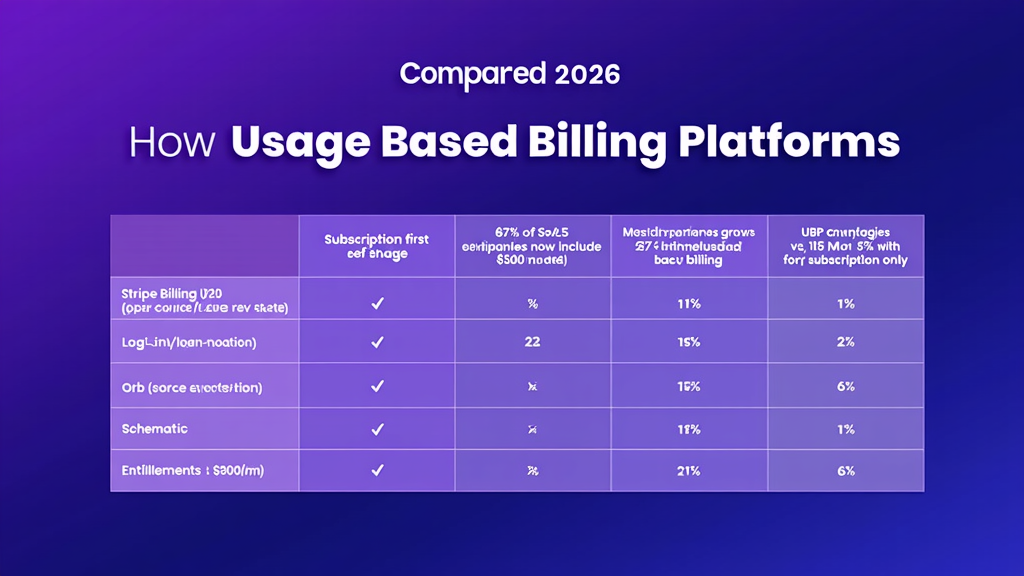
Billing Platform Comparison for SaaS in 2026
| Platform | Architecture | Pricing | Best For | Data Residency |
|---|---|---|---|---|
| Stripe Billing | Subscription-first + meters | 0.5–0.7% of revenue | Simple UBP, <$2M ARR | Stripe servers |
| Lago | Invoice-based metering | Free (open source) / $500+/mo cloud | Complex pricing, data control | Self-hosted or Lago cloud |
| Orb | Invoice-based metering | ~$500–$2,000/mo | Enterprise contracts, committed spend | Orb cloud |
| Schematic | Entitlements + billing | ~$500/mo+ | Feature flags + usage gating combined | Schematic cloud |
| Amberflo | Real-time metering | Custom / % of revenue | AI SaaS, real-time billing | Amberflo cloud |
| Fungies.io | MoR + usage billing | 2–5% of revenue | Global SaaS with tax compliance needs | Fungies servers |
The Common Mistakes That Break UBP Implementations
Mistake 1: Choosing a metric customers can’t understand
If customers can’t predict their bill, they’ll churn. “Compute units” is confusing. “API calls” is clear. Always test your billing metric by asking a customer: “Can you estimate your bill at the end of the month?” If they can’t, change the metric.
Mistake 2: No spend controls
Usage can spike. A bug in a customer’s code can generate millions of API calls in minutes. Without spend caps, you’ll face either a massive underbilling (if you absorb the cost) or a customer support disaster (if you charge them). Implement per-customer monthly spend limits with configurable alerts at 80% and hard limits at 100%.
Mistake 3: Billing in arrears with no deposits
Pure pay-as-you-go with monthly billing means you extend credit to every customer. For low-trust customers or high-volume products, this is a bad idea. Require a payment method on file. For high-volume customers, require prepaid credits or a deposit equal to one month’s expected bill.
Mistake 4: Ignoring the tax layer
Usage-based invoices go to global customers. A $500 SaaS invoice to a French business triggers EU VAT reporting. A $200 invoice to a California startup triggers US sales tax in some jurisdictions. If you’re not using a Merchant of Record, you need to layer tax compliance on top of your billing infrastructure. That’s either a significant engineering project or a third-party integration (TaxJar, Anrok, Avalara).
Mistake 5: Building too complex too early
Start simple. One metric, one rate. Get it live, get feedback. Add tiers after you see how customers actually use the product. Many teams spend 3 months building elaborate pricing logic before a single customer has seen it. Ship the simple version.
Key Takeaways
- Usage-based pricing works because it aligns cost with value — customers who get more out of the product pay more. NRR for UBP companies averages 120%+ vs 109% for subscription-only.
- Pick the right metric first — it should be tied to value, measurable, and intuitive. API calls, tokens, and storage are generally safe choices. “Compute units” is not.
- Start with Stripe Billing if you’re under $2M ARR. Graduate to Lago, Orb, or Schematic when you need committed spend, ramp schedules, or complex contract terms.
- Don’t ignore the tax layer — global UBP invoices trigger VAT, GST, and sales tax obligations. A Merchant of Record handles this automatically; DIY requires dedicated compliance infrastructure.
- Monitor bill shock and NRR, not just MRR. UBP changes your revenue dynamics fundamentally — you need different metrics to understand what’s happening.
FAQ
What’s the difference between usage-based pricing and metered billing?
They’re the same thing. Metered billing is the infrastructure mechanism (measuring consumption and billing based on it). Usage-based pricing is the commercial model. The terms are often used interchangeably. Technically, you implement usage-based pricing by building a metered billing system.
How does usage-based pricing affect revenue forecasting?
It makes forecasting harder. You lose the predictability of fixed MRR. The solution is to track usage trends per cohort: how much does a typical customer’s usage grow month-over-month? Build a probabilistic forecast range rather than a point estimate. Also: floor revenue (minimum committed spend from annual contracts) provides a predictable base to build from.
Can I use usage-based pricing on Stripe without a third-party billing platform?
Yes, for simple cases. Stripe Billing has native metered subscription support. You create a price with usage_type: "metered", report usage via the UsageRecords API, and Stripe bills at cycle end. It works well for single-metric pricing at lower volumes. It gets painful when you need tiered pricing, committed spend, or multiple billing dimensions simultaneously.
What does a Merchant of Record handle that a billing platform doesn’t?
A billing platform (Stripe, Orb, Lago) handles metering, pricing logic, and invoice generation. It doesn’t handle global tax compliance. A Merchant of Record (MoR) like Fungies.io sits between you and the customer legally — it’s the entity of record for the sale, which means it handles EU VAT, US sales tax, Australian GST, and other jurisdictional obligations. For global SaaS, combining a metering platform with an MoR gives you full coverage without building tax infrastructure yourself.
Conclusion
Usage-based pricing isn’t just a trend — it’s the natural evolution of SaaS billing as products become more infrastructure-heavy and consumption-driven. The math is clear: UBP companies grow faster, retain more revenue, and expand automatically as customers succeed.
The implementation challenge is real, but manageable. Define your metric carefully, instrument your code reliably, pick the right billing infrastructure for your stage, and don’t skip the tax layer.
If you’re building a SaaS product and want usage-based billing with global tax compliance handled out of the box, Fungies.io handles both — metered billing plus Merchant of Record status in 100+ countries. No separate tax integration required.
References
- OpenView Partners SaaS Benchmarks 2026 — openviewpartners.com
- Bessemer Venture Partners, “State of the Cloud” Report 2025 — bvp.com
- Schematic: Usage-Based Billing Explained for SaaS Teams (2026) — schematichq.com
- Abaxus: 7 Best Usage-Based Billing Platforms for SaaS in 2026 — abaxus.software
- Credyt: Usage-Based Billing Software in 2026 — credyt.ai
- Ordway Labs: Usage-Based Pricing for SaaS: 8 Stats on Revenue Predictability — ordwaylabs.com
- Stripe: Usage-Based Billing — stripe.com