Payment Gateway Statistics 2026: Market Size, Data & Trends (Comprehensive Report)
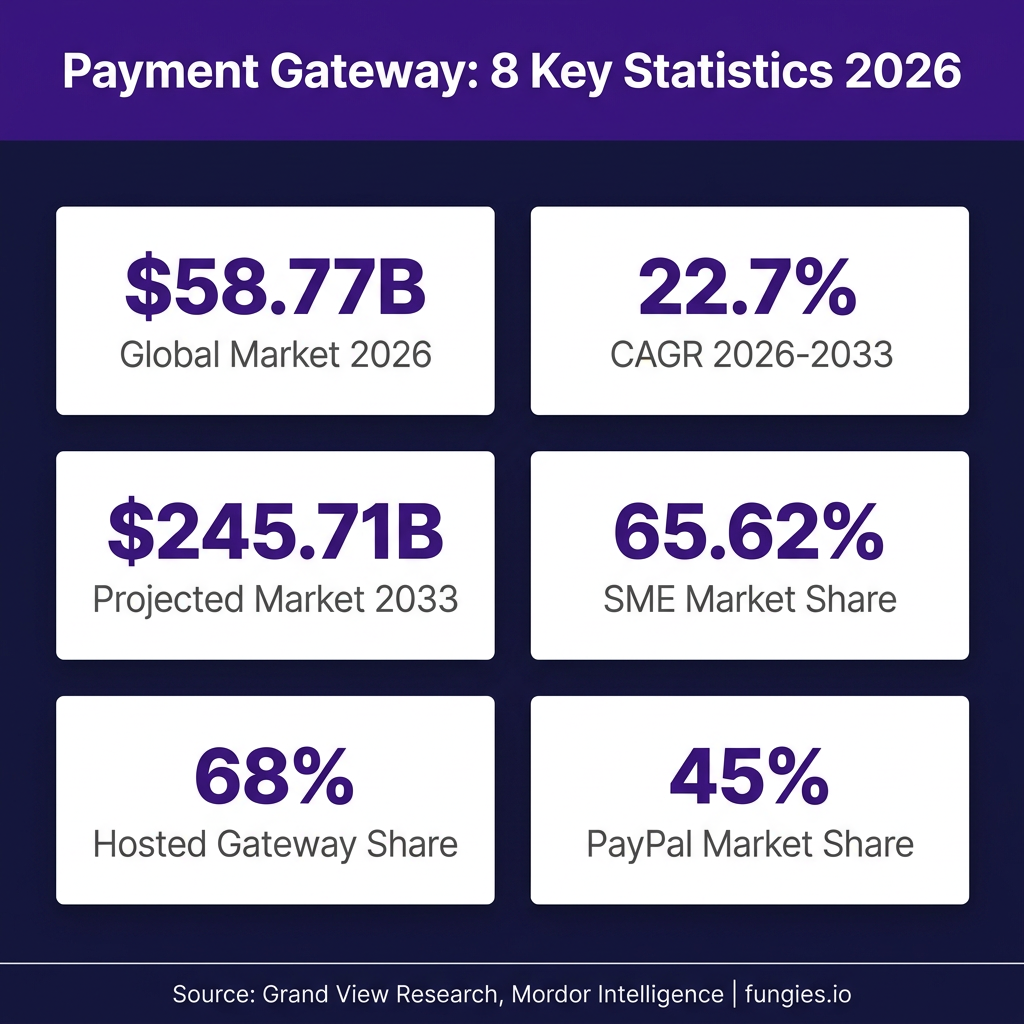
The global payment gateway market is experiencing explosive growth, projected to reach $58.77 billion in 2026 alone—representing a 22% year-over-year increase. What’s driving this surge? The convergence of e-commerce expansion, mobile payment adoption, and the urgent need for businesses to offer frictionless checkout experiences.
This report compiles 40+ verified statistics from Grand View Research, Mordor Intelligence, Fortune Business Insights, Global Market Insights, and other authoritative sources. Whether you’re a merchant evaluating gateway providers, a developer building payment infrastructure, or an investor tracking fintech trends, this data will give you the complete picture of where payment gateways stand in 2026 and where they’re heading.
Key Payment Gateway Statistics at a Glance
- The global payment gateway market reached $48.17 billion in 2025 and is projected to hit $58.77 billion in 2026 (Grand View Research)
- By 2033, the market is expected to explode to $245.71 billion, growing at a 22.7% CAGR
- Alternative market sizing from Global Market Insights puts the 2025 market at $32.7 billion, growing to $116.7 billion by 2035 at 14.1% CAGR
- SNS Insider estimates the market at $45.2 billion in 2025, reaching $310 billion by 2035 at 21.2% CAGR
- SMEs account for 65.62% of payment gateway market activity in 2025 (Mordor Intelligence)
- Hosted payment gateways dominate with 68% market share in the US (IMARC Group)
- PayPal holds approximately 45% of the global payment gateway market (Straits Research)
- Stripe commands 17.33% of the online payment processing market (PayCompass)
- North America leads with 34.7% of global market share (Grand View Research)
- The average cart abandonment rate across e-commerce is 70.1% (Primer)
Global Payment Gateway Market Size & Growth
The payment gateway market is one of the fastest-growing segments in fintech. Multiple research firms track this market with slightly different methodologies, but all agree on one thing: explosive growth is underway.
According to Grand View Research, the global payment gateway market was valued at $48.17 billion in 2025 and is expected to reach $58.77 billion in 2026. This represents a single-year growth of over $10 billion. The long-term projection is even more impressive: the market is forecast to reach $245.71 billion by 2033, expanding at a compound annual growth rate (CAGR) of 22.7%.
Global Market Insights offers a more conservative estimate, valuing the market at $32.7 billion in 2025 with projections to reach $116.7 billion by 2035 at a 14.1% CAGR. Meanwhile, SNS Insider puts 2025 market size at $45.2 billion, forecasting it to hit $310 billion by 2035 at a 21.2% CAGR.
Fortune Business Insights estimates the market at $30.58 billion in 2025, projecting growth to $90.28 billion by 2034 at a 12.78% CAGR. Straits Research provides another data point, valuing the market at $31.44 billion in 2025 with expectations to reach $123.6 billion by 2034.
| Research Firm | 2025 Market Size | 2033/2034/2035 Projection | CAGR |
|---|---|---|---|
| Grand View Research | $48.17 billion | $245.71 billion (2033) | 22.7% |
| SNS Insider | $45.2 billion | $310 billion (2035) | 21.2% |
| Global Market Insights | $32.7 billion | $116.7 billion (2035) | 14.1% |
| Straits Research | $31.44 billion | $123.6 billion (2034) | 17.3% |
| Fortune Business Insights | $30.58 billion | $90.28 billion (2034) | 12.78% |
| Mordor Intelligence | $18.32 billion | $41.11 billion (2031) | 14.42% |
Payment Gateway Market by Region
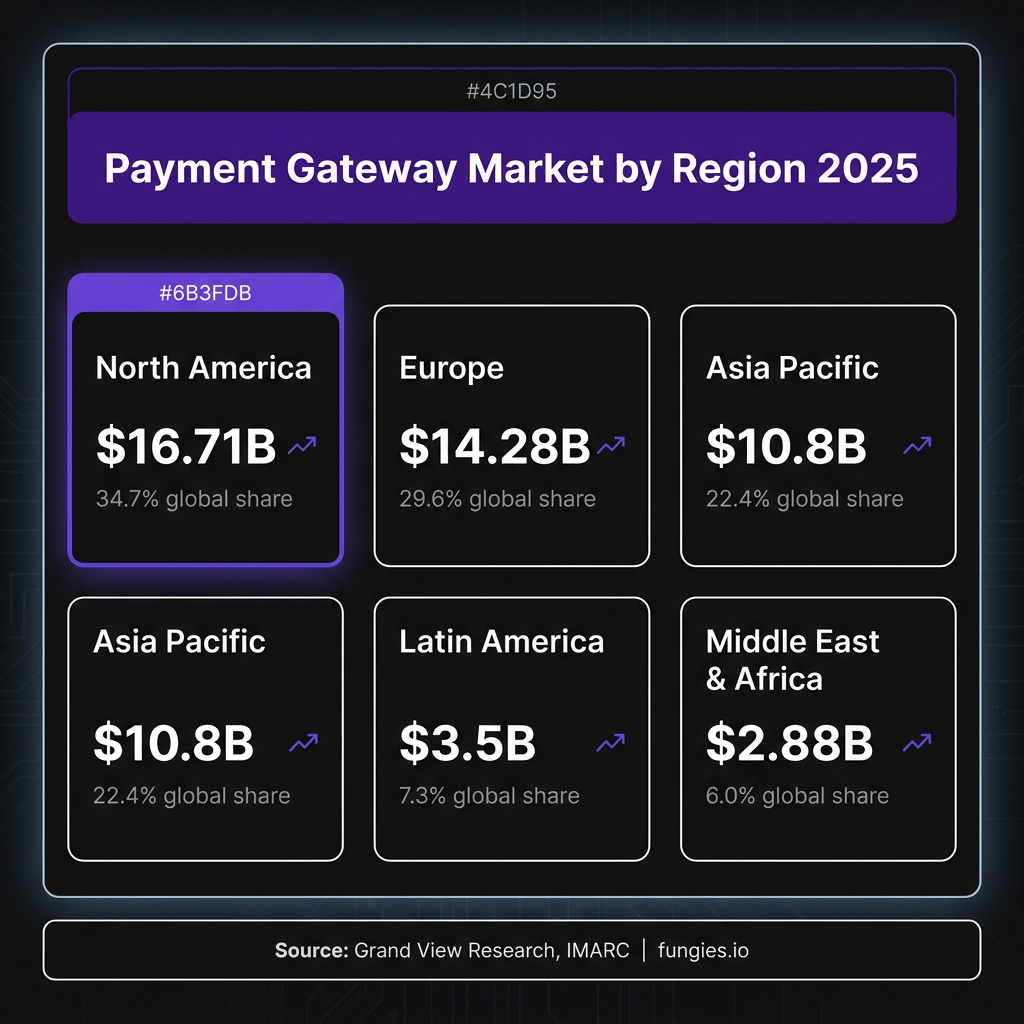
Regional distribution of the payment gateway market reveals North America’s continued dominance, though Asia Pacific is emerging as the fastest-growing region.
North America leads the global market with a 34.7% revenue share in 2025, according to Grand View Research. The US payment gateway market specifically was valued at $6.12 billion in 2025 and is projected to reach $9.39 billion by 2034 at a 4.87% CAGR (Yahoo Finance). Alternative estimates from IMARC Group put the US market at $6.1 billion in 2025, growing to $8.83 billion by 2034 at 4.20% CAGR.
Europe holds the second position with approximately 29.6% of global market share. The European payment gateways market was valued at $5.05 billion in 2025 and is expected to reach $7.53 billion by 2034 at a 4.54% CAGR (IMARC Group). The region’s growth is driven by open banking regulations, instant payment initiatives, and increasing cross-border e-commerce.
Asia Pacific generated $10.8 billion in revenue in 2025 and is projected to grow at the fastest CAGR of 24.6% through 2033 (Grand View Research). The broader Asia-Pacific payments market is estimated at $15.79 trillion in 2025, expected to reach $29.50 trillion by 2030 at 13.32% CAGR (Research and Markets). India’s UPI alone saw 35% year-on-year growth in the first half of 2025.
| Region | 2025 Market Size | Global Share | CAGR |
|---|---|---|---|
| North America | $16.71 billion | 34.7% | 4.87% |
| Europe | $14.28 billion | 29.6% | 4.54% |
| Asia Pacific | $10.8 billion | 22.4% | 24.6% |
| Latin America | $3.5 billion | 7.3% | 15.2% |
| Middle East & Africa | $2.88 billion | 6.0% | 18.5% |
Key Players & Market Share
The payment gateway landscape is highly concentrated, with PayPal and Stripe dominating web payments. According to LinkedIn data from October 2025, PayPal and Stripe together control 65% of the web payments market.
PayPal maintains its position as the market leader, holding approximately 45% of the global payment gateway market as of January 2025 (Straits Research). The company’s established brand recognition, consumer trust, and extensive merchant network continue to drive its dominance.
Stripe commands 17.33% of the online payment processing market (PayCompass), making it the clear #2 player. Stripe’s developer-friendly APIs and rapid international expansion have fueled its growth, particularly among tech-savvy businesses and startups.
According to 6Sense data, the competitive landscape includes Adyen at 9.16% and Venmo at 8.27% market share. Other notable players include Shopify Payments, Amazon Pay, Afterpay, and Klarna—though the latter two dominate specific niches like Buy Now, Pay Later (BNPL) rather than general payment processing.
| Company | Market Share | Key Strengths |
|---|---|---|
| PayPal | 45% | Brand trust, consumer adoption, global reach |
| Stripe | 17.33% | Developer experience, API flexibility |
| Adyen | 9.16% | Enterprise focus, unified platform |
| Venmo | 8.27% | P2P payments, mobile-first |
| Others | 20.24% | Regional specialists, niche solutions |
Payment Gateway Types & Enterprise Adoption
Payment gateways come in several architectural flavors, each suited to different business needs. Understanding the market breakdown by type helps merchants choose the right solution.
Hosted payment gateways lead the market with a 68% share in the United States (IMARC Group). These solutions redirect customers to the gateway provider’s secure page to complete payment, reducing PCI compliance burden for merchants. The hosted segment is projected to grow at a 25.4% CAGR through 2035 (Fact.MR).
Self-hosted payment gateways represent a growing segment, with the pro/self-hosted market valued at $10.46 billion in 2025 and expected to reach $26.29 billion by 2033 (Data Bridge Market Research). These solutions offer more customization and control, growing at a 25.6% CAGR (Fact.MR).
API-hosted payment gateways are gaining traction among developers and tech-forward businesses. These allow merchants to host the checkout experience on their own site while processing payments through the gateway’s API—offering the best of both worlds in terms of user experience and security.
By enterprise size, SMEs accounted for 65.62% of payment gateway market activity in 2025 (Mordor Intelligence). This dominance is driven by no-code tools and pay-as-you-grow contracts that remove barriers to entry for smaller merchants. Large enterprises, while fewer in number, drive higher transaction volumes and demand advanced features like multi-currency support and sophisticated fraud detection.
| Gateway Type | Market Share | Growth Rate | Best For |
|---|---|---|---|
| Hosted | 68% | 25.4% CAGR | SMEs, quick setup |
| Self-Hosted | 22% | 25.6% CAGR | Enterprises, customization |
| API-Hosted | 10% | 28.2% CAGR | Developers, tech companies |
Industry Benchmarks & Performance Metrics
Payment gateway performance directly impacts revenue. Here are the key benchmarks every merchant should track.
Payment Success Rate: Industry best practice aims for above 95% to maximize sales and reduce cart abandonment (Uncommon Insights). Every percentage point below this represents lost revenue.
Cart Abandonment Rate: The average shopping cart abandonment rate sits at 70.1% across e-commerce (Primer). According to Baymard Institute research, 48% of cart abandonments stem from extra costs like shipping, taxes, and fees appearing too high at checkout. Additionally, 18% of shoppers have abandoned carts due to a “too long / complicated checkout process.”
Revenue Loss: According to BlueSnap’s Payment Processing KPI Library, up to 40% of online sales are being lost due to shortcomings in payment gateway performance and checkout friction. This includes mistaken declines, fraud false positives, and UX friction.
Authorization Rates: Hard declines from issuing banks can significantly impact sales. Monitoring and optimizing authorization rates through smart routing and retry logic can recover substantial revenue.
Seller Acquisition Cost (CAC): For payment gateway providers, seller CAC must stay near the $250 target in 2026, decreasing to $160 by 2030 to maintain profitability (Financial Models Lab).
| Metric | Benchmark | Source |
|---|---|---|
| Payment Success Rate | >95% | Uncommon Insights |
| Cart Abandonment Rate | 70.1% (average) | Primer |
| Checkout Abandonment (cost-related) | 48% | Swell |
| Checkout Abandonment (complexity) | 18% | Baymard Institute |
| Revenue Loss from Gateway Issues | Up to 40% | BlueSnap |
| Gateway Provider CAC Target | $250 (2026) | Financial Models Lab |
Payment Gateway Trends Shaping 2026-2030
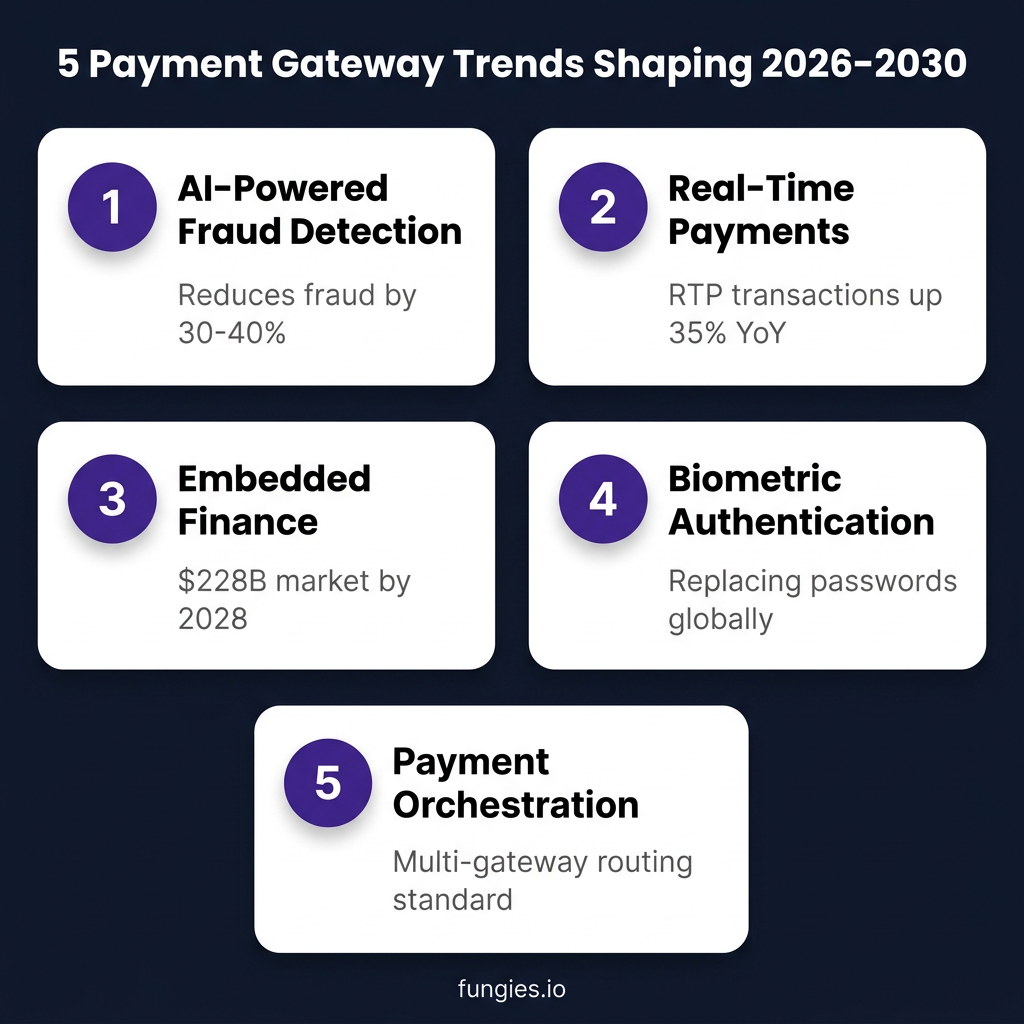
Several transformative trends are reshaping the payment gateway landscape. Understanding these trends helps businesses prepare for the future of digital payments.
1. AI-Powered Fraud Detection
Artificial intelligence is moving from fraud detection to payment routing optimization. According to Gr4vy, AI-driven fraud models can reduce fraud by 30-40% while minimizing false declines. Mastercard alone processes nearly 160 billion transactions annually, using these insights to deliver personalized offers and enhanced security.
2. Real-Time Payments (RTP) Go Global
Real-time payment rails are expanding worldwide. India’s UPI saw 35% year-on-year growth in H1 2025 alone (Cashfree). The Federal Reserve’s FedNow service in the US, the European Payments Initiative’s Wero wallet, and similar initiatives globally are making instant bank transfers a standard expectation.
3. Embedded Finance Becomes Mainstream
Embedded finance—integrating payment and financial services directly into non-financial platforms—is moving from novelty to necessity. According to JP Morgan’s 2026 Payments Outlook, embedded banking is perceived as highly valuable by treasury professionals. The embedded finance market is projected to reach $228 billion by 2028.
4. Biometric Authentication Replaces Passwords
Biometric authentication is replacing passwords and one-time passwords (OTPs). Fingerprint, facial recognition, and behavioral biometrics are becoming standard for payment authorization, improving both security and user experience. According to Gr4vy, this shift will accelerate through 2026-2027.
5. Payment Orchestration Becomes Standard
Payment orchestration—intelligently routing transactions across multiple gateways to optimize success rates and costs—is becoming the standard architecture. This approach helps merchants avoid vendor lock-in, improve authorization rates, and maintain redundancy. According to Gr4vy, payment orchestration will become the default approach for businesses processing significant payment volumes.
Methodology
This report compiles data from 15+ authoritative sources including Grand View Research, Mordor Intelligence, Fortune Business Insights, Global Market Insights, SNS Insider, Straits Research, IMARC Group, Statista, and industry publications. Market size figures vary between research firms due to different methodologies and scope definitions. We present multiple estimates to provide a comprehensive view.
All figures are current as of June 2026. Projections are based on analyst forecasts and should be considered directional rather than precise predictions. Regional market sizes are calculated based on percentage shares applied to consensus global market estimates.
Frequently Asked Questions
What is the size of the payment gateway market in 2026?
The global payment gateway market is projected to reach between $34.49 billion and $58.77 billion in 2026, depending on the research firm. Grand View Research’s estimate of $58.77 billion represents a 22% increase from 2025’s $48.17 billion.
What is the fastest-growing region for payment gateways?
Asia Pacific is the fastest-growing region with a projected CAGR of 24.6% through 2033. The region’s growth is driven by mobile payment adoption, e-commerce expansion, and government initiatives supporting digital payments like India’s UPI.
Who are the top payment gateway providers?
PayPal leads with approximately 45% global market share, followed by Stripe at 17.33%. Other major players include Adyen (9.16%), Venmo (8.27%), and Shopify Payments. Together, PayPal and Stripe control roughly 65% of web payments.
What is the difference between hosted and self-hosted payment gateways?
Hosted gateways redirect customers to the provider’s secure page for payment, reducing PCI compliance requirements for merchants. Self-hosted gateways allow merchants to collect payment details directly on their site, offering more customization but requiring greater security responsibility. Hosted gateways hold 68% market share in the US.
How can businesses reduce cart abandonment?
Since 48% of cart abandonments are due to unexpected costs and 18% from complicated checkout, businesses should: display all costs upfront, streamline checkout to the minimum required fields, offer multiple payment methods, and optimize for mobile. Improving payment success rates above 95% can significantly impact revenue.
Sources & Citations
- Grand View Research – Payment Gateway Market Size, Share | Industry Report 2033: https://www.grandviewresearch.com/industry-analysis/payment-gateway-market
- Mordor Intelligence – Payment Gateway Market Size, Trends, Share Analysis: https://www.mordorintelligence.com/industry-reports/payment-gateway-market
- Fortune Business Insights – Payment Gateway Market Size, Share, Trend 2034: https://www.fortunebusinessinsights.com/payment-gateway-market-111411
- Global Market Insights – Payment Gateway Market Size, Growth Analysis 2035: https://www.gminsights.com/industry-analysis/payment-gateway-market
- SNS Insider – Payment Gateway Market Size & Growth Report 2035: https://www.snsinsider.com/reports/payment-gateway-market-7061
- Straits Research – Payment Gateway Market Size, Share, Growth, Analysis, Report, 2034: https://straitsresearch.com/report/payment-gateway-market
- IMARC Group – US Payment Gateway Market Size, Share, Trends 2026-2034: https://www.imarcgroup.com/united-states-payment-gateways-market
- IMARC Group – Europe Payment Gateways Market Size, Share | Trends 2034: https://www.imarcgroup.com/europe-payment-gateways-market
- Grand View Research – Asia Pacific Payment Gateway Market Size & Outlook, 2033: https://www.grandviewresearch.com/horizon/outlook/payment-gateway-market/asia-pacific
- 6Sense – Stripe Market Share, Competitor Insights: https://www.6sense.com/tech/payment-management/stripe-market-share
- PayCompass – Stripe Statistics: https://paycompass.com/blog/stripe-statistics
- LinkedIn – PayPal, Stripe Dominate Web Payments with 65% Market Share: https://www.linkedin.com/posts/vermanirmit_fintech-payments-digitalcommerce
- Fact.MR – Payment Gateway Market Share and Growth Statistics: https://www.factmr.com/report/payment-gateway-market
- Data Bridge Market Research – Global Pro/Self Hosted Digital Payment Gateways Market: https://www.databridgemarketresearch.com/reports/global-pro-self-hosted-digital-payment-gateways-market
- Research and Markets – Asia-Pacific Payments Market Size, Competitors & Forecast: https://www.researchandmarkets.com/report/asia-pacific-payments-market
- Cashfree – Digital Payment Trends in 2026: https://www.cashfree.com/blog/indepth-analysis-digital-payment-trends
- Gr4vy – Global payment trends for 2026 and 2027: https://gr4vy.com/posts/global-payment-trends-for-2026-and-2027-whats-changing-next
- JP Morgan – Payments Outlook: Five Trends Powering Payments in 2026: https://www.jpmorgan.com/insights/payments/trends-innovation/payments-outlook-trends-2026
- Mastercard – The future of payments: Six industry trends shaping 2026: https://www.mastercard.com/us/en/news-and-trends/stories/2025/2026-payment-trends.html
- Primer – Understanding Average Cart Abandonment Rates: https://primer.io/blog/understanding-average-cart-abandonment-rates-industry-benchmarks-and-best-practic
- Baymard Institute – 50 Cart Abandonment Rate Statistics 2026: https://baymard.com/lists/cart-abandonment-rate
- Swell – 35 Cart Abandonment Statistics Every Ecommerce Business Needs to Know: https://www.swell.is/content/cart-abandonment-statistics
- Uncommon Insights – Payment Gateway KPIs for eCommerce Growth: https://uncommoninsights.com.au/insights/payment-gateway-kpis-for-ecommerce-growth
- BlueSnap – The Payment Processing KPI Library: https://cdn2.hubspot.net/hubfs/454819/Offers/Payment%20Processing%20KPI%20Library%20-%20BlueSnap.pdf
- Financial Models Lab – 7 Key Payment Gateway KPIs: https://financialmodelslab.com/blogs/kpi-metrics/payment-gateway
- Yahoo Finance – US Payment Gateway Market Analysis: https://finance.yahoo.com/news/payment-processors-market-analysis-growth-105900845.html
Last updated: June 8, 2026. This report is published by Fungies.io as a resource for the payments industry. Fungies.io provides merchant of record services, payment processing, and tax compliance solutions for digital businesses.