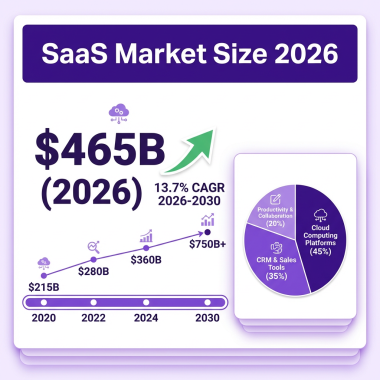
Sixty-one percent of SaaS companies have already switched to some form of usage-based pricing — and the ones that did it right are growing 38% faster than their per-seat peers. If you’re still charging a flat monthly fee while your customers use wildly different amounts of your product, you’re leaving money on the table and creating churn risk at the same time.
This guide covers everything: what usage-based pricing actually is, the four billing models you can choose from, real implementation steps with specific tooling, and the tradeoffs nobody talks about — like revenue predictability and sales compensation complexity.
Whether you’re building a new SaaS product, an AI tool, or migrating an existing subscription product, this is the implementation guide I wish existed when I was figuring this out.
What Is Usage-Based Pricing for SaaS?
Usage-based pricing (UBP) — also called consumption-based pricing or metered billing — means customers pay based on what they actually consume, not for access to the software. Instead of $99/month regardless of how much they use, they pay per API call, per GB stored, per message sent, per active user, or per AI token processed.
It’s not new. AWS pioneered it with cloud infrastructure. Twilio built a $20B+ company on it charging $0.0079 per SMS. Stripe charges 2.9% + 30¢ per transaction. Snowflake charges per compute credit. What’s new is that indie SaaS and AI apps are now adopting it too — not just infrastructure giants.
The core premise: revenue grows when customers succeed. That alignment is the reason it works so well.
The 4 Usage-Based Pricing Models (With Real Examples)
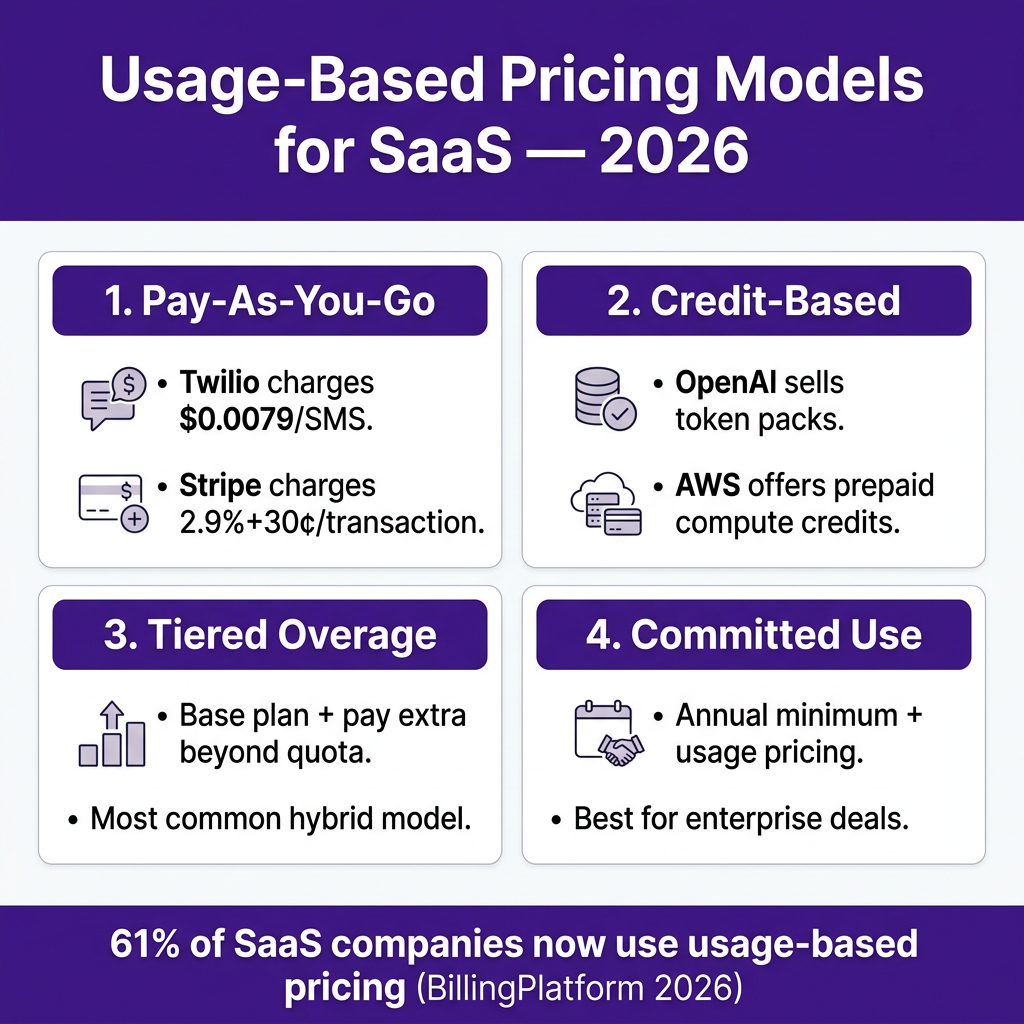
There’s no single “usage-based model.” There are four distinct approaches, each with different revenue characteristics and implementation complexity:
1. Pure Pay-As-You-Go
Customers pay only for what they use, with no base fee. Low barrier to entry, but revenue can be unpredictable and it’s harder to forecast.
- Twilio: $0.0079/SMS sent or received
- SendGrid: From $0.00060/email at scale
- AWS Lambda: $0.20 per 1 million requests
Best for: Developer tools, API products, infrastructure services. Not great for early-stage SaaS that needs monthly recurring revenue (MRR) predictability.
2. Credit-Based Pricing
Customers buy a pack of credits upfront and spend them on usage. You get revenue upfront; they get flexibility. This is the dominant model for AI products in 2026.
- OpenAI: Sells prepaid token credits (API usage)
- Anthropic Claude: Token packs for API customers
- Midjourney: Monthly plans with image generation credits
Best for: AI/LLM tools, image generation, video processing — any product with variable COGS per action.
3. Tiered Overage (Hybrid)
Customers pay a flat base subscription that includes a usage quota. Beyond that quota, they pay per unit. This is the most common model in 2026 because it balances predictability with scalability.
- HubSpot: Base plan includes X contacts; pay per 1,000 beyond that
- Intercom: Monthly plan with seat + usage limits
- Mailchimp: Free tier up to 500 contacts, then tiered pricing
Best for: Most B2B SaaS — it gives you predictable MRR while capturing expansion revenue from power users.
4. Committed Use / Annual Minimums
Customers commit to a minimum spend over a contract period, then pay usage rates on top. Standard in enterprise deals. Gives you revenue predictability while they get discounted rates.
- Snowflake: Pre-purchased compute credits with committed contract minimums
- Google Cloud: Committed use discounts (1-year or 3-year)
- Datadog: Annual contracts with committed spend tiers
Best for: Enterprise SaaS, infrastructure products, teams with direct sales motions.
| Model | Revenue Predictability | Barrier to Entry | Expansion Revenue | Best For |
|---|---|---|---|---|
| Pure Pay-As-You-Go | Low | Very Low | High | APIs, developer tools |
| Credit-Based | Medium (upfront) | Low | Medium | AI tools, LLM apps |
| Tiered Overage | High (base) + variable | Medium | Very High | B2B SaaS, PLG products |
| Committed Use | Very High | High | Medium | Enterprise SaaS |
Why Usage-Based Pricing Is Taking Over in 2026
The numbers are pretty clear at this point:
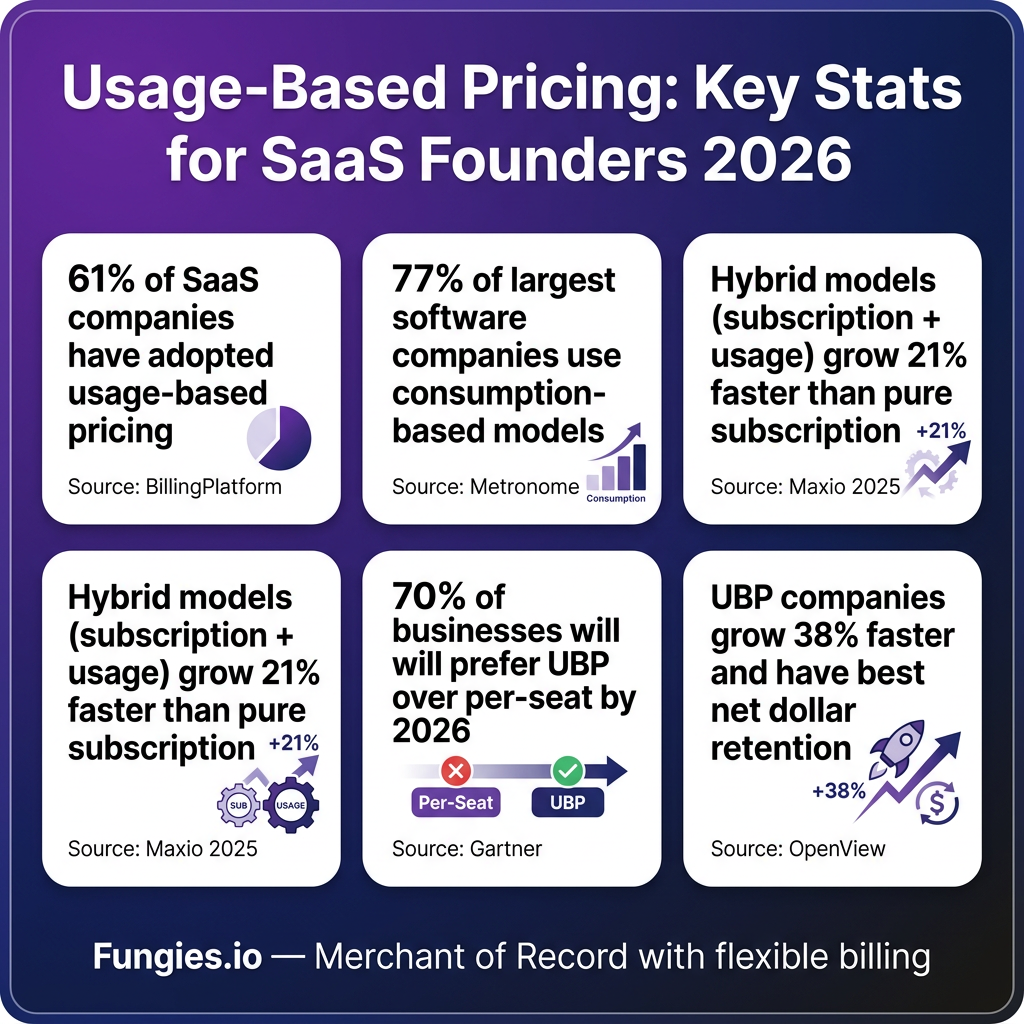
- 61% of SaaS companies have adopted some form of usage-based pricing (BillingPlatform, 2026)
- 77% of the largest software companies incorporate consumption-based pricing (Metronome State of UBP 2025)
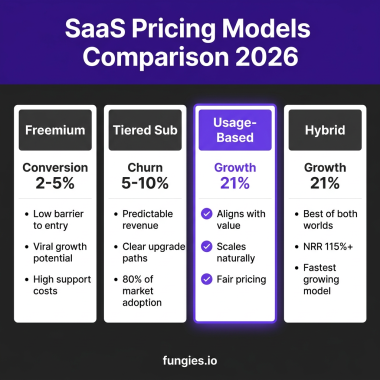
- Companies using hybrid models (subscription + usage) report the highest median growth rate of 21%, outperforming pure subscription companies (Maxio 2025 Pricing Trends Report)
- Gartner predicts 70% of businesses will prefer usage-based pricing over per-seat models by 2026
- OpenView research: UBP companies grow 38% faster and 7 of 9 best-performing recent IPOs had usage-based models with best net dollar retention
The shift is driven by three forces. First, buyers changed: enterprise procurement teams got burned by shelfware — paying for 500 seats when 80 people actually used the product. Second, AI changed cost structures: when your COGS varies massively per customer based on GPU usage, flat pricing means you lose money on power users. Third, product-led growth (PLG) changed acquisition: a low-cost trial that scales with usage is a much easier sell than an upfront commitment.
How to Choose Your Value Metric
This is the most important decision you’ll make. Your value metric is the thing you measure and charge for. Get it wrong and customers feel nickel-and-dimed. Get it right and pricing scales naturally with the value they receive.
Rules for picking a good value metric:
- It should scale with customer success. If a customer gets more value from your product, they should naturally use more of the metric — and pay more. API calls work for this. “Number of emails in the system” doesn’t.
- It should be easy to understand. Customers need to predict their bill. “Compute units” is confusing. “Emails sent” is clear.
- It should be hard to game. If customers can hack around the metric to reduce their bill without actually reducing value, you’ve got a bad metric.
- It should align with your COGS. If your infrastructure cost scales with data processed, that’s a natural billing unit.
| Product Type | Recommended Value Metric | Real Example |
|---|---|---|
| Email/messaging tool | Emails sent / contacts reached | Mailchimp charges per contact |
| API product | API calls / requests | Twilio charges per SMS/call |
| AI/LLM tool | Tokens processed / API calls | OpenAI charges per 1M tokens |
| Data/analytics SaaS | Records processed / data queried | Snowflake charges per compute credit |
| Storage tool | GB stored / bandwidth used | AWS S3 charges per GB/month |
| eCommerce/payments | GMV / transactions processed | Stripe charges % per transaction |
| Collaboration SaaS | Active users (not seats) | Notion charges per active workspace member |
One thing worth noting: Fungies.io (merchant of record for SaaS) supports flexible billing configurations including one-time charges, subscriptions, and usage-based overages — so whatever metric you choose, you don’t have to build the billing infrastructure yourself. You can wire up usage events and we handle the invoicing, tax collection, and payouts.
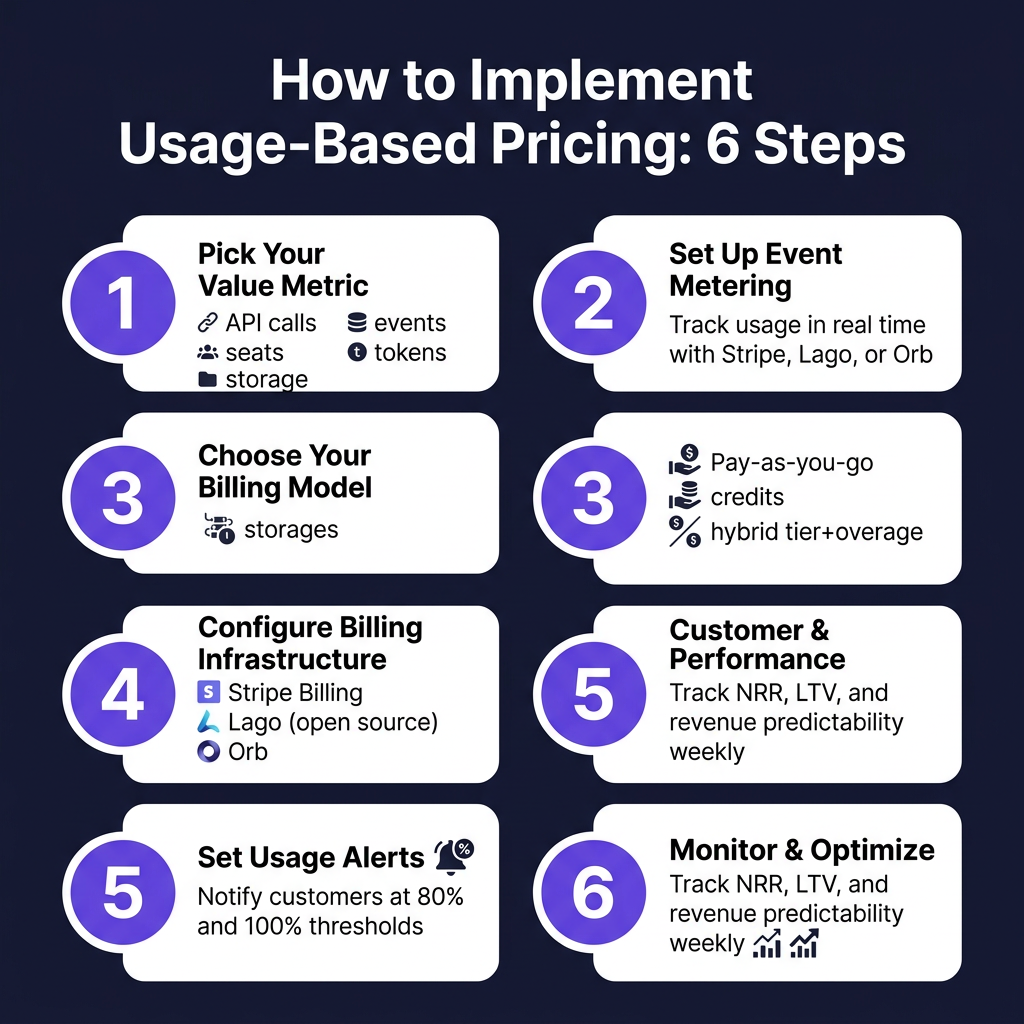
The 6-Step Implementation Guide
Step 1: Pick Your Value Metric (and validate it with customers)
Before you write a line of code, talk to 10 customers. Ask: “If you were charged based on [metric], would that feel fair?” You’re testing whether they can predict their bill and whether the metric scales with value they receive. A metric that surprises customers with huge invoices at end of month = churn. A metric that feels proportional = expansion revenue.
Step 2: Instrument your product to track usage
You need to emit usage events from your product. Every API call, every document processed, every message sent — these need to be captured in near real-time and sent to your billing system. Use a dedicated event pipeline (Kafka, SQS, or even a simple webhook queue) rather than writing directly to your billing database. Volume will surprise you.
// Example: emit usage event when processing a document
await billingClient.ingest({
  customerId: "cust_123",
  eventName: "document_processed",
  timestamp: new Date().toISOString(),
  properties: { pages: 5, model: "gpt-4o" }
});
Step 3: Choose your billing infrastructure
You have four main options in 2026:
- Stripe Billing + Metered: Best if you’re already on Stripe and have moderate usage volume. Simple setup, good docs, but subscription-first architecture — not ideal for high-volume per-request billing.
- Lago (open source): Self-hosted, fully featured, free. Best for engineering teams who want control and compliance. Takes setup time but gives you total flexibility.
- Orb: Purpose-built for usage billing with custom SQL metrics and dimensional pricing. Best for complex enterprise contracts.
- Schematic: Best for early-stage SaaS integrating feature flags with usage limits — pairs well with Stripe.
Step 4: Design your pricing tiers and overage rates
Don’t just set a price per unit. Think about:
- What’s the lowest viable entry point (to maximize trial-to-paid)?
- What quota goes in each tier?
- What’s the overage rate — and is it linear or decreasing with volume?
- Do you want spend caps (for budget-conscious buyers)?
The safest default for most B2B SaaS: base subscription that includes a reasonable monthly quota (enough for most customers), then a per-unit overage rate at roughly 2–3× your COGS per unit.
Step 5: Build usage alerts and spend notifications
This is what separates companies that churn customers from ones that expand them. Set automated alerts at 80% and 100% of usage quota. Email the customer, show an in-app banner, and give them a one-click path to upgrade. Customers who hit limits without warning = cancellations. Customers who see the limit coming and upgrade proactively = expansion revenue.
Step 6: Train your go-to-market team
Usage-based pricing changes how sales, CS, and finance work. Sales can no longer quote flat annual contracts — they need to work with estimated usage. CS needs to monitor usage trends to spot churn risk (customer suddenly using 20% less = a bad sign). Finance needs new forecasting models because MRR is now variable. Plan for this before launch, not after.
Platform Comparison: Best Tools to Implement Usage-Based Pricing
| Platform | Best For | Architecture | Pricing | Open Source |
|---|---|---|---|---|
| Stripe Billing | Existing Stripe users, moderate volume | Subscription-first | 0.5–0.8% of revenue | No |
| Lago | Engineering-led teams, compliance needs | Invoice-based | Free (self-hosted) | Yes |
| Orb | Enterprise, complex pricing rules | Invoice-based | Custom enterprise pricing | No |
| Metronome | Stripe ecosystem, high event volume | Invoice-based | Custom | No |
| Schematic | Early SaaS + feature flags + entitlements | Hybrid | Free tier + paid | No |
| Flexprice | Early-stage SaaS first adoption | Hybrid metering | Free tier + paid | No |
| Fungies.io | Full MoR + billing + tax compliance | Merchant of Record | 5% of revenue | No |
A quick note on Fungies.io vs pure billing tools: Lago and Orb handle billing logic but not tax compliance, payments infrastructure, or refunds. If you’re selling internationally and need VAT/GST handled automatically — which you do if you’re selling to customers in EU, UK, Australia, etc. — a merchant of record like Fungies wraps all of this together. You focus on building the product; we handle invoicing, tax collection, remittance, and payouts.
The Real Downsides Nobody Tells You About
Look, usage-based pricing is great — but it’s not magic. Here’s what actually goes wrong:
Revenue predictability tanks (temporarily)
When you move from flat subscriptions to usage-based, your MRR number becomes harder to forecast. 73% of SaaS companies with usage-based models are actively forecasting variable revenue (Maxio 2025). You need cohort analysis, average usage per tier, and p25/p50/p75 usage distributions — not just “number of customers × plan price.”
Sales compensation gets complicated fast
Sales reps used to booking a clean $12K ARR deal now have to estimate usage. Do they get commission on minimum committed spend? On actual first-year usage? On expanded usage in year two? Nail this before you flip the model or you’ll lose your sales team.
Surprise bills create churn
The #1 cause of UBP churn is unexpected invoices. A customer on a $200/month plan who gets a $1,400 invoice because their product went viral that month is going to cancel. Build spend caps, usage alerts, and real-time dashboards as first-class features — not afterthoughts.
Low-usage customers may pay less than your COGS
Usage-based pricing means some customers can use your product so lightly that their bill doesn’t cover your infrastructure, support, or customer success costs. You need a floor — either a minimum monthly fee or a minimum committed usage amount.
Key Takeaways
- Start with the hybrid model (base + overage) — it gives you predictable MRR while capturing expansion revenue. Pure pay-as-you-go is harder to forecast and plan around.
- Your value metric is more important than your price. A metric that doesn’t scale with customer value will create churn regardless of how cheap you make it. Test with real customers first.
- Build usage alerts as a core feature, not an ops afterthought. The best UBP products treat usage transparency as a trust signal — customers who can see their usage and predict their bill stay longer.
- Use dedicated billing infrastructure for anything non-trivial. Stripe Billing works fine for simple metered billing. For AI products or complex enterprise contracts, Lago (open source) or Orb will save you months of engineering.
- Handle tax compliance before you scale. The moment you have customers in EU or UK, every usage-based invoice needs VAT applied correctly. A merchant of record handles this automatically — you don’t have to think about it per transaction.
FAQ
What’s the difference between usage-based pricing and metered billing?
They’re often used interchangeably, but there’s a subtle distinction. Metered billing is the technical mechanism — measuring and charging for units consumed. Usage-based pricing is the business model and strategy. Metered billing is how you implement usage-based pricing. You can have metered billing inside a subscription (overage charges) or as a standalone pay-as-you-go model.
Can I migrate from subscription to usage-based pricing without churning customers?
Yes, but plan the migration carefully. The safest approach: grandfather existing customers on their current plan while offering a new usage-based option. Run both models in parallel for 3–6 months. Migrate customers to the new model when they’re up for renewal, not mid-contract. Always communicate the change with specific examples of what they’d pay under the new model before the change takes effect.
How does usage-based pricing work with a merchant of record?
A merchant of record like Fungies.io sits between you and your customer on invoices. You configure your pricing logic (including usage rules and overages), and we handle the invoicing, payment collection, tax calculation, and remittance to tax authorities globally. You report usage events to us; we handle the billing and compliance. This is especially valuable for global sales where VAT, GST, and sales tax rules differ by country.
What’s the best usage-based pricing model for AI SaaS tools?
Credit-based pricing or hybrid (subscription + credits) works best for most AI tools. Pure pay-as-you-go creates sticker shock when inference costs are variable. Credits give customers budget predictability. A flat base plan that includes N credits per month, with the ability to buy additional credit packs, is the dominant model among successful AI SaaS products in 2026 — used by OpenAI, Anthropic, Midjourney, and most of the AI API ecosystem.
Conclusion
Usage-based pricing isn’t just a trend — it’s becoming the default model for SaaS in 2026. The data backs it up: faster growth, better net dollar retention, lower barrier to entry. The hard part isn’t deciding to do it; it’s implementing it properly without creating billing surprises, revenue forecasting headaches, or sales compensation chaos.
The core principles are simple: pick a value metric that scales with customer success, build transparent usage tracking, and use the right billing infrastructure for your scale. Do those three things and you’ll capture more expansion revenue than any seat-based pricing ever could.
If you’re building a SaaS product and want to launch with usage-based billing globally — including automatic tax handling in 190+ countries — sign up for Fungies.io. We’re a merchant of record designed for exactly this: flexible pricing, global payments, and zero tax headaches.
References
- BillingPlatform: 6 Proven Usage-Based Pricing Examples for SaaS Companies
- Metronome: State of Usage-Based Pricing 2025 Report
- Maxio: 2025 SaaS Pricing Trends Report
- OpenView Partners: Usage-Based Pricing: The Next Evolution in Software Pricing
- Schematic: Usage-Based Billing Explained for SaaS Teams (2026 Guide)
- Lago Blog: 8 SaaS Usage-Based Pricing Examples
- Stripe: Usage-Based Pricing Strategy for SaaS
- Credyt.ai: Usage-Based Billing Software in 2026: Compare Pricing and Features