Here’s a number worth sitting with: a SaaS company doing $100K in annual revenue pays roughly $1,200–$6,400 more per year depending on whether they use Stripe alone or a Merchant of Record — and that gap widens dramatically once you add global tax compliance, fraud tooling, and subscription management.
Stripe is excellent. It’s the default. But “default” doesn’t mean “right for every stage.” In 2026, the payments landscape has matured enough that founders now have real, well-funded alternatives that handle the full merchant liability stack — not just the card swipe.
This guide breaks down exactly when Stripe isn’t enough, what the real alternatives cost, and how to pick the right stack for where your SaaS is today.
Why Stripe Alone Falls Short for Global SaaS
Stripe is a payment processor, not a Merchant of Record. That distinction sounds technical but has real consequences:
- You own the tax liability. Selling to a buyer in Germany? You owe German VAT. Texas? Texas sales tax. Japan? JCT. Stripe doesn’t remit these for you (Stripe Tax helps automate calculation, but the liability stays with you).
- You own the fraud and chargebacks. When a customer disputes a charge, it’s your reserves at risk, not Stripe’s.
- You own the compliance footprint. GDPR data residency, PSD2 SCA rules, local consumer protection laws — all on your legal team.
For a US-based solo founder selling to US customers, this is manageable. For anyone selling internationally at volume, it becomes a full-time legal project.
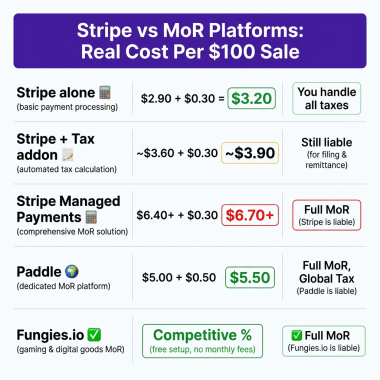
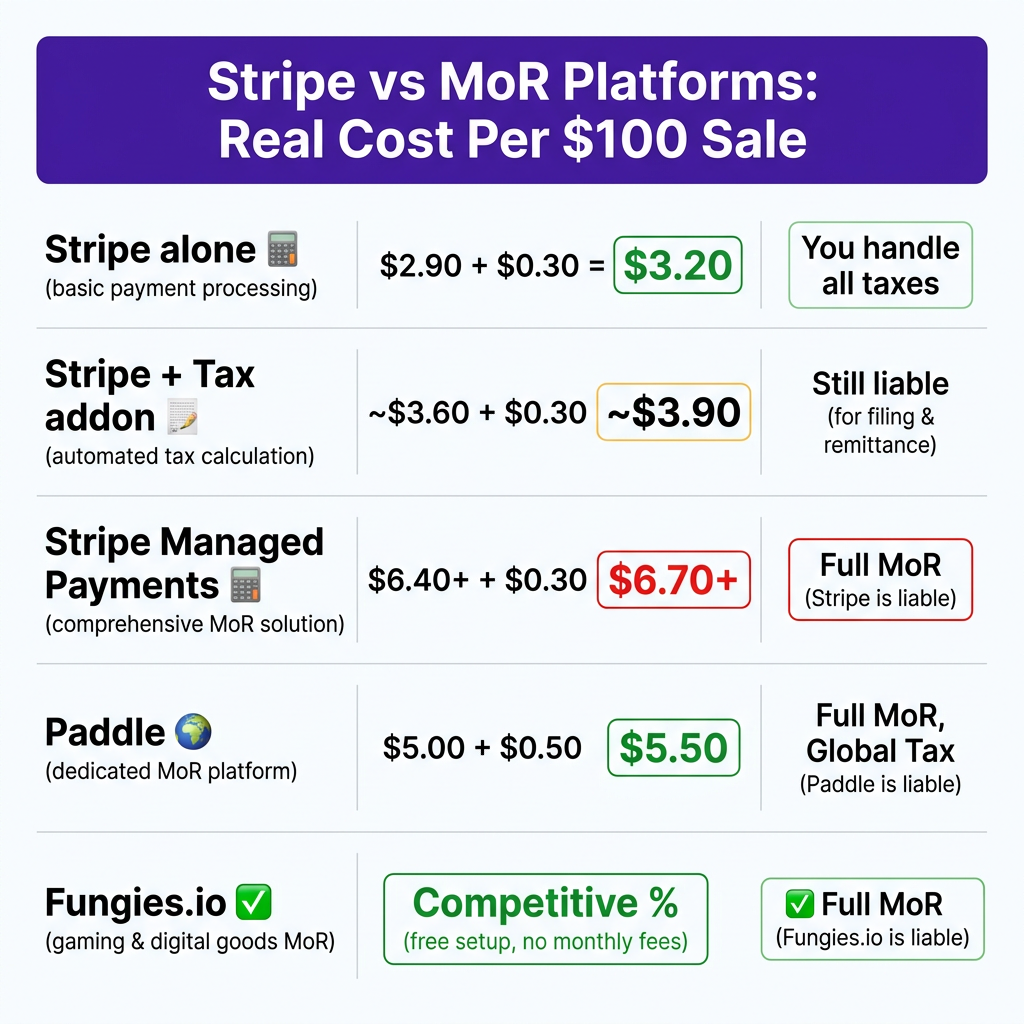
The 2026 landscape makes this decision even more interesting: Stripe launched Stripe Managed Payments — its own MoR product — with a 3.5% fee on top of standard Stripe fees. That means 6.4%+ per domestic transaction before currency conversion. It’s real MoR coverage, but it’s the most expensive option on the market.
Stripe Managed Payments: The Official MoR Option (And Its Cost)
In mid-2026, Stripe rolled out Managed Payments to broader access after months in private beta. Born from the Lemon Squeezy acquisition, it’s built directly into the Stripe Dashboard and offers genuine MoR functionality:
- Stripe handles global tax collection and remittance
- Stripe takes on fraud liability and chargeback exposure
- Works as a transaction-level toggle — you don’t have to convert your entire account
- Delivered through Stripe Checkout, Payment Links, and the Link wallet (200M+ saved cards)
The cost:
| Transaction type | Stripe base fee | Managed Payments surcharge | Total |
|---|---|---|---|
| Domestic US card | 2.9% + $0.30 | +3.5% | 6.4% + $0.30 |
| International card | 2.9% + 1.5% + $0.30 | +3.5% | 7.9%+ + $0.30 |
| With currency conversion | +1% FX on top | +3.5% | 8.9%–10%+ |
That’s real MoR coverage. But it’s more expensive than every dedicated MoR platform available today. If you’re already deep in the Stripe ecosystem and need minimal disruption, it’s worth evaluating — but the math rarely wins against purpose-built alternatives.
The 6 Best Stripe Alternatives for SaaS Founders in 2026
1. Fungies.io — Best for Digital Products and SaaS with No Monthly Fees
Fungies.io is a Merchant of Record designed specifically for SaaS subscriptions, digital products, and game assets. The standout: no monthly fees, no setup costs, commission-only pricing. You pay when you earn.
- Acts as MoR — handles VAT, sales tax, GST globally
- Built-in storefront + embeddable checkout
- No $19/month subscription or per-seat costs
- Integrates with Stripe (you connect your Stripe account)
- Especially strong for indie developers, game studios, and early-stage SaaS
Best for: Founders who want MoR protection without committing to monthly platform costs.
2. Paddle — Best for Scaling B2B SaaS
Paddle is the most established pure-play MoR for SaaS. It handles everything: tax collection in 200+ countries, fraud management, subscription billing, invoicing, and compliance. Founded in 2012, it processes billions in GMV annually.
- Fee: 5% + $0.50 per transaction (all-in, no hidden add-ons)
- Paddle Billing for sophisticated subscription models
- Strong enterprise track record
- Developer-friendly API
- Buyer portal + self-serve subscription management
Best for: Series A+ SaaS companies with significant international revenue who need a battle-tested MoR with enterprise support.
3. Dodo Payments — Best for Indie Devs and AI Startups
Founded in 2023, Dodo Payments is one of the fastest-growing MoR platforms, targeting indie developers and AI-first startups. Its API is clean and the setup time is genuinely fast — many founders report going live in under a day.
- Fee: 4% + $0.40 domestic, +1.5% international, +0.5% subscriptions
- Full MoR: global tax, fraud, chargebacks handled
- Optimized for AI tools, SaaS, and digital products
- Strong webhook and API documentation
- Growing fast: 5,000+ businesses onboarded in first year
Best for: Developer-led teams building AI apps, micro-SaaS, or indie tools who want low fees and fast integration.
4. Creem — Best Developer-Focused MoR with Lowest Base Fees
Creem positions itself as “the Stripe for SaaS that needs MoR” — developer-first, clean API, and competitive pricing. It’s gained significant traction among indie hackers and ProductHunt communities.
- Fee: 2.9% + $0.30 + 1% MoR surcharge = ~3.9% + $0.30 all-in
- Full MoR coverage: global tax, fraud, chargebacks
- Hosted checkout + embeddable widget
- Built-in affiliate management
- Minimal onboarding friction
Best for: Technical founders who want near-Stripe pricing with full MoR liability coverage.
5. FastSpring — Best for Enterprise Software and B2B Licensing
FastSpring has been in the MoR game since 2005. It’s the oldest and most enterprise-focused option on this list — strong for desktop software, B2B licensing, and companies that need hands-on account management.
- Fee: ~5.9% + $0.95 per transaction (higher than peers, but includes white-glove service)
- Global tax compliance in 200+ jurisdictions
- Software license management built in
- Physical goods + digital in one platform
- Dedicated account manager for larger volumes
Best for: Established software companies (desktop apps, B2B SaaS) doing $500K+ ARR who need premium support and complex licensing models.
6. Polar — Best Open-Source and Developer-Native Option
Polar is the most developer-centric option — open source, clean GitHub integrations, and built for dev tools, open-source maintainers, and API-first products. It offers full MoR capabilities with a focus on transparency.
- Fee: 4% + $0.40
- Full MoR: global tax, fraud, compliance
- Native GitHub integration for open-source monetization
- Subscription, one-time, and usage-based billing
- Affonso affiliate integration available
Best for: Open-source maintainers, developer tool builders, and teams that want full visibility into their billing infrastructure.
Head-to-Head Comparison: Stripe vs Top MoR Alternatives
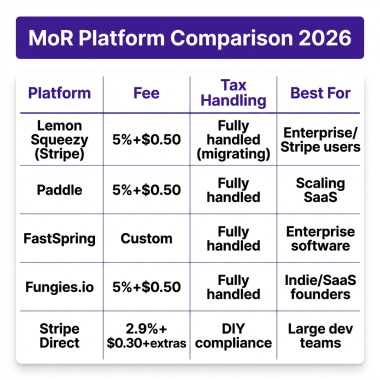
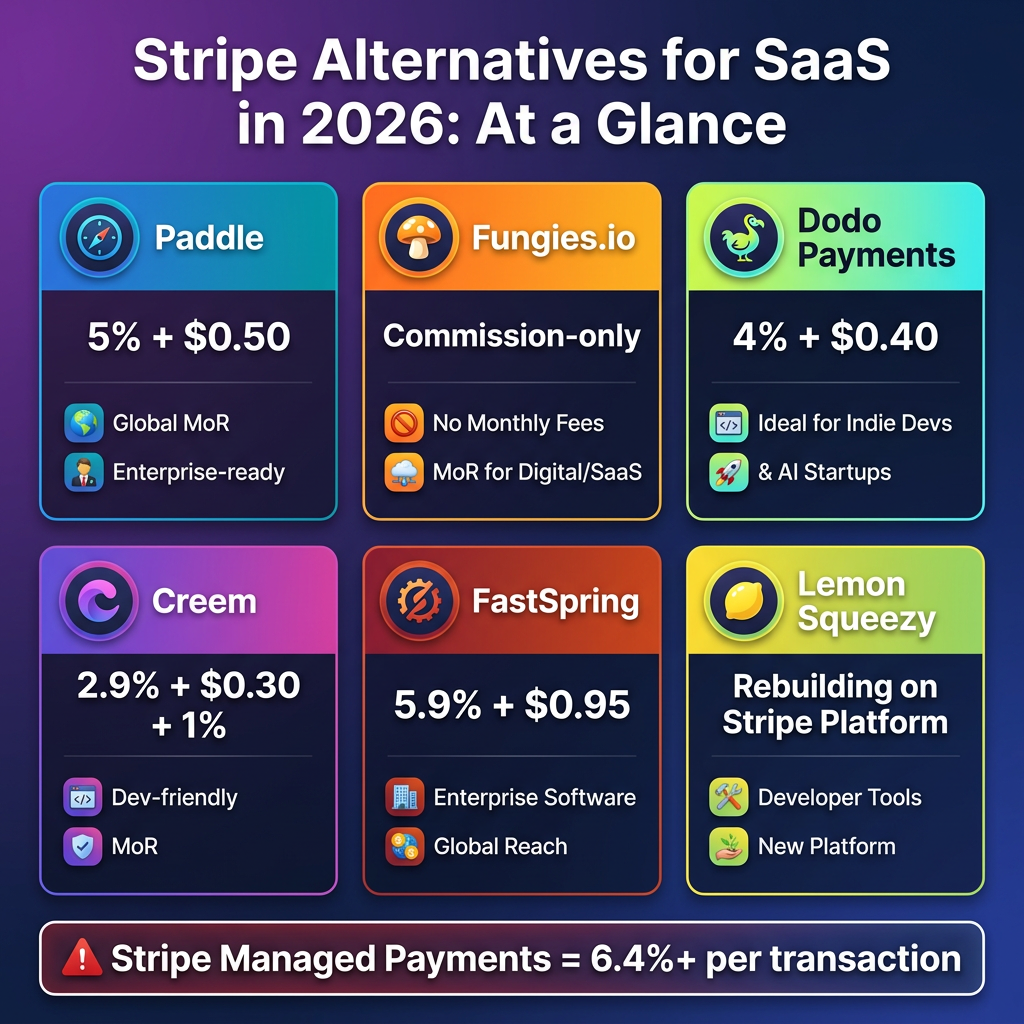
| Platform | Type | Base Fee | MoR Coverage | Best For | Monthly Cost |
|---|---|---|---|---|---|
| Stripe (standard) | PSP | 2.9% + $0.30 | ❌ None | Domestic, simple setup | $0 |
| Stripe + Tax | PSP + tax tool | 2.9% + $0.30 + tax add-on | ⚠️ Partial (liability stays with you) | US-focused with automation | Varies |
| Stripe Managed Payments | MoR | 6.4%+ + $0.30 | ✅ Full | Stripe-native teams, accept higher cost | $0 |
| Fungies.io | MoR | Commission only | ✅ Full | Digital products, SaaS, indie devs | $0 |
| Paddle | MoR | 5% + $0.50 | ✅ Full | Scaling B2B SaaS | $0 |
| Dodo Payments | MoR | 4% + $0.40 | ✅ Full | Indie devs, AI startups | $0 |
| Creem | MoR | ~3.9% + $0.30 | ✅ Full | Developer-first teams | $0 |
| FastSpring | MoR | ~5.9% + $0.95 | ✅ Full | Enterprise software | $0 |
| Polar | MoR | 4% + $0.40 | ✅ Full | Dev tools, open source | $0 |
The Real Cost Calculation: Stripe + Compliance vs MoR
Most founders compare the headline fees. That’s the wrong move. Here’s a more honest cost model for a SaaS doing $200K ARR with 40% international revenue:
| Cost item | Stripe + tools | Typical MoR (Fungies/Paddle) |
|---|---|---|
| Transaction fees (domestic) | $3,480 (2.9%) | $6,000–8,000 (5%) |
| International surcharge | $1,200 (1.5%) | Included |
| Currency conversion | $800 (1%) | Included |
| Stripe Tax addon | $600–1,200/yr | Included |
| Tax registration (EU VAT, US states) | $2,000–5,000/yr (accountant) | Included |
| Fraud/chargeback management | $500–2,000/yr | Included |
| Total estimated cost | $8,580–$13,780 | $6,000–$8,000 |
The “cheaper” payment processor often isn’t cheaper when you count everything. This math shifts as volume grows — at $1M+ ARR, the spread can easily exceed $40,000 annually.
When Stripe Still Wins
Stripe isn’t wrong — it’s often the right tool for specific situations:
- B2B invoicing-heavy businesses where customers pay on NET30/NET60 terms
- Pure US sales with no international ambition in the next 12 months
- Marketplace platforms where Stripe Connect’s split payment logic is essential
- Heavy Stripe ecosystem integration (Radar, Sigma, Atlas) where switching costs are high
- Pre-revenue validation where you need maximum flexibility and zero upfront cost
Migration: How Hard Is It to Switch from Stripe?
This is the question most founders avoid asking until they’re already frustrated. Here’s the honest breakdown by platform:
| Platform | Migration effort | Stripe integration needed? | Customer data migration |
|---|---|---|---|
| Fungies.io | Low (1–3 days) | Yes, connects to Stripe | Minimal, storefront-based |
| Dodo Payments | Low (1–2 days) | No, full replacement | Manual subscription migration |
| Creem | Low (few hours) | No, full replacement | API migration tools available |
| Paddle | Medium (1–2 weeks) | No, full replacement | Paddle migration service available |
| FastSpring | High (2–4 weeks) | No, full replacement | Migration assistance included |
The biggest migration headache is always active subscriptions. Platforms like Paddle offer migration services, but you’ll need to coordinate with existing subscribers, update payment methods, and handle any billing cycle edge cases. Plan for 2x your estimated time.
5 Key Takeaways
- Stripe Managed Payments is real MoR coverage — at a price. 6.4%+ per domestic transaction is significantly more expensive than every dedicated MoR alternative.
- The “Stripe is cheaper” assumption breaks down fast with international sales. Once you add tax tools, legal compliance costs, and fraud management, a MoR often costs less total.
- Fungies.io is the lowest-friction option for digital products and SaaS — no monthly fees, commission-only, and full MoR coverage from day one.
- Creem and Dodo Payments are the best options for indie hackers and AI startups — fast setup, developer-friendly APIs, and competitive fees (~4%).
- Paddle and FastSpring remain the enterprise-grade default — battle-tested, comprehensive, and worth the slightly higher fee if you need white-glove support.
FAQ
Is Stripe a Merchant of Record?
Not by default. Stripe is a payment processor — you remain the Merchant of Record for all transactions. Stripe Managed Payments is Stripe’s MoR product (launched 2026), but it adds 3.5% on top of standard Stripe fees, bringing the total to 6.4%+ per domestic transaction.
What’s the cheapest Stripe alternative with full MoR coverage?
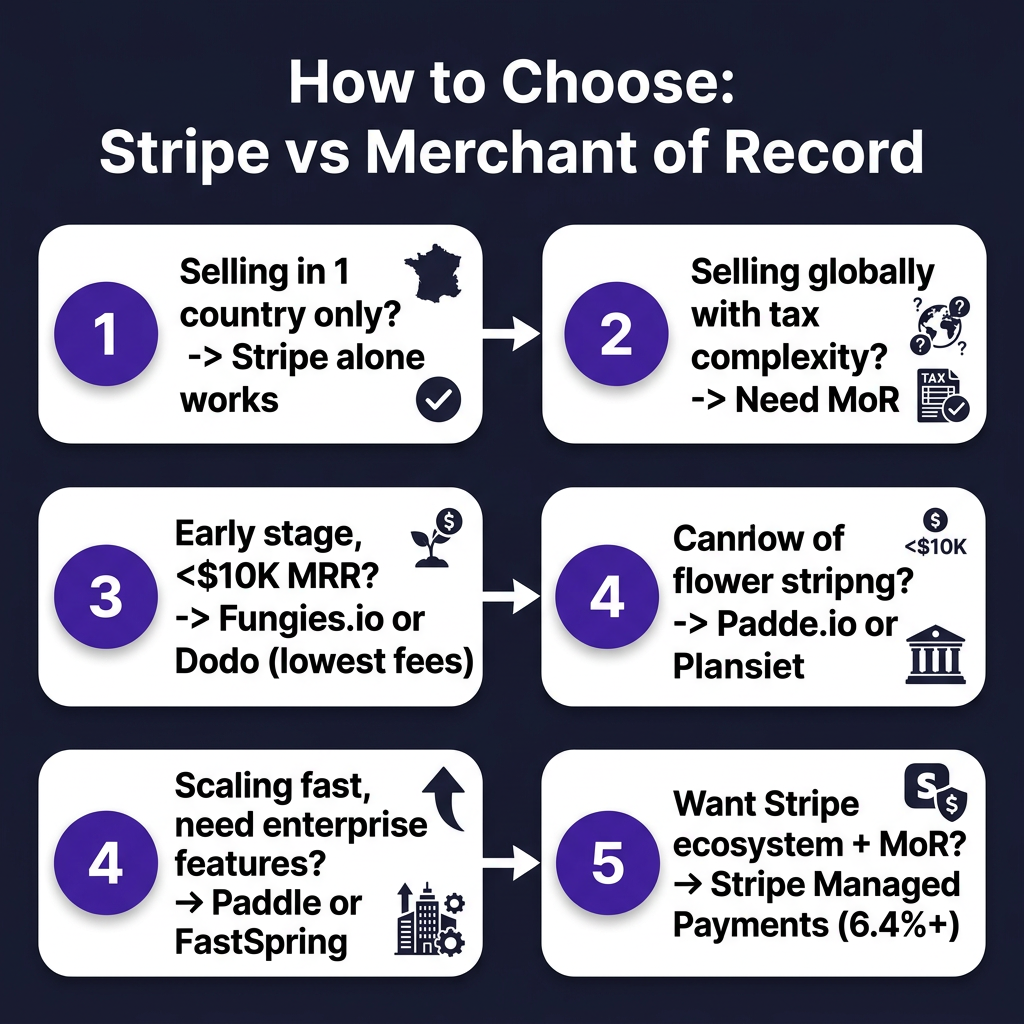
Creem is currently the lowest-cost MoR at approximately 3.9% + $0.30 per transaction (Stripe base + 1% MoR surcharge). Dodo Payments and Polar come in at around 4% + $0.40. Fungies.io uses commission-only pricing with no monthly fees, which can be even cheaper at lower volumes.
Can I use Stripe and a MoR platform at the same time?
Yes. Fungies.io, for example, connects directly to your Stripe account — letting you use Stripe’s underlying payment infrastructure while Fungies handles the MoR layer. Other platforms like Paddle are full replacements and process payments independently.
Do I need a Merchant of Record if I’m only selling in the US?
It depends on volume. Once you’re collecting sales tax in multiple US states (economic nexus typically kicks in around $100K revenue or 200 transactions per state), the compliance overhead grows fast. A MoR can simplify this even for US-only businesses. For international sales, a MoR is almost always worth it above $5K/month in revenue.
Bottom Line
In 2026, the question isn’t really “Stripe or not Stripe” — it’s “how much of the merchant liability do I want to own?” The more you own, the cheaper the base fee but the higher your operational and legal costs.
For most SaaS founders building globally, a dedicated MoR platform starts paying for itself quickly. Try Fungies.io for free — no monthly fees, no setup costs, and you’re live with full global MoR coverage in under a day.
References
- Stripe Managed Payments — Official Page
- Dodo Payments: Stripe Managed Payments Fees Explained (June 2026)
- Dodo Payments: Payment Processing Fees Compared — Stripe vs PayPal vs Square (June 2026)
- Affonso: Top Stripe Alternatives in 2026
- Better Launch: Stripe vs Paddle 2026
- F3 Fundit: Stripe vs Paddle vs Lemon Squeezy for Micro-SaaS
- Lemon Squeezy: 2026 Update + Stripe Managed Payments
- Stripe Support: Managed Payments Pricing