Here’s a number that should stop you in your tracks: only 0.2% of websites are running A/B tests. Yet the companies that do? They’re the ones dominating their markets. Netflix runs thousands of experiments annually. Amazon famously tests everything. And SaaS companies with mature experimentation programs see 3-5x higher conversion rates than those flying blind.
The problem isn’t that A/B testing doesn’t work. It’s that most SaaS teams don’t know which tools to use. With Google Optimize shutting down in 2023, the landscape shifted dramatically. Enterprise incumbents like Optimizely raised prices. New players like PostHog and Statsig emerged with developer-first approaches. And the gap between “we should test that” and actually running experiments has never been wider.
What Makes an A/B Testing Tool Right for SaaS?
Before diving into the tools, let’s get clear on what actually matters for SaaS companies. Not all A/B testing platforms are built the same, and the wrong choice will cost you twice: once in subscription fees, and again in missed opportunities.
Here’s what separates the tools that drive real growth from the ones that collect dust:
- Statistical rigor: Does it use frequentist or Bayesian statistics? Can it handle multiple testing correction? Bad math leads to false positives.
- Integration depth: Your testing tool needs to talk to your analytics stack, CRM, and product analytics. Siloed experiments are useless.
- Testing surfaces: Client-side (visual editor) for landing pages, server-side for product features, mobile SDKs for apps.
- Feature flags: Modern SaaS testing isn’t just A/B—it’s gradual rollouts, kill switches, and targeted delivery.
- Pricing transparency: Some enterprise tools hide pricing for a reason. Know what you’re getting into.
The 10 Best A/B Testing Tools for SaaS in 2026
I’ve analyzed pricing, features, and real user feedback from G2, Reddit, and implementation partners. These are the tools actually moving metrics for SaaS teams in 2026.
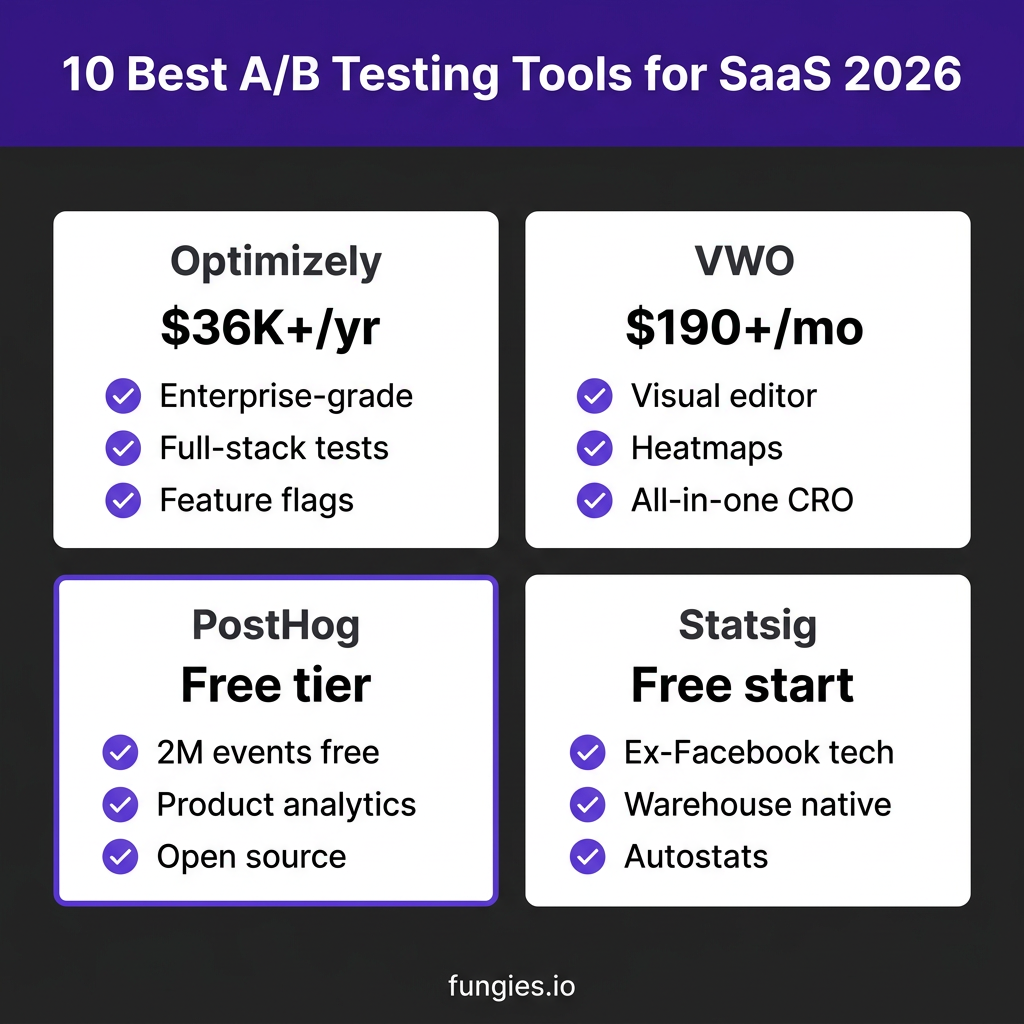
1. PostHog — Best Free A/B Testing for Startups
PostHog isn’t just an A/B testing tool—it’s an all-in-one product OS combining analytics, session replay, feature flags, and experimentation. Built by engineers who were frustrated with fragmented tooling, it’s become the go-to for technical SaaS teams.
Key features:
- Generous free tier: 2 million events/month
- Server-side and client-side testing
- Built-in product analytics and session replay
- Feature flags with targeting
- Open source (self-host option)
- SQL access to raw data
Pricing: Free up to 2M events, then usage-based. Most startups stay free for months.
Best for: Technical founders, product-led growth companies, and teams wanting analytics + testing in one platform.
2. Optimizely — Best for Enterprise Experimentation
Optimizely is the 800-pound gorilla of A/B testing. If you’re running experiments across web, mobile, and server-side with complex personalization needs, it’s hard to beat. But that power comes at a price—literally.
Key features:
- Full-stack experimentation (web, mobile, server, OTT)
- Advanced personalization and AI-powered optimization
- Feature management and progressive delivery
- Content management integration
- Enterprise-grade security and compliance
Pricing: $36,000-$50,000+ per year. No self-serve option—enterprise sales only.
Best for: Large enterprises with dedicated experimentation teams and six-figure testing budgets.
3. VWO — Best All-in-One CRO Platform
VWO (Visual Website Optimizer) has evolved from a simple testing tool into a comprehensive conversion optimization platform. It combines A/B testing with heatmaps, session recordings, surveys, and form analytics—everything you need to understand why visitors aren’t converting.
Key features:
- Visual editor for non-technical users
- Integrated heatmaps and session recordings
- Multivariate and split URL testing
- Personalization engine
- Server-side testing (higher tiers)
Pricing: $190-$999+ per month depending on features and traffic.
Best for: Marketing teams who want testing + behavior analytics without engineering dependencies.
4. Statsig — Best for Data-Driven Product Teams
Statsig was built by ex-Facebook engineers who scaled the social network’s internal experimentation platform. It brings that same statistical rigor to SaaS teams, with warehouse-native architecture and advanced statistical engines.
Key features:
- Autostats engine (Bayesian + sequential testing)
- Data warehouse integration (Snowflake, BigQuery, Redshift)
- Feature gates and dynamic configs
- Holdouts and mutual exclusion
- Metric definition and tracking
Pricing: Free tier available, then usage-based. Enterprise pricing custom.
Best for: Data-savvy product teams who want Facebook-caliber experimentation.
5. GrowthBook — Best Open-Source A/B Testing
GrowthBook is the open-source alternative to expensive enterprise platforms. It gives you full control over your data, integrates with your existing warehouse, and doesn’t lock you into proprietary systems.
Key features:
- Truly open source (MIT license)
- Data warehouse native (bring your own data)
- Feature flagging with targeting rules
- Visual editor for non-technical users
- Self-hosted or cloud options
Pricing: Free self-hosted, or cloud starting at $20/seat/month.
Best for: Teams with data engineering resources who want full ownership of their experimentation stack.
6. Convert Experiences — Best for Privacy-Focused Teams
Convert has carved out a niche as the privacy-first A/B testing platform. With GDPR compliance baked in and no third-party cookie dependencies, it’s popular among European SaaS companies and healthcare/fintech teams.
Key features:
- GDPR, CCPA, and HIPAA compliant
- Anti-flicker technology
- Advanced behavioral targeting
- 1:1 personalization
- Shopify integration with price testing
Pricing: $299/month for 100k tested users (annual billing).
Best for: Privacy-conscious companies, EU-based SaaS, and regulated industries.
7. AB Tasty — Best for Marketing Teams
AB Tasty focuses on making experimentation accessible to marketers. With a visual editor that requires zero coding and built-in personalization, it’s designed for teams who want to move fast without engineering bottlenecks.
Key features:
- Visual WYSIWYG editor
- AI-powered personalization
- Widget library for quick experiments
- Server-side testing capabilities
- Mobile app testing
Pricing: Custom pricing based on traffic and features.
Best for: Marketing teams who need to run tests without developer involvement.
8. LaunchDarkly — Best Feature Flagging + Testing
LaunchDarkly started as a feature flagging platform and added experimentation capabilities. If your primary need is gradual rollouts with testing as a secondary benefit, it’s worth considering.
Key features:
- Enterprise-grade feature flags
- Experimentation add-on available
- Multi-environment management
- Advanced targeting and segmentation
- Robust SDK support
Pricing: Starts at $8.33/seat/month for feature flags; experimentation is additional.
Best for: Engineering teams who need feature management first, experimentation second.
9. Eppo — Best for Warehouse-Native Experimentation
Eppo takes a different approach: instead of collecting its own data, it runs experiments directly on your data warehouse. This means zero data discrepancies between your experiment results and business metrics.
Key features:
- Direct warehouse integration (Snowflake, Databricks, BigQuery)
- CUPED variance reduction for faster results
- Metric definition in SQL
- Causal inference capabilities
- Collaborative experiment planning
Pricing: Custom enterprise pricing.
Best for: Data-mature companies with established warehouses and data teams.
10. Mida — Best Free Google Optimize Alternative
When Google Optimize shut down, many teams were left scrambling. Mida emerged as the best free alternative, offering a visual editor, GA4 integration, and a permanently free tier up to 100,000 monthly tested users.
Key features:
- Permanently free tier (100k MTU)
- Visual editor with AI assistance
- Native GA4 integration
- Lightweight script (fast loading)
- No credit card required
Pricing: Free up to 100k MTU, then paid plans.
Best for: Small teams looking for a free, lightweight alternative to Google Optimize.
A/B Testing Tool Comparison Table
| Tool | Best For | Starting Price | Free Tier | Server-Side |
|---|---|---|---|---|
| PostHog | Startups, PLG | Free | 2M events | Yes |
| Optimizely | Enterprise | $36K+/yr | No | Yes |
| VWO | Marketing teams | $190/mo | No | Yes |
| Statsig | Data teams | Free | Generous | Yes |
| GrowthBook | Open-source fans | Free/$20 | Unlimited | Yes |
| Convert | Privacy-focused | $299/mo | No | Yes |
| AB Tasty | Marketers | Custom | No | Yes |
| LaunchDarkly | Feature flags | $8.33/seat | No | Yes |
| Eppo | Data warehouses | Custom | No | Yes |
| Mida | Free testing | Free | 100k MTU | No |
How to Choose the Right A/B Testing Tool for Your SaaS
With ten solid options, how do you pick? Here’s my decision framework based on hundreds of SaaS implementations:
Choose PostHog if: You’re a startup or growth-stage company wanting analytics + testing in one platform. The free tier is genuinely generous, and the open-source nature means no vendor lock-in.
Choose Optimizely if: You’re an enterprise with complex personalization needs and a dedicated experimentation team. The price is steep, but the capabilities are unmatched at scale.
Choose VWO if: Your marketing team needs to run tests without engineering help. The integrated heatmaps and recordings give you the full picture of user behavior.
Choose Statsig if: You have a data team and want Facebook-level statistical rigor. The warehouse integration and advanced stats are worth the learning curve.
Choose GrowthBook if: You want full control over your data and don’t mind self-hosting. It’s the most flexible option for technical teams.
Getting Started: Your First A/B Test
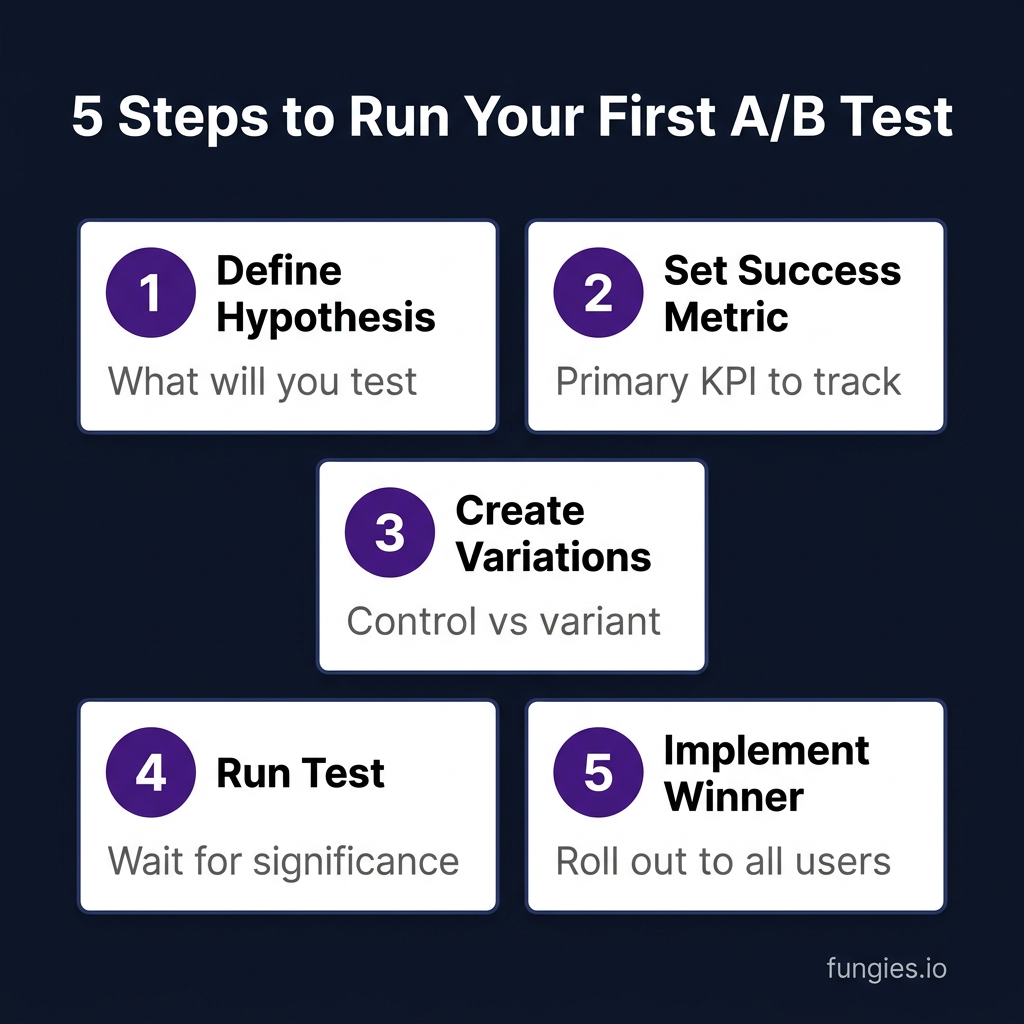
Here’s the truth: most SaaS companies overthink their first test. They spend weeks debating what to test, building complex variations, and arguing about metrics. Meanwhile, the companies winning are running simple tests fast.
Start here:
- Test your headline. It’s the highest-leverage, lowest-effort change you can make.
- Pick one metric. Signups, demo requests, or activation—choose one and stick to it.
- Run until statistical significance. Use a calculator. Don’t eyeball it.
- Implement winners quickly. A test sitting in “analysis” is wasted opportunity.
Remember: the goal isn’t to run perfect experiments. It’s to make better decisions than your competitors who aren’t testing at all.
FAQ: A/B Testing for SaaS
What’s a good conversion rate for SaaS landing pages?
The median SaaS landing page converts at 3.8%, but top performers hit 15% or higher. The key is benchmarking against your own historical performance, not industry averages. A 2% lift on a page with 10,000 monthly visitors is 200 additional conversions.
How long should I run an A/B test?
Run until you reach statistical significance—typically 95% confidence. For most SaaS companies with moderate traffic, this means 2-4 weeks. Don’t peek at results early; it introduces bias. Use a sample size calculator before starting.
Can I A/B test pricing pages?
Yes, but carefully. Testing pricing requires server-side implementation to avoid SEO issues and ensure consistent user experiences. Tools like Optimizely, VWO, and PostHog support this. Always test on new visitors only to avoid showing different prices to the same user.
What’s the difference between client-side and server-side testing?
Client-side testing modifies the page in the browser using JavaScript—great for landing pages, but can cause flicker. Server-side testing changes the response on your server before it reaches the user—better for product features, pricing, and avoiding flicker entirely.
Do I need a developer to run A/B tests?
It depends. Visual editors (VWO, AB Tasty, Mida) let marketers run tests without code. But server-side tests, feature flags, and complex experiments require engineering. The most mature programs have both marketers and developers collaborating.
Conclusion: Start Testing Today
The SaaS companies winning in 2026 aren’t guessing—they’re testing. While 99.8% of websites rely on opinions and gut feel, the 0.2% running experiments are compounding small wins into massive competitive advantages.
You don’t need Optimizely’s enterprise budget to start. PostHog’s free tier handles millions of events. Mida gives you 100,000 tested users at no cost. Even a simple headline test can reveal insights that transform your conversion rate.
The tools in this guide are all capable of driving growth. The question isn’t which one to pick—it’s whether you’ll actually start testing. My advice? Pick one, run your first experiment this week, and build from there.
And while you’re optimizing your conversion funnel, don’t forget about the other side of growth: monetization. Fungies.io helps SaaS companies sell globally with built-in tax compliance, multiple payment methods, and a developer-friendly checkout. Because what good is more traffic if you can’t capture the revenue?