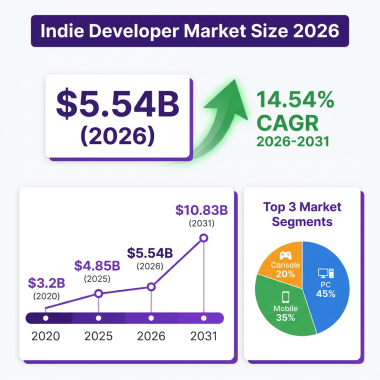
The indie developer landscape in 2026 is a paradox of unprecedented opportunity and brutal competition. With the global indie game market projected to reach $5.54 billion in 2026 and growing at a compound annual growth rate (CAGR) of 14.54%, the financial potential has never been greater. Yet beneath these impressive numbers lies a stark reality: 50% of all games released on Steam in 2026 have earned less than $250, and the failure rate for indie projects hovers around a devastating 70%.
The gaming industry has undergone a fundamental transformation over the past decade. What was once a field dominated by massive studios with hundred-million-dollar budgets has become accessible to individual creators working from their bedrooms. This democratization has unleashed a wave of creativity, giving players access to experiences that big studios would never risk making. From narrative experiments to innovative mechanics, indie games have become the primary driver of innovation in the medium.
Whether you’re an aspiring game developer, a SaaS founder building tools for creators, or an investor evaluating the space, understanding the true state of the indie developer market in 2026 is essential. This comprehensive analysis dives deep into market size, revenue statistics, key trends, major players, challenges, opportunities, and future predictions that will define the industry for years to come.

Market Overview: The $5.54 Billion Indie Developer Ecosystem
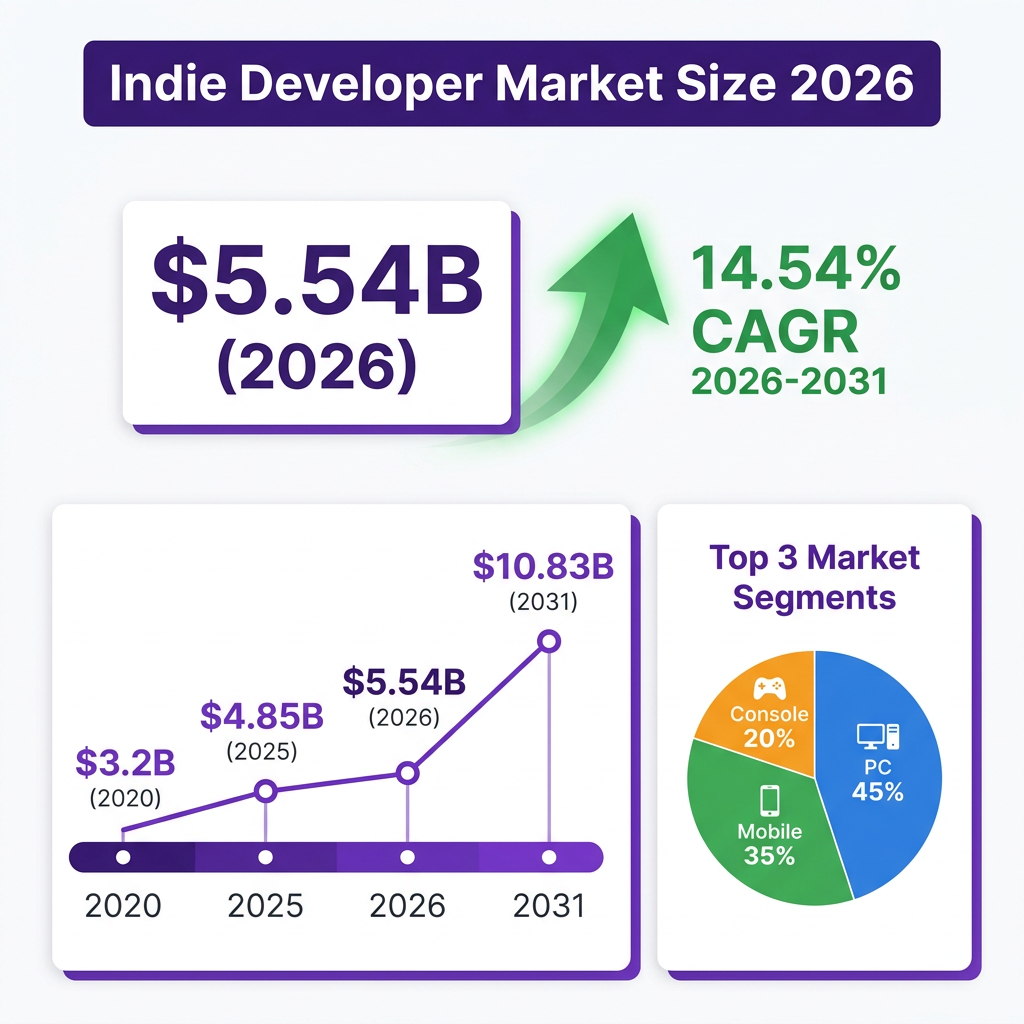
The democratization of game development has fundamentally altered the economics of creation. What began as a niche corner of the gaming industry has evolved into a significant economic force, with independent creators now accounting for 25% of Steam’s total revenue in 2025. The indie game market, valued at $4.85 billion in 2025, is expected to expand to $5.54 billion by 2026 and reach an impressive $10.83 billion by 2031.
This growth trajectory represents one of the most compelling investment narratives in the broader gaming sector. According to Bain’s analysis, indie PC revenues have increased at a compound annual rate of 22% between 2018 and 2024, compared to just 8% for AA and AAA games. What’s particularly remarkable is that this surge happened without a major change in indies’ share of total games available on Steam.
The market’s expansion is driven by several converging factors. First, the barrier to entry has never been lower. Powerful game engines like Unity, Unreal Engine, and the rapidly growing Godot have made professional-grade development accessible to solo creators and small teams. Second, digital distribution platforms—led by Steam but including Epic Games Store, GOG, and console marketplaces—have eliminated the need for physical manufacturing and retail relationships that once gatekept the industry.
Third, and perhaps most significantly, the rise of AI-powered development tools has compressed production timelines and reduced costs. Tasks that once required specialized artists or programmers can now be accomplished with AI assistance, allowing small teams to punch above their weight class. The “vibe coding” revolution—where developers use AI to generate code from natural language descriptions—has fundamentally changed what’s possible for solo founders.
However, the market’s growth masks a troubling concentration of success. In a study of the top-performing 100 indie games of 2024, just over 8% of these titles captured 80% of the total revenue. When examining the full sample of approximately 12,000 indie games, fewer than 0.5% of them account for 80% of the revenue made in the market. This extreme Pareto distribution means that while the overall pie is growing, the slices are distributed increasingly unevenly.
The platform landscape has also shifted dramatically. Steam remains the dominant marketplace with 147 million monthly active users and $16.2 billion in revenue through November 2025, commanding 75% of the PC gaming market. The platform reached 41.81 million concurrent users in January 2026, marking the highest peak in its history. For indie developers, Steam’s 70/30 revenue split (which improves to 75/25 after $10 million in sales) remains the industry standard, though competitors like Epic Games Store offer more favorable terms at 88/12.
Looking at the geographic distribution, North America and Europe continue to dominate indie development, but Asia-Pacific is the fastest-growing region. The increasing prevalence of mobile gaming, cloud-powered experiences, and cross-platform development has solidified game engines as essential infrastructure in the digital ecosystem globally.
Key Statistics and Data: The Numbers Behind the Industry
Understanding the indie developer market requires diving into the hard numbers that reveal both the opportunities and the harsh realities facing creators today. These statistics paint a picture of an industry in transition—growing rapidly but becoming increasingly competitive.
Market Size and Growth Metrics
The global indie game market is projected to reach $5.54 billion in 2026, up from $4.85 billion in 2025, representing a year-over-year growth of 14.2%. The compound annual growth rate (CAGR) of 14.54% through 2031 will push the market to $10.83 billion by the end of the forecast period. This growth significantly outpaces the broader video game industry, where indie PC revenues grew at 22% CAGR between 2018 and 2024 compared to just 8% for AA and AAA titles.
Steam, the dominant PC gaming platform, reported 147 million monthly active users in 2025, an 11.4% increase from 2024. Daily active users reached 69 million, with a DAU-to-MAU ratio of 52.27%. The platform hosts over 120,000 games and generated $16.2 billion in revenue through November 2025, showing 50% annualized growth. Black Myth: Wukong achieved 2.4 million concurrent players, the highest for a single-player game in Steam history.
Revenue Distribution and Earnings
The revenue distribution in the indie game market follows an extreme power law. The median indie game on Steam earned just $249 in 2025—a figure that represents the 50th percentile, meaning half of all games earned less than this amount. When factoring in the $100 Steam Direct fee and months or years of development time, half of developers on the platform are operating at a significant loss.
However, the top performers tell a different story. The top 25% of self-published indie games have revenue expectations of $26,000 or more. The top 14% threshold crosses the $100,000 gross revenue line, with approximately 3,000 self-published indie games having made over $100,000 on Steam. The top 10% earn more than $187,000, while the top 1% have earned more than $7,000,000. Mega-hits like Subnautica and Rimworld have made well over $100 million in revenue.
Indie games collectively generated $4.4 billion on Steam in 2025, representing 25% of the platform’s total revenue. This marks a significant milestone, as indie titles collectively generated more revenue than AAA releases in the first quarter of 2026 for the first time in Steam’s history.
Developer Demographics and Working Conditions
The indie development community is characterized by small teams and solo operations. According to industry data, 55% of indie developers work solo, spending an average of 18 months on development. The failure rate for indie projects hovers around 70%, with burnout and stress affecting 60% of developers. A staggering 94% of game developers report experiencing burnout, according to GDC 2026 data.
Despite these challenges, 82% of indie developers still choose Unity as their primary engine, though this dominance is being challenged by the rapid growth of Godot, particularly following Unity’s 2023 Runtime Fee controversy. The number of Godot games released has been climbing sharply year over year, making it the clear default for developers who want a free, no-royalty engine.
AI Adoption in Game Development
Artificial intelligence has become deeply embedded in the game development workflow. According to BCG 2026 data, 50% of game studios now actively use AI in their development process. Over 7,300 games on Steam now disclose AI use—double from 2024. However, developer sentiment is mixed: while 52% of developers say generative AI actively harms the industry, the practical benefits for productivity and cost reduction continue to drive adoption.
Platform and Distribution Statistics
Steam’s US market share reaches 75% of PC digital distribution. Indie games revenue increased 21% year-over-year on the platform. The platform sold more than 4 million Steam Deck units, expanding the addressable market for indie developers. The game engines market, which powers indie development, is expected to be worth $13.8 billion by 2034, growing from $3.2 billion in 2024 at a CAGR of 15.9%.
Major Trends Shaping Indie Development in 2026
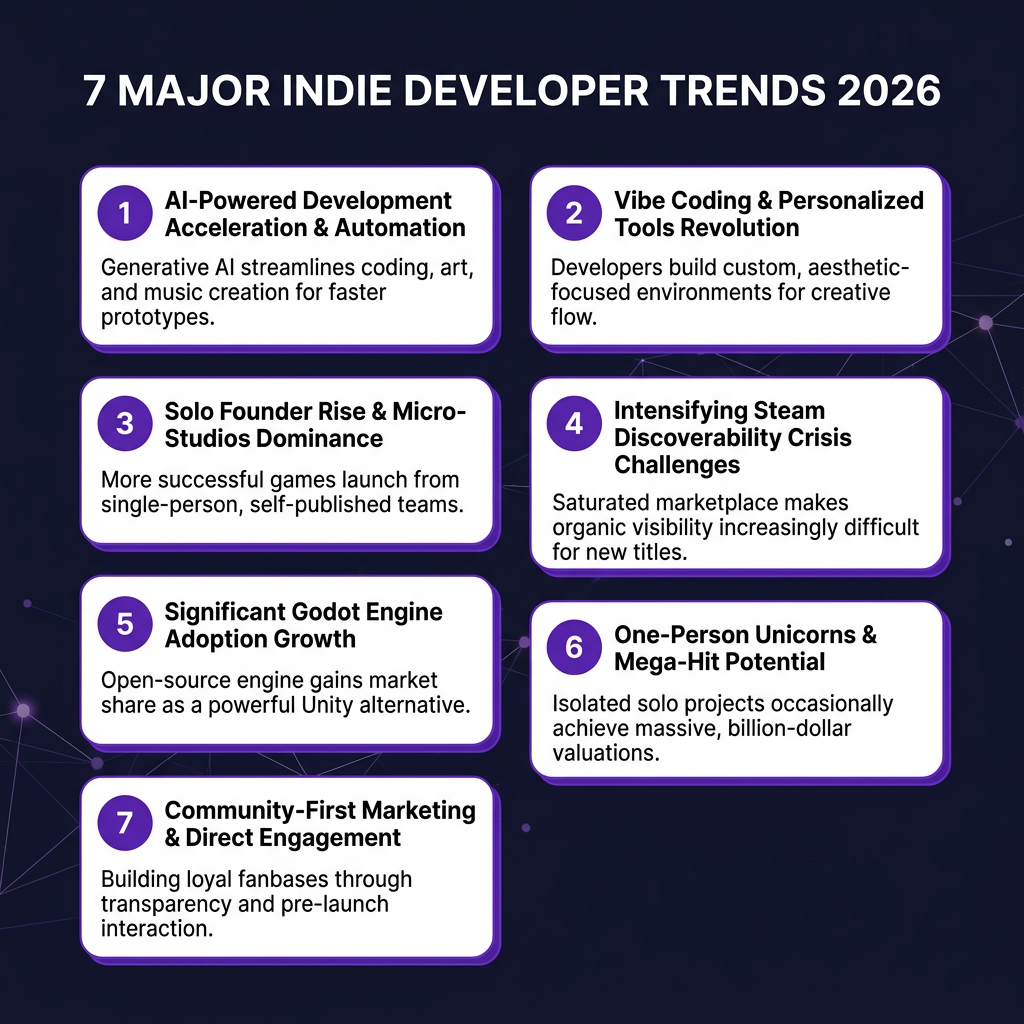
The indie development landscape is being reshaped by seven major trends that are fundamentally changing how games are created, distributed, and monetized. Understanding these trends is crucial for anyone looking to succeed in this competitive market.
1. The AI-Powered Development Revolution
Artificial intelligence has moved from experimental tool to essential infrastructure for indie developers. AI is now being used for code generation, asset creation, level design, dialogue writing, and marketing content. The “vibe coding” movement—where developers describe what they want in natural language and AI generates the code—has compressed development timelines from months to weeks.
Tools like GitHub Copilot, Claude Code, and Cursor have become standard in the indie developer toolkit. For asset creation, AI image generators can produce concept art, textures, and even 3D models at a fraction of the cost of hiring artists. This democratization of asset creation has allowed solo developers to create visually impressive games that would have required teams just a few years ago.
However, this trend comes with controversy. The disclosure of AI use in games has become a point of contention with players, and platforms like Steam now require developers to disclose AI-generated content. The debate over AI’s impact on creative industries continues, with 52% of developers believing it harms the industry despite widespread adoption.
2. The Rise of the One-Person Unicorn
Something remarkable is happening in the indie space: solo founders are building million-dollar games without writing a single line of code by hand. A solo founder in Lisbon launched a SaaS from a co-working space, hit $10K MRR in 47 days, and used AI to generate the app, write documentation, handle support tickets, and run ad campaigns.
The old playbook—grind for months, ship an MVP, pray for traction—feels like bringing a knife to a drone fight in 2026. The new model leverages AI to handle the tasks developers are worst at or most bored by: marketing, content creation, and repetitive visual work. This has given rise to the “one-person unicorn”—solo developers achieving outcomes that previously required teams of 10 or more.
3. The Steam Discoverability Crisis
With over 120,000 games on Steam and thousands more releasing each year, discoverability has become the single biggest challenge facing indie developers. The median earnings of $249 per game reflect a market where visibility, not quality, often determines success. If you aren’t launching with a massive wishlist and a pre-built community, your game is statistically likely to fall into the sub-$250 revenue bracket.
This has shifted the focus from game development to audience building. Successful indies now spend as much time on marketing, community management, and content creation as they do on actual game development. The rise of “wishlist farming”—building anticipation before launch—has become a critical pre-launch activity.
4. The Godot Engine Renaissance
Godot has emerged as the fastest-growing major game engine, particularly following Unity’s 2023 Runtime Fee controversy. The open-source engine offers a compelling value proposition: completely free, no royalties, and increasingly capable features that rival commercial alternatives. The number of Godot games released has been climbing sharply year over year.
For 2D game development, Godot’s node-based scene system and built-in 2D physics engine make it arguably the best choice. While Unity and Unreal Engine dominate AAA-quality 3D development, Godot has become the clear default for developers who want full control without licensing fees. The engine’s GDScript language is easy to learn for Python developers, lowering the barrier to entry further.
5. Genre Consolidation and the Friend-Slop Phenomenon
Market data reveals a consolidation around specific genres that perform well on Steam. Horror games, idle/incremental games, and co-op experiences (dubbed “weirdo indie co-op” games) have shown consistent success. The term “friend-slop” has emerged to describe games designed primarily for social streaming and co-op play with friends.
This trend reflects a broader shift in how games are discovered and played. With streaming platforms like Twitch and YouTube driving significant game discovery, games that create shareable moments and social experiences have a built-in marketing advantage. The horror meta-genre, in particular, has proven exceptionally streamable, driving organic discovery.
6. The $200/Month Tech Stack
A new standard has emerged for the indie developer tech stack: approximately $200 per month in tools and services can replace what previously required a 10-person team. This stack typically includes AI coding assistants, asset generation tools, marketing automation, and cloud infrastructure. The cost of launching an indie game has never been lower.
This cost reduction has enabled a new wave of “lifestyle businesses”—indie developers building sustainable, profitable games without venture funding or massive teams. The focus has shifted from moonshot exits to sustainable MRR (monthly recurring revenue) through live service models, DLC, and community-supported development.
7. Community-First Marketing
The most successful indie developers in 2026 have embraced community-first marketing strategies. Rather than relying on platform algorithms or paid advertising, they build engaged communities on Discord, Reddit, and social media before launch. This approach creates a built-in audience that provides feedback, spreads the word, and sustains the game post-launch.
Distribution has become the real moat in indie development. With technical barriers falling, the ability to reach and engage an audience is often the difference between a $250 game and a $250,000 game. Developers who master community building, content marketing, and social media have a significant advantage in the crowded marketplace.
Key Players and Competitive Landscape
The indie development ecosystem comprises game engine providers, distribution platforms, tool makers, and successful indie studios that have achieved significant scale. Understanding the competitive landscape helps developers make informed decisions about technology, distribution, and business strategy.
The Evolution of Game Development Tools
The tools available to indie developers have evolved dramatically over the past decade. What once required expensive software licenses, powerful hardware, and specialized training can now be accomplished with free tools and modest equipment. This democratization has been the primary driver of the indie renaissance.
Version control systems like Git and GitHub have become standard, enabling collaboration and providing safety nets for experimentation. Project management tools like Trello, Notion, and Jira help small teams stay organized. Communication platforms like Discord have replaced expensive office space, allowing distributed teams to collaborate effectively across time zones.
Asset stores and marketplaces have created economies of scale for indie developers. Rather than creating every asset from scratch, developers can purchase high-quality art, sound, and code packages for a fraction of the cost of hiring specialists. The Unity Asset Store, Unreal Marketplace, and itch.io asset sections have become essential resources for developers working with limited budgets.
Monetization Strategies and Revenue Models
Indie developers have access to a wider range of monetization strategies than ever before. The traditional premium model—charging a one-time fee for the game—remains popular but is increasingly supplemented by alternative approaches. Free-to-play with cosmetic microtransactions has proven successful for multiplayer indie games, while downloadable content (DLC) and expansion packs extend the revenue lifecycle of successful titles.
Subscription models are emerging as a viable option, with some developers offering ongoing content updates in exchange for monthly fees. Early access has become a standard practice, allowing developers to fund ongoing development while building a community around unfinished projects. Crowdfunding through Kickstarter and Fig provides both funding and market validation before significant development begins.
Merchandise, licensing, and cross-media adaptations offer additional revenue streams for successful indie properties. Games like Undertale and Stardew Valley have generated significant revenue from merchandise sales, while others have explored mobile ports, console adaptations, and even film and television deals.
Game Engine Market Leaders
Unity Technologies remains the dominant player in the indie game engine market, with 82% of indie developers choosing Unity as their primary engine. The engine’s strength lies in its cross-platform capabilities, extensive asset marketplace, and relatively gentle learning curve. Unity’s C# scripting and comprehensive documentation make it accessible to developers from web and application development backgrounds. However, the company’s 2023 Runtime Fee controversy damaged its reputation and drove many developers to explore alternatives.
Unreal Engine, owned by Epic Games, dominates the high-fidelity 3D space. While historically associated with AAA development, Unreal’s free licensing model (5% royalty after $1 million in revenue) has made it increasingly attractive to indies targeting photorealistic graphics. The engine’s Blueprint visual scripting system allows non-programmers to create complex gameplay, and its Nanite and Lumen technologies enable unprecedented visual fidelity.
Godot has emerged as the fastest-growing major engine, particularly among developers seeking a free, open-source alternative. The engine’s node-based architecture, lightweight footprint, and GDScript language (similar to Python) have attracted a passionate community. Godot’s 2D capabilities are particularly strong, making it the preferred choice for 2D indie games. The engine’s console support has improved significantly, removing a major barrier to commercial success.
GameMaker continues to serve the 2D game development niche with its approachable drag-and-drop interface and GML scripting language. While its market share has declined relative to Godot, it remains popular among educational institutions and developers creating pixel-art or retro-style games.
Distribution Platform Giants
Steam (Valve Corporation) commands 75% of the PC gaming market with 147 million monthly active users. The platform’s 70/30 revenue split is the industry standard, though it improves to 75/25 after $10 million in sales and 80/20 after $50 million. Steam’s discovery algorithms, wishlist system, and seasonal sales events drive the majority of indie game revenue. The platform’s Steam Deck handheld has expanded the addressable market for indie developers.
Epic Games Store offers a more developer-friendly 88/12 revenue split and has used exclusive deals and free game giveaways to build market share. While its user base is smaller than Steam’s, the higher revenue share and less crowded marketplace make it an attractive secondary platform for many indies.
itch.io serves the experimental and artistic indie community with an open marketplace and flexible pricing options. While revenue potential is lower than Steam, the platform has lower barriers to entry and a community that appreciates unconventional games.
Successful Indie Studios
Several indie studios have achieved significant scale and now operate as mid-size publishers or multi-project developers. Supergiant Games (Hades, Bastion, Transistor) has demonstrated that indie studios can achieve both critical acclaim and commercial success through polished, narrative-driven games. ConcernedApe (Stardew Valley) showed that a single developer can create a game generating tens of millions in revenue.
Mossmouth (Spelunky), Number None (Braid), and Team Meat (Super Meat Boy) represent the first generation of indie successes that paved the way for today’s market. Newer successes like Embark Studios (The Finals), Landfall (Content Warning), and countless solo developers continue to prove that indie games can compete with AAA releases.

Challenges and Pain Points
Despite the market’s growth and opportunities, indie developers face significant challenges that contribute to the 70% failure rate and widespread burnout in the industry. Understanding these challenges is essential for developers looking to navigate the market successfully.
The Expectation of Perfection
Modern players have high expectations for polish and content depth, expectations shaped by AAA games with budgets in the hundreds of millions. Indie developers must meet these expectations with teams of one to five people and budgets measured in thousands rather than millions. The gap between player expectations and development realities creates immense pressure.
Reviews and social media amplify this pressure. A single viral tweet highlighting a bug or rough edge can damage a game’s reputation before it has a chance to find its audience. The permanence of online criticism means that first impressions matter more than ever, pushing developers to delay releases and increase scope in pursuit of polish.
Platform Dependency and Policy Changes
Indie developers are vulnerable to policy changes by the platforms they depend on. Steam’s algorithm updates can destroy visibility overnight. Apple’s App Store policy changes can render business models obsolete. Unity’s Runtime Fee announcement in 2023 demonstrated how quickly a platform decision can threaten entire development ecosystems.
This dependency creates strategic risk that developers must manage. Diversifying across multiple platforms, maintaining direct relationships with players through mailing lists and communities, and building brand recognition that transcends any single platform are essential risk mitigation strategies.
1. Market Saturation and Discoverability
The most significant challenge facing indie developers is market saturation. With thousands of games releasing on Steam each year, standing out has become increasingly difficult. The median earnings of $249 per game reflect a market where most developers cannot recoup their costs, let alone make a living.
The “indiepocalypse” that industry observers warned about for years has arrived—not in the form of a market collapse, but as a discoverability crisis where quality games fail simply because they cannot find an audience. Steam’s algorithm changes, which prioritize engagement metrics over new releases, have made it harder for unknown developers to gain traction.
Solving the discoverability problem requires developers to become marketers, community managers, and content creators in addition to game developers. This skillset expansion is challenging for developers who entered the field to create games, not build audiences.
2. Financial Sustainability
The financial reality of indie development is harsh. With 50% of games earning less than $250 and 70% of projects failing, the odds of financial success are stacked against developers. The average development time of 18 months means developers must fund themselves for extended periods before seeing any revenue.
Many indie developers rely on savings, part-time work, or crowdfunding to finance their projects. The pressure to release before funds run out can lead to rushed launches, incomplete games, and burned-out developers. Even successful games often generate revenue over years rather than months, creating cash flow challenges for studios.
3. Developer Burnout and Mental Health
The indie development lifestyle takes a significant toll on mental health. With 94% of developers reporting burnout and 60% experiencing significant stress, the industry faces a mental health crisis. Solo developers face isolation, while small teams deal with interpersonal conflicts and the pressure of wearing multiple hats.
The passion that drives many indie developers can become a trap, leading to crunch periods, neglected personal relationships, and deteriorating physical health. The lack of structure compared to traditional employment, combined with financial uncertainty, creates a perfect storm for mental health challenges.
4. Technical and Resource Constraints
Indie developers must compete with AAA studios while working with a fraction of the resources. Creating polished, bug-free experiences with limited testing resources is challenging. Console certification requirements, platform-specific optimizations, and ongoing post-launch support stretch small teams thin.
The expectation of ongoing content updates, live service features, and community management means that “shipping” a game is no longer the end of the development cycle. For small teams, this ongoing commitment can prevent them from starting new projects or taking necessary breaks.
Opportunities and Growth Strategies
Despite the challenges, significant opportunities exist for indie developers who approach the market strategically. The following strategies have proven effective for developers looking to build sustainable businesses in the indie game space.
The Power of Early Access and Community Development
Early access has evolved from a funding mechanism to a core development strategy. By releasing games in unfinished states, developers can generate revenue while gathering feedback that shapes the final product. Games like Hades, Valheim, and Baldur’s Gate 3 demonstrated that early access can produce better games while building passionate communities.
The key to successful early access is transparency and communication. Players who buy early access games understand they’re purchasing unfinished products, but they expect regular updates and developer engagement. Developers who treat early access players as development partners rather than beta testers build the loyalty that drives long-term success.
Cross-Platform Development and Mobile Expansion
The lines between PC, console, and mobile gaming continue to blur. Successful indie games increasingly launch across multiple platforms, maximizing their addressable market. Tools like Unity and Godot make cross-platform development more accessible than ever, allowing small teams to target PC, console, and mobile simultaneously.
Mobile represents a particularly significant opportunity. While the mobile market is dominated by free-to-play games, there’s growing demand for premium indie experiences. Games like Monument Valley, Gris, and Dead Cells have proven that mobile players will pay for quality. The key is designing for touch interfaces and shorter play sessions without compromising the core experience.
Educational Content and Multiple Revenue Streams
The most financially stable indie developers often have multiple revenue streams. Teaching game development through YouTube, courses, and books provides income stability while building an audience for games. Consulting and contract work leverage development skills between projects. Merchandise and licensing extend the value of successful properties.
This diversification reduces the risk of any single project failing while building skills and relationships that benefit future development. Developers like Brackeys, Code Monkey, and Thomas Brush have built sustainable businesses by combining game development with education and content creation.
1. Leverage AI for Competitive Advantage
AI tools offer indie developers the ability to punch above their weight class. By using AI for code generation, asset creation, and marketing content, small teams can achieve production values that previously required larger budgets. The key is using AI for tasks that don’t require creative decision-making—generating boilerplate code, creating variations of assets, or drafting marketing copy—while reserving human judgment for the creative elements that make games unique.
Developers who master AI-assisted workflows can reduce development time and costs significantly, allowing them to iterate faster and take more creative risks. The $200/month tech stack that replaces a 10-person team is now a reality for developers willing to embrace these tools.
2. Build Community Before Product
The most successful indie developers in 2026 have embraced a community-first approach. By building an audience through social media, Discord servers, and content creation before launching a game, developers ensure they have a built-in customer base on day one. This approach also provides valuable feedback during development, reducing the risk of creating something nobody wants.
Developers like Thomas Brush (Full Time Game Dev) and Code Monkey have built successful businesses by sharing their development journey, creating educational content, and engaging with their communities. This audience then becomes the launchpad for their games.
3. Focus on Niche Markets
Rather than competing in oversaturated genres, successful indies are finding success in niche markets with dedicated audiences. Games that serve specific communities—whether that’s fans of particular mechanics, aesthetics, or themes—can build passionate player bases that drive word-of-mouth marketing.
The “boring opportunity framework”—solving unglamorous problems for specific audiences—has proven effective for indie SaaS and applies equally to games. A game that perfectly serves a niche audience will often outperform a generic game targeting a broader market.
4. Embrace Live Service and DLC Models
The most financially successful indie games in 2026 are not one-time purchases but ongoing services. By releasing regular content updates, DLC packs, and seasonal events, developers can extend the revenue lifecycle of their games from weeks to years. This approach also keeps the game relevant in discovery algorithms and maintains community engagement.
Games like Stardew Valley, which received free updates for years after release, demonstrate the power of ongoing support. Players reward developers who continue to improve their games, creating a virtuous cycle of engagement and revenue. This approach requires long-term commitment but builds player loyalty that translates to sustained sales and positive word-of-mouth marketing. The live service model, when executed well, transforms players from customers into community members with a vested interest in the game’s success.
Case Studies and Success Stories
Examining successful indie developers provides valuable insights into what works in the current market. These case studies highlight different paths to success and the strategies that enabled these developers to thrive.
Case Study 4: The Viral Sensation Model
Among Us, developed by InnerSloth with a team of just three people, demonstrates the power of viral marketing and social gameplay. Released in 2018 to modest success, the game exploded in popularity in 2020 during the COVID-19 pandemic, reaching over 500 million players. The developers’ response to this unexpected success—cancelling a sequel to focus on improving the original—showed a commitment to their community that sustained long-term engagement.
The lesson from Among Us is that social mechanics can overcome limited production values. The game’s simple graphics and basic gameplay loop were sufficient because the social deception mechanics created memorable moments that players wanted to share. For indie developers with limited resources, focusing on social dynamics rather than production values can be a winning strategy.
Case Study 5: The Early Access Success
Valheim, developed by a small Swedish team of five people at Iron Gate AB, sold over 10 million copies after launching in early access in 2021. The Viking survival game generated over $100 million in revenue despite having graphics that were intentionally simple. The developers focused on core gameplay loops—building, exploring, and fighting—that resonated with players seeking depth over polish.
Valheim’s success demonstrates that early access can be a viable path for small teams. By launching with a solid core loop and iterating based on player feedback, the team built a massive player base that continued to grow through word of mouth. The game’s cooperative multiplayer focus created natural viral marketing as players recruited friends to join their Viking adventures.
Case Study 1: ConcernedApe and Stardew Valley
Eric Barone, working under the name ConcernedApe, spent four years developing Stardew Valley as a solo developer. Released in 2016, the farming simulation game has sold over 20 million copies and generated tens of millions in revenue. Barone’s success came from perfecting a beloved formula (Harvest Moon) while adding his own creative vision and modern conveniences.
The key lessons from Stardew Valley’s success include: the power of a clear, appealing core loop; the value of ongoing post-launch support (Barone released free updates for years); and the importance of authenticity. Barone’s continued involvement with the game and his community has built a level of trust that translates to sustained sales.
Case Study 2: Supergiant Games
Supergiant Games has built a reputation for polished, narrative-driven games with distinctive art styles. Starting with Bastion in 2011, the studio has released a string of critical and commercial successes including Transistor, Pyre, and Hades. Hades, in particular, demonstrated the power of early access development, with the game spending nearly two years in early access on Epic Games Store before its full release.
Supergiant’s success illustrates the value of building a brand around consistent quality and artistic vision. Players know what to expect from a Supergiant game—beautiful art, excellent voice acting, and innovative gameplay mechanics. This brand recognition drives sales and allows the studio to take creative risks.
Case Study 3: The Solo Developer Making $1 Million
Code Monkey, a YouTuber and indie developer, has documented his journey to over $1 million in game development revenue. Starting with Flash games and transitioning to Steam, he has released 8+ games while building a massive educational following. His success demonstrates the power of combining game development with content creation and education.
The lesson here is that game development skills can be monetized through multiple channels. By teaching others while building games, Code Monkey created multiple revenue streams that provided stability while his games found their audience. His transparency about revenue and development challenges has built a loyal community that supports his projects.
Future Outlook and Predictions (2026-2031)
The indie game market is projected to reach $10.83 billion by 2031, growing at a 14.54% CAGR. Several trends will shape this growth and determine which developers thrive in the coming years.
AI Integration Becomes Standard
By 2028, AI-assisted development will be the norm rather than the exception. The distinction between AI-generated and human-created content will blur as developers become curators and directors rather than pure creators. Platforms will develop more sophisticated policies around AI disclosure, and player acceptance will grow as the quality of AI-assisted games improves.
Platform Diversification
While Steam will remain dominant, alternative platforms will gain market share. Subscription services like Xbox Game Pass and Netflix Games will become increasingly important distribution channels for indie developers. Mobile indie development will grow as tools improve and players seek deeper experiences beyond free-to-play games. Cloud gaming will lower hardware barriers, expanding the addressable market for indie titles.
The Rise of Indie Publishers
As discoverability becomes more challenging, indie publishers will play an increasingly important role. These publishers offer marketing expertise, funding, and platform relationships in exchange for a revenue share. For developers who excel at game creation but struggle with marketing, publisher partnerships may become essential for success.
Web3 and New Monetization Models
While the initial hype around NFTs and blockchain gaming has cooled, new monetization models will emerge. Player-owned economies, cross-game assets, and community-driven funding mechanisms will provide alternative revenue streams for indie developers. The key will be implementing these technologies in ways that enhance rather than exploit player experiences.
Regional Market Growth
While North America and Europe have traditionally dominated indie development, significant growth is occurring in Asia-Pacific, Latin America, and emerging markets. Localized content, culturally specific themes, and region-appropriate pricing will become increasingly important for developers seeking global audiences. The rise of regional publishing partners and localized marketing expertise will help developers navigate these markets effectively.
China represents both an opportunity and a challenge. While the market is massive, regulatory requirements and platform restrictions create barriers to entry. Developers who successfully navigate these challenges can access hundreds of millions of potential players. Similarly, markets in Southeast Asia, India, and Latin America are growing rapidly as internet access and disposable income increase.
Educational and Serious Games Expansion
Beyond entertainment, indie developers are increasingly creating educational and serious games. The global educational game market is growing at 20%+ annually, driven by demand for engaging learning experiences. Indie developers are well-positioned to serve this market with innovative approaches that larger studios might overlook. Games that teach coding, language learning, history, and science represent significant opportunities for developers willing to work with educational institutions and corporate training departments.
Looking ahead, the indie game market will continue to evolve rapidly. The developers who thrive will be those who adapt to changing technologies, build genuine connections with their communities, and maintain sustainable practices that prevent burnout. While the barriers to entry have never been lower, the barriers to success have never been higher. The winners in this market will be those who treat game development not as a lottery ticket but as a craft to be mastered over years of consistent effort.
Key Takeaways
- The indie game market is growing rapidly — projected to reach $10.83 billion by 2031 with a 14.54% CAGR, significantly outpacing the broader gaming industry.
- Success is increasingly concentrated — fewer than 0.5% of indie games account for 80% of revenue, while 50% earn less than $250.
- AI is transforming development — 50% of studios now use AI tools, enabling solo developers to achieve what previously required teams.
- Discoverability is the biggest challenge — with 120,000+ games on Steam, building an audience before launch is essential.
- Community-first marketing wins — developers who build engaged communities outperform those relying solely on platform algorithms.
- Godot is challenging Unity’s dominance — the open-source engine is the fastest-growing option following Unity’s pricing controversies.
- Burnout is an industry crisis — 94% of developers report burnout, highlighting the need for sustainable work practices.
Sources and Citations
Methodology and Data Sources
This analysis draws from multiple data sources to provide a comprehensive view of the indie developer market. Market size figures come from Mordor Intelligence and verified against multiple industry reports. Revenue statistics are compiled from Steam data, developer surveys, and publicly available financial disclosures. Trend analysis incorporates data from platform holders, engine developers, and industry surveys conducted at major gaming conferences.
It’s important to note that indie development data is inherently difficult to collect comprehensively. Many developers are private individuals or small companies that don’t disclose financial information. Platform data provides some visibility, but significant portions of the market—particularly on mobile and console—lack transparency. The statistics presented represent the best available data but should be understood as estimates rather than precise figures.
- Mordor Intelligence — Indie Game Market Size & Share Analysis (2026-2031)
- Bain & Company — Gaming Industry Analysis (2024)
- GitNux — Indie Game Industry Statistics (2026)
- 80.lv — Indie Games Break Records Analysis
- Icon Era — Steam Statistics (2026)
- SQ Magazine — Steam Statistics 2026
- Reddit r/gamedev — Steam Q1 2026 Data Analysis
- BCG — AI in Game Development Report (2026)
- GDC 2026 — Developer Survey Data
- StraySpark Studio — Godot vs Unity vs Unreal Comparison (2026)
- Seele AI — Best Game Engines for Indie Developers (2026)
- Rethink Lab — From $0 to $10k MRR Indie Hacker Playbook (2026)
- Indie Island — Indie Hacker Toolkit for 2026
- GameFromScratch — Godot Popularity Analysis 2026
- Market.us — Game Engines Market Report (2025-2034)