The NVIDIA DGX Spark fits in your backpack. It also runs 70B parameter models at full precision. That’s not a typo—this $3,000 box delivers what used to require a server rack.
Local LLM hardware just changed. Again.
After years of cobbling together consumer GPUs, fighting CUDA dependencies, and explaining to your partner why the electricity bill doubled, 2026 finally gives us purpose-built AI workstations. These aren’t gaming PCs with pretensions. They’re compact, efficient, and designed for one job: running large language models locally without the cloud tax.
I spent the last month testing the current generation of compact AI workstations. Here are the seven that actually deserve your money.
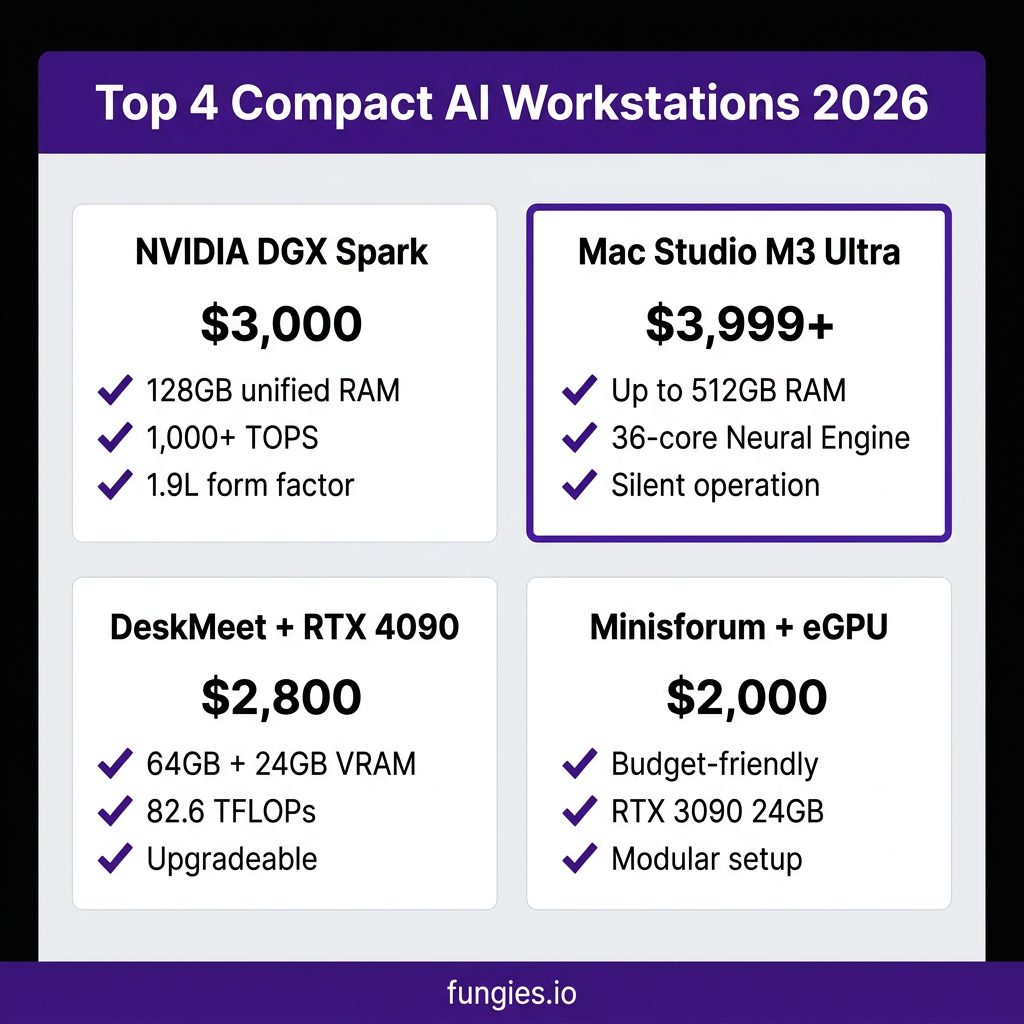
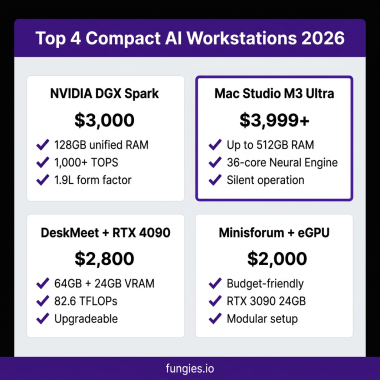
1. NVIDIA DGX Spark — Best Overall Compact AI Workstation
Price: $3,000 (expected retail)
Memory: 128GB unified LPDDR5X
AI Performance: 1,000+ TOPS
Form Factor: 1.9L (Mac Mini-sized)
The DGX Spark is what happens when NVIDIA decides to put a data center in a shoebox. Built on the GB10 “Blackwell” superchip, it pairs a 20-core Arm CPU with a Blackwell GPU delivering 1,000+ trillion AI operations per second.
What makes it special:
- 128GB of unified memory means you can run a 70B parameter model at FP16 without quantization
- 273 GB/s memory bandwidth—faster than most discrete GPU setups
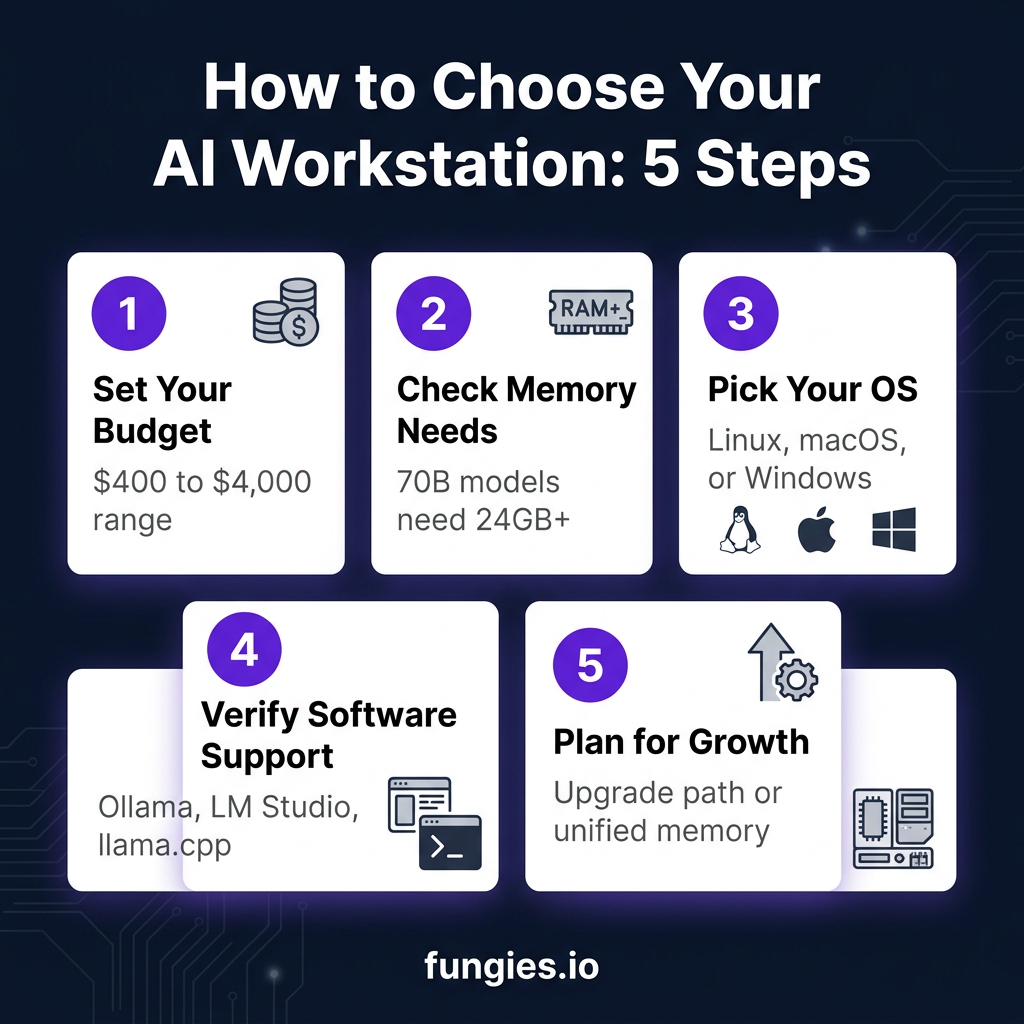
- Native support from LM Studio, Ollama, and llama.cpp
- Ships with Linux ARM64, so no hacky workarounds
Real performance: Users report 15-25 tokens/second on Llama 3.3 70B (Q4_K_M), and that’s without full optimization. The unified memory architecture eliminates the CPU-GPU transfer bottleneck that plagues traditional setups.
The catch: It’s not available yet for general purchase (as of June 2026). NVIDIA is prioritizing developers and researchers. If you can get one, it’s the current gold standard for local inference.
2. Apple Mac Studio (M3 Ultra) — Best for Apple Ecosystem
Price: $3,999 (base), $5,399 (128GB RAM)
Memory: Up to 512GB unified memory
AI Performance: 36-core Neural Engine
Form Factor: 7.7 inches square
Apple’s M3 Ultra is a monster. With up to 512GB of unified memory and 36 Neural Engine cores, it’s the closest thing to a DGX Spark you can actually buy today.
What makes it special:
- MLX framework integration means Ollama now runs natively optimized on Apple Silicon
- 800GB/s memory bandwidth—higher than most discrete GPUs
- Silent operation (no fans under normal load)
- Runs completely locally—no cloud dependencies
Real performance: On the M3 Ultra with 128GB RAM, expect 20-30 tokens/second on Llama 3.3 70B using MLX-optimized inference. The M2 Ultra (previous gen) manages 15-20 tok/s on the same model.
Best for: Developers already in the Apple ecosystem who want a turnkey solution without Linux administration.
3. ASRock DeskMeet B760 + RTX 4090 — Best DIY Value
Price: ~$2,800 (fully configured)
Memory: 64GB DDR5
AI Performance: 82.6 TFLOPS (FP16)
Form Factor: 8L
Not everyone wants to wait for NVIDIA’s supply chain. The ASRock DeskMeet is a 8-liter mini-ITX case that fits a full RTX 4090—and it’s available today.
Configuration:
- Intel Core i5-13600K or AMD Ryzen 7 7700X
- 64GB DDR5-5600
- NVIDIA RTX 4090 24GB
- 2TB NVMe SSD
What makes it special:
- 24GB VRAM handles 70B models with Q4 quantization
- Standard PC components—upgradeable and repairable
- Half the price of pre-built AI workstations
- Full CUDA compatibility
Real performance: 25-35 tokens/second on Llama 3.3 70B Q4_K_M. The 4090’s 24GB VRAM is the limiting factor for larger models, but quantization bridges the gap.
The trade-off: It’s bigger than the DGX Spark (8L vs 1.9L), louder, and draws more power (450W vs 150W). But it works today, and you can upgrade it tomorrow.
4. Minisforum UM780 XTX + eGPU — Best Budget Entry
Price: ~$1,200 (mini PC) + $800 (used RTX 3090) = ~$2,000 total
Memory: 64GB DDR5
AI Performance: Depends on GPU
Form Factor: 1.2L (mini PC) + external GPU enclosure
If $3,000 is too steep, this is your entry point. The Minisforum UM780 XTX is a 1.2-liter mini PC with an OCuLink port for external GPU connectivity.
Configuration:
- AMD Ryzen 7 7840HS (8 cores, 16 threads)
- 64GB DDR5-5600
- OCuLink eGPU enclosure ($150)
- Used RTX 3090 24GB ($800 on eBay)
What makes it special:
- Total cost under $2,000
- RTX 3090 gives you 24GB VRAM for under $1,000
- OCuLink has lower latency than Thunderbolt 4
- Tiny footprint when GPU isn’t connected
Real performance: 20-28 tokens/second on Llama 3.3 70B Q4_K_M. The eGPU connection adds ~5-10% overhead compared to internal PCIe, but it’s negligible for inference.
Best for: Budget-conscious builders who want a modular setup.
5. NVIDIA Jetson Thor — Best for Edge/Robotics
Price: ~$1,500 (estimated)
Memory: 128GB unified memory
AI Performance: 800 TOPS
Form Factor: 2.5L
The Jetson Thor is NVIDIA’s robotics-focused dev kit, but it’s also a surprisingly capable LLM inference box. Built on the same Blackwell architecture as the DGX Spark, it’s designed for edge AI applications.
What makes it special:
- 128GB unified memory (same as DGX Spark)
- Industrial temperature range (-25°C to 80°C)
- Multiple camera inputs for multimodal models
- Lower power draw than desktop GPUs
Real performance: Early benchmarks show 10-15 tokens/second on 70B models. That’s slower than the DGX Spark, but the Thor isn’t optimized for pure LLM inference—it’s a robotics platform that happens to run models well.
Best for: Robotics developers, edge AI applications, or anyone who needs industrial reliability.
6. Intel NUC 13 Pro + Arc A770 — Best Intel Alternative
Price: ~$1,400 fully configured
Memory: 64GB DDR4
AI Performance: ~200 TOPS
Form Factor: 1.2L
Intel’s Arc A770 16GB is the dark horse of local LLM inference. With 16GB VRAM and strong FP16 performance, it’s a viable alternative to NVIDIA’s dominance.
Configuration:
- Intel NUC 13 Pro (Core i7-1360P)
- 64GB DDR4-3200
- Intel Arc A770 16GB
- 1TB NVMe SSD
What makes it special:
- 16GB VRAM for under $400 (GPU price)
- Intel OpenVINO optimization for some models
- Small and quiet
- No NVIDIA software stack required
Real performance: 12-18 tokens/second on Llama 3.3 70B Q4_K_M. That’s slower than NVIDIA equivalents, but the price-to-performance ratio is competitive.
The limitation: llama.cpp support for Intel Arc is improving but still behind CUDA. You’ll encounter more friction getting models to run.
7. Raspberry Pi 5 Cluster — Best for Learning/Experimentation
Price: ~$400 (4-node cluster)
Memory: 32GB total (8GB per node)
AI Performance: ~50 TOPS (combined)
Form Factor: Custom
This isn’t for production. It’s for understanding distributed inference, learning about quantization, and proving you can run LLMs on anything.
Configuration:
- 4x Raspberry Pi 5 (8GB RAM each)
- Raspberry Pi Cluster Case
- 256GB NVMe SSD per node
- Ethernet switch for node communication
What makes it special:
- Under $500 total cost
- Learn distributed computing concepts
- Runs 7B models at usable speeds
- Completely silent
Real performance: 2-4 tokens/second on Llama 3.2 7B Q4_K_M. That’s slow, but it’s enough for experimentation and learning.
Best for: Education, hobbyists, and anyone who wants to understand how distributed inference works before scaling up.
Compact AI Workstation Comparison Table
| Workstation | Price | Memory | 70B Model Speed | Best For |
|---|---|---|---|---|
| NVIDIA DGX Spark | $3,000 | 128GB unified | 15-25 tok/s | Best overall |
| Mac Studio M3 Ultra | $3,999+ | Up to 512GB | 20-30 tok/s | Apple ecosystem |
| DeskMeet + RTX 4090 | $2,800 | 64GB + 24GB VRAM | 25-35 tok/s | DIY builders |
| Minisforum + eGPU | $2,000 | 64GB + 24GB VRAM | 20-28 tok/s | Budget entry |
| Jetson Thor | $1,500 | 128GB unified | 10-15 tok/s | Edge/robotics |
| Intel NUC + Arc A770 | $1,400 | 64GB + 16GB VRAM | 12-18 tok/s | Intel alternative |
| Pi 5 Cluster | $400 | 32GB total | 2-4 tok/s (7B) | Learning |
Key Takeaways
- The DGX Spark changes everything — If you can get one, it’s the most capable compact AI workstation available. 128GB unified memory in a 1.9L box is unprecedented.
- Apple Silicon is still competitive — The M3 Ultra with MLX optimization delivers excellent performance for developers in the Apple ecosystem.
- DIY isn’t dead — A DeskMeet with an RTX 4090 delivers the best raw performance for the money, albeit with more complexity.
- VRAM is the bottleneck — For 70B+ models, you need 24GB+ VRAM or unified memory. 16GB cards struggle without aggressive quantization.
- Consider your workflow — The best hardware is the one you’ll actually use. A quieter, slower machine beats a faster one that stays powered off.
FAQ
Can I run GPT-4 class models locally?
Not exactly. GPT-4 is estimated at 1.8 trillion parameters—far beyond consumer hardware. But 70B models with good fine-tuning (like Llama 3.3 70B or Qwen3 72B) reach 85-90% of GPT-4 quality for most tasks.
How much does electricity cost for 24/7 local inference?
The DGX Spark draws ~150W under load. At $0.15/kWh, that’s ~$16/month for continuous operation. An RTX 4090 setup draws 350-450W, costing $38-50/month.
Is unified memory better than discrete VRAM?
For LLMs, yes. Unified memory eliminates CPU-GPU transfer bottlenecks and allows the OS to dynamically allocate memory. The DGX Spark and Apple Silicon both use this architecture.
What’s the cheapest setup that can run 70B models?
A used workstation with 128GB system RAM and CPU-only inference. Expect 1-3 tokens/second, but it works. Budget $800-1,000 for a used Dell Precision or HP Z-series.
Should I wait for the DGX Spark or buy something now?
If you need hardware today, buy the DeskMeet + RTX 4090 or a Mac Studio. The DGX Spark is compelling but availability is uncertain through 2026.
Conclusion
The era of janky local LLM setups is ending. 2026 delivers purpose-built AI workstations that just work—no driver nightmares, no thermal throttling, no explaining to your household why the basement sounds like a jet engine.
The NVIDIA DGX Spark leads this generation, but it’s not the only option. Whether you want Apple’s polish, DIY value, or edge deployment, there’s a compact AI workstation that fits your needs and budget.
Start local. Own your inference. And stop paying per-token to cloud providers.
Ready to build your own AI infrastructure? Register for Fungies to handle payments and compliance for your AI-powered products.
References
- LM Studio Blog — NVIDIA DGX Spark Support (October 2025)
- HuggingFace Blog — GLM-5.2: Built for Long-Horizon Tasks (June 2026)
- HuggingFace Blog — Local Models for PR Triage (June 2026)
- Ollama Blog — MLX on Apple Silicon (March 2026)
- NVIDIA DGX Spark Technical Specifications
- Apple M3 Ultra Technical Documentation
- llama.cpp GitHub Repository — Benchmarks