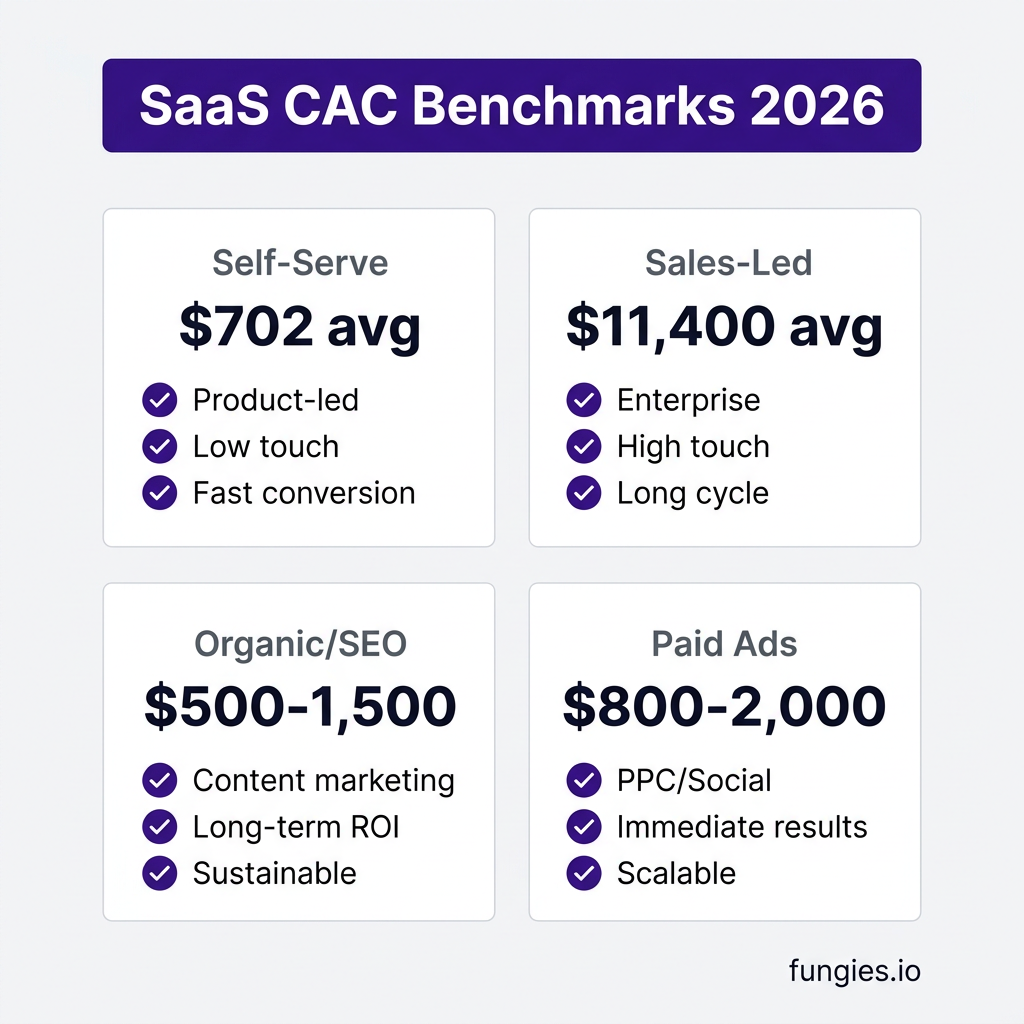
Here’s a number that should keep every SaaS founder up at night: customer acquisition costs have surged 60% over the past five years. In 2026, the median B2B SaaS company spends $702 to acquire a self-serve customer and a staggering $11,400 for sales-led enterprise deals. That’s a 16x gap — the widest it’s ever been.
But here’s what most people miss. While your competitors are burning cash on increasingly expensive paid ads, smart SaaS companies are building acquisition engines that actually get cheaper as they scale. I’ve spent years running paid campaigns across every major channel, and I can tell you this: the companies winning in 2026 aren’t the ones with the biggest budgets. They’re the ones with the most strategic channel mix.
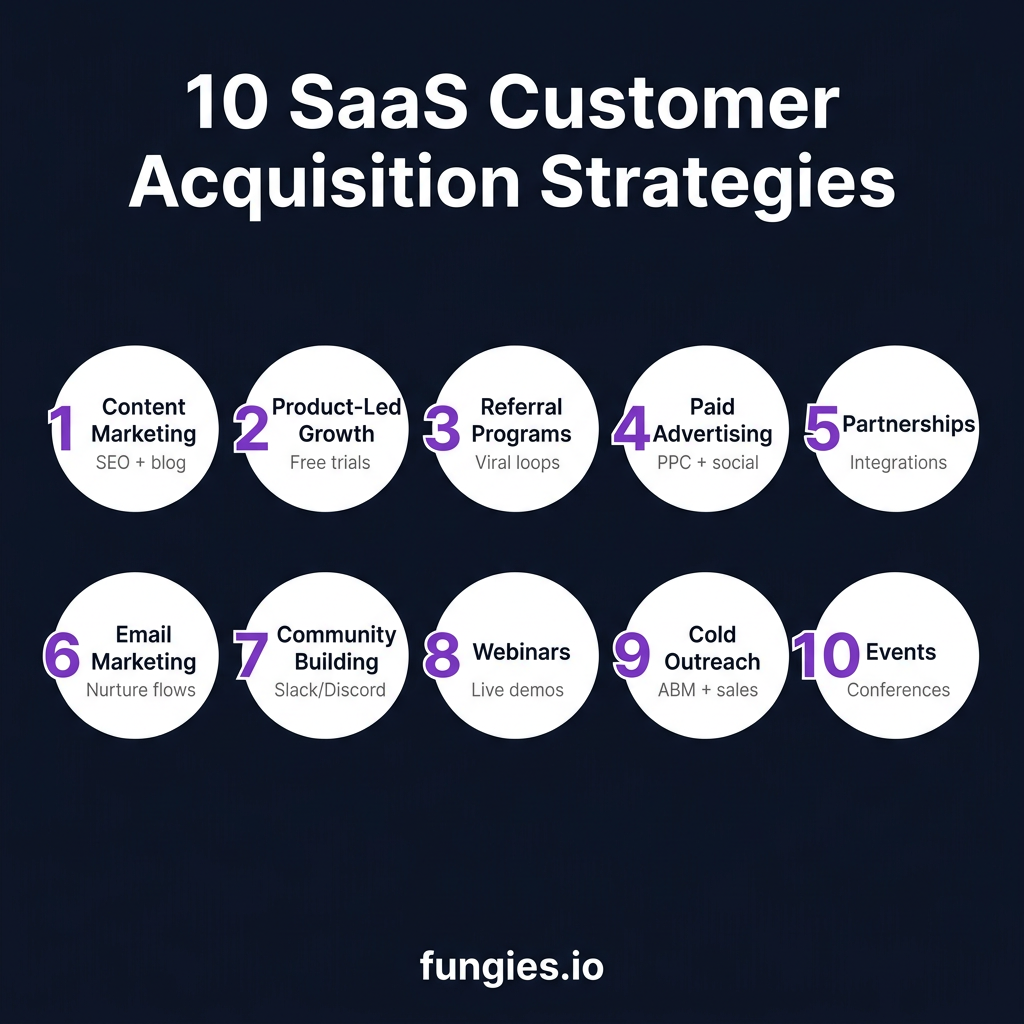
In this guide, I’ll break down the 10 most effective SaaS customer acquisition strategies based on real 2026 data. These aren’t theoretical frameworks — they’re battle-tested tactics from companies that have actually scaled. Whether you’re a seed-stage startup trying to find product-market fit or a growth-stage company optimizing for efficiency, you’ll find actionable strategies you can implement this quarter.
What Is Customer Acquisition in SaaS?
Customer acquisition in SaaS is the complete process of attracting, converting, and onboarding new paying users to your software product. Unlike traditional businesses where a sale is the end of the journey, SaaS acquisition is just the beginning — you’re building a relationship that (hopefully) lasts years.
The math is straightforward but brutal. You calculate Customer Acquisition Cost (CAC) by dividing your total sales and marketing spend by the number of new customers acquired in a period. If you spent $50,000 on marketing and sales in a month and acquired 100 customers, your CAC is $500.
But here’s where it gets interesting. The average CAC payback period for B2B SaaS is now 16 months — meaning it takes over a year just to break even on each new customer. Top-quartile companies recover CAC in under 6 months. That 10-month difference is often the gap between a company that survives and one that doesn’t.
Why Customer Acquisition Costs Are Skyrocketing in 2026
Before diving into strategies, you need to understand why acquisition has gotten so expensive. Three structural shifts are driving this:
First, longer B2B consideration cycles. The average B2B buyer now requires 14% more touchpoints before closing compared to 2023. Decision-makers are more risk-averse, budgets are tighter, and everyone wants more proof before committing.
Second, attribution loss from cookie deprecation. Privacy changes have inflated reported CAC by 25-45% because we’re simply losing visibility into which channels actually drive conversions. The customer journey is more fragmented than ever.
Third, platform cost inflation. LinkedIn ad costs have surged 89% since 2019. Google Ads CPC for competitive SaaS keywords routinely hits $50-100. What worked three years ago is now economically unviable for many companies.
The 10 Best SaaS Customer Acquisition Strategies for 2026
Now let’s get into the strategies. I’ve organized these by motion type — product-led, sales-led, and hybrid approaches — with real data on what works.
1. Content Marketing and SEO
Best for: Long-term sustainable growth, companies with 6+ months runway
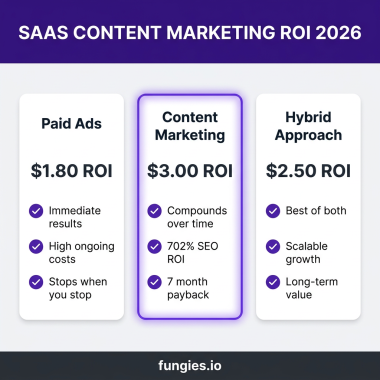
Content marketing remains the most cost-efficient acquisition channel for SaaS — when done right. Companies with mature content programs report blended CAC that’s 60-70% lower than paid-only competitors. The catch? It takes 6-12 months to see meaningful results.
The 2026 playbook has evolved. Generic “ultimate guides” don’t cut it anymore. What’s working now:
- Original research and data: First-party studies, benchmark reports, and proprietary data get 3x more backlinks than opinion pieces
- Product-led content: Tutorials and use-case content that naturally showcases your product’s value
- Comparison and alternatives content: High-intent keywords like “[competitor] alternatives” and “[category] software comparison”
- Programmatic SEO: Scaled landing pages for long-tail keywords (think Zapier’s integration pages)
HubSpot built a $2 billion company largely on the back of their content engine. Their Website Grader — a free tool that generates SEO reports — has driven millions of qualified leads over the years. That’s the power of product-led content.
2. Product-Led Growth (PLG)
Best for: Self-serve products, developer tools, horizontal SaaS
Product-led growth lets your product do the selling. Instead of forcing prospects through a sales demo, you give them immediate access to experience value. The data is compelling: PLG companies grow 2.2x faster than sales-led companies at similar stages.
The 2026 PLG playbook includes:
- Freemium models: Not just “free trial” — genuinely usable free tiers that demonstrate value
- Time-to-value optimization: Getting users to their first “aha moment” within minutes, not days
- In-product virality: Features that naturally encourage sharing (think Calendly’s “powered by” links)
- Self-serve onboarding: Interactive tutorials, contextual tooltips, and progressive disclosure
Slack, Notion, and Figma all built billion-dollar businesses on PLG principles. Their CAC is a fraction of sales-led competitors because the product itself is the primary acquisition channel.
3. Referral Programs and Viral Loops
Best for: Products with network effects, consumer-facing SaaS, team collaboration tools
Dropbox’s famous referral program — giving free storage for inviting friends — drove 3,900% growth in 15 months. While that exact playbook won’t work today, referral programs remain one of the most cost-effective acquisition channels when properly executed.
What makes referrals work in 2026:
- Double-sided incentives: Both referrer and referee get value (Notion gives credits to both parties)
- Immediate rewards: Don’t make users wait — deliver value instantly upon referral
- Low friction: One-click sharing, pre-written messages, clear value proposition
- Strategic timing: Ask for referrals when users are most engaged (after achieving a milestone)
The key metric here is your viral coefficient (K-factor). If K > 1, each user brings in more than one new user, and you have exponential growth. Most successful SaaS companies see K-factors between 0.15 and 0.35 — not viral in the Dropbox sense, but still a meaningful acquisition channel.
4. Strategic Paid Advertising
Best for: Validated products with proven LTV, companies optimizing for speed over efficiency
Paid ads are expensive, but they’re also predictable and scalable. The key is strategic channel selection based on your target customer:
- Google Ads: High intent, high CPC ($50-100 for competitive SaaS keywords), best for bottom-funnel capture
- LinkedIn Ads: Best B2B targeting but expensive ($8-15 CPC, $50-100 CPM), ideal for enterprise
- Reddit Ads: Undervalued for developer/technical audiences, 40-60% lower CAC than LinkedIn
- Twitter/X Ads: Good for awareness and community building, challenging for direct response
The 2026 paid strategy that works: start with bottom-funnel retargeting (cheapest, highest intent), then expand to lookalike audiences once you have conversion data. Never start with broad prospecting — that’s how you burn budget.
5. Strategic Partnerships and Integrations
Best for: Products in established ecosystems, tools that complement popular platforms
Building integrations with platforms your customers already use is one of the highest-ROI acquisition strategies. When you integrate with Slack, Salesforce, or Shopify, you tap into their existing user bases.
Successful partnership strategies include:
- App marketplace listings: Shopify App Store, Salesforce AppExchange, Slack App Directory
- Technology partnerships: Co-marketing with complementary tools (think: email marketing + CRM)
- Integration-led growth: Making your product essential to workflows in larger platforms
- Channel partnerships: Reseller and affiliate programs for indirect sales
Zapier built a $5 billion company almost entirely on integrations. They don’t create value directly — they connect tools that do. Every integration is a distribution channel.
6. Email Marketing and Marketing Automation
Best for: Nurturing leads, reducing sales cycles, increasing conversion rates
Email marketing consistently delivers the highest ROI of any channel — $36-42 returned for every $1 spent. For SaaS specifically, email serves multiple acquisition functions:
- Lead nurturing: Drip campaigns that educate prospects and build trust over time
- Onboarding sequences: Converting trials to paid through targeted value demonstration
- Re-engagement: Win-back campaigns for churned or inactive users
- Lifecycle marketing: Triggered emails based on user behavior and milestones
The key is segmentation. Blast emails to your entire list and you’ll see 0.5% click rates. Targeted emails to specific user segments based on behavior? 10-15% is achievable.
7. Community-Led Growth
Best for: Developer tools, niche B2B products, companies with passionate user bases
Communities are the new moat. Companies like Notion, Figma, and Webflow have built thriving user communities that drive acquisition through network effects and social proof.
Community-led acquisition works through:
- User-generated content: Templates, tutorials, and resources created by your community
- Social proof: Public showcases of what users are building with your product
- Word-of-mouth: Organic recommendations within professional networks
- Reduced support costs: Community members helping each other
Notion’s template gallery — almost entirely user-created — is a massive acquisition channel. Every template shared is an advertisement for Notion.
8. Webinars and Live Demos
Best for: Complex products, high-ACV sales, building thought leadership
Webinars have made a comeback in 2026. With AI-generated content flooding the internet, live, interactive sessions have become differentiation. A well-executed webinar can convert 15-25% of attendees to trials or demos.
Effective webinar strategies:
- Educational focus: Teach something valuable, don’t just pitch your product
- Live Q&A: Real-time interaction builds trust and addresses objections
- On-demand replays: Extend the life of your content with recorded versions
- Series approach: Multi-session courses that build relationships over time
The key is balancing education with subtle product placement. Teach first, sell second.
9. Account-Based Marketing (ABM)
Best for: Enterprise SaaS, high-ACV deals, focused target account lists
ABM flips the traditional funnel. Instead of casting a wide net and qualifying down, you identify specific target accounts and create personalized campaigns for each. It’s expensive per-account but highly efficient for enterprise deals.
Modern ABM in 2026 includes:
- Intent data: Identifying accounts actively researching solutions like yours
- Personalized content: Custom landing pages, case studies, and outreach for target accounts
- Multi-channel orchestration: Coordinated outreach across email, LinkedIn, ads, and direct mail
- Sales-marketing alignment: Tight coordination between teams on target accounts
ABM isn’t for everyone — you need high enough ACV to justify the investment. But for enterprise SaaS, it’s often the most efficient path to closed deals.
10. Events and Conferences
Best for: Building relationships, enterprise deals, industry visibility
In-person events are back post-pandemic, and they’re more valuable than ever in an increasingly digital world. The challenge is measuring ROI — events are expensive, and attribution is messy.
Event strategies that work:
- Speaking engagements: Thought leadership positioning, not vendor pitches
- Targeted sponsorships: Focus on niche events where your ICP congregates
- Private dinners and meetups: Intimate settings for relationship building
- Virtual events: Lower cost, broader reach, easier to measure
The key is being strategic. Don’t sponsor every event — pick 3-5 where your exact target customers will be, and invest heavily in making an impact.
SaaS Customer Acquisition Strategy Comparison
Here’s how these strategies stack up across key dimensions:
| Strategy | Time to Results | Typical CAC Range | Scalability | Best For |
|---|---|---|---|---|
| Content/SEO | 6-12 months | $500-1,500 | High | Long-term growth |
| Product-Led Growth | 3-6 months | $100-500 | Very High | Self-serve products |
| Referral Programs | 1-3 months | $50-200 | Medium | Network effect products |
| Paid Advertising | Immediate | $800-2,000 | High | Speed to market |
| Partnerships | 3-9 months | $300-800 | Medium | Ecosystem products |
| Email Marketing | 1-3 months | $50-150 | High | Nurturing/retention |
| Community | 6-12 months | $200-600 | Medium | Passionate users |
| Webinars | 1-2 months | $400-1,000 | Medium | Complex products |
| ABM | 3-6 months | $5,000-15,000 | Low | Enterprise deals |
| Events | Immediate | $2,000-10,000 | Low | Relationship building |
How to Choose the Right Acquisition Mix for Your SaaS
There’s no universal “best” acquisition strategy. The right mix depends on your product, market, and stage:
Early-stage (Seed to Series A): Focus on 1-2 channels max. Product-led growth if you can make it work, content marketing if you have longer runway. Don’t spread yourself thin.
Growth-stage (Series B+): Diversify across 3-4 channels. You should have enough data to know what works. Double down on winners, cut losers fast.
Enterprise SaaS: ABM + events + partnerships. High-touch sales motions require high-touch acquisition.
Self-serve/PLG: Product-led growth + content + referrals. Let the product do the heavy lifting.
The key metric to watch is your LTV:CAC ratio. A healthy SaaS company maintains at least 3:1 — meaning each customer generates 3x more value than it costs to acquire them. Top-performing companies hit 5:1 or higher.
FAQ: SaaS Customer Acquisition
What is a good CAC for SaaS?
A good CAC depends on your customer lifetime value (LTV) and business model. As a rule of thumb, your LTV:CAC ratio should be at least 3:1. For self-serve SaaS, CAC under $500 is strong. For sales-led enterprise, CAC under $10,000 is reasonable if your ACV justifies it.
How long should CAC payback period be?
The median B2B SaaS company recovers CAC in 16 months. Top-quartile companies achieve payback in under 6 months. Aim for under 12 months if you’re cash-constrained, under 18 months if you have strong funding.
What’s the difference between blended and paid CAC?
Blended CAC includes all customers acquired through any channel (including organic). Paid CAC only counts customers from paid channels. The ratio between them tells you how dependent you are on paid acquisition. A 2.4x to 3.1x ratio of paid to blended CAC means 60-70% of customers come from organic channels.
Which acquisition channel has the lowest CAC?
Referral programs and organic SEO typically have the lowest CAC — often $50-200 per customer. However, they also take longer to scale. The “cheapest” channel depends on your timeline and resources.
How do I reduce my SaaS CAC?
Focus on three levers: (1) Improve conversion rates at each funnel stage, (2) Shift spend to lower-cost channels like content and referrals, and (3) Increase customer lifetime value so you can afford higher acquisition costs. Most companies over-invest in top-of-funnel and under-invest in conversion optimization.
Conclusion: Building Your Acquisition Engine
Customer acquisition in 2026 is harder than ever — but that creates opportunity. While your competitors chase increasingly expensive paid channels, you can build sustainable acquisition engines that get cheaper as you scale.
The winning formula? Start with product-led growth if your product allows it. Layer in content marketing for long-term sustainability. Use paid channels strategically for speed and scale. And never stop optimizing your conversion funnel — small improvements compound into massive differences over time.
Remember: acquisition is only half the battle. The best SaaS companies acquire customers efficiently and keep them for years. If you’re looking for a platform that handles the entire customer lifecycle — from checkout to tax compliance — check out Fungies. We help SaaS companies sell globally with a simple 5% + $0.50 per transaction fee and no monthly charges.