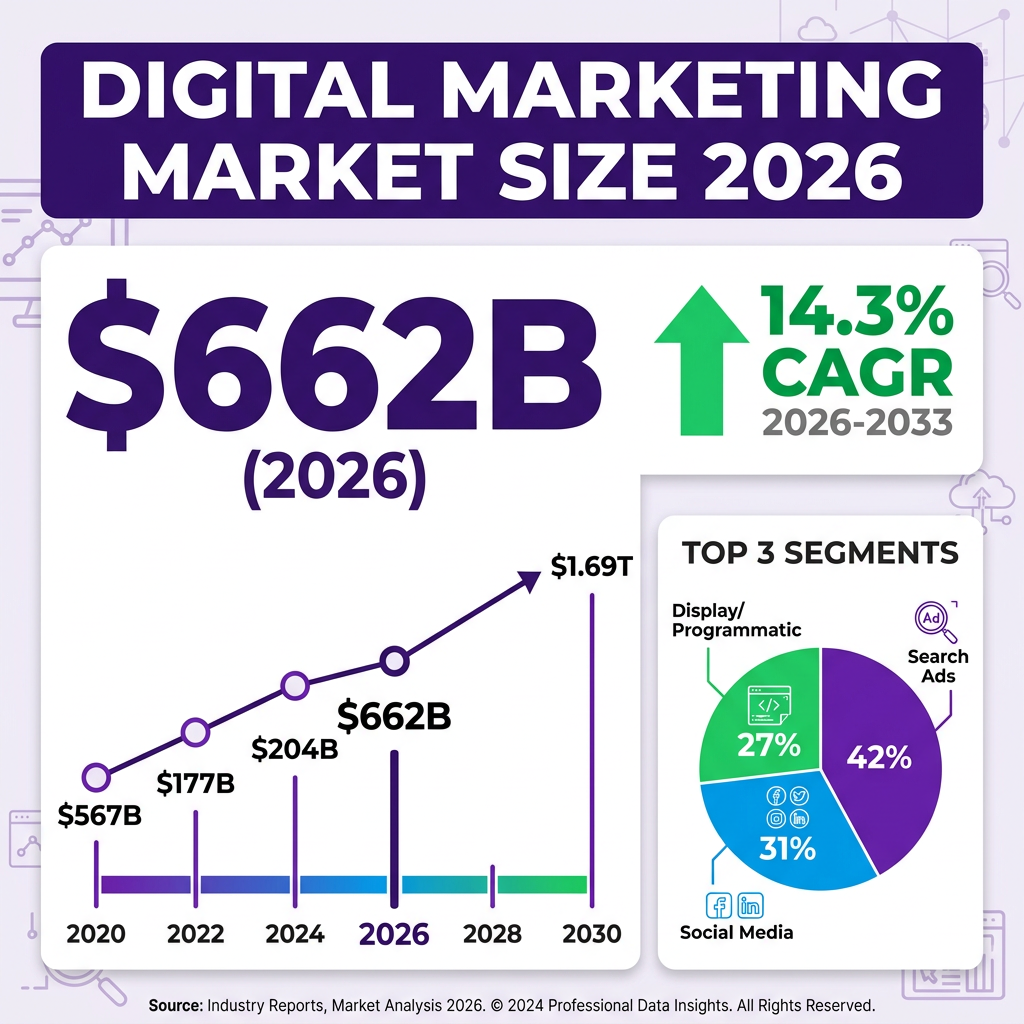
The digital marketing landscape has undergone a seismic transformation in 2026. With global digital advertising spend projected to reach $662.3 billion this year—up from $567.9 billion in 2025—the industry is experiencing unprecedented growth driven by artificial intelligence, privacy-first strategies, and the continued dominance of mobile and video consumption. For marketers, business owners, and SaaS founders, understanding these shifts isn’t optional—it’s survival.
What makes 2026 particularly significant is the convergence of multiple forces: the maturation of AI-powered marketing tools, the deprecation of third-party cookies forcing a fundamental rethink of targeting strategies, and the explosive growth of short-form video content reshaping how brands connect with audiences. The stakes have never been higher, nor the opportunities more abundant.

Market Overview: The $662 Billion Digital Marketing Ecosystem
The digital marketing market has evolved from a niche discipline to the dominant force in global advertising. In 2026, digital channels account for over 67% of all media spend worldwide, a figure that would have seemed impossible just a decade ago. The market’s growth trajectory is nothing short of remarkable: starting from $461.2 billion in 2021, the industry has expanded to $683.5 billion by the end of 2025, and current projections place it at $662.3 billion for 2026 with a compound annual growth rate (CAGR) of 14.3% through 2033.
What’s driving this explosive growth? Several interconnected factors are at play. First, the continued shift of consumer attention from traditional media to digital platforms has created an irreversible trend. Second, the sophistication of targeting and measurement capabilities has made digital advertising increasingly attractive to performance-minded marketers. Third, the democratization of marketing technology has enabled businesses of all sizes to compete effectively, not just those with enterprise budgets.
The market’s composition reveals interesting dynamics across segments. Search advertising remains the largest single category, generating approximately $311.86 billion in 2025 and projected to reach $354.9 billion in 2026 at a 13.8% CAGR. Social media advertising follows closely, with Meta alone generating $196 billion in advertising revenue in 2025, up 22.1% year over year. Programmatic advertising has become the dominant transaction method, accounting for over 90% of all digital display ad spending by 2026.
Looking at regional distribution, North America continues to lead in absolute spending, but Asia-Pacific is showing the fastest growth rates. The global advertising market is on track to reach $1.25 trillion in total ad spending by 2026, with digital capturing an ever-increasing share. By 2030, digital advertising alone is projected to exceed $1.69 trillion, representing a fundamental restructuring of how businesses allocate marketing resources.
The software infrastructure supporting this ecosystem has also seen massive growth. The digital marketing software market is projected to grow from $86.3 billion in 2025 to $99.3 billion in 2026, reaching $321.8 billion by 2033 at an 18.3% CAGR. This reflects the increasing complexity of marketing operations and the need for sophisticated tools to manage multi-channel campaigns, customer data, and performance analytics.
Key Statistics and Data: The Numbers That Matter
Understanding the digital marketing landscape requires diving deep into the data. Here are the statistics that should inform every marketing decision in 2026:
The sheer scale of the digital marketing industry in 2026 is staggering. With over 5.2 billion people using social media platforms and nearly 4.73 billion email users worldwide, the addressable market for digital marketers has never been larger. Yet with this scale comes complexity—96.55% of web pages receive zero organic traffic from Google, illustrating the fierce competition for visibility in an increasingly crowded digital landscape.
What separates successful digital marketers from the rest is their ability to interpret these statistics and translate them into actionable strategies. The data points below represent not just numbers, but opportunities—channels where investment yields returns, trends that indicate shifting consumer behavior, and benchmarks against which to measure performance.
Global Market Metrics
- Global digital ad spend 2026: $662.3 billion (up from $567.9B in 2025)
- Digital share of total media spend: 67%
- Projected 2030 market size: $1.69 trillion
- Overall CAGR (2026-2033): 14.3%
- Digital marketing software market 2026: $99.3 billion
- Content marketing industry revenue 2025: $94 billion
- Content marketing growth rate: 10.4% annually
Social Media Marketing Statistics
- Global social media users 2026: 5.2 billion (64% of world population)
- Projected social media users by 2030: 6.6 billion
- Average daily social media usage: 2 hours 28 minutes
- Facebook monthly active users: 3.1 billion
- YouTube monthly active users: 2.9 billion
- Instagram monthly active users: 2.3 billion
- TikTok monthly active users: 1.6 billion
- Global social media ad spend 2025: $275.98 billion
- Projected social media ad spend 2030: $480 billion
- Meta daily active people (DAP): 3.56 billion (up 4% YoY)
Search and SEO Statistics
- Organic search share of website traffic: 53%
- Google’s global search traffic share: 89.85%
- Position #1 organic CTR: 39.8%
- Position #2 organic CTR: 18.7%
- Position #3 organic CTR: 10.2%
- Web pages with zero organic traffic: 96.55%
- Searches ending without a click: 60% (due to AI Overviews)
- Mobile share of website traffic: 60%
Email Marketing Statistics
- Global email users 2026: 4.73 billion
- Daily emails sent/received: 392 billion
- Email marketing ROI: $36-$42 for every $1 spent
- Abandoned cart email open rate: 50.5%
- Abandoned cart conversion rate: 3.33%
- Top-performing abandoned cart conversion: 7.69%
- Email revenue from triggered campaigns: 77%
Content Marketing Statistics
- Content marketing ROI: $3 for every $1 invested
- SEO ROI for B2B companies: 748%
- B2B marketers using content marketing: 73%
- B2C marketers using content marketing: 70%
- Video content ROI speed advantage: 49% faster than text
- Marketers emphasizing video importance: 95%
- Monthly content marketing investment ($5K-$10K): 58% of companies
Programmatic Advertising Statistics
- Programmatic share of digital display: 90%+
- Global programmatic ad spend 2025: $550+ billion
- Programmatic CTV ad spend 2026: $45+ billion
- Video share of programmatic spend: ~50%
- Mobile share of programmatic spend: 71%
- US digital display via programmatic: 88%
- Programmatic conversion improvement with data: 10-30%
- DCO CTR improvement: 20-60% higher
AI and Marketing Automation Statistics
- Marketers expecting to increase AI usage: 91%
- Top 1,000 brands using AI: 73%
- AI chat personalization bounce rate reduction: 25%
- Campaign creation time reduction with AI: 60%
- Weekly time saved on scheduling: 4 hours
- Ad spend waste eliminated by AI: 50%
- Routine inquiries handled by chatbots: 80%
- Forecasting errors reduced by AI: 30%
- A/B testing speed increase: 65%
- CRM data entry automated: 75%
- Digital marketing tasks automated by 2026: 45%
Major Trends Shaping Digital Marketing in 2026
The digital marketing landscape of 2026 is defined by seven transformative trends that are reshaping how brands connect with audiences, measure performance, and drive growth. Understanding these trends is essential for any marketer looking to maintain competitive advantage.
These trends don’t exist in isolation—they intersect and reinforce each other in complex ways. AI-powered personalization, for example, enables more effective first-party data strategies while also driving the evolution of marketing automation. The rise of short-form video creates new opportunities for influencer marketing, while simultaneously challenging traditional SEO approaches as AI-generated summaries change how users discover content.
For marketers, the challenge isn’t just understanding each trend individually, but recognizing how they combine to create new opportunities and threats. The companies winning in 2026 are those that have built organizational capabilities to adapt quickly as these trends evolve.
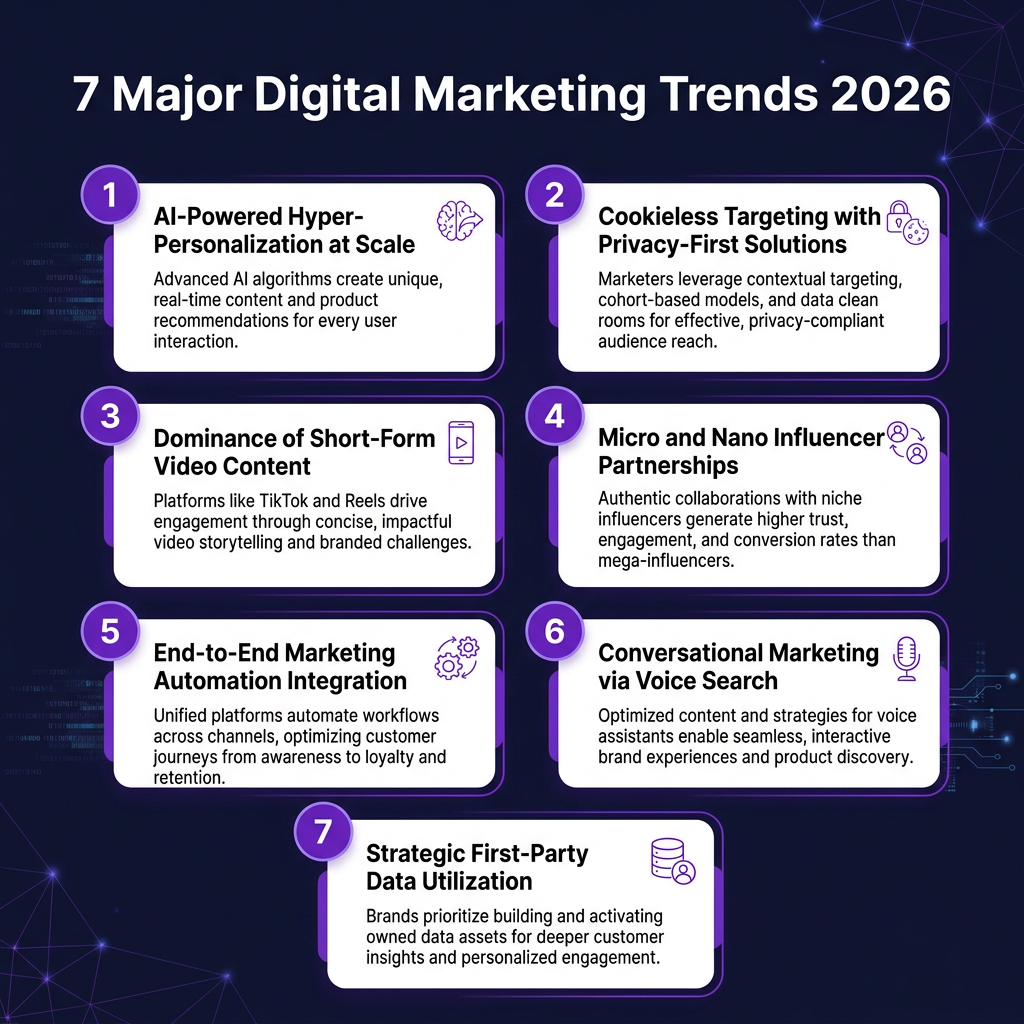
1. AI-Powered Personalization at Scale
Artificial intelligence has moved from experimental to essential in 2026. With 91% of marketing professionals planning to increase AI usage, the technology is now deeply embedded in every aspect of marketing operations. The most significant impact is in personalization—AI enables hyper-personalized experiences that were previously impossible to deliver at scale.
Netflix’s recommendation engine, which predicts viewer preferences to reduce churn, exemplifies this trend. Amazon dynamically updates product recommendations based on real-time behavior. Spotify curates personalized playlists that boost user loyalty. These aren’t just features—they’re competitive advantages powered by sophisticated AI systems.
The shift toward autonomous campaigns represents the next evolution. AI now manages campaigns end-to-end, optimizing creatives, budgets, and targeting in real-time without human intervention. This isn’t about replacing marketers—it’s about amplifying their capabilities. As David Visser, CEO of Zyber and Unlocked, notes: “2026 is the year AI will finally handle the heavy lifting so marketers can focus on creativity, strategy, and community connection.”
2. The Cookieless Future and First-Party Data
The deprecation of third-party cookies has fundamentally changed how marketers approach targeting and measurement. While Google ultimately decided against blocking third-party cookies by default in Chrome, instead presenting users with a “global consent prompt,” the practical effect is similar—most users decline tracking, creating an environment comparable to Safari or Firefox.
This shift has elevated first-party data from nice-to-have to essential. First-party data—information collected directly from customers with explicit permission—is more accurate, more compliant, and more stable than third-party behavioral data ever was. Brands are now investing heavily in loyalty programs, direct relationships, and value exchanges that encourage customers to share their data willingly.
Contextual targeting has also seen a resurgence. Instead of tracking individuals across the web, marketers are placing ads based on the content being consumed. This privacy-safe approach is proving surprisingly effective, particularly when combined with AI-powered content analysis that understands context at a granular level.
3. Short-Form Video Dominance
Short-form video has become the dominant content format in 2026. TikTok’s 1.6 billion monthly active users and Instagram’s continued investment in Reels reflect a fundamental shift in how consumers prefer to engage with content. The statistics are compelling: video delivers ROI 49% faster than text-based content, and 95% of marketers highlight the importance of video in their overall strategy.
The format’s success lies in its alignment with modern attention spans and mobile consumption patterns. Users can consume dozens of short videos in the time it takes to read a single article, and the algorithmic feeds ensure high relevance. For marketers, this means rethinking content strategies to prioritize video production, even for traditionally text-heavy industries.
TikTok’s engagement rates are roughly eight times higher than Instagram’s, making it the platform marketers most commonly plan to increase investment in during 2026. However, the landscape is evolving rapidly—what works today may not work tomorrow, requiring constant experimentation and adaptation.
4. Influencer Marketing Maturation
Influencer marketing has grown from a $1.7 billion industry in 2016 to $16.4 billion in 2022, and the trajectory continues upward. In 2026, brands are expected to spend more on influencer marketing than on digital ads—a remarkable shift that reflects changing consumer trust patterns.
The industry has matured significantly. Micro-influencers (10,000-100,000 followers) often deliver better ROI than celebrity partnerships, offering higher engagement rates and more authentic connections with niche audiences. The focus has shifted from reach to relevance, with brands prioritizing influencers whose values align with their own and whose audiences match their target demographics.
Measurement has also improved. Advanced attribution models can now track the full customer journey from influencer content to conversion, providing clear ROI data that justifies continued investment. This has transformed influencer marketing from a brand awareness play to a performance channel.
5. Marketing Automation Evolution
Marketing automation has evolved from scheduled workflows to self-optimizing systems that plan, execute, and adjust campaigns across channels in real-time. This shift is driven by AI integration that enables predictive analytics, dynamic content personalization, and autonomous optimization.
The impact on efficiency is dramatic. AI-powered automation is saving marketers 4 hours weekly on scheduling alone, while handling 80% of routine customer inquiries through chatbots. Automated email flows now generate 77% of email revenue, with abandoned cart sequences achieving 50.5% open rates and 3.33% conversion rates.
Perhaps most importantly, automation enables personalization at scale. What was once limited to enterprise companies with massive marketing teams is now accessible to businesses of all sizes. This democratization is leveling the playing field and forcing larger competitors to innovate continuously.
6. Voice and Conversational Search
Voice search optimization has become critical as smart speakers and voice assistants proliferate. The way people search by voice differs significantly from typed queries—more conversational, longer, and often question-based. This requires a fundamental rethink of SEO strategy.
Conversational AI is also transforming customer service and sales. Advanced chatbots can now handle complex inquiries, qualify leads, and even close sales without human intervention. The key is creating experiences that feel natural and helpful rather than robotic and frustrating.
For local businesses, voice search is particularly important. “Near me” queries continue to grow, and voice assistants often provide a single answer rather than a list of results. Being that single answer requires focused local SEO efforts and structured data implementation.
7. Generative Engine Optimization (GEO)
Perhaps the most significant trend of 2026 is the rise of Generative Engine Optimization (GEO)—optimizing content for AI summaries in tools like Google AI Overviews and Perplexity. AI-generated summaries have slashed organic click-through rates by up to 60%, forcing marketers to rethink visibility entirely.
GEO requires a different approach than traditional SEO. Content must be structured for AI comprehension, with clear headings, concise answers, and comprehensive coverage of topics. The goal isn’t just to rank—it’s to be the source that AI systems cite in their summaries.
This trend represents both a threat and an opportunity. While organic traffic may decline for some queries, being featured in AI summaries can drive significant brand awareness and establish authority. Smart marketers are adapting their content strategies to optimize for both traditional search and AI-generated responses.
Key Players and Competitive Landscape
The digital marketing ecosystem is dominated by a handful of tech giants, but the competitive dynamics are shifting in interesting ways. Understanding the landscape is crucial for making informed platform and partnership decisions.
The concentration of market power among Google, Meta, and Amazon has created both opportunities and challenges for marketers. On one hand, these platforms offer unparalleled reach, sophisticated targeting capabilities, and robust measurement tools. On the other hand, dependence on a small number of platforms creates vulnerability—algorithm changes, policy updates, or pricing increases can dramatically impact marketing performance.
This dynamic has sparked growing interest in alternative platforms and owned channels. Marketers are increasingly diversifying their channel mix, investing in email marketing, building direct relationships with customers, and exploring emerging platforms like TikTok and LinkedIn. The goal is to reduce platform risk while maintaining the scale and efficiency that major platforms provide.
Another important development is the rise of retail media networks. Amazon’s advertising business has demonstrated the power of placing ads directly at the point of purchase, and other retailers are following suit. Walmart, Target, and Instacart have all launched advertising platforms, creating new opportunities for brands to reach consumers with high purchase intent.

The Triopoly: Google, Meta, and Amazon
Google, Meta, and Amazon collectively control over 50% of the global digital advertising market. Each has carved out distinct strengths:
Google (Alphabet) remains the global market leader through its Google Ads platform. With 89.85% of global search traffic, Google’s dominance in search advertising is unparalleled. The company’s strength lies in intent-based targeting—reaching users actively searching for solutions. YouTube, with 2.9 billion monthly active users and 1 billion hours watched daily, extends Google’s reach into video advertising.
Meta (Facebook, Instagram, WhatsApp) is projected to overtake Google in total digital ad revenues by the end of 2026, both globally and in the US. With 3.56 billion daily active people across its family of apps, Meta offers unmatched reach and sophisticated interest-based targeting. The company’s 22.1% year-over-year revenue growth reflects its continued innovation in ad formats and measurement.
Amazon has transformed from an e-commerce platform to an advertising powerhouse. By leveraging its vast trove of consumer purchase data, Amazon offers targeting precision that other platforms can’t match. For product-based businesses, Amazon advertising has become essential.
Emerging Players and Challengers
While the triopoly dominates, several platforms are gaining ground:
TikTok has emerged as the fastest-growing advertising platform, with 1.6 billion monthly active users and engagement rates eight times higher than Instagram. The platform’s algorithmic feed and creative tools have made it particularly attractive to younger demographics.
LinkedIn dominates B2B advertising, with professional targeting capabilities that no other platform can match. As B2B marketing shifts digital, LinkedIn’s importance continues to grow.
Microsoft (Bing) has gained significant ground with AI-powered search features, capturing an increasing share of the search market and offering competitive advertising options.
Ad Tech Infrastructure
Beyond the consumer-facing platforms, a complex ecosystem of ad technology providers enables programmatic buying, measurement, and optimization. Companies like The Trade Desk, PubMatic, and Magnite provide the infrastructure that powers modern digital advertising. As privacy regulations tighten and cookies deprecate, these companies are racing to develop alternative identity and targeting solutions.
Regional Market Analysis
The digital marketing landscape varies significantly across regions, with different markets at different stages of maturity and facing unique challenges and opportunities.
North America
North America remains the largest digital advertising market in absolute terms, with the United States alone accounting for a significant portion of global ad spend. The region leads in adoption of new technologies and marketing approaches, making it a bellwether for global trends. However, the market is also highly competitive, with high customer acquisition costs and mature digital infrastructure.
Key characteristics of the North American market include high mobile penetration, sophisticated programmatic advertising infrastructure, and strong adoption of AI-powered marketing tools. Privacy regulations like CCPA in California are setting standards that other regions are likely to follow.
Europe
Europe presents a complex landscape shaped by stringent privacy regulations, particularly GDPR. While these regulations create compliance challenges, they also drive innovation in privacy-preserving marketing techniques. European marketers have become leaders in first-party data strategies and consent-based marketing.
The European market is also characterized by significant variation between countries, with different languages, cultural preferences, and regulatory environments requiring localized approaches. The UK’s departure from the EU has added additional complexity for marketers operating across the region.
Asia-Pacific
Asia-Pacific is the fastest-growing region for digital marketing, driven by rapid digital adoption in countries like India, Indonesia, and Vietnam. Mobile-first is the dominant paradigm in this region, with many users accessing the internet exclusively through smartphones.
China represents a unique case, with domestic platforms like WeChat, Douyin (TikTok), and Alibaba dominating the landscape. International marketers face significant challenges entering this market, but the potential rewards are substantial given the size and sophistication of Chinese digital consumers.
Latin America and Middle East/Africa
These emerging markets present significant growth opportunities, with increasing internet penetration and growing middle classes driving digital adoption. However, they also face challenges including infrastructure limitations, payment system complexities, and varying levels of digital literacy.
Marketers entering these regions need to adopt mobile-first strategies, account for lower bandwidth environments, and build trust with consumers who may be less familiar with digital commerce.
Challenges and Pain Points
Despite the opportunities, digital marketing in 2026 faces significant challenges that require strategic attention and resource allocation. These challenges are not temporary obstacles to be overcome—they represent fundamental shifts in how digital marketing operates that will persist and evolve in the coming years.
The most successful marketers in 2026 are those who have accepted these challenges as the new normal and built strategies that account for them. Rather than fighting against privacy regulations or algorithm changes, they’re finding ways to thrive within these constraints, often discovering competitive advantages in the process.
1. Privacy and Data Governance
The deprecation of third-party cookies has created a measurement and targeting crisis. With 60% of searches now ending without a click due to AI Overviews and featured snippets, traditional SEO metrics are becoming less reliable. Meanwhile, privacy regulations like GDPR and CCPA continue to expand, creating compliance complexity for global campaigns.
The shift to first-party data requires significant investment in data infrastructure, consent management, and customer relationship building. Brands that haven’t begun this transition are already behind.
2. Algorithm Dependency and Platform Risk
Marketers have become dangerously dependent on platform algorithms. A single algorithm update can destroy traffic and revenue overnight. The 96.55% of web pages that receive zero organic traffic from Google illustrates how difficult it is to achieve visibility in an algorithmically-curated world.
This dependency creates platform risk—businesses that rely heavily on a single channel are vulnerable to changes outside their control. Diversification isn’t just a strategy; it’s survival.
3. Content Saturation and Attention Scarcity
The explosion of content creation has led to unprecedented saturation. With 392 billion emails sent daily and billions of social media posts, cutting through the noise requires exceptional creativity and strategic precision. The average user’s attention is divided across multiple platforms and devices, making sustained engagement increasingly difficult.
This challenge is compounded by AI-generated content flooding the market. While AI tools increase production capacity, they also raise the bar for content quality—mediocre content is no longer competitive.
Opportunities and Growth Strategies
Within these challenges lie significant opportunities for marketers willing to adapt and innovate. The same forces disrupting traditional marketing approaches—AI, privacy regulations, platform fragmentation—are also creating new opportunities for those who move quickly.
The key insight for 2026 is that marketing success increasingly depends on building sustainable competitive advantages rather than exploiting temporary arbitrage opportunities. The days of gaming algorithms or relying on single-channel strategies are over. Sustainable growth requires diversified channel strategies, strong customer relationships, and organizational capabilities that enable rapid adaptation.
1. AI-First Marketing Operations
Companies that fully embrace AI are seeing dramatic efficiency gains. The 60% reduction in campaign creation time, 50% elimination of ad spend waste, and 30% reduction in forecasting errors represent competitive advantages that compound over time. The key is integrating AI across the entire marketing workflow, not just using it for isolated tasks.
Early adopters are building capabilities that will be difficult for laggards to match. As AI tools become more sophisticated, the gap between AI-enabled and traditional marketing operations will widen.
2. Community-Led Growth
As traditional advertising becomes more expensive and less effective, community-led growth offers a sustainable alternative. Building engaged communities around brands creates organic advocacy, reduces customer acquisition costs, and generates valuable first-party data.
This approach requires long-term thinking and genuine value creation, but the returns can exceed traditional advertising. Communities create network effects that compound over time, making them increasingly valuable assets.
3. Owned Channel Investment
The limitations of third-party platforms have sparked a renewed focus on owned channels—email lists, websites, and mobile apps. These assets provide direct customer relationships that aren’t subject to algorithm changes or platform policies.
Email marketing’s $36-$42 ROI per dollar spent makes it the highest-returning channel for most businesses. Investing in list growth, segmentation, and automation delivers consistent, measurable returns.
Building Your 2026 Marketing Technology Stack
Selecting the right marketing technology is crucial for executing effective digital marketing strategies. The ideal stack depends on your business size, industry, and specific goals, but several categories of tools are essential for most organizations.
Customer Relationship Management (CRM)
A CRM system is the foundation of modern marketing operations, serving as the central repository for customer data and enabling personalized communication at scale. Leading options include Salesforce for enterprise organizations, HubSpot for mid-market companies, and Zoho CRM for smaller businesses. The key is selecting a platform that integrates well with your other tools and provides the automation capabilities you need.
Marketing Automation
Marketing automation platforms enable you to create sophisticated customer journeys that deliver the right message at the right time. Email automation, lead scoring, and behavioral triggers are standard features. Marketo, Pardot, and ActiveCampaign are popular choices, each with different strengths depending on your use case.
Analytics and Attribution
With privacy regulations limiting traditional tracking methods, modern analytics requires a multi-faceted approach. Google Analytics 4 remains the standard for web analytics, but many organizations are supplementing it with first-party data platforms, server-side tracking, and privacy-preserving measurement techniques. Attribution modeling has become increasingly complex, requiring sophisticated tools to understand the true impact of each touchpoint.
Content Management and Creation
Content management systems (CMS) like WordPress, Contentful, and Webflow provide the foundation for content marketing efforts. For content creation, AI-powered tools are becoming essential—platforms like Jasper, Copy.ai, and SurferSEO help create optimized content at scale. Video creation tools like Descript and Canva have democratized video production, making it accessible to organizations without dedicated video teams.
Advertising Platforms
Most organizations will need to manage campaigns across multiple advertising platforms. While each major platform (Google Ads, Meta Ads, TikTok Ads, LinkedIn Ads) has its own native interface, many marketers use third-party tools like Skai, Marin Software, or Smartly.io to manage campaigns across platforms and gain unified reporting.
Case Studies and Success Stories
Theory is valuable, but real-world examples demonstrate how these trends and strategies play out in practice. The following case studies illustrate how companies of different sizes and industries are navigating the digital marketing landscape of 2026.
Case Study 1: PaintNite’s Email Automation Success
PaintNite, an experiential entertainment company, implemented sophisticated email automation flows that dramatically outperformed their campaign-based approach. Their automated flow conversion rate reached 8.47%—approximately 7% higher than their campaign average. This case illustrates the power of behavioral triggers and personalized timing in email marketing.
The key to their success was mapping the customer journey and identifying high-intent moments—abandoned carts, post-purchase follow-ups, and re-engagement opportunities. By automating responses to these moments, they achieved consistent revenue generation without proportional increases in marketing effort.
Case Study 2: Netflix’s AI-Powered Personalization
Netflix’s recommendation engine is perhaps the most sophisticated example of AI-powered personalization in marketing. By analyzing viewing patterns, the platform predicts preferences and surfaces content that keeps users engaged. This personalization reduces churn and increases lifetime value.
The lesson for marketers is clear: AI can predict customer needs and deliver personalized experiences at scale. While most businesses don’t have Netflix’s resources, the underlying principles—collecting behavioral data, applying machine learning, and personalizing experiences—are accessible to businesses of all sizes.
Case Study 3: B2B SaaS SEO Strategy
A B2B SaaS company implementing programmatic SEO strategies achieved 748% ROI from their organic search efforts. By systematically creating content around high-intent keywords, optimizing technical SEO, and building authoritative backlinks, they established sustainable competitive advantage.
Their approach focused on the 3.8x backlink advantage that top-ranked pages enjoy—creating linkable assets, conducting original research, and building relationships with industry publications. This investment in organic visibility paid dividends long after the initial work was complete.
Future Outlook and Predictions (2026-2030)
Looking ahead, several trends will shape the digital marketing landscape through 2030. While predicting the future is inherently uncertain, the trajectory of current trends provides a reasonable basis for anticipating how the industry will evolve.
The most significant shift will be the complete integration of AI into every aspect of marketing operations. By 2030, AI won’t be a separate tool or capability—it will be embedded in every marketing platform, automating routine decisions and augmenting human creativity. Marketers will spend less time on execution and more time on strategy, creative direction, and building customer relationships.
Another major shift will be the maturation of privacy-first marketing. By 2030, the transition away from third-party cookies will be complete, and first-party data strategies will be standard practice. Brands that have invested in building direct customer relationships and transparent data practices will enjoy significant competitive advantages.
Market Growth Projections
The digital marketing market is projected to reach $1.69 trillion by 2033, growing at a 14.3% CAGR. By 2030, digital will capture nearly 65% of global ad spend, cementing its position as the dominant marketing channel. The software infrastructure supporting this growth will exceed $321 billion by 2033.
AI Integration Deepens
By 2030, AI will be fully integrated into every aspect of marketing operations. Predictive analytics will enable anticipatory marketing—reaching customers before they even recognize their own needs. Autonomous campaigns will become the norm, with human marketers focusing on strategy, creativity, and relationship building.
Privacy-First Marketing Matures
The transition to privacy-first marketing will be complete by 2030. First-party data strategies, contextual targeting, and privacy-preserving measurement will be standard practice. Brands that build trust through transparent data practices will enjoy competitive advantages in customer acquisition and retention.
Immersive and Interactive Formats
AR, VR, and interactive content will move from experimental to mainstream. As hardware becomes more accessible and 5G/6G networks enable richer experiences, marketers will have new formats to engage audiences. The line between digital and physical marketing will continue to blur.
Social Commerce Explosion
Social media platforms are becoming digital malls, particularly on TikTok and Facebook. By 2030, social commerce will represent a significant share of e-commerce transactions, with seamless in-app purchasing becoming standard. This trend will require marketers to rethink the traditional separation between awareness and conversion.
Key Takeaways
The digital marketing landscape of 2026 presents both unprecedented opportunities and significant challenges. Success requires understanding the forces shaping the industry and building organizational capabilities to adapt as these forces evolve.
- The digital marketing market will reach $662.3 billion in 2026, growing at 14.3% CAGR through 2033—representing the largest opportunity in marketing history
- AI is no longer optional—91% of marketers are increasing AI usage, with automation delivering 60% time savings and 50% waste reduction
- First-party data is the new currency—the cookieless future requires investment in direct customer relationships and privacy-compliant data strategies
- Short-form video dominates—TikTok and Instagram Reels are where attention lives, with video delivering ROI 49% faster than text
- Email remains the ROI champion—with $36-$42 return per dollar spent and 77% of revenue from automated flows, email deserves continued investment
- Platform diversification is essential—dependence on any single platform creates vulnerability; sustainable growth requires multi-channel strategies
- Content quality matters more than quantity—with 96.55% of web pages receiving zero organic traffic, mediocre content is no longer competitive
- Measurement is becoming more complex—privacy regulations and AI-generated summaries are changing how we track and attribute marketing performance
The marketers and companies that will thrive in this environment are those that embrace change, invest in building sustainable competitive advantages, and maintain a relentless focus on delivering value to their customers. The tools and tactics will continue to evolve, but the fundamentals—understanding your audience, creating compelling content, and building genuine relationships—remain constant.
Sources and Citations
- Grand View Research – Digital Marketing Software Market Size Report, 2026-2033
- Grand View Research – Digital Advertising Market Size & Share Report, 2026-2033
- Research and Markets – Digital Advertising Market Report 2026
- Statista Market Insights – Global Advertising Market Forecast 2026
- eMarketer – Meta to Surpass Google in Digital Ad Revenues Forecast 2026
- Hostinger – 47 Essential Digital Marketing Statistics for 2026
- SQ Magazine – Digital Marketing Statistics 2026: Big Insights
- SeoProfy – 113 Digital Marketing Statistics for 2026
- DreamIT CS – AI Digital Marketing in 2026: Trends, Tools & Growth Strategies
- Klaviyo – 8 Marketing Automation Trends for 2026
- WSI World – Top Digital Marketing Trends for 2026
- Dotdigital – 2026 Marketing Predictions
- Panamedia – Top 7 Digital Marketing Trends to Watch in 2026
- Entrepreneurs HQ – 91 Digital Marketing Industry Statistics 2026
- Webandcrafts – Digital Marketing Statistics 2026
- Digital Applied – Digital Advertising Statistics 2026
- Quartr – The Rise of Google, Meta, Amazon, and YouTube in Advertising
- WorldMetrics – AI Marketing Automation Statistics 2026
- Seattle Organic SEO – AI & Marketing in 2026
- Shopify – 34 AI in Marketing Statistics 2026
- NewMedia – 200+ Social Media Marketing Statistics 2026
- Hootsuite – 60+ Social Media Statistics Marketers Need to Know 2026
- Technology Checker – Social Media Advertising Insights 2026
- Thrive Agency – Social Media Marketing Statistics 2026
- Digital Applied – Data Privacy Marketing 2026: Cookieless Strategy
- Adrenalead – Advertising Without Cookies: Where to Start in 2026
- MarkNtel Advisors – Digital Marketing Market Research Report 2030
- Define Marketing – 2030 Digital Marketing Forecast
- Genesys Growth – 45 Content Marketing ROI Statistics 2026
- Typeface AI – 50+ Content Marketing Statistics 2026
- Digital Elevator – 39 Content Marketing Statistics 2026
- Digital Applied – Content Marketing Statistics 2026
- CodeCrew – The Ultimate 2026 Email Marketing Stats List
- Snov.io – 101+ Best Email Marketing Statistics 2026
- Digital Applied – Email Marketing Statistics 2026
- Robly – Email Marketing Statistics for 2026
- BizIQ – SEO Statistics 2026
- SE Ranking – 120+ SEO & Marketing Stats for 2026
- Searchlab – SEO Statistics 2026
- AIOSEO – 85+ SEO Statistics for 2026
- SeoProfy – 126 SEO Statistics 2026
- Digital Applied – Programmatic Advertising Statistics 2026
- AdTaxi – Driving Better Performance From Programmatic in 2026
- Marketing LTB – Programmatic Advertising Statistics 2026
- Renub – Programmatic Advertising Market Outlook 2026
- Persistence Market Research – Programmatic Advertising Market Forecast 2033