Here’s a number that should stop every SaaS founder in their tracks: 42% of SaaS startups fail because they build something nobody needs. And here’s the kicker — most of them had a decent product. What they lacked was positioning that made their value obvious to the right customers.
In 2026, the SaaS market is more crowded than ever. With over 30,000 SaaS companies globally and AI lowering the barrier to entry by the day, differentiation isn’t a nice-to-have anymore. It’s survival. This guide breaks down exactly how to position your SaaS so customers get it, buy it, and love it.
What Is SaaS Competitive Positioning?
Competitive positioning is how you define your product’s place in the market so that your unique value is obvious to your target customers. It’s not branding. It’s not messaging. It’s the strategic foundation that makes both of those work.
April Dunford, author of “Obviously Awesome” and the go-to expert on B2B tech positioning, puts it simply: positioning is the context you place your product in so your value is obvious. Change the context, change how customers perceive your value.
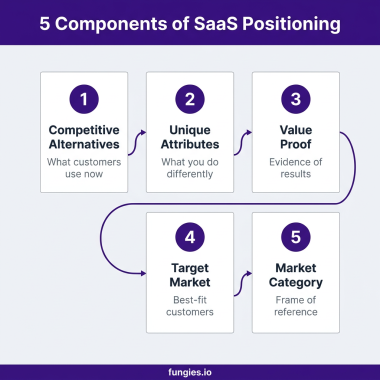
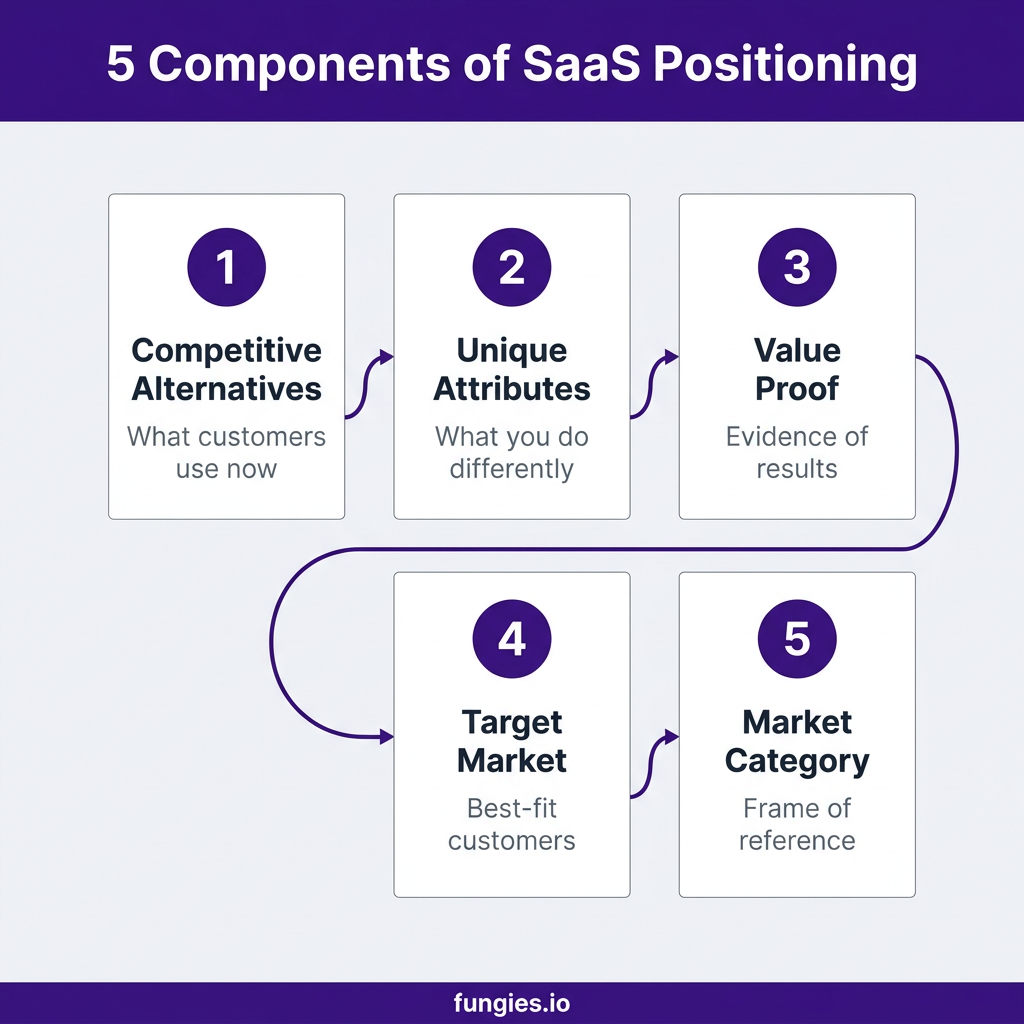
Here’s what positioning actually includes:
- Competitive alternatives — What would customers use if you didn’t exist?
- Unique attributes — What makes you different from those alternatives?
- Value proof — How can you prove that value is real?
- Target market characteristics — Who cares most about that value?
- Market category — What frame of reference makes your value obvious?
Why Positioning Matters More Than Ever in 2026
The SaaS landscape has shifted dramatically. According to recent data, 92% of SaaS startups fail within three years. The ones that survive aren’t necessarily the ones with the best products — they’re the ones who figured out how to stand out.
Several forces are making positioning critical:
- AI is commoditizing features — If your moat is code, you don’t have a moat anymore. AI can replicate features faster than ever.
- Buyers are overwhelmed — The average B2B buyer evaluates 5-7 solutions before purchasing. If you’re not immediately clear, you’re out.
- 94% of buyers shortlist before talking to sales — Your positioning needs to work without a salesperson explaining it.
- Category creation is harder — Creating a new market category used to be a viable strategy. Now, it’s expensive and risky.
The 5 Components of Strong SaaS Positioning
Let’s break down each component of positioning with real examples from successful SaaS companies.
1. Competitive Alternatives
This isn’t just a list of your direct competitors. It’s everything your target customers might use to solve their problem — including spreadsheets, manual processes, hiring more people, or doing nothing at all.
Example: When Slack launched, they didn’t position against other chat tools. They positioned against email. Their famous “email killer” framing made their value obvious — less email clutter, faster team communication.
2. Unique Attributes
What do you have that alternatives don’t? This isn’t about listing every feature. It’s about identifying the 2-3 things that truly differentiate you.
Example: Figma’s unique attribute wasn’t just “design in the browser.” It was real-time collaborative design that worked for entire teams, not just individual designers. That distinction mattered.
3. Value Proof
Claims without proof are just noise. Your positioning needs evidence that your unique attributes deliver real value.
Types of value proof:
- Customer case studies with specific metrics
- ROI calculators
- Third-party validation (G2 reviews, analyst reports)
- Usage data showing engagement
- Customer testimonials with outcomes
4. Target Market Characteristics
Not everyone cares about your unique value equally. Strong positioning targets the specific customers who care most about what you do differently.
Example: Notion could have targeted “everyone who takes notes.” Instead, they focused on teams who need flexible, collaborative workspaces. That focus made their positioning sharper and their product better.
5. Market Category
The category you choose provides context that makes your value obvious. Sometimes that means fitting into an existing category. Sometimes it means creating a subcategory.
Example: Drift didn’t just build “live chat software.” They created the “conversational marketing” category. That framing made their value — using conversations to generate leads — immediately clear.
Building Defensible Competitive Moats
Positioning gets you in the door. Moats keep competitors out. In 2026, with AI rapidly commoditizing features, moats matter more than ever.
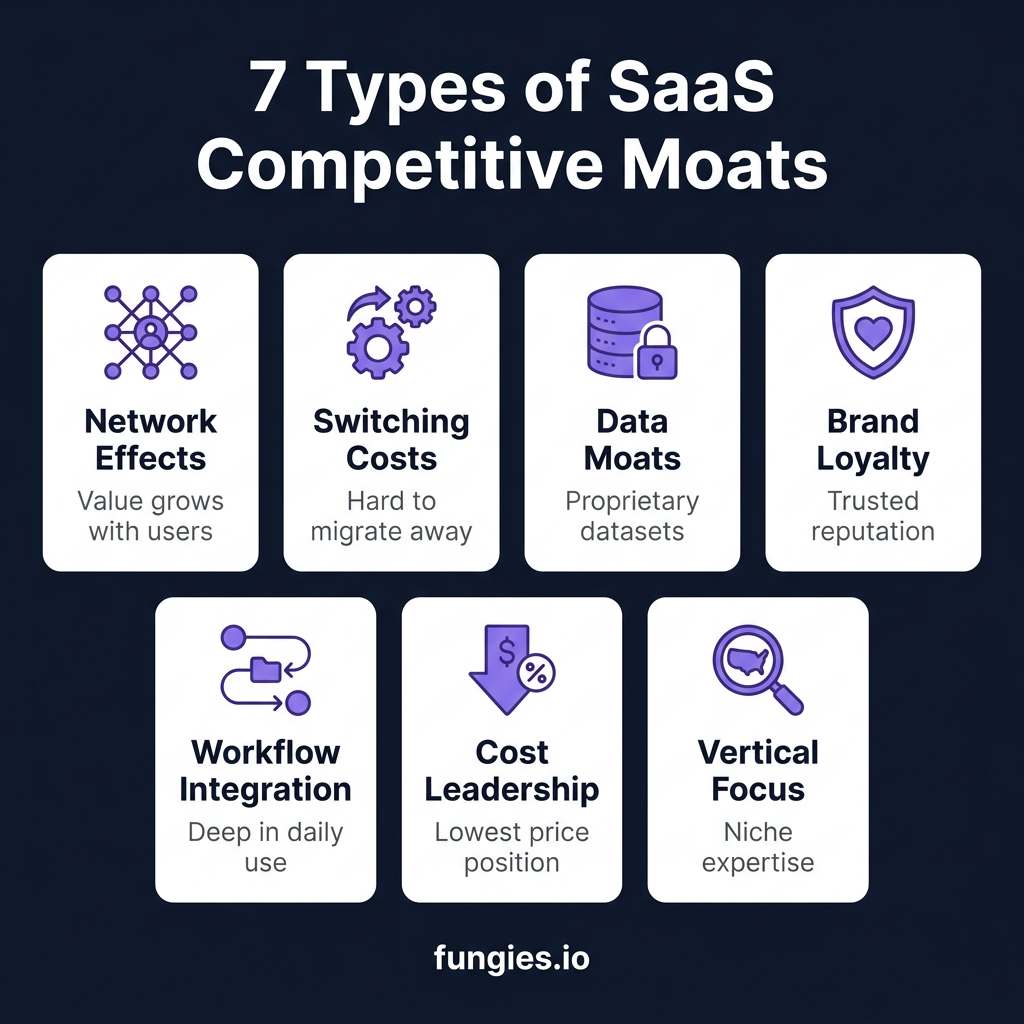
Here are the seven types of competitive moats that actually work for SaaS companies:
1. Network Effects
Your product becomes more valuable as more people use it. This is the strongest moat in SaaS.
Examples: Slack (more teammates = more value), Zoom (more people with the app = easier meetings), Figma (more designers collaborating = better workflows).
2. Switching Costs
It becomes painful for customers to leave. This can be data migration complexity, workflow retraining, or integrations that would break.
Examples: Salesforce (deep CRM integrations), SAP (enterprise-wide process embedding), Stripe (extensive payment infrastructure).
3. Data Moats
You accumulate proprietary data that improves your product over time. In the AI era, this moat is getting stronger.
Examples: Gong (millions of sales call recordings), Clearbit (massive B2B contact database), Tesla (billions of real-world driving miles).
4. Brand Loyalty
Customers choose you even when alternatives are cheaper or have more features. This takes time to build but creates durable advantage.
Examples: Notion (cult-like user community), Superhuman (premium email with devoted users), Apple (ecosystem lock-in + brand love).
5. Workflow Integration
Your product becomes deeply embedded in daily workflows. The deeper you integrate, the harder you are to replace.
Examples: Zapier (connects 5,000+ apps), GitHub (central to developer workflows), Linear (replaced Jira for modern teams).
6. Cost Leadership
You can sustainably offer lower prices than competitors. This is hard to maintain in SaaS but powerful when achieved.
Examples: AWS (economies of scale), Canva (freemium model with low paid tiers), Fungies.io (5% + $0.50 flat pricing vs competitors’ higher fees).
7. Vertical Focus
You dominate a specific industry or use case so thoroughly that generalist competitors can’t compete.
Examples: Toast (restaurants), Shopify (e-commerce), Veeva (pharmaceuticals).
The Positioning Process: A 10-Step Framework
Ready to fix your positioning? Here’s the framework April Dunford uses with scaling tech companies:
Step 1: Understand Your Best Customers
Interview 10-15 of your happiest customers. Not just any customers — the ones who’d be devastated if you shut down tomorrow. What do they love? What would they use if you didn’t exist?
Step 2: List Competitive Alternatives
Make a comprehensive list. Include direct competitors, indirect alternatives, and “do nothing” or “build in-house” options.
Step 3: Identify Your Unique Attributes
What can you do that alternatives can’t? Focus on capabilities, not features. “Real-time collaboration” is a capability. “Commenting system” is a feature.
Step 4: Map Value to Customer Outcomes
How do your unique attributes translate to customer outcomes? Real-time collaboration → faster project completion → ships products sooner.
Step 5: Define Your Best-Fit Customers
Who cares most about those outcomes? Be specific. “B2B companies” is too broad. “B2B SaaS marketing teams at 50-200 person companies” is specific.
Step 6: Choose Your Market Category
What context makes your value obvious? Sometimes it’s an existing category. Sometimes you need to create a subcategory. Test both.
Step 7: Develop Your Positioning Statement
Synthesize everything into a clear statement: For [target customers] who [problem], [product] is a [category] that [key benefit]. Unlike [alternatives], we [unique differentiation].
Step 8: Test with Real Customers
Run your positioning by prospects who don’t know you. Do they get it immediately? If not, iterate.
Step 9: Align Your Team
Everyone — sales, marketing, product, support — needs to understand and use the positioning consistently.
Step 10: Evolve as You Grow
Positioning isn’t set-it-and-forget-it. Revisit it quarterly. As you add features, enter new markets, or face new competitors, your positioning should evolve.
Common Positioning Mistakes to Avoid
After working with dozens of SaaS companies, I’ve seen the same positioning mistakes over and over. Here’s what to watch out for:
Mistake 1: The “Everything to Everyone” Trap
Trying to appeal to everyone appeals to no one. The most successful SaaS companies start narrow and expand. Notion started with notes, then expanded. Stripe started with developer-friendly payments, then expanded.
Mistake 2: Feature-First Positioning
Leading with features instead of outcomes. Customers don’t buy features. They buy better outcomes. “AI-powered analytics” is a feature. “Know which leads will convert before your competitors” is an outcome.
Mistake 3: Copying Competitors
If your positioning sounds like your competitors’, you’re invisible. You don’t need to be radically different — just clearly different on dimensions that matter to your target customers.
Mistake 4: Ignoring Indirect Competition
Your biggest competitor might be a spreadsheet, not another SaaS tool. Understanding all alternatives helps you position against the status quo, not just other startups.
Mistake 5: Static Positioning
Markets evolve. Competitors copy. What worked last year might not work this year. Great positioning is a living thing that you revisit regularly.
Positioning in Practice: Real SaaS Examples
Let’s look at how successful SaaS companies have used positioning to win:
| Company | Category Play | Key Differentiator | Result |
|---|---|---|---|
| Slack | Created “team communication” category vs email | Real-time, searchable, fun | $27B acquisition |
| Figma | Repositioned design as collaborative | Browser-based, multiplayer | $20B acquisition |
| Notion | Created “all-in-one workspace” category | Flexibility + community templates | $10B valuation |
| Superhuman | Premium positioning in crowded email market | Speed + keyboard shortcuts | $1B+ valuation |
| Gong | Created “revenue intelligence” category | AI analysis of sales calls | $7.2B valuation |
FAQ: SaaS Competitive Positioning
How often should we revisit our positioning?
At minimum, review quarterly. Revisit immediately when: you launch major features, enter new markets, face new competitors, or your conversion rates drop.
What’s the difference between positioning and messaging?
Positioning is the internal strategic foundation — who you’re for, what you do differently, why it matters. Messaging is how you communicate that positioning externally. You need solid positioning before you can create effective messaging.
Should we create a new category or fit into an existing one?
Most SaaS companies should start by fitting into an existing category where customers are already looking. Category creation is expensive and risky — only pursue it if you truly have something that doesn’t fit anywhere else.
How do we know if our positioning is working?
Key indicators: prospects understand what you do within 5 seconds, sales cycles shorten, win rates improve against competitors, customers describe you consistently using your positioning language.
Can small SaaS companies compete on positioning against big players?
Absolutely. In fact, positioning is often the only advantage small companies have. You can be more specific about your target market, more opinionated about your approach, and more nimble in evolving your position.
Conclusion: Positioning Is Your Growth Lever
In a market where AI can replicate features in weeks and new competitors launch daily, your positioning is your most durable advantage. It’s not about being different for the sake of it. It’s about being uniquely valuable to a specific set of customers who care deeply about what you do differently.
The SaaS companies that win in 2026 and beyond won’t be the ones with the most features. They’ll be the ones who make their value obvious to the right customers at the right time. That’s what great positioning does.
Ready to grow your SaaS with better positioning? Create your free Fungies account and launch your store in minutes — we’ll handle payments, tax compliance, and global checkout so you can focus on what makes your product obviously awesome.