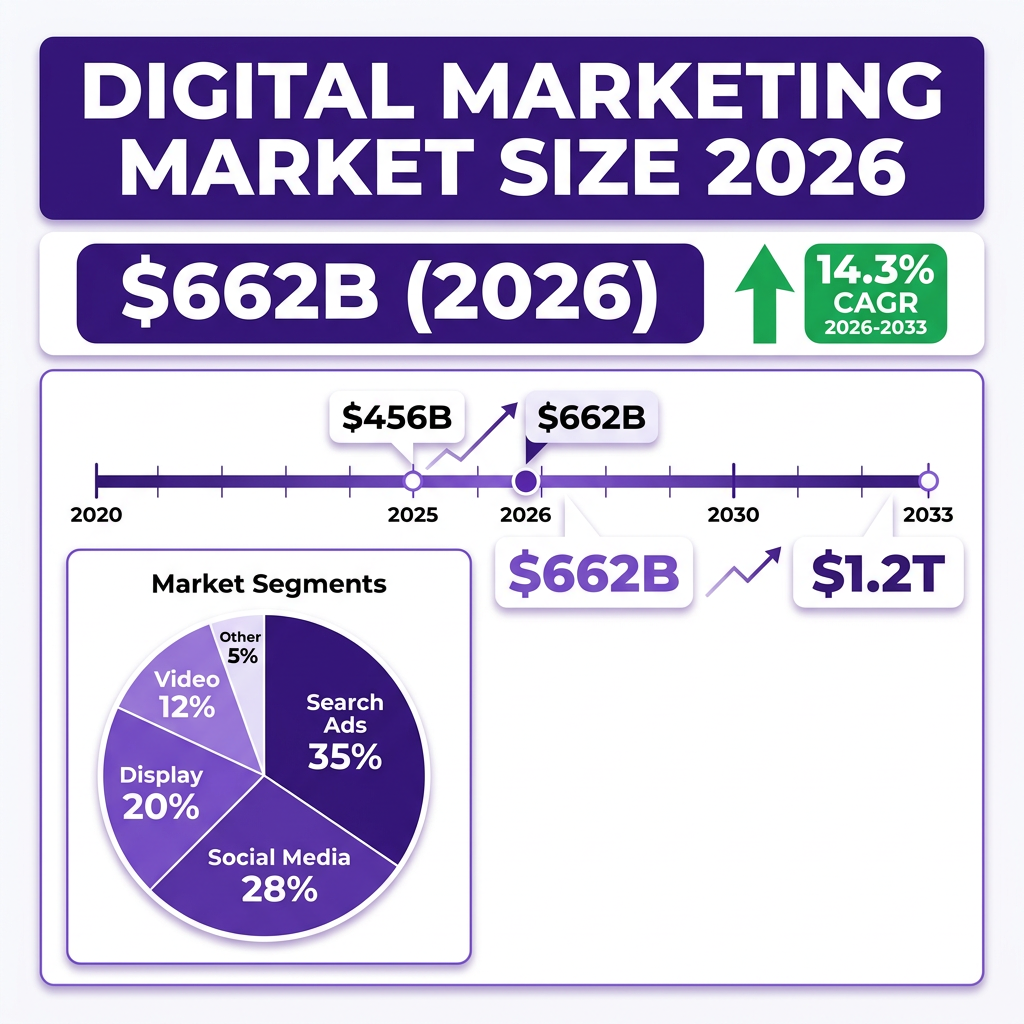
The digital marketing landscape has reached an inflection point in 2026. With global spending projected to hit $662.3 billion this year and a compound annual growth rate of 14.3% through 2033, the industry is experiencing unprecedented transformation. Artificial intelligence has moved from experimental tool to core infrastructure, privacy regulations have fundamentally altered data collection practices, and the way consumers discover brands has shifted dramatically toward AI-powered search and social commerce.
This isn’t just another year of incremental change. The decisions marketers make in 2026 will determine their competitive position for the next decade. The brands that thrive are those adapting to a world where third-party cookies have effectively disappeared, where AI agents now influence purchasing decisions, and where personalized experiences at scale have become table stakes rather than differentiators.
In this comprehensive analysis, we’ll examine the data driving these shifts, identify the seven trends reshaping the industry, analyze the competitive landscape dominated by tech giants, and provide actionable strategies for navigating the challenges and opportunities ahead. Whether you’re a CMO allocating billion-dollar budgets or a founder building your first marketing engine, this report provides the intelligence you need to make informed decisions.

Market Overview: The $662 Billion Digital Marketing Ecosystem
The digital marketing market has evolved from a niche channel to the dominant force in global advertising. In 2026, digital channels account for approximately 67% of all media spending worldwide, a figure that continues to climb as traditional media—print, radio, and even linear television—sees accelerating declines.
According to research from IMARC Group, the global digital marketing market was valued at $456.7 billion in 2025 and is expected to reach $1.2 trillion by 2034. This represents a compound annual growth rate of nearly 11%, though certain segments like AI-powered marketing tools and programmatic advertising are growing significantly faster at 14-16% annually.
The driving force behind this expansion is the continued penetration of internet connectivity globally. As of 2024, approximately 5.35 billion people were using the internet, representing 66.2% of the global population. This connectivity has fundamentally transformed consumer behavior, with the average person now spending over 6 hours daily online across multiple devices and platforms.
Regional distribution of digital marketing spend reveals important strategic insights. North America currently dominates with approximately 35% of global digital ad spend, driven by high consumer purchasing power and sophisticated marketing technology infrastructure. The Asia-Pacific region follows closely at 30%, with China, Japan, and India representing the largest markets. Europe accounts for roughly 22%, while Latin America and the Middle East/Africa collectively represent the remaining 13%.
However, growth rates tell a different story. While North America and Europe are maturing markets with single-digit annual growth, Asia-Pacific is expanding at 15-18% annually, and emerging markets in Africa and Southeast Asia are seeing growth rates exceeding 20%. For global brands, this geographic divergence requires nuanced strategies—maximizing efficiency in saturated markets while capturing growth in emerging economies.
The shift toward digital has been particularly pronounced in certain industries. E-commerce and retail lead adoption, with digital marketing representing 70-80% of total marketing budgets. Technology and SaaS companies follow closely, often allocating 60-70% to digital channels. Even traditionally conservative sectors like financial services and healthcare have accelerated digital transformation, with digital marketing shares increasing from 30% to 50% over the past three years.
Looking at channel mix within digital marketing, search advertising remains the largest segment at approximately 35% of total digital ad spend, generating over $230 billion annually. Social media advertising follows at 28%, having grown from just 8% a decade ago. Display advertising, including programmatic and native formats, accounts for 20%. Video advertising, spanning connected TV, YouTube, and social platforms, represents 12% but is growing fastest at 18% annually. The remaining 5% includes emerging formats like audio streaming, gaming, and virtual reality advertising.
Programmatic advertising has become the dominant transaction method, expected to account for 87% of digital advertising revenue in 2026. This automated approach to buying and placing ads has transformed the industry, enabling real-time optimization, precise audience targeting, and unprecedented scale. However, it has also introduced complexity around transparency, brand safety, and ad fraud that marketers must navigate carefully.
Key Statistics and Data: 25 Numbers That Define Digital Marketing in 2026
Data-driven decision making requires reliable benchmarks. The following statistics provide a quantitative foundation for understanding the digital marketing landscape in 2026, drawn from verified industry reports and research firms.
Market Size and Growth
- $662.3 billion: Projected global digital advertising spend in 2026 (Grand View Research)
- $1.2 trillion: Expected market size by 2034 (IMARC Group)
- 14.3% CAGR: Growth rate for digital advertising through 2033
- 67%: Share of total media spending captured by digital channels
- 5.35 billion: Global internet users as of 2024 (66.2% of world population)
- $1.3 trillion: Alternative projection for digital marketing market value by 2033 (Hostinger)
- 13.6% CAGR: Alternative growth forecast through 2033
Platform and Channel Performance
- 87%: Share of digital advertising transacted programmatically in 2026
- 35%: Search advertising’s share of total digital ad spend
- 28%: Social media advertising’s share of total digital ad spend
- 18%: Annual growth rate for video advertising (fastest-growing segment)
- $37.95 billion: US connected TV (CTV) ad spend in 2026
- 62.3%: Combined market share of Google, Meta, and Amazon in global digital ads
- $243.46 billion: Meta’s projected net ad revenue for 2026 (potentially surpassing Google)
Consumer Behavior and Engagement
- 6+ hours: Average daily time spent online per person globally
- 68.8%: Marketers who feel confident keeping up with new social media features (HubSpot)
- 25.7%: Global SMS marketing click-through rate (7x higher than email)
- 3.7%: Average email click-through rate and click-to-open rate (Dotdigital)
- 30%: Percentage of informational queries answered by AI without requiring clicks
AI and Technology Adoption
- 38%: Share of marketing startup funding directed to AI-powered automation
- 22%: Share of funding for AdTech and programmatic advertising startups
- 16%: Share of funding for content marketing and creation tools
- 50%: Approximate share of US venture funding directed to AI in Q4 2025
- $141 billion: Global VC funding in Q4 2025 (12% quarter-over-quarter increase)
Benchmarks and ROI Metrics
- 3:1 to 5:1: Target LTV:CAC ratio for healthy digital marketing performance
- 3.5%+: Strong paid search conversion rate threshold
- 9.8%: Average click-through rate for first-page SEO results
- 18-47%: Expected reduction in organic traffic due to AI answering queries directly
These statistics reveal several critical insights. First, the concentration of power among tech giants (Google, Meta, Amazon controlling over 60% of the market) creates both opportunities and risks for advertisers. Second, the rapid adoption of AI—evidenced by funding patterns and technology integration—is fundamentally changing how marketing work gets done. Third, the decline in organic reach and the rise of zero-click searches require marketers to rethink their channel mix and measurement approaches.
Major Trends Shaping Digital Marketing in 2026
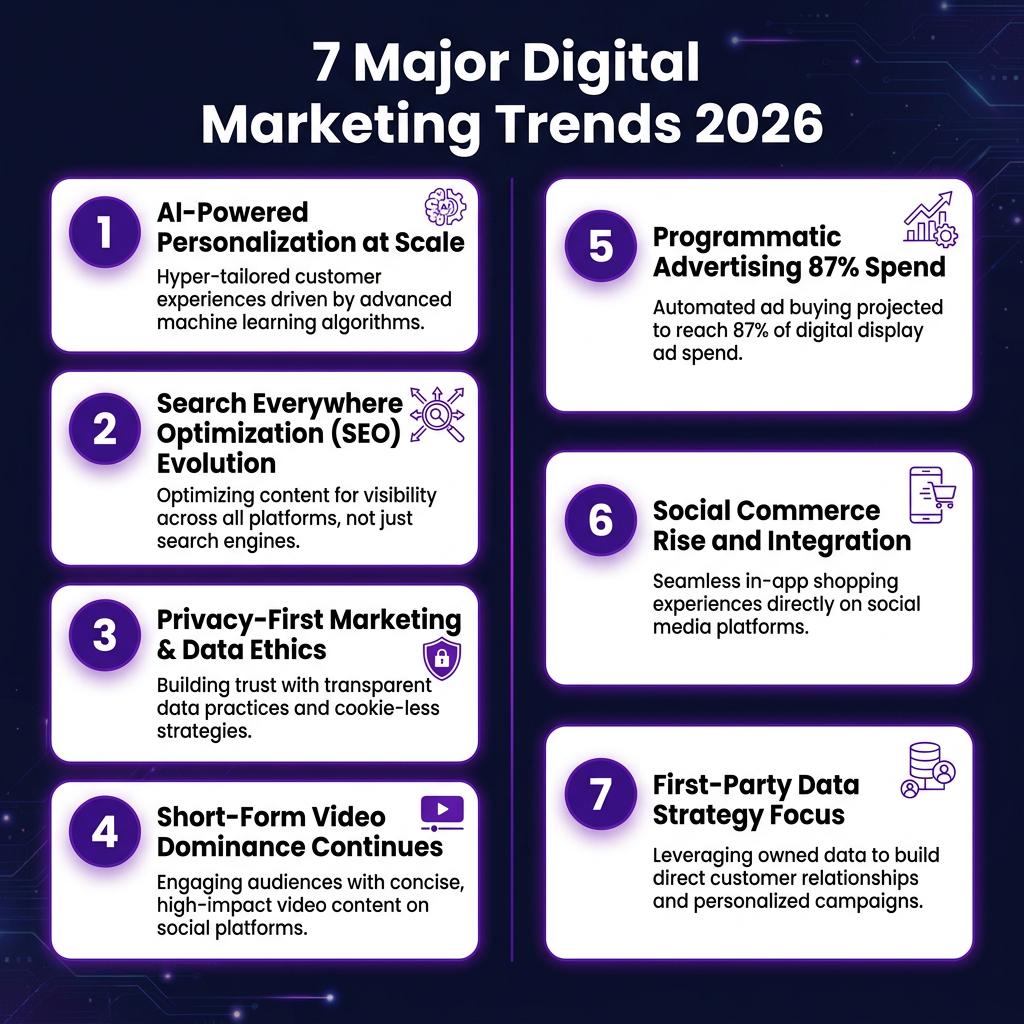
The digital marketing industry is being reshaped by seven converging trends that are altering how brands connect with consumers, allocate budgets, and measure success. Understanding these trends is essential for developing strategies that will remain relevant as the landscape continues evolving.
Trend 1: AI-Powered Personalization at Scale
Artificial intelligence has transitioned from experimental technology to core marketing infrastructure. In 2026, AI isn’t just automating repetitive tasks—it’s enabling personalization at a scale previously impossible. Machine learning algorithms now analyze vast datasets in real-time to predict consumer behavior, optimize campaign performance, and deliver individualized experiences across every touchpoint.
The impact is measurable: companies leveraging AI for personalization see revenue increases of 10-30% compared to those using traditional segmentation approaches. AI-powered recommendation engines, dynamic content optimization, and predictive lead scoring have become standard capabilities rather than competitive advantages.
However, this trend comes with important caveats. As AI becomes ubiquitous, the brands that differentiate are those using it thoughtfully—combining algorithmic efficiency with human creativity and strategic oversight. The most successful implementations treat AI as an augmentation of human capabilities rather than a replacement.
Trend 2: Search Everywhere Optimization (SEO)
The traditional concept of search engine optimization has evolved into what industry experts call “Search Everywhere Optimization.” In 2026, consumers discover products and services through an expanding array of search interfaces: traditional Google search, AI-powered overviews, voice assistants, social media platforms, and even generative AI chatbots.
This shift has profound implications. Google’s AI Overviews now answer up to 30% of informational queries directly on the search results page, reducing click-through rates to traditional websites by 18-47% depending on the query type. Marketers must now optimize for visibility within these AI-generated answers, not just for ranking positions.
Social platforms have become search engines in their own right. TikTok, Instagram, and Pinterest now serve as primary discovery tools for younger demographics, with 40% of Gen Z consumers preferring social search over traditional Google search for certain categories. This requires brands to maintain presence and optimize content across an expanding ecosystem of search interfaces.
Trend 3: Privacy-First Marketing and First-Party Data Strategy
The era of third-party cookies has effectively ended. While Google surprised the industry in April 2025 by deciding not to block third-party cookies by default in Chrome, the alternative—a global consent prompt—has resulted in the vast majority of users declining tracking. Combined with Safari and Firefox’s existing blocks, third-party cookies now reach only a small fraction of users.
This has accelerated the shift to first-party data strategies. Brands are investing heavily in building direct relationships with consumers, creating value exchanges that encourage voluntary data sharing, and developing sophisticated customer data platforms (CDPs) to unify and activate owned data assets.
Privacy regulations continue expanding globally. Beyond GDPR in Europe and CCPA in California, new regulations in Brazil, India, and other markets are creating a complex compliance landscape. The brands succeeding in this environment treat privacy not as a constraint but as a trust-building opportunity—being transparent about data practices and giving consumers genuine control over their information.
Trend 4: Short-Form Video Dominance
Short-form video has become the dominant content format across platforms. TikTok’s success has forced adaptations from Instagram (Reels), YouTube (Shorts), and even LinkedIn and Pinterest. In 2026, short-form video accounts for the majority of social media engagement and an increasing share of advertising budgets.
The format’s effectiveness stems from its alignment with declining attention spans and mobile-first consumption patterns. Videos under 60 seconds generate 2.5x more engagement than longer formats, and platforms’ algorithms heavily favor this content type in their recommendation engines.
For marketers, this trend requires significant adaptation. Traditional brand messaging and polished production values often underperform compared to authentic, creator-style content. The most successful brands are building in-house content studios, partnering with creators at scale, and developing agile production workflows that can respond to trending topics in real-time.
Trend 5: The Rise of AI Agents in Consumer Journeys
Perhaps the most transformative trend for 2026 is the emergence of AI agents that act on behalf of consumers. These intelligent systems research products, compare prices, read reviews, and even make purchases autonomously based on parameters set by their human users.
This represents a fundamental shift in how marketing works. Instead of persuading individual consumers, brands must now optimize for AI agents that evaluate options algorithmically. Product data feeds, structured markup, review sentiment, and pricing transparency become critical competitive factors. Marketing teams are beginning to employ “agent optimization” specialists alongside traditional SEO and paid media experts.
Early data suggests that AI agents already influence 8-12% of e-commerce transactions, with projections suggesting this could reach 30% by 2028. Brands that optimize for agent discovery and evaluation now will have significant advantages as this behavior becomes mainstream.
Trend 6: Social Commerce and Shoppable Content
The boundary between content and commerce continues dissolving. Social commerce—purchasing products directly within social media platforms—has grown from a novelty to a major channel, with global sales through social platforms expected to exceed $100 billion in 2026.
Platforms have invested heavily in reducing friction from discovery to purchase. Instagram Shopping, TikTok Shop, Pinterest Product Pins, and similar features enable seamless transactions without leaving the app. Live shopping, popular in Asian markets for years, is gaining traction in Western markets as well.
This trend is particularly significant for direct-to-consumer brands and retailers. Social commerce offers lower customer acquisition costs compared to traditional advertising in saturated channels, though it also creates dependency on platform algorithms and policies. Successful brands treat social commerce as a distinct channel with its own content strategies, measurement frameworks, and operational requirements.
Trend 7: Return to Owned Channels
After years of prioritizing social media and paid advertising, sophisticated marketers are returning to channels they control: email, SMS, mobile apps, and owned web experiences. This “return to owned channels” is driven by several factors: rising paid media costs, algorithm changes that reduce organic reach, privacy regulations that limit targeting, and a recognition that rented audiences on social platforms are inherently unstable.
Email marketing has experienced a renaissance, with advanced segmentation, automation, and personalization driving significant ROI improvements. SMS marketing, with its 25.7% average click-through rate, has become a high-value channel for time-sensitive communications. Mobile apps, while expensive to develop and maintain, offer unmatched engagement and data collection capabilities for brands that can justify the investment.
The strategic implication is clear: brands must balance reach (through paid and social channels) with ownership (through direct relationships). The most resilient marketing strategies build audiences on owned channels while using paid and social for acquisition and amplification.
Key Players and Competitive Landscape
The digital marketing ecosystem is dominated by a small number of technology giants, but the competitive dynamics are shifting in ways that create both opportunities and challenges for advertisers and competing platforms.
The Triopoly: Google, Meta, and Amazon
Google, Meta, and Amazon collectively control approximately 62.3% of global digital advertising spend, a concentration of market power that has attracted regulatory scrutiny worldwide. However, their relative positions are shifting:
Google (Alphabet) has long been the market leader, with its dominance in search advertising providing a foundation for expansion into display, video, and programmatic. Google’s ad revenue comes primarily from Google Ads (search and display) and YouTube. However, the company faces headwinds from AI-powered search interfaces that reduce click-through rates, regulatory challenges to its ad tech stack, and increasing competition from Amazon in product search.
In 2026, Google is projected to generate approximately $237 billion in ad revenue. The company is investing heavily in AI-powered advertising products, including Performance Max campaigns that automate targeting and creative optimization across Google’s properties. It’s also developing new ad formats for AI Overviews, attempting to monetize the shift toward zero-click search.
Meta (Facebook, Instagram, WhatsApp) is projected to surpass Google in net ad revenue for the first time in 2026, reaching over $243 billion. This milestone reflects Meta’s successful navigation of privacy changes (particularly Apple’s ATT framework), its aggressive investment in AI-powered targeting and creative tools, and the continued growth of Instagram and WhatsApp as advertising platforms.
Meta’s Reels has been particularly successful in capturing short-form video advertising budgets, while its Advantage+ shopping campaigns have simplified campaign management for e-commerce advertisers. The company’s AI investments, including its Llama models, are being integrated across its advertising products to improve targeting, creative generation, and measurement.
Amazon has grown from an e-commerce platform to the third-largest digital advertising company globally, with projected 2026 revenue exceeding $65 billion. Amazon’s advertising business benefits from unique advantages: purchase intent data that enables highly effective targeting, closed-loop attribution that connects advertising to sales, and a rapidly expanding off-platform advertising network.
For product-based advertisers, Amazon has become essential. The platform now captures over 50% of product search queries, surpassing Google for this use case. Amazon’s advertising products have expanded beyond sponsored products to include display, video, and even connected TV advertising through its DSP.
Emerging Challengers
While the triopoly dominates, several platforms are gaining share in specific segments:
TikTok has become a major advertising platform, particularly for reaching younger demographics. Despite regulatory challenges in some markets, TikTok’s ad revenue continues growing rapidly, driven by its highly engaging short-form video format and sophisticated targeting capabilities. The platform’s shopping features are also gaining traction, creating new opportunities for direct-response advertisers.
Microsoft Advertising has benefited from the integration of AI into Bing search, gaining market share from Google. The company’s partnership with OpenAI has created unique advertising opportunities within AI-powered search experiences. While still small relative to Google, Microsoft’s growth rate exceeds the market average.
Retail Media Networks beyond Amazon are expanding rapidly. Walmart, Target, Instacart, and other retailers have developed sophisticated advertising platforms that leverage their first-party purchase data. Collectively, retail media is growing at 20%+ annually and capturing budgets that previously went to traditional digital advertising.
Connected TV Platforms including Roku, Hulu, and YouTube TV are capturing television advertising budgets as viewing shifts from linear to streaming. The ability to target TV advertising with digital-like precision, combined with improved measurement capabilities, is driving significant investment in this channel.
The MarTech Ecosystem
Beyond advertising platforms, the marketing technology landscape includes thousands of vendors providing specialized tools for content management, marketing automation, customer data platforms, analytics, and creative production. This ecosystem has seen significant consolidation, with private equity firms acquiring and merging vendors to create integrated platforms.
Major categories include:
- Customer Data Platforms (CDPs): Segment, mParticle, Tealium, and Adobe Real-Time CDP
- Marketing Automation: HubSpot, Marketo, Pardot, and ActiveCampaign
- Content Management: WordPress, Contentful, Sanity, and Adobe Experience Manager
- Analytics: Google Analytics 4, Amplitude, Mixpanel, and Heap
- Creative Production: Canva, Figma, Adobe Creative Cloud, and emerging AI tools
The trend toward platform consolidation continues, with marketers preferring integrated suites over best-of-breed point solutions. However, the rapid evolution of AI is creating opportunities for new entrants that can deliver differentiated capabilities around content generation, predictive analytics, and workflow automation.

Challenges and Pain Points
Despite the opportunities, digital marketing in 2026 faces significant challenges that require strategic attention and resource allocation. Understanding these pain points is essential for developing resilient marketing strategies.
Challenge 1: Signal Loss and Measurement Degradation
The combination of privacy regulations, browser restrictions on third-party cookies, and platform privacy changes (particularly Apple’s App Tracking Transparency) has created a measurement crisis. Marketers can no longer reliably track user journeys across devices and platforms, attribute conversions to specific touchpoints, or build comprehensive audience profiles using third-party data.
This “signal loss” has several consequences. Return on ad spend (ROAS) calculations have become less reliable, making budget allocation decisions more difficult. Lookalike audiences built on third-party data have degraded in quality. Cross-channel attribution models struggle to account for the full customer journey.
The response requires investment in first-party data infrastructure, adoption of privacy-preserving measurement techniques (like data clean rooms and aggregated measurement), and a shift toward marketing mix modeling and incrementality testing as primary measurement approaches.
Challenge 2: Rising Customer Acquisition Costs
Customer acquisition costs (CAC) have increased significantly across digital channels. On Meta platforms, CAC has risen 40-60% over the past three years for many advertisers. Google Search CPCs continue climbing in competitive categories. The combination of increased competition, reduced targeting precision, and platform algorithm changes has made paid acquisition more expensive.
This challenge is particularly acute for direct-to-consumer brands that built their businesses on Facebook and Instagram advertising. Many are struggling to maintain profitability as their core acquisition channel becomes more expensive.
Strategic responses include diversifying channel mix to include emerging platforms, investing in organic channels with lower marginal costs, improving conversion rates through CRO, and increasing customer lifetime value through retention and expansion initiatives. The most successful brands are shifting from pure acquisition focus to balanced growth strategies that emphasize retention and organic growth.
Challenge 3: Content Saturation and Attention Scarcity
The democratization of content creation—accelerated by AI tools that can generate text, images, and video—has led to unprecedented content saturation. Consumers are overwhelmed with marketing messages across every channel, making it increasingly difficult for brands to capture and hold attention.
Social media algorithms compound this challenge by prioritizing content that generates immediate engagement, often favoring sensational or controversial material over thoughtful brand messaging. Organic reach on most platforms has declined to the point where paid promotion is essentially required for visibility.
Breaking through this noise requires exceptional creativity, genuine value creation, and strategic distribution. Brands must create content that is truly distinctive—whether through unique perspectives, superior production values, or genuine utility. The era of mediocre content supported by paid distribution is ending; only remarkable content earns attention organically.
Opportunities and Growth Strategies
Within these challenges lie significant opportunities for brands that adapt quickly and invest strategically. The following growth strategies represent the highest-leverage opportunities in the 2026 digital marketing landscape.
Opportunity 1: AI-Augmented Marketing Operations
While AI presents challenges (including content saturation), it also offers transformative opportunities for marketing efficiency and effectiveness. The key is implementing AI to augment human capabilities rather than replace them entirely.
High-impact applications include:
- Content personalization: Using AI to dynamically customize website experiences, email content, and ad creative based on user behavior and preferences
- Predictive analytics: Leveraging machine learning to identify high-value prospects, predict churn risk, and optimize campaign timing
- Creative optimization: Employing AI to generate and test variations of ad creative, landing pages, and email subject lines at scale
- Workflow automation: Automating routine tasks like reporting, budget pacing, and bid management to free human marketers for strategic work
Organizations that successfully integrate AI into their marketing operations are seeing productivity improvements of 30-50% and performance improvements of 15-25%. The competitive advantage goes to those who move quickly to build AI capabilities while maintaining human oversight of strategy and creative direction.
Opportunity 2: First-Party Data Excellence
The decline of third-party data makes first-party data—information collected directly from customers and prospects—more valuable than ever. Brands that build sophisticated first-party data strategies gain significant advantages in targeting, personalization, and measurement.
Effective first-party data strategies include:
- Value exchange programs: Offering genuine value (content, tools, discounts, experiences) in exchange for data sharing
- Progressive profiling: Collecting information incrementally across multiple interactions rather than demanding everything upfront
- Zero-party data collection: Explicitly asking customers about their preferences, intentions, and interests
- Data unification: Breaking down silos to create comprehensive customer profiles that inform all marketing activities
Brands with rich first-party data assets can maintain targeting precision even as third-party options disappear. They can also build direct relationships that reduce dependency on platform algorithms and create sustainable competitive advantages.
Opportunity 3: Community-Led Growth
As paid acquisition becomes more expensive, community-led growth offers a sustainable alternative. Building engaged communities around brands, products, or shared interests creates organic growth engines that reduce dependency on paid advertising.
Community-led growth strategies include:
- Brand communities: Creating spaces (forums, Discord servers, private groups) where customers connect with each other and the brand
- Advocate programs: Systematically identifying, nurturing, and mobilizing enthusiastic customers to spread the word
- User-generated content: Encouraging and amplifying content created by customers, which tends to outperform brand-created content in authenticity and engagement
- Creator partnerships: Building long-term relationships with creators who genuinely love the brand rather than transactional influencer campaigns
Brands that successfully build communities see lower customer acquisition costs, higher lifetime values, and greater resilience to platform algorithm changes. The investment required is significant—community building is a long-term strategy, not a quick fix—but the returns compound over time.
Case Studies and Success Stories
Theory is valuable, but real-world examples demonstrate how these trends and strategies play out in practice. The following case studies illustrate successful approaches to the challenges and opportunities of digital marketing in 2026.
Case Study 1: AI-Powered Personalization Drives 40% Revenue Increase
A mid-sized e-commerce retailer in the home goods category faced stagnating growth and rising customer acquisition costs. The company implemented a comprehensive AI-powered personalization strategy across its marketing stack.
The implementation included: dynamic website personalization that adjusted homepage content and product recommendations based on browsing history; AI-generated email content with personalized subject lines, product recommendations, and send-time optimization; and predictive models that identified high-value prospects for targeted advertising campaigns.
Results after 12 months: website conversion rate increased 25%, email revenue increased 60%, customer acquisition cost decreased 20%, and overall revenue increased 40%. The key success factor was treating AI as an augmentation of existing processes rather than a replacement—the company maintained human oversight of creative direction while leveraging algorithms for optimization and scale.
Case Study 2: First-Party Data Strategy Reduces CAC by 35%
A SaaS company in the project management space faced the same challenge as many B2B marketers: the degradation of third-party data made their traditional account-based marketing approach increasingly expensive and less effective.
The company pivoted to a first-party data strategy centered on a free assessment tool that provided genuine value to prospects while collecting detailed information about their needs and challenges. This zero-party data was integrated with behavioral data from product usage and website interactions to create comprehensive prospect profiles.
The company also invested in building an engaged community through a Slack workspace where customers and prospects discussed productivity best practices. This community became a source of organic growth and a channel for gathering insights that informed product development and marketing messaging.
Results after 18 months: customer acquisition cost decreased 35%, sales cycle length decreased 25%, and net revenue retention increased from 105% to 118%. The community now generates 20% of new qualified leads organically.
Case Study 3: Search Everywhere Optimization Captures New Audiences
A consumer packaged goods brand traditionally focused on Google SEO and Facebook advertising recognized that their target demographic (Gen Z and young Millennials) was increasingly discovering products through TikTok, Pinterest, and AI-powered search interfaces.
The company restructured its content strategy to optimize for “search everywhere.” This included: creating short-form video content optimized for TikTok and Instagram Reels search; developing Pinterest-optimized content that captured visual search queries; restructuring website content to appear in AI Overviews and featured snippets; and building presence on emerging platforms like Perplexity and other AI search tools.
Results after 12 months: TikTok became the second-largest source of website traffic (after organic Google search); Pinterest drove 15% of e-commerce revenue; and the brand appeared in AI-generated answers for 200+ relevant queries. Total digital revenue increased 55% while paid advertising spend increased only 10%.
Future Outlook and Predictions: 2026-2030
Looking beyond 2026, several trends will continue reshaping the digital marketing landscape through 2030. Understanding these longer-term shifts enables marketers to make strategic investments today that will pay dividends in the years ahead.
Prediction 1: AI Agents Become Primary Decision-Makers
By 2028, we project that AI agents will influence or execute 30% of consumer purchases. This shift will fundamentally change marketing from persuasion of humans to optimization for algorithms. Brands will need to maintain comprehensive product data feeds, optimize for agent evaluation criteria, and potentially pay for placement within agent recommendation systems.
The implications are profound: traditional brand building may become less important than technical optimization; comparison shopping will happen instantaneously without human involvement; and price transparency will increase dramatically as agents evaluate options across the entire market in milliseconds.
Prediction 2: The $1.5 Trillion Milestone
The global digital marketing market will exceed $1.5 trillion by 2030, with digital capturing nearly 75% of total advertising spend. This growth will be driven by continued expansion in emerging markets, new advertising formats (AR/VR, ambient computing), and the monetization of AI-powered interfaces.
However, growth rates will vary significantly by segment. Traditional display advertising will grow slowly (5-7% annually), while AI-powered personalization tools, retail media networks, and immersive advertising formats will grow at 20-30% annually.
Prediction 3: Regulatory Fragmentation Creates Complexity
Privacy and data regulations will continue proliferating, but without global harmonization. By 2030, we expect 50+ countries to have implemented GDPR-style privacy laws, each with unique requirements. This regulatory fragmentation will increase compliance costs and create competitive advantages for companies that can navigate complexity effectively.
The brands that thrive will treat privacy compliance as a core competency, investing in legal expertise, technical infrastructure, and transparent customer communication. Those that treat compliance as a checkbox exercise will face increasing penalties and reputational damage.
Prediction 4: The Consolidation of Marketing Technology
The fragmented MarTech landscape will consolidate significantly as private equity firms acquire and merge vendors to create integrated platforms. By 2030, we expect 5-7 dominant platforms to control 70% of the market, compared to today’s fragmented ecosystem of 8,000+ vendors.
This consolidation will simplify technology decisions for marketers but may reduce innovation and increase prices. Organizations should evaluate their technology stacks with consolidation in mind, prioritizing vendors with strong balance sheets and clear paths to independence or acquisition by major platforms.
Prediction 5: Human Creativity Becomes the Scarce Resource
As AI handles increasingly sophisticated execution tasks, human creativity and strategic thinking become the primary differentiators. By 2030, the most valuable marketing professionals will be those who can develop distinctive creative concepts, design innovative customer experiences, and make strategic decisions in ambiguous situations.
This shift has implications for talent strategy: organizations should invest in developing creative and strategic capabilities while leveraging AI for execution; marketing education should emphasize creative problem-solving over technical skills that AI will automate; and compensation models should recognize the increasing value of human creativity.
Key Takeaways
- The digital marketing market will reach $662 billion in 2026, growing at 14.3% annually through 2033. This growth creates opportunities but also intensifies competition for attention and talent.
- AI has become core infrastructure, not just a tool. Brands must integrate AI across their marketing operations while maintaining human oversight of strategy and creative direction.
- Privacy regulations and platform changes have ended the third-party data era. First-party data strategies and privacy-compliant measurement approaches are now essential.
- Search is fragmenting across platforms and interfaces. Marketers must optimize for traditional search, social search, voice search, and AI-powered discovery simultaneously.
- Community-led growth offers a sustainable alternative to increasingly expensive paid acquisition. Brands should invest in building owned audiences and engaged communities.
Sources and Citations
- IMARC Group – Digital Marketing Market Report 2026-2034: https://www.imarcgroup.com/digital-marketing-market-statistics
- Hostinger – 47 Essential Digital Marketing Statistics for 2026: https://www.hostinger.com/tutorials/digital-marketing-statistics
- Grand View Research – Digital Advertising Market Size Report: https://www.grandviewresearch.com/industry-analysis/digital-advertising-market-report
- Entrepreneurs HQ – 91 Digital Marketing Industry Statistics: https://entrepreneurshq.com/digital-marketing-industry-statistics
- Digital Applied – Digital Advertising Statistics 2026: https://www.digitalapplied.com/blog/digital-advertising-statistics-2026-data-points
- WSI World – Marketing & AI Predictions for 2026: https://www.wsiworld.com/blog/marketing-ai-predictions-that-will-shape-search-strategy-and-spend-in-2026
- LSEO – Top 10 Digital Marketing Trends for 2026: https://lseo.com/blog/generative-engine-optimization/top-10-digital-marketing-trends-for-2026
- Dotdigital – 2026 Marketing Predictions: https://dotdigital.com/blog/2026-marketing-predictions
- Improvado – 7 AI Marketing Trends for 2026: https://improvado.io/blog/ai-marketing-trends
- Quartr – The Rise of Google, Meta, Amazon in Advertising: https://quartr.com/insights/company-research/the-rise-of-google-meta-amazon-and-youtube-in-advertising
- WSJ – Meta Expected to Unseat Google as Largest Digital-Ad Player: https://www.wsj.com/business/media/meta-expected-to-unseat-google-as-worlds-largest-digital-ad-player-83d3f522
- Bain & Company – Global Venture Capital Outlook: https://www.bain.com/insights/global-venture-capital-outlook-latest-trends-snap-chart
- Digital Applied – Digital Marketing KPIs 2026: https://www.digitalapplied.com/blog/digital-marketing-kpis-2026-100-metrics-reference
- Adrenalead – Advertising Without Cookies 2026: https://adrenalead.com/en/blog/advertising-without-cookies
- TrustArc – Privacy Enforcement Surging 2026: https://trustarc.com/resource/privacy-enforcement-surging-2026