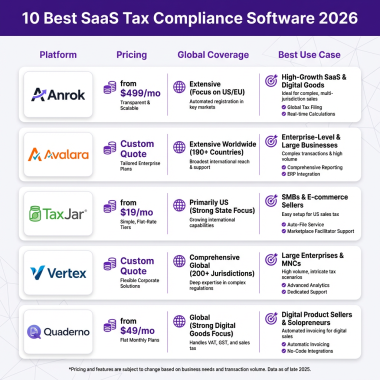
Selling digital products globally in 2026 isn’t just about building great software—it’s about navigating a labyrinth of tax regulations that can make or break your business. The EU VAT gap reached €128 billion in 2023, and over 110 countries now require VAT registration for foreign digital service providers. If you’re selling SaaS, digital downloads, or online services without understanding Merchant of Record (MOR) solutions, you’re exposing your business to massive compliance risk.
This guide breaks down everything you need to know about the Merchant of Record model: what it is, how it works, who needs it, and how it compares to handling tax compliance yourself. Whether you’re a SaaS founder, indie game developer, or content creator, understanding MOR could save you thousands in compliance costs and eliminate your tax liability entirely.
What Is a Merchant of Record?
A Merchant of Record (MOR) is a legal entity that takes on the responsibility of selling goods or services on behalf of your business. When you use an MOR like Fungies, Paddle, or FastSpring, they become the seller of record in the transaction—not you. This means they handle payment processing, tax calculation and collection, compliance, fraud prevention, and refunds.
Here’s the critical distinction: without an MOR, you are the merchant. You’re responsible for registering for VAT/GST in every country where you have customers, calculating the correct tax rates (which change constantly), filing returns on different schedules, and remitting payments to tax authorities. Miss a filing deadline in Germany? That’s up to €25,000 in penalties. Fail to register in a US state where you’ve triggered economic nexus? Expect back taxes plus 5-25% penalty fees plus compounding interest.
With an MOR, they assume this liability. They register for tax IDs, they calculate and collect taxes, they file returns, they handle audits. You get a simple fee structure—typically a percentage of transaction value plus a fixed per-transaction fee—and zero compliance headaches.
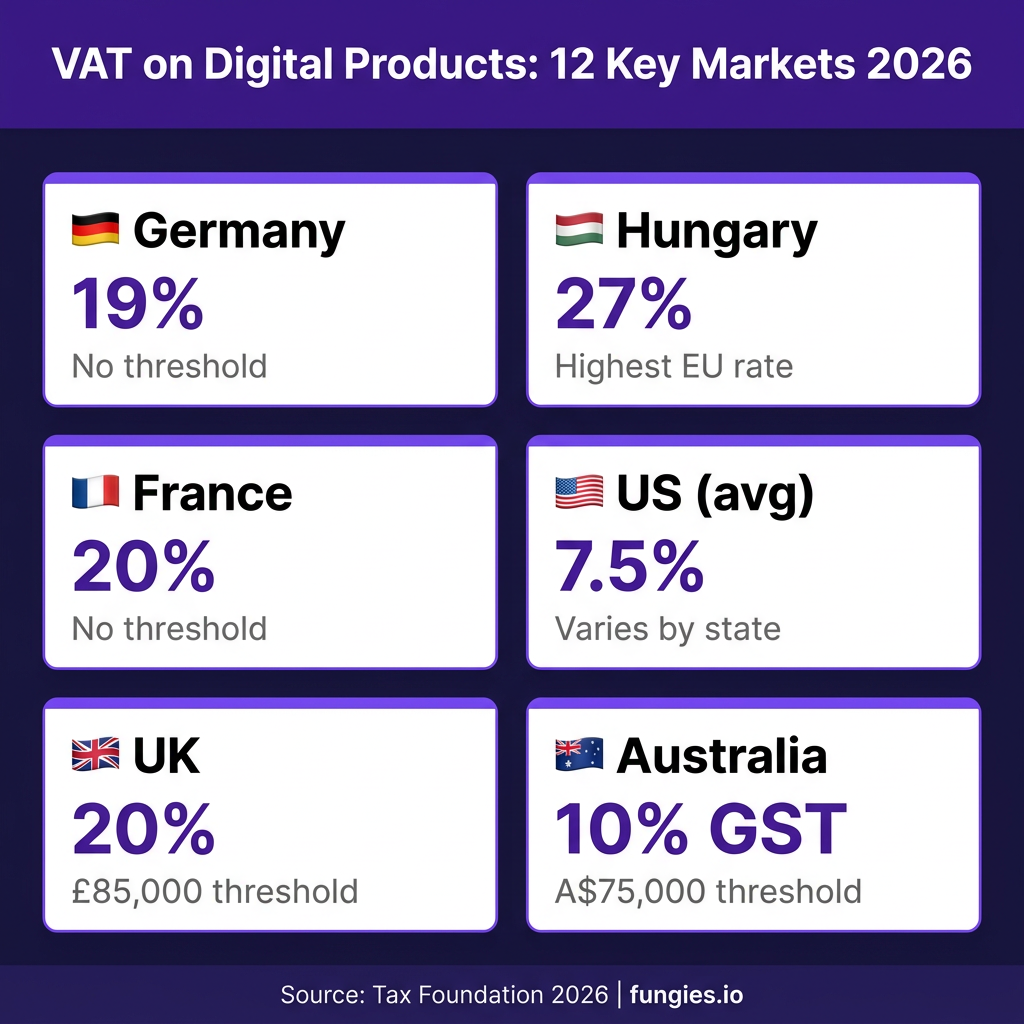
Global Digital Tax Rates at a Glance
Key Statistics: The State of Digital Tax Compliance
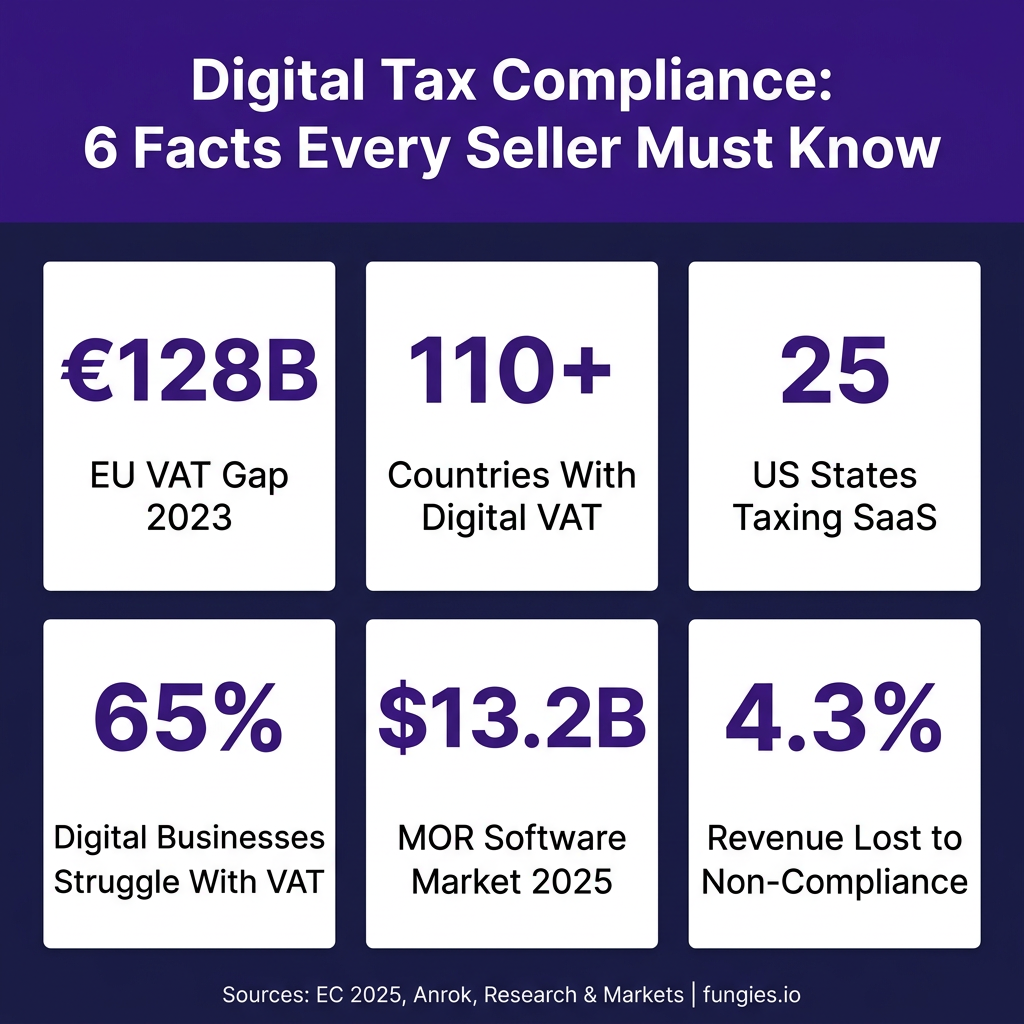
- €128 billion — The EU VAT compliance gap in 2023, representing 9.5% of total VAT liability (European Commission, 2025)
- 110+ countries — Now require VAT/GST registration for foreign digital service providers (Fonoa, 2026)
- 25 US jurisdictions — Tax SaaS products in some form as of 2025, up from 22 in 2024 (Anrok)
- 65% — Of digital businesses selling across EU borders struggle with VAT compliance in their first two years (European Commission)
- $13.2 billion — Global Merchant of Record software market size in 2025, projected to reach $35.4 billion by 2032 (Research and Markets)
- 4.3% — Average revenue lost by non-compliant SaaS businesses to penalties and uncollected tax (Anrok)
- $465 billion — Projected global SaaS market size by 2026 (Precedence Research)
- 14.96% CAGR — Growth rate of the MOR software market through 2032
- €25,000 — Maximum late filing penalty in Germany for VAT non-compliance
- 45+ US states — Have economic nexus laws requiring out-of-state sellers to collect sales tax
Country-by-Country Tax Rules for Digital Products
Understanding where and how digital products are taxed is essential for any online business. Here’s a comprehensive breakdown of the major markets:
European Union: VAT OSS System
The EU operates a One-Stop Shop (OSS) system that allows businesses to report and pay VAT for cross-border B2C sales through a single quarterly return filed in their home country. However, this doesn’t eliminate the complexity—you still need to track VAT rates across 27 member states, understand reduced rates for specific categories, and maintain detailed records.
| Country | Standard VAT Rate | Registration Threshold | Filing Frequency | Late Filing Penalty |
|---|---|---|---|---|
| Hungary | 27% | No threshold (non-EU) | Quarterly via OSS | Up to €25,000 |
| Finland | 25.5% | No threshold (non-EU) | Quarterly via OSS | Up to €15,000 |
| Croatia | 25% | No threshold (non-EU) | Quarterly via OSS | Up to €20,000 |
| Denmark | 25% | No threshold (non-EU) | Quarterly via OSS | Up to €12,000 |
| Sweden | 25% | No threshold (non-EU) | Quarterly via OSS | Up to €15,000 |
| France | 20% | No threshold (non-EU) | Quarterly via OSS | Up to €15,000 |
| Germany | 19% | No threshold (non-EU) | Quarterly via OSS | Up to €25,000 |
| Cyprus | 19% | No threshold (non-EU) | Quarterly via OSS | Up to €10,000 |
| Malta | 18% | No threshold (non-EU) | Quarterly via OSS | Up to €12,000 |
| Luxembourg | 17% | No threshold (non-EU) | Quarterly via OSS | Up to €10,000 |
Source: Tax Foundation, European Commission 2026
United Kingdom
Post-Brexit, the UK operates its own VAT system. The standard rate is 20% for digital services. Non-UK businesses must register for UK VAT immediately upon making any B2C digital sales—there’s no registration threshold for foreign sellers. The UK’s VAT registration threshold for domestic businesses is £85,000, but this doesn’t apply to non-UK companies selling digital services.
United States: Economic Nexus Chaos
The US has no federal sales tax. Instead, 45 states plus Washington D.C. impose sales tax, each with different rules for SaaS and digital products. Following the 2018 South Dakota v. Wayfair Supreme Court decision, states can require out-of-state sellers to collect sales tax based on economic nexus—purely revenue or transaction volume, regardless of physical presence.
| State | Economic Nexus Threshold | SaaS Taxable? | Base Rate |
|---|---|---|---|
| California | $100,000 or 200 transactions | Generally exempt | 7.25% |
| New York | $100,000 or 200 transactions | Yes | 4% |
| Texas | $100,000 or 200 transactions | Yes (80% rule) | 6.25% |
| Florida | $100,000 | No | 6% |
| Illinois | $100,000 or 200 transactions | Yes | 6.25% |
| Pennsylvania | $100,000 | Yes | 6% |
| Ohio | $100,000 or 200 transactions | Yes | 5.75% |
| Georgia | $100,000 or 200 transactions | Yes | 4% |
| North Carolina | $100,000 or 200 transactions | Yes | 4.75% |
| Michigan | $100,000 or 200 transactions | Yes | 6% |
Source: TaxCloud, Numeral 2026
Other Major Markets
| Country | Tax Type | Rate | Threshold | Filing |
|---|---|---|---|---|
| Australia | GST | 10% | A$75,000 | Quarterly |
| Canada | GST/HST | 5-15% | C$30,000 | Annual/Quarterly |
| Norway | VAT | 25% | No threshold | Quarterly |
| Switzerland | VAT | 8.1% | CHF 100,000 | Quarterly |
| New Zealand | GST | 15% | NZ$60,000 | Bi-monthly |
| Japan | Consumption Tax | 10% | ¥10 million | Annual |
| South Korea | VAT | 10% | No threshold | Quarterly |
| Singapore | GST | 9% | S$1 million | Quarterly |
Source: PWC Worldwide Tax Summaries 2026
Digital Tax Compliance: By The Numbers
Tax Obligations by Business Type
Different digital business models face different tax obligations. Here’s how compliance requirements break down:
| Business Type | Key Tax Obligations | Common Mistakes | Risk Level |
|---|---|---|---|
| SaaS Companies | Economic nexus in 25+ US states; EU VAT OSS; Global VAT registration | Assuming SaaS isn’t taxable; missing nexus thresholds | High |
| Content Creators | EU VAT on digital products; US 1099-K reporting; Self-employment tax | Not registering for VAT; ignoring 1099-K thresholds | Medium |
| AI/API Companies | B2B reverse charge rules; B2C VAT obligations; Service classification | Misclassifying AI outputs; missing B2C thresholds | High |
| Game Developers | Digital goods VAT globally; Platform withholding; Regional content ratings | Assuming platform handles all tax; DLC taxability | Medium-High |
| E-learning/Courses | EU VAT on educational services; US state variations | Educational exemption confusion; B2B vs B2C rules | Medium |
Tax Remittance: What It Means and How It Works
Tax remittance is the process of sending collected taxes to the appropriate tax authorities. Sounds simple, but when you’re selling globally, it becomes extraordinarily complex.
Here’s what self-remittance actually involves: You collect VAT from EU customers at their local rate (17-27%). You collect GST from Australian customers (10%). You collect sales tax from US customers (0-13% depending on state). Then, on different schedules—monthly, quarterly, or annually—you file returns in each jurisdiction and remit the collected taxes.
Miss a filing deadline? Penalties start accruing immediately. In Germany, late filing can result in penalties up to 10% of assessed VAT (capped at €25,000) plus interest. In the UK, late payment penalties are now percentage-based on VAT owed. US states typically charge 5-25% penalty on unpaid tax plus monthly compounding interest.
With an MOR, remittance is their problem. They collect the taxes, they file the returns, they handle the payments. You receive your revenue net of their fees, with no exposure to filing deadlines or penalty risk.
Fines and Penalties: What Non-Compliance Costs
Tax authorities worldwide are getting more aggressive about collecting revenue from digital businesses. The cost of non-compliance isn’t just the unpaid tax—it’s penalties, interest, and potential criminal liability.
| Jurisdiction | Fine Type | Amount | Interest Rate | Criminal Threshold |
|---|---|---|---|---|
| Germany | Late Filing | Up to €25,000 | Base rate + 2% | Intentional evasion |
| UK | Late Payment | 2-15% of VAT owed | Bank of England + 2.5% | Fraudulent evasion |
| France | Late Filing | Up to €15,000 | 0.4% monthly | Organized fraud |
| US (NY) | Failure to File | Up to 30% of tax due | Varies by state | Willful evasion |
| US (CA) | Penalty | 5-25% of unpaid tax | Current federal rate | Tax fraud |
| Australia | General Interest Charge | Shortfall + 20% | ~7-11% annually | Intentional evasion |
Sources: Vertex Inc., Tax Foundation, HMRC, OECD 2025
Beyond financial penalties, non-compliance can trigger audits that consume hundreds of hours, damage your reputation with payment processors, and in extreme cases, result in criminal prosecution. The EU’s DAC7 directive now requires digital platforms to report seller information to tax authorities automatically—hiding from tax obligations is no longer possible.
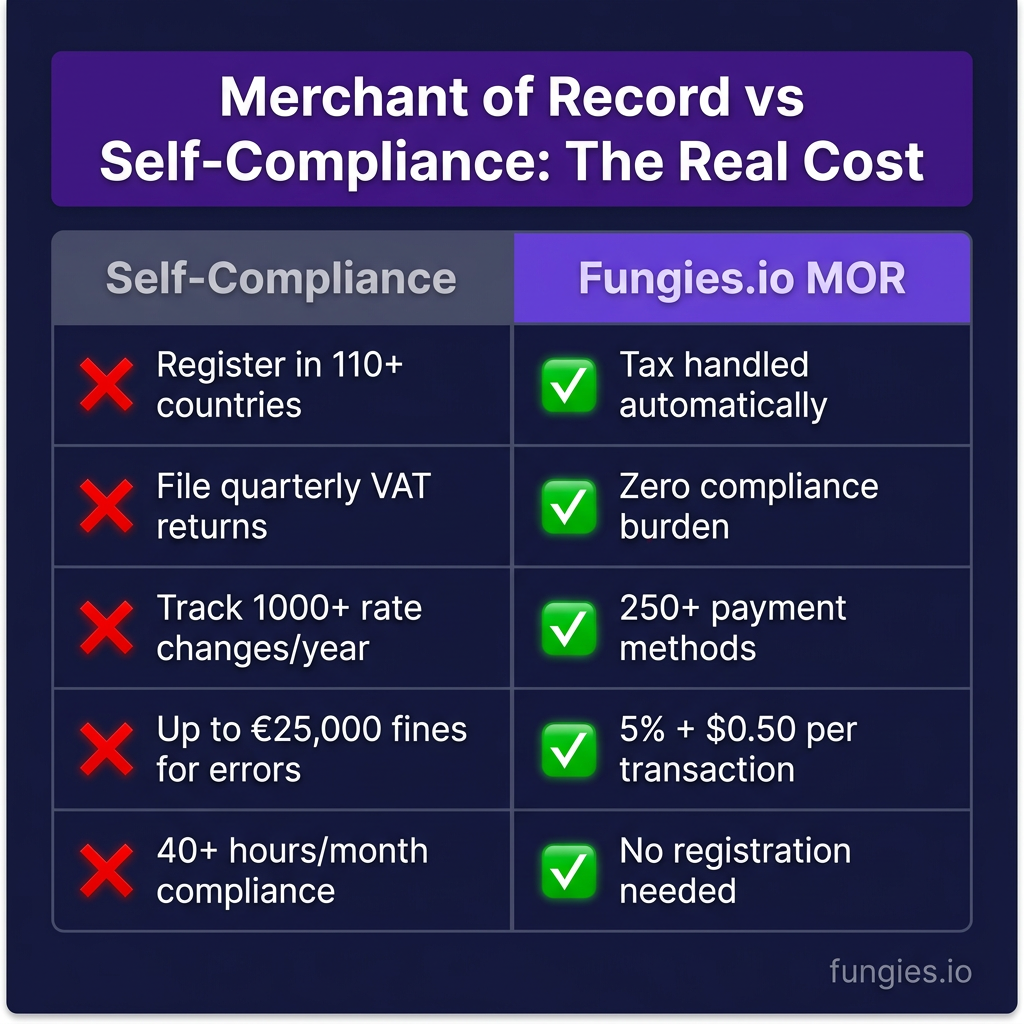
MOR vs Self-Compliance: The Real Cost Comparison
How Merchant of Record Solves Tax Compliance
The Merchant of Record model transfers tax liability from you to the MOR provider. Here’s how Fungies.io handles this:
- Automatic Tax Calculation: Real-time tax calculation at checkout based on customer location and product type
- Global Registration: Fungies maintains tax registrations in 50+ countries so you don’t have to
- Return Filing: All VAT, GST, and sales tax returns filed automatically on your behalf
- Remittance: Taxes paid to authorities on schedule, every time
- Audit Support: If tax authorities have questions, Fungies handles the response
- Liability Protection: Fungies assumes legal responsibility for tax compliance
The cost? 5% + $0.50 per transaction—with no monthly fees, no setup costs, and no hidden charges. Compare that to the cost of self-compliance: registering in 110+ countries (thousands in fees), hiring tax accountants ($5,000-15,000/month), software subscriptions ($500-2,000/month), and the risk of penalties that can reach tens of thousands per violation.
MOR Provider Comparison
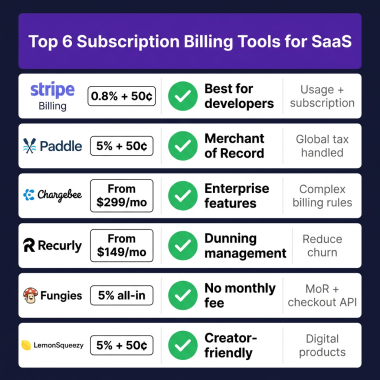
| Provider | Pricing Model | Tax Coverage | Best For |
|---|---|---|---|
| Fungies.io | 5% + $0.50/transaction | 50+ countries | SaaS, games, digital products |
| Paddle | 5% + $0.50/transaction | Global | Software, SaaS |
| FastSpring | Custom pricing | Global | Enterprise software |
| Lemon Squeezy | 5% + $0.50/transaction | US, EU, UK | Creators, small SaaS |
| Cleverbridge | Enterprise pricing | Global | Enterprise B2B SaaS |
Frequently Asked Questions
What is the difference between a payment gateway and a merchant of record?
A payment gateway (like Stripe or PayPal) processes payments but doesn’t assume tax liability. You’re still responsible for tax registration, calculation, filing, and remittance. An MOR handles the entire transaction lifecycle including tax compliance. With a gateway, you’re the merchant; with an MOR, they are.
Do I need to charge VAT on SaaS subscriptions in the EU?
Yes. B2C SaaS subscriptions are subject to VAT in all EU member states at the customer’s local rate (17-27%). Non-EU businesses must register for VAT immediately—there’s no threshold. You can use the One-Stop Shop (OSS) system to file a single quarterly return covering all EU sales, but you still need to track rates, collect tax, and maintain compliance.
What happens if I don’t collect sales tax in the US?
If you have economic nexus in a state (typically $100,000 in sales or 200 transactions annually) and don’t collect sales tax, you’ll owe back taxes plus penalties of 5-25% of the unpaid amount, plus compounding interest. States can audit your records going back several years. The 2018 Wayfair decision means physical presence is no longer required for nexus—you can trigger obligations purely through online sales volume.
How does the EU VAT One Stop Shop (OSS) work?
OSS allows businesses selling B2C digital services across the EU to register in one member state and file a single quarterly VAT return covering all EU sales. Tax is charged at the customer’s local rate, but remitted through your chosen member state. While this simplifies filing, you still need to track 27 different VAT rates, maintain accurate location evidence, and handle registration and compliance yourself—unless you use an MOR.
What are the penalties for not registering for VAT in the EU?
Penalties vary by country but are severe. In Germany, late filing can cost up to €25,000. In the UK, penalties are now percentage-based (2-15% of VAT owed). France charges up to €15,000 for late filing. Beyond fines, you’ll owe back taxes plus interest, and may face criminal prosecution for intentional evasion. Tax authorities share information across borders through the DAC7 directive, making non-compliance increasingly risky.
Conclusion: Eliminate Tax Liability with Fungies
The global tax landscape for digital products has never been more complex. With 110+ countries requiring VAT registration, 25 US states taxing SaaS, and penalties that can reach tens of thousands of dollars per violation, self-compliance is a massive burden and risk.
A Merchant of Record eliminates this complexity. By transferring tax liability to Fungies, you get:
- Automatic tax calculation and collection in 50+ countries
- Zero registration, filing, or remittance burden
- Protection from penalties and audit risk
- Simple, transparent pricing: 5% + $0.50 per transaction
- 250+ payment methods for global conversion
Don’t let tax compliance hold back your growth. Register for Fungies today and focus on building your product while we handle the complexity of global tax compliance.
Sources & References
- European Commission — VAT Gap Report 2025: €128 billion compliance gap
- Tax Foundation — VAT Rates in Europe 2026
- Anrok — SaaS Sales Tax by State 2026
- TaxCloud — Economic Nexus State-by-State Guide 2026
- Research and Markets — Merchant of Record Software Market 2025-2032
- FastSpring — Enterprise Guide to Merchant of Record
- Vertex Inc. — VAT Non-Compliance Penalties Guide
- Paddle — Consequences of Sales Tax Non-Compliance
- Tax Foundation — EU VAT Compliance Gap Analysis
- Fonoa — Global VAT & GST on Digital Services Guide
- European Union — VAT One Stop Shop (OSS) Official Guide
- PWC — Worldwide VAT Rates Quick Chart 2026
- Numeral — SaaS Sales Tax State-by-State 2026
- Paddle — How to Evaluate a Merchant of Record 2026
- Dodo Payments — Top Merchant of Record Platforms 2026