The $100B Pricing Mistake Most SaaS Companies Are Making
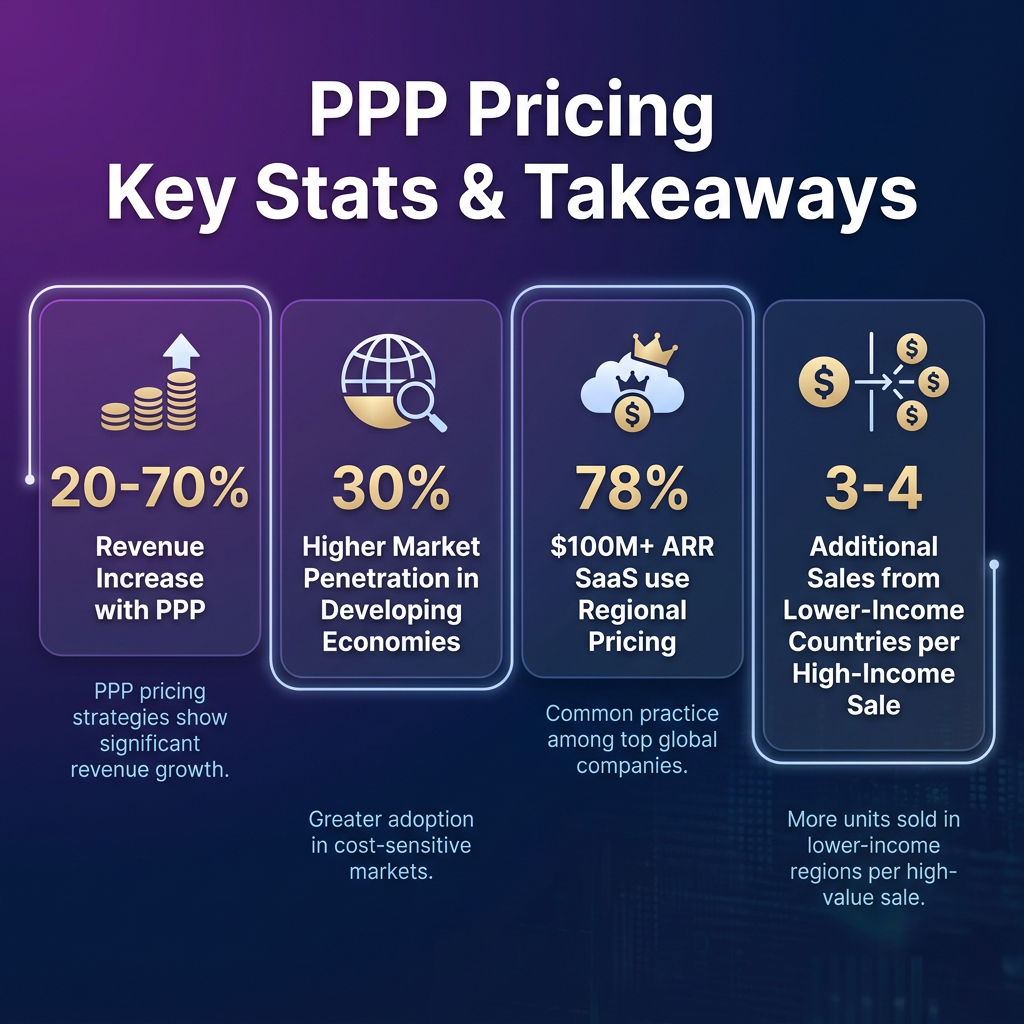
Here’s a number that should keep you up at night: 78% of SaaS companies that exceed $100M ARR implement some form of regional pricing optimization. Meanwhile, the majority of indie founders and smaller SaaS businesses charge the same $29/month whether their customer is in San Francisco or São Paulo.
According to research by ProfitWell, companies using flat global pricing strategies experience up to 30% lower market penetration in developing economies compared to those implementing economic adjustment models. That’s not just missed revenue—it’s handing your competitors entire markets on a silver platter.
Enter purchasing power parity (PPP) pricing—a strategy that’s revolutionizing how forward-thinking SaaS companies approach global expansion. By adjusting prices based on local economic conditions, you’re not “discounting” your product. You’re making it accessible to customers who genuinely can’t afford US prices but would happily pay what your product is worth in their local context.
What Is Purchasing Power Parity (PPP) Pricing?
Purchasing power parity is an economic theory that compares currencies based on what they can actually buy in their respective countries, rather than just exchange rates. The Big Mac Index is the classic example—if a burger costs $5 in the US and ₹250 in India, the implied PPP exchange rate is 50 rupees per dollar, not the market rate of 83.
For SaaS founders, PPP pricing means adjusting your subscription costs based on the local cost of living and average income levels. A $49/month plan might be an impulse purchase in California but represents a significant financial commitment in Kolkata.
Here’s the key insight: PPP pricing isn’t about being cheap—it’s about being fair. You’re aligning your price with the value your customer can realistically afford, not arbitrarily discounting.
Why PPP Pricing Works: The Psychology Behind It
When you charge a flat global price, you’re implicitly saying that your product’s value is the same everywhere. But that’s not how value perception works.
A developer in Bangalore earning $15,000/year sees your $50/month tool very differently than a developer in Boston earning $120,000. To the Bangalore developer, that’s 4% of their monthly income. To the Boston developer, it’s 0.5%. Same product, wildly different value equations.
PPP pricing fixes this by making your product feel appropriately priced in every market. The result? Higher conversion rates, better customer satisfaction, and—counterintuitively—often higher total revenue because you’re capturing customers who would otherwise churn or never convert.
The Data Doesn’t Lie
According to ParityDeals, companies implementing PPP pricing see an average of 20-70% increase in sales from regions with lower purchasing power. Their data shows that every 1 sale from a high-income country (like the US) leads to 3-4 additional sales from lower-purchasing-power countries when PPP pricing is implemented.
ProfitWell’s analysis of over 5,000 SaaS companies found that businesses implementing strategic regional pricing saw 18% higher growth rates and 25% higher revenue per customer on average.
How to Implement PPP Pricing: A 5-Step Framework
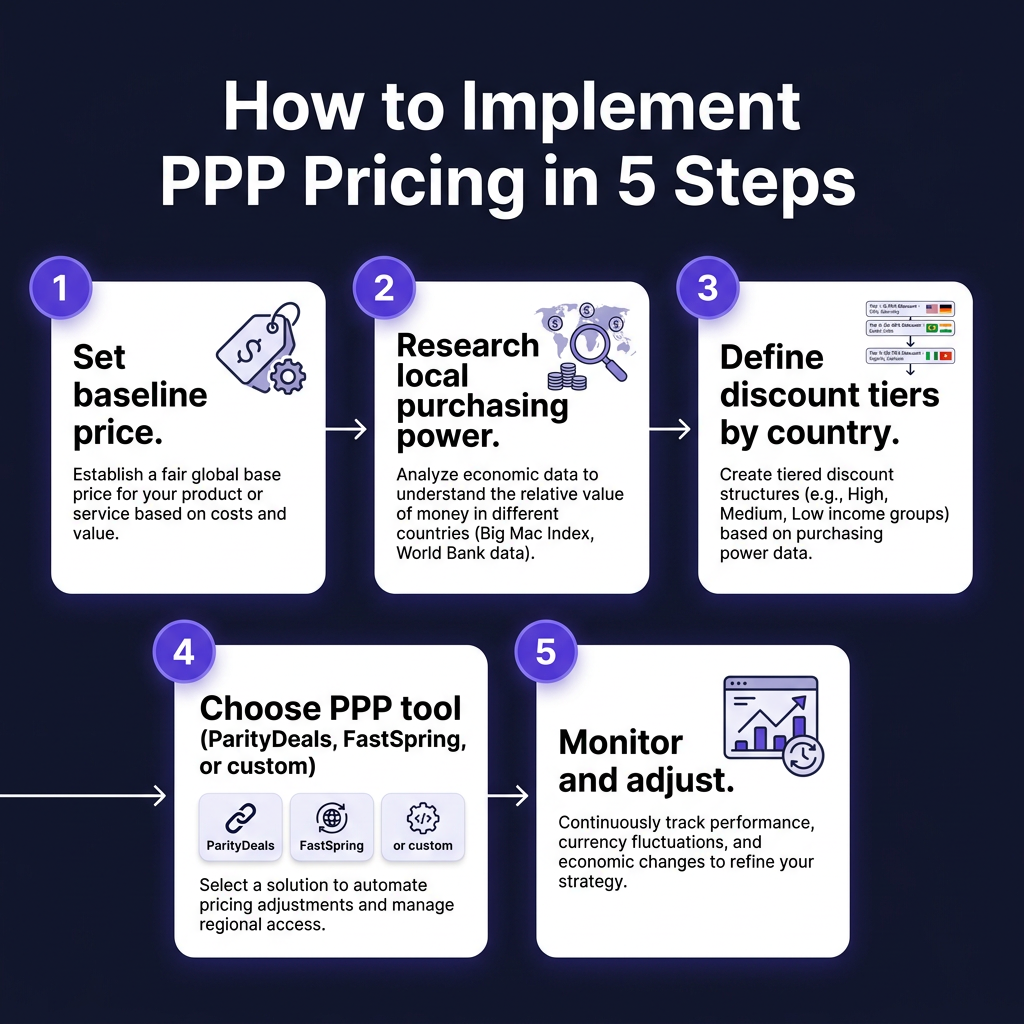
Step 1: Set Your Baseline Price
Start with your core market—typically the US or Western Europe. This is your reference point. Make sure this price is optimized and profitable before you start discounting for other regions.
Step 2: Research Local Purchasing Power
Use reliable data sources to understand the economic reality in your target markets:
- OECD PPP data — The gold standard for cross-country price comparisons
- World Bank GDP per capita (PPP) — Great for understanding relative income levels
- Numbeo cost of living indices — Real-world consumer price comparisons
- Local salary surveys — Developer salaries vary dramatically by region
Step 3: Define Your Discount Tiers
Most SaaS companies using PPP pricing organize countries into 3-5 tiers:
| Tier | Discount | Example Countries |
|---|---|---|
| Tier 1 (High Income) | 0% (baseline) | USA, Switzerland, Norway, Australia |
| Tier 2 (Upper Middle) | 20-30% | Poland, Chile, Malaysia, Turkey |
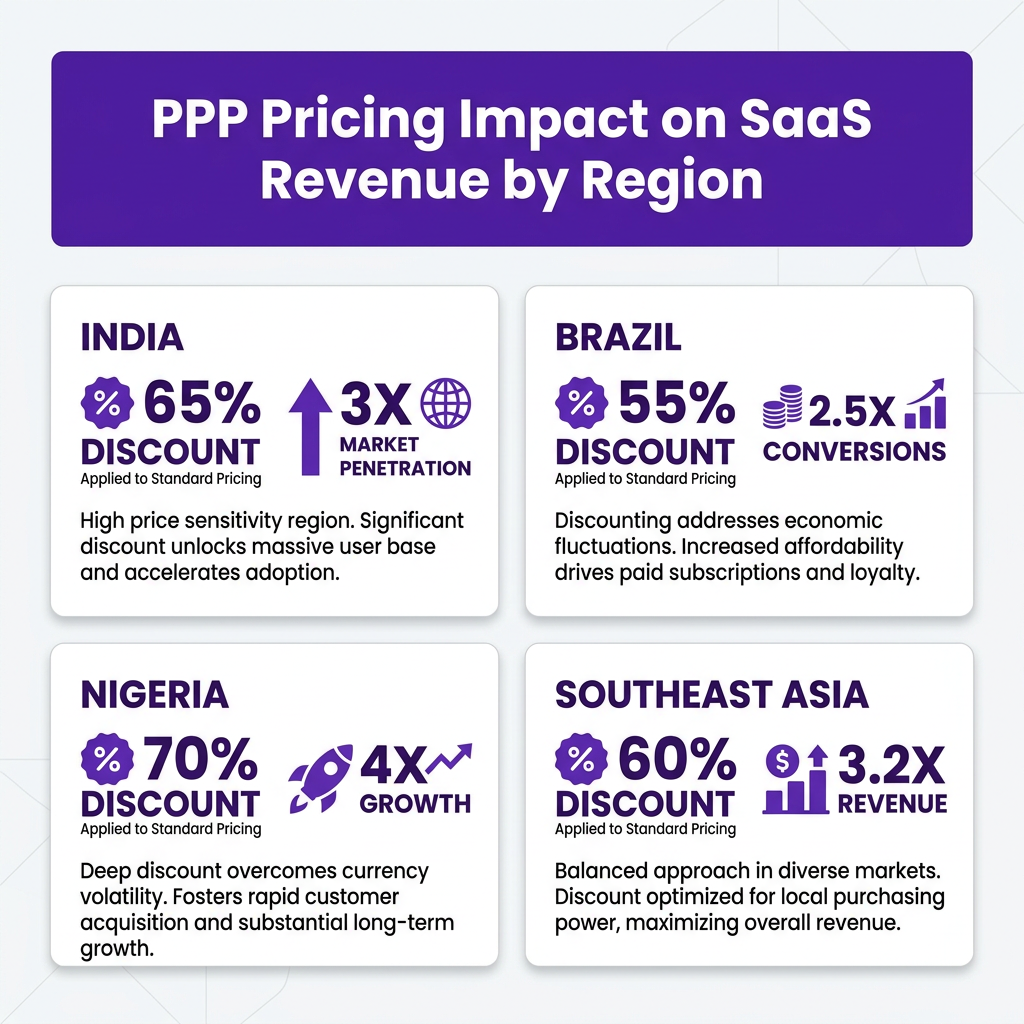
| Tier 3 (Lower Middle) | 40-55% | Brazil, Mexico, South Africa, Thailand |
| Tier 4 (Low Income) | 60-75% | India, Nigeria, Bangladesh, Vietnam |
Step 4: Choose Your Implementation Method
You have several options for implementing PPP pricing:
Option A: ParityDeals (Easiest)
ParityDeals is a dedicated PPP pricing platform that integrates with Paddle, Lemon Squeezy, Stripe, and others. It automatically detects user location and shows appropriate discounts via a banner on your site. Setup takes about 5 minutes.
Option B: Merchant of Record with Built-in PPP
Platforms like FastSpring and Fungies.io include PPP pricing as a native feature. You set your tiers, and they handle the rest—including tax compliance, which is crucial when you’re selling at different price points globally.
Option C: Custom Implementation
If you have engineering resources, you can build your own solution using IP geolocation (MaxMind, IP2Location) and dynamic pricing logic. This gives you maximum control but requires ongoing maintenance.
Step 5: Monitor, Test, and Adjust
PPP pricing isn’t set-and-forget. Economic conditions change, and your tiers should evolve:
- Track conversion rates by country
- Monitor for VPN abuse (people faking locations for discounts)
- Adjust tiers based on actual performance data
- Review quarterly as exchange rates and economies shift
PPP Pricing by Platform: A Comparison
| Platform | PPP Support | Ease of Setup | Best For |
|---|---|---|---|
| ParityDeals | Full (via banner) | 5 minutes | Any platform with coupon codes |
| FastSpring | Native | 15 minutes | Software & digital goods |
| Fungies.io | Native | 10 minutes | SaaS & AI products |
| Paddle | Via ParityDeals | 20 minutes | SaaS with complex billing |
| Stripe | Custom build | 1-2 weeks | Enterprise with dev resources |
Common PPP Pricing Mistakes to Avoid
Mistake 1: Going Too Aggressive Too Fast
Don’t offer 80% discounts on day one. Start conservative (30-40% for lower-income markets) and adjust based on data. You can always increase discounts; it’s harder to walk them back.
Mistake 2: Ignoring VPN Abuse
Some users will try to game your system. Implement basic checks: require credit cards with local billing addresses for high discounts, or use ParityDeals’ built-in fraud detection.
Mistake 3: Forgetting About Support Costs
If you’re selling at 60% off in India but providing the same support as US customers paying full price, your unit economics might not work. Consider tiered support or self-service options for discounted tiers.
Mistake 4: Static Pricing
Economies change. Turkey’s inflation hit 75% in 2024. Argentina’s currency crisis is ongoing. Review your PPP tiers at least quarterly and adjust for major economic shifts.
Real-World PPP Pricing Examples
Notion: Uses regional pricing with significant discounts in India and other developing markets. Result: Massive adoption in regions where $10/month would be prohibitive.
Spotify: Famously uses PPP pricing with family plans costing the equivalent of $2-3/month in some markets vs. $16/month in the US. Their global subscriber growth speaks for itself.
JetBrains: Offers location-based discounts of up to 50% for developers in qualifying countries. They’ve built a massive global user base partly because their tools are accessible worldwide.
Key Takeaways: Should You Implement PPP Pricing?
- PPP pricing can increase revenue by 20-70% in lower-income markets without cannibalizing high-income country sales
- 78% of $100M+ ARR SaaS companies use regional pricing—it’s a proven growth strategy
- Start with 3-4 pricing tiers based on GDP per capita (PPP) data
- Use tools like ParityDeals or a Merchant of Record to avoid building custom infrastructure
- Monitor for abuse but don’t let fear of edge cases block a strategy that helps legitimate customers
FAQ: PPP Pricing for SaaS
Is PPP pricing the same as just offering discounts?
No. Discounts are temporary promotions. PPP pricing is a permanent, data-driven strategy that aligns your price with local purchasing power. It’s about fairness, not sales tactics.
Won’t customers in high-income countries be upset about paying more?
Generally no—they don’t see the lower prices elsewhere. PPP pricing is typically implemented via geo-targeted checkout flows or coupon codes. US customers see US prices; Indian customers see Indian prices.
How do I handle tax compliance with different prices?
This is where a Merchant of Record (MoR) becomes valuable. Platforms like Fungies.io, Paddle, or FastSpring handle tax calculation and remittance regardless of your price point in each country.
Can I use PPP pricing with Stripe?
Yes, but it requires custom development. You’ll need to implement geolocation, dynamic price display, and location verification. Most founders find it easier to use ParityDeals with Stripe or switch to an MoR with native PPP support.
Conclusion: The World Is Bigger Than the US
If you’re charging the same price globally, you’re leaving money on the table—and excluding talented developers, creators, and businesses who simply can’t afford US prices but would be valuable customers at a fair local price.
Purchasing power parity pricing isn’t charity. It’s smart business. You’re expanding your addressable market, improving conversion rates, and building a global user base that will advocate for your product.
The tools to implement PPP are better than ever. Whether you choose ParityDeals for a quick setup or a Merchant of Record like Fungies.io for an all-in-one solution, you can be up and running in under an hour.
Ready to go global? Sign up for Fungies.io and start accepting payments with built-in PPP pricing, global tax compliance, and local payment methods—all without writing a line of code.